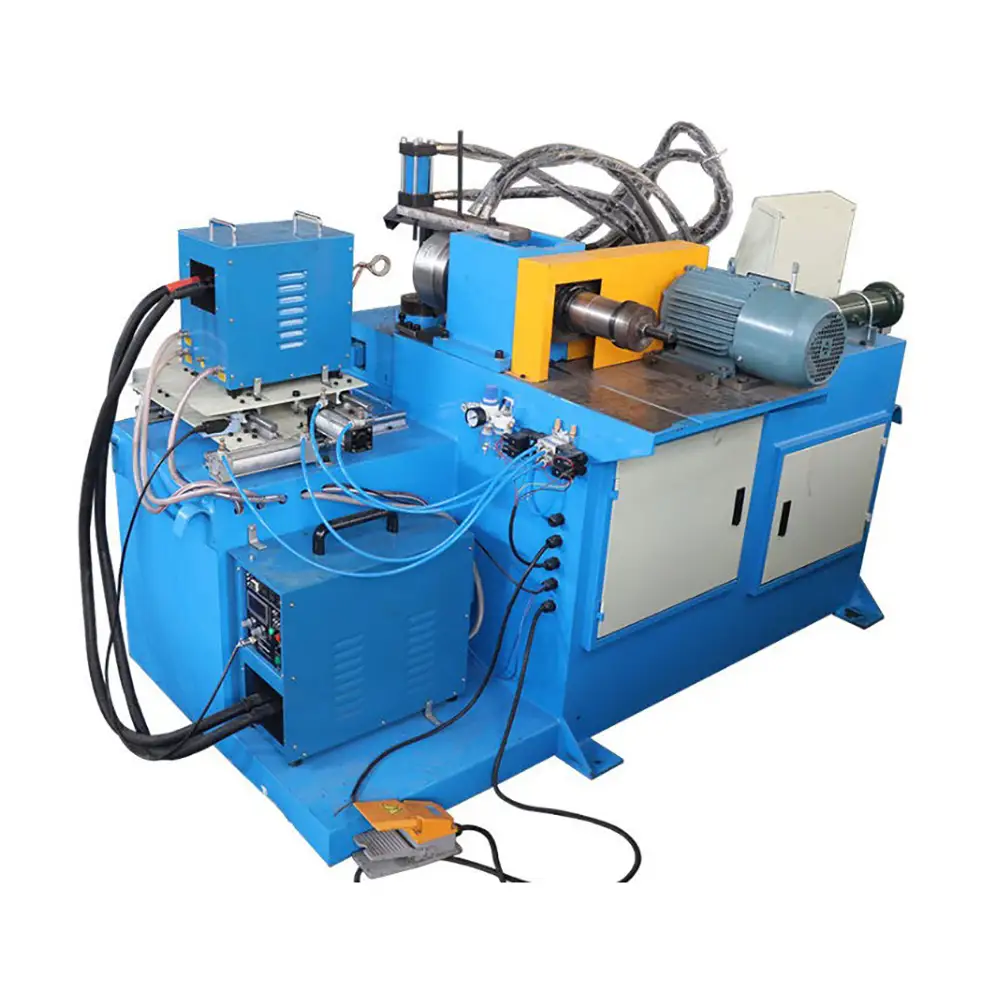
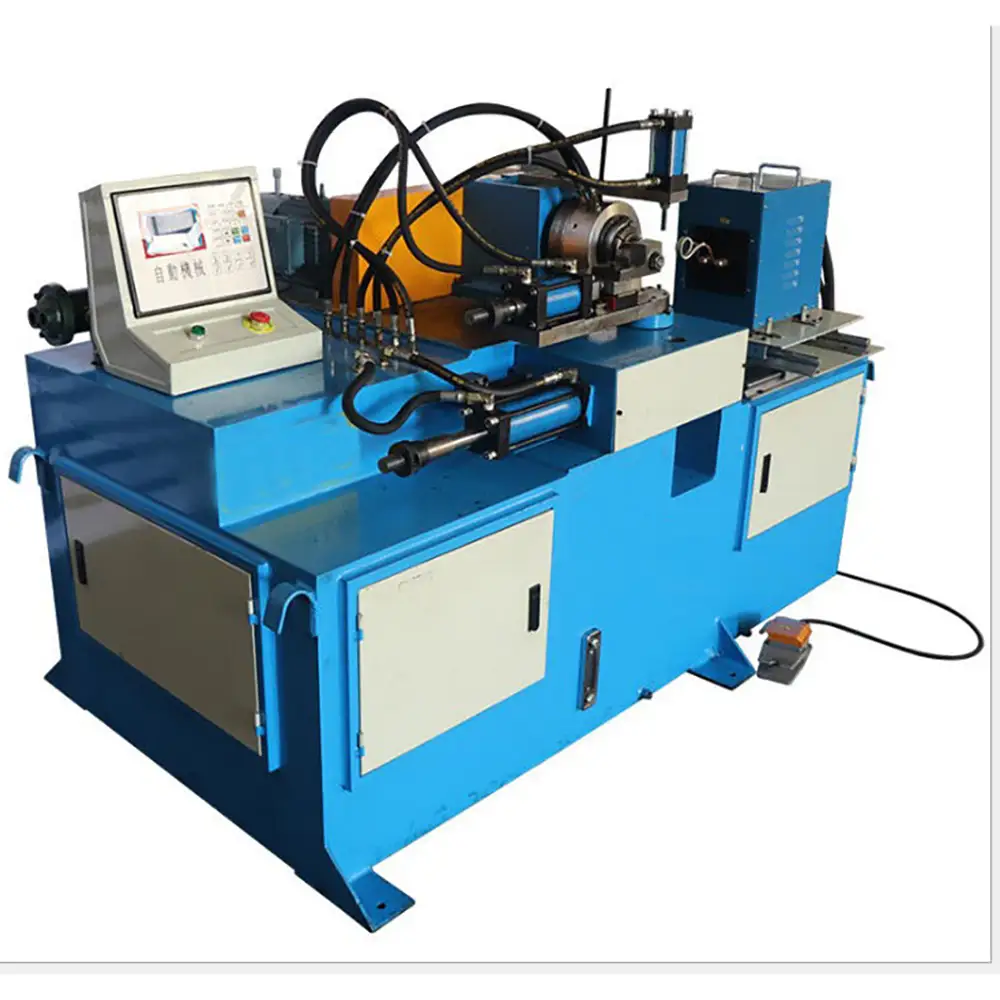
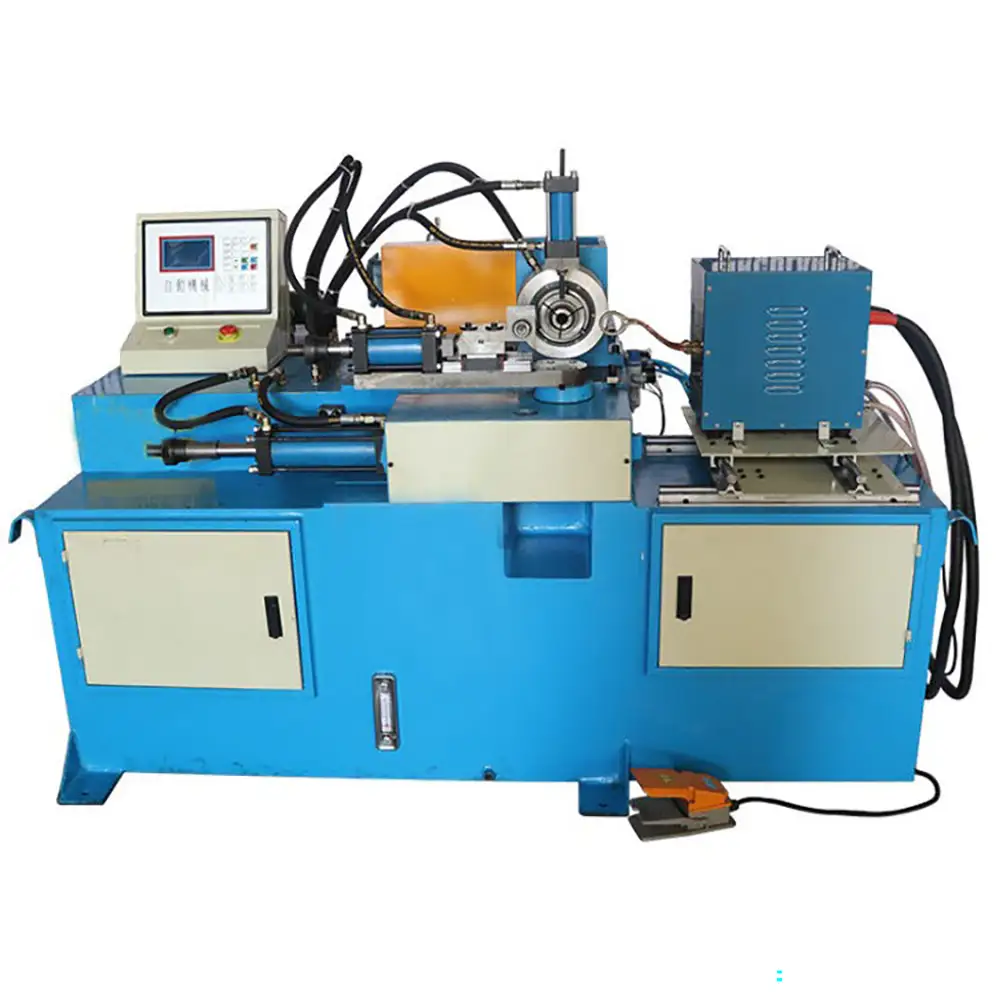
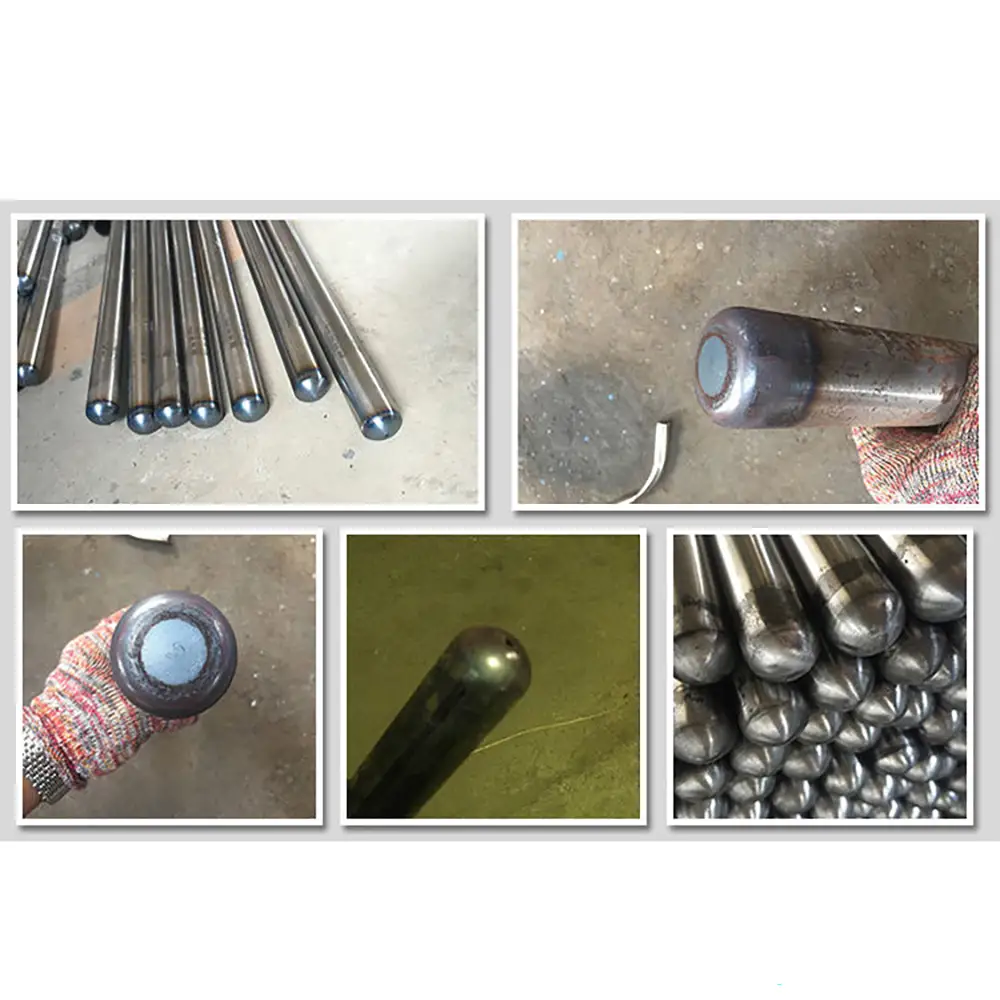
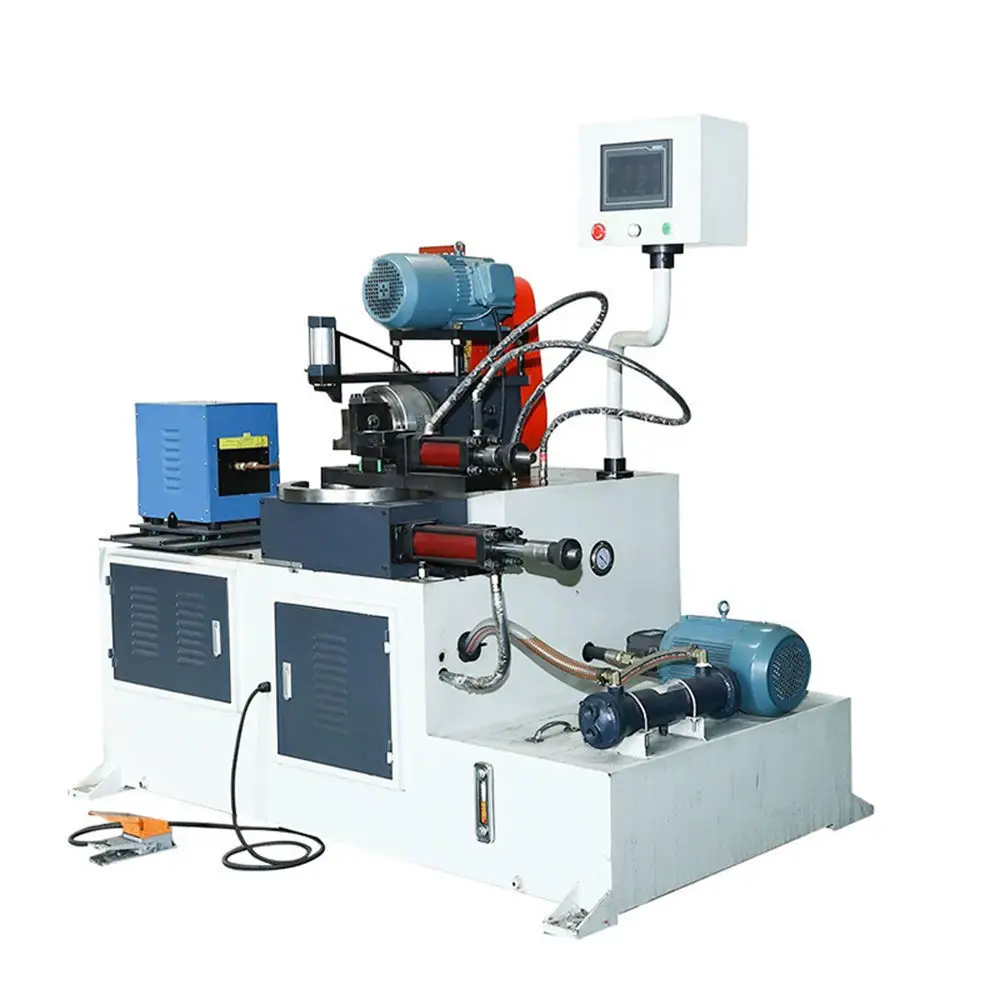
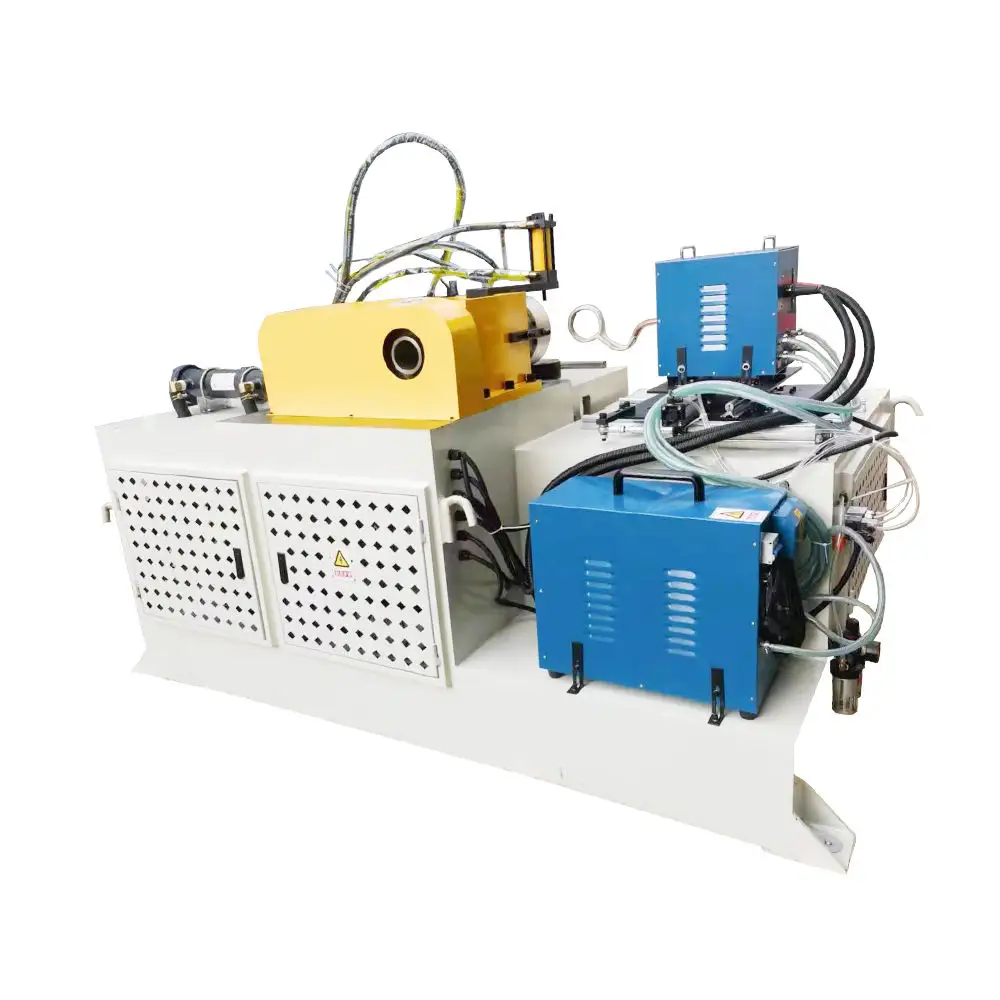
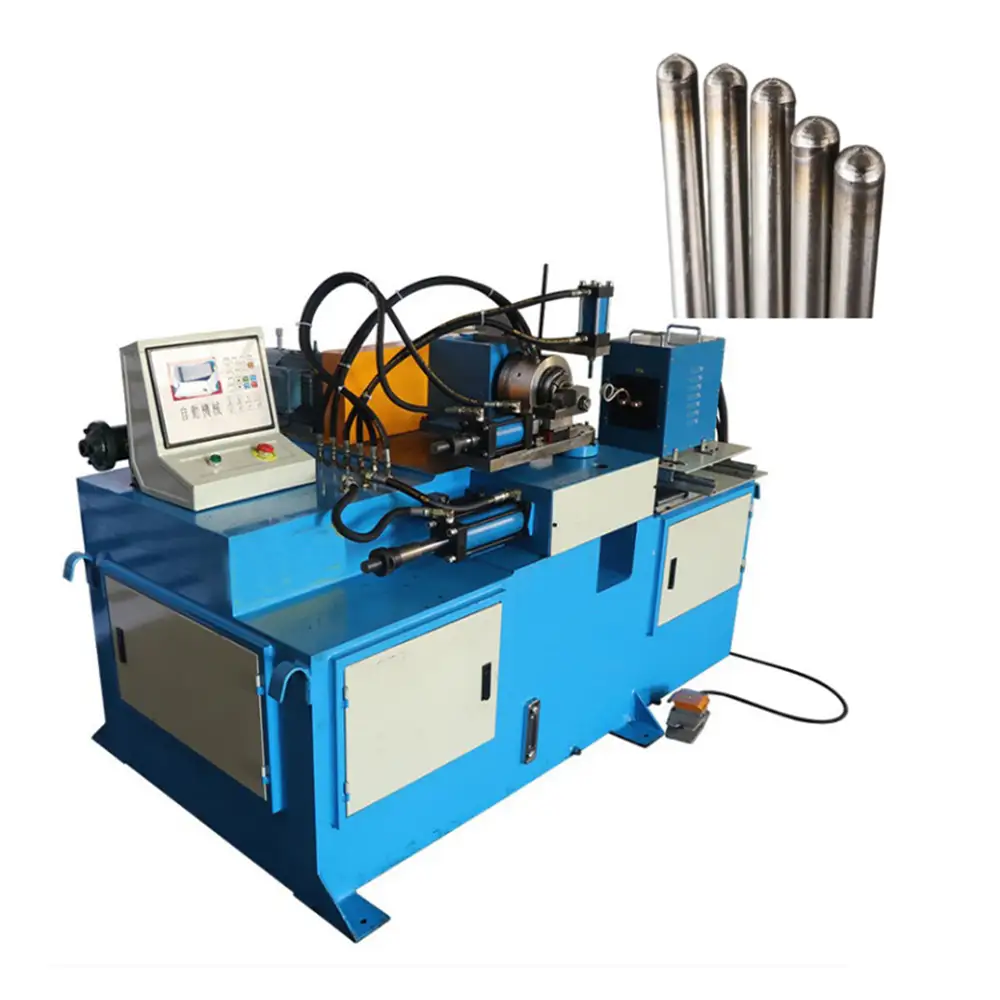
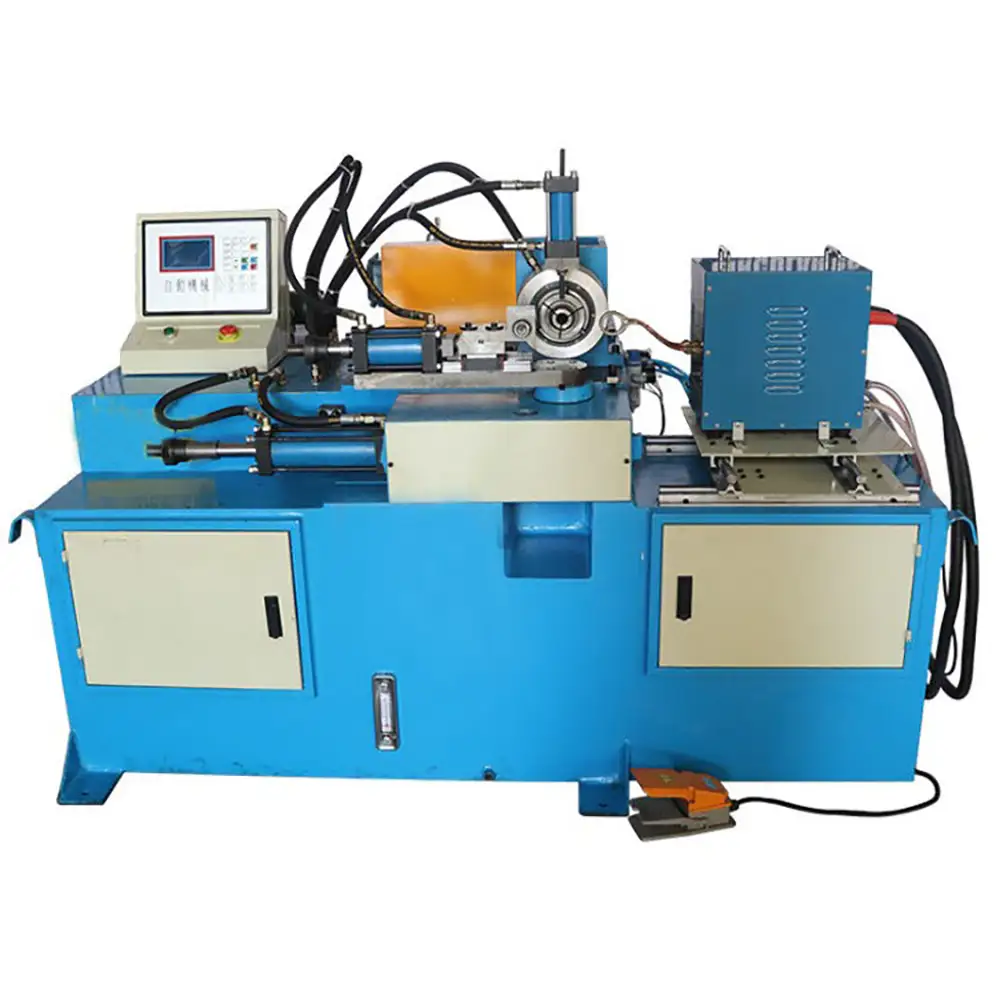
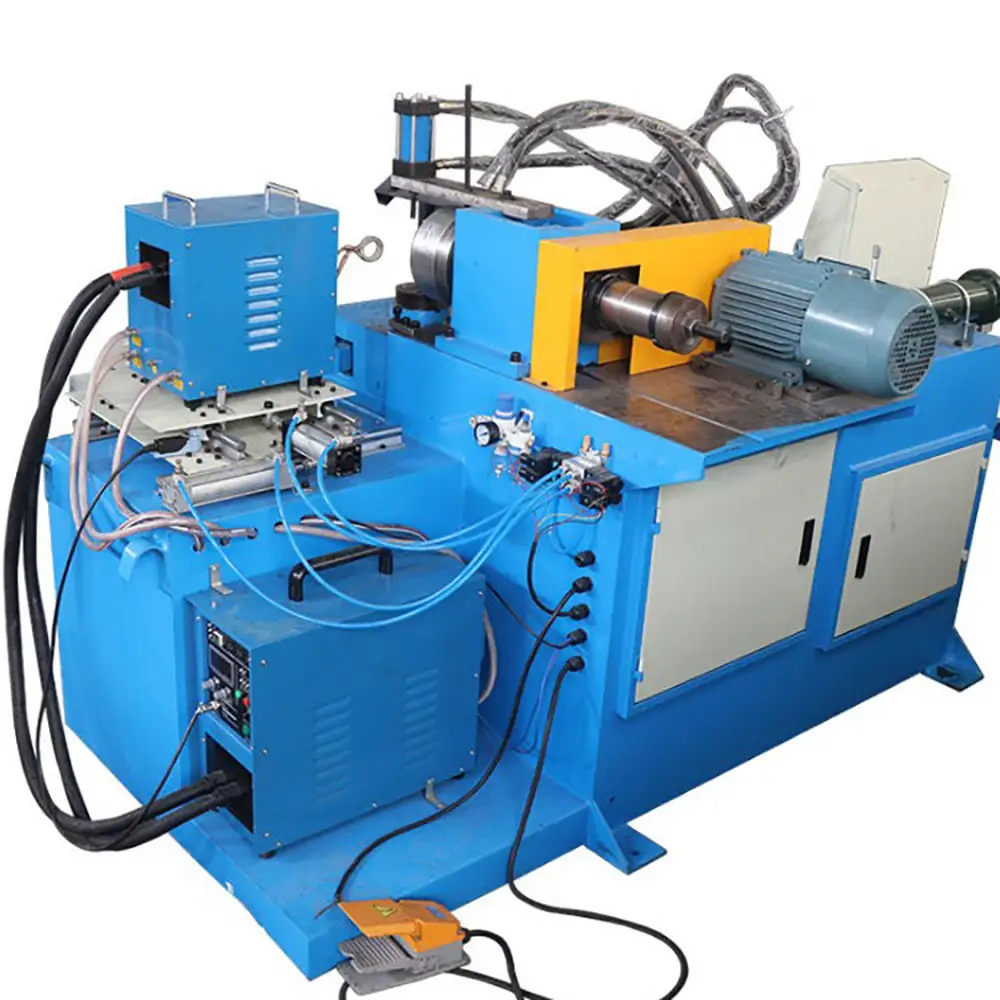
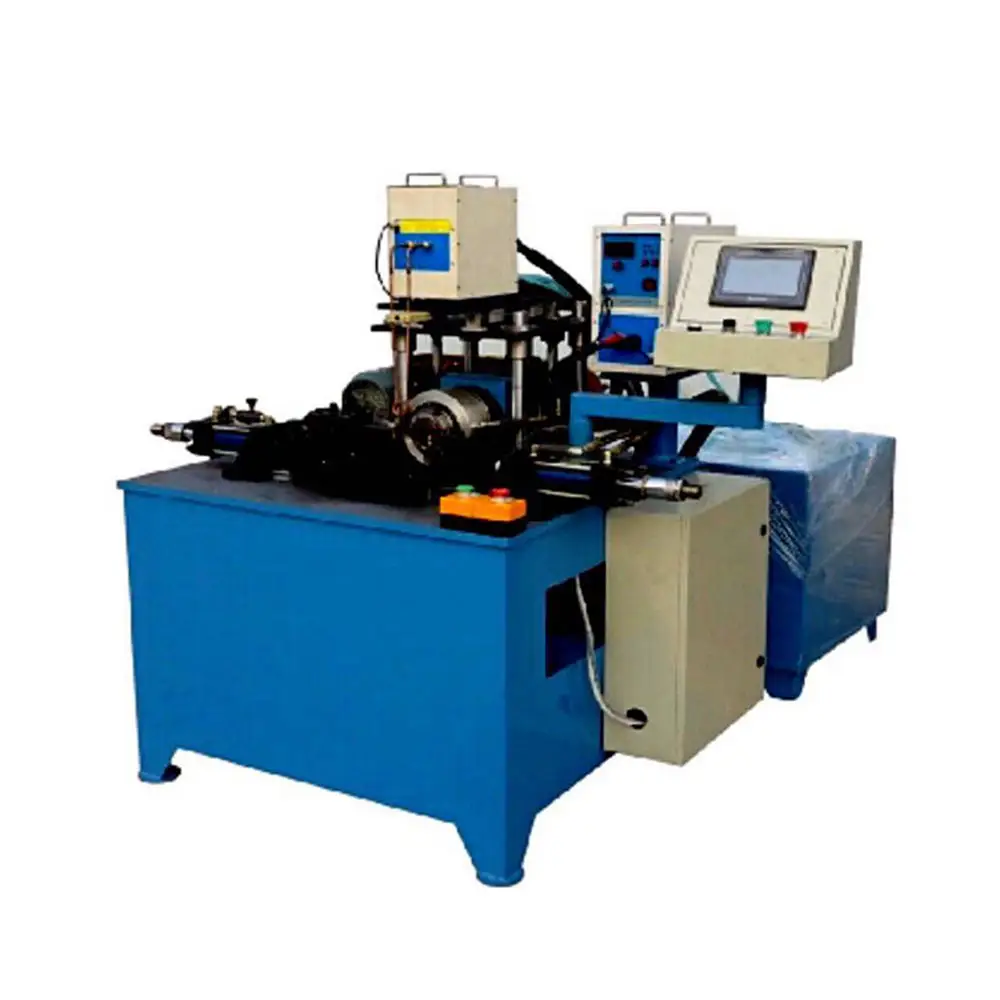
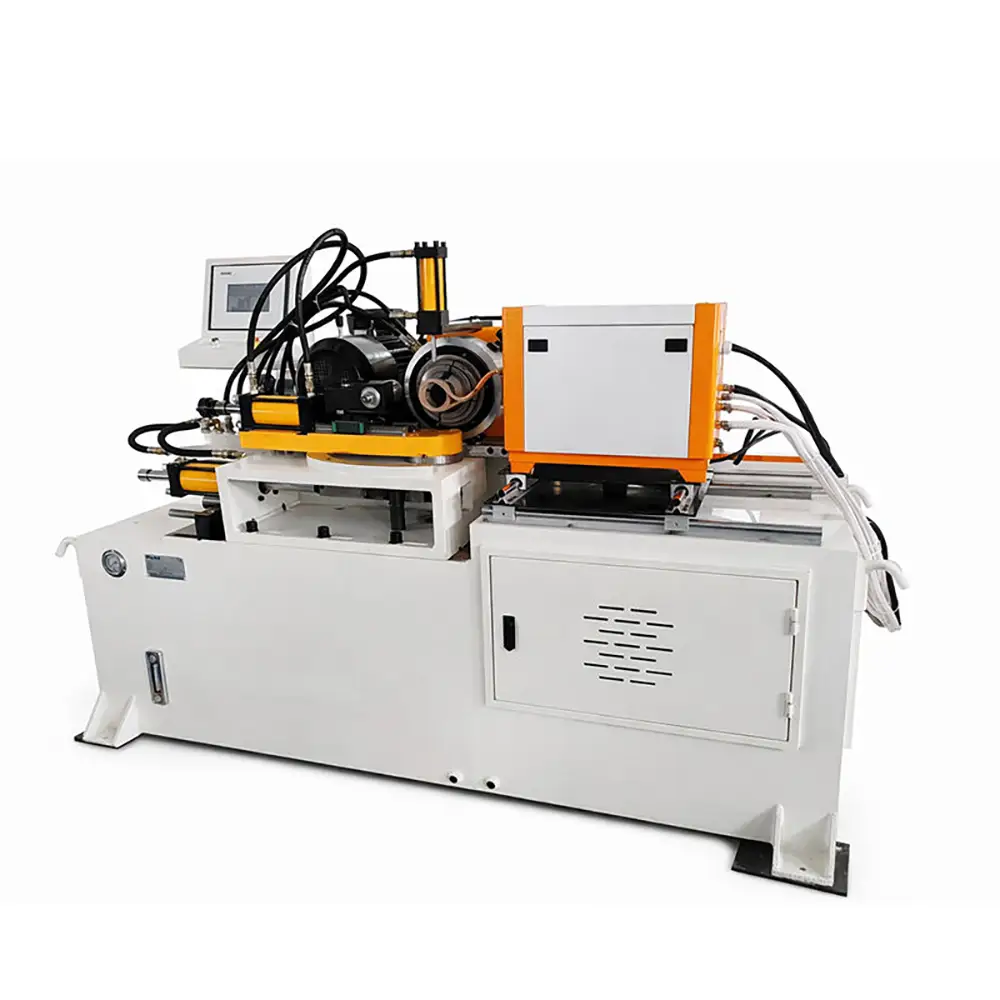
1 Suitable for carbon steel, stainless steel copper and other metal pipes
2 High frequency heating, automatic rotary sealing
3 Sealing,positioning and Brake stop accomplish at one time
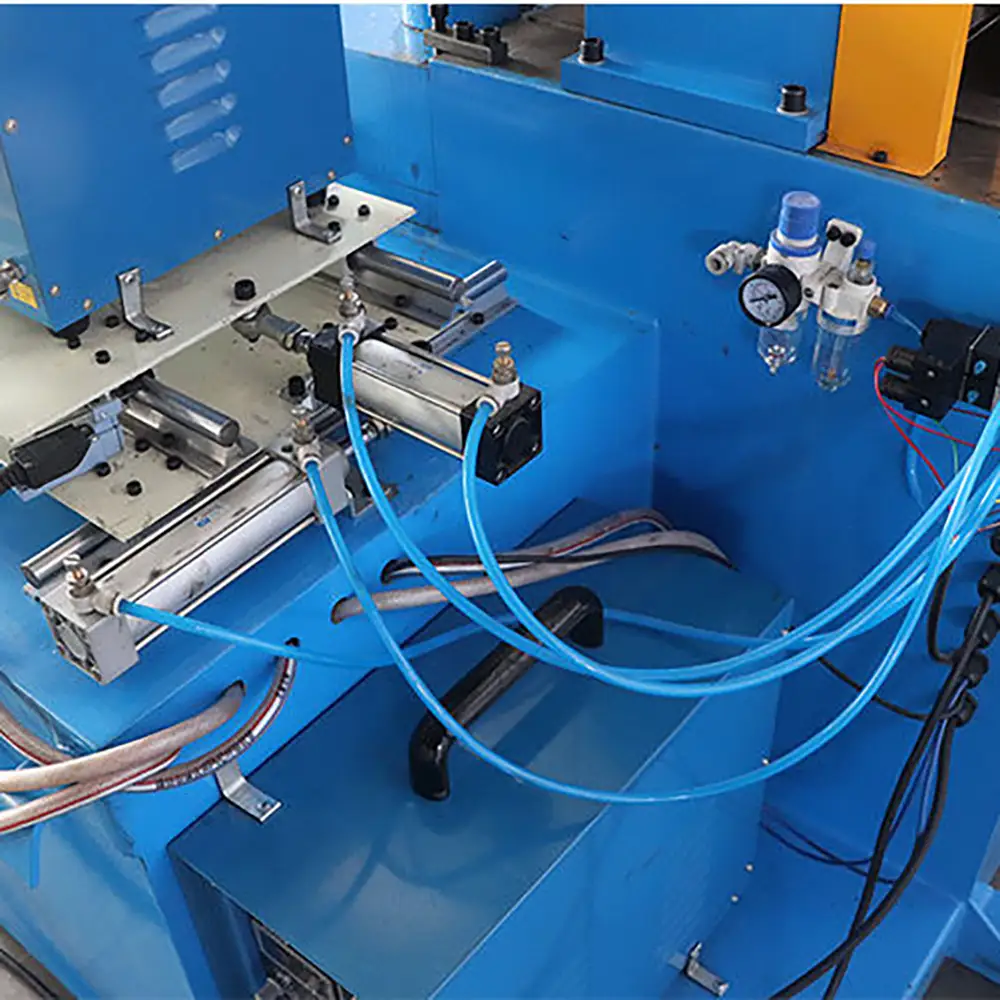
4 Pneumatically control the movement of high frequency heater
|
Item |
Specification |
|
Processing range of diameter |
8-40mm |
|
Thickness of pipe |
1-3mm |
|
Pipe length |
50-6000mm |
|
Processing speed |
85 degreed/S |
|
Main motor |
1.5kw |
|
Pump motor |
3kw |
|
High frequency heater |
15kw |
|
Machine measure |
1900x900x1600mm |
|
Weight |
680kg |
Pipe End Closing Machine and Tube Top Sealing Machine
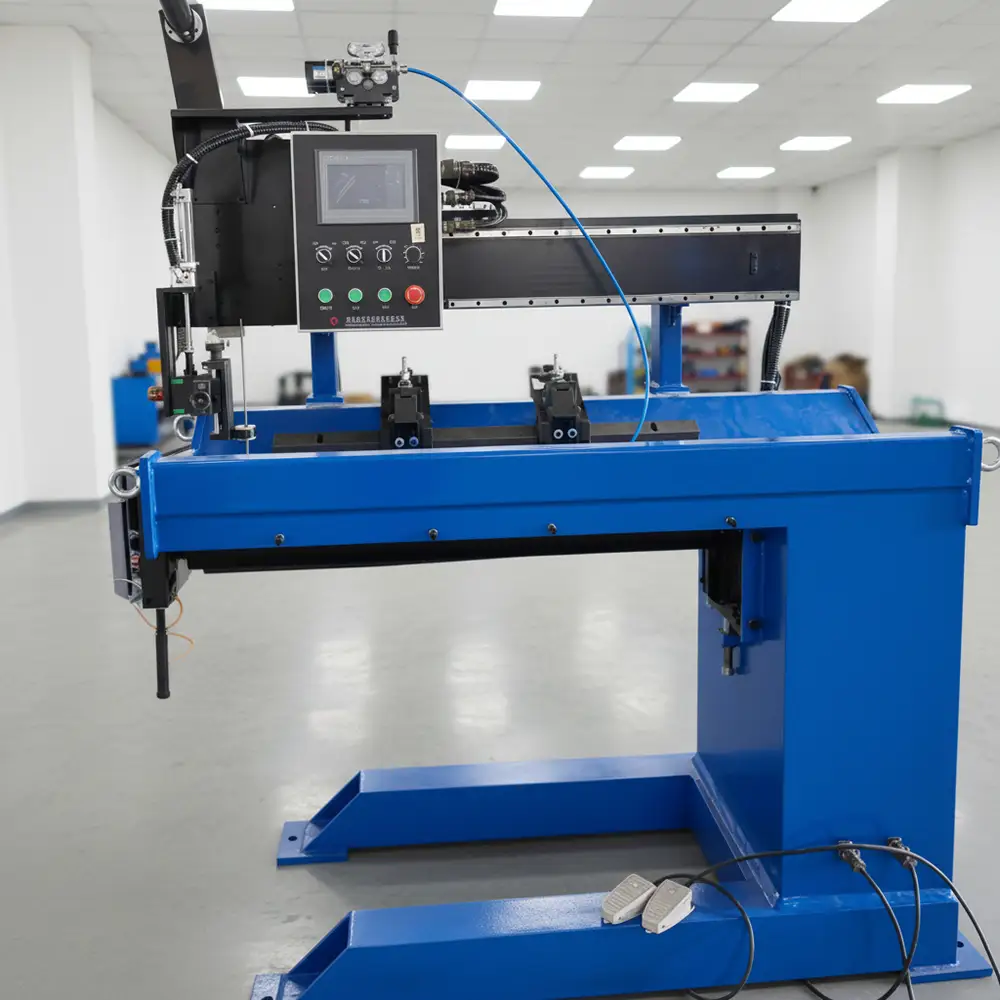
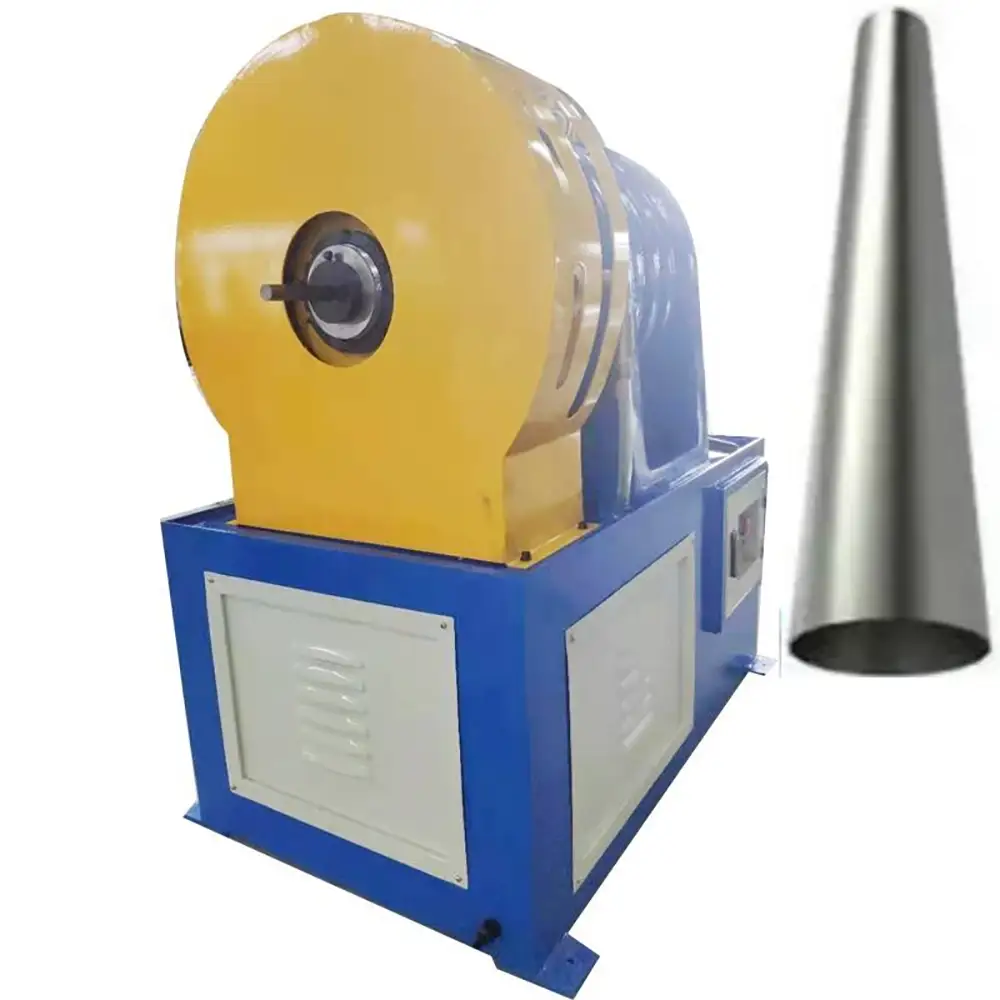
The Pipe End Closing Machine Tube Top Sealing Machine is a specialized metal tube processing solution designed for pipe end closing,tube top sealing,end reducing,and end forming applications. The machine uses controlled forming tooling to reshape the open end of a suitable metal tube or pipe into a specified profile for assembly,sealing,connection,or subsequent manufacturing processes.
Tube end closing is commonly required when a tubular component needs a reduced,closed,or shaped end. The term tube top sealing machine can refer to equipment that forms or closes the top end of a tube or tubular component before additional sealing,joining,or finishing operations.
This type of equipment can be used in automotive components,exhaust systems,metal furniture,HVAC equipment,heat exchangers,refrigeration systems,industrial machinery,and general fabrication.
The actual processing capacity depends on tube material,diameter,wall thickness,length,tooling,and the required finished end geometry.
Pipe End Closing Process
Pipe end closing reduces or reshapes an open pipe end using mechanical forming tools.
During operation,the workpiece is positioned and clamped securely. A dedicated forming die,closing tool,mandrel,or other forming component then applies controlled force to the tube end.
Depending on the tooling,the machine can perform:
Pipe end closing
Tube top closing
Tube end reducing
Pipe end shrinking
Tube necking
End diameter reduction
Tube end shaping
Partial end closing
Formed end transitions
The final shape is determined by the tooling and product drawing. Different tube diameters and end profiles normally require different tooling configurations.
Tube Top Sealing Applications
Tube top sealing can be used when the upper or terminal section of a tubular component needs to be closed or formed.
The machine can reshape the tube top into a smaller opening,closed profile,or specified transition. Depending on the final product,the formed end may then be welded,brazed,plugged,clamped,or fitted with another component.
Mechanical tube closing should not automatically be interpreted as creating a pressure-tight seal. If the product is designed to contain liquids,gases,or pressure,the final sealing method and testing requirements should be evaluated separately.
This makes the machine suitable for tube preparation and end forming as well as selected sealing-related manufacturing processes.
Tube End Reducing and Shrinking
Tube end reducing is one of the common applications of pipe end closing equipment.
The process decreases the diameter of a selected tube section so that it can connect with a smaller component or achieve a required product shape.
Tube end shrinking can also be used to create a tapered or stepped transition. Depending on the amount of reduction and material properties,the process may be performed in one or multiple forming steps.
Important factors include:
Tube outside diameter
Wall thickness
Material strength
Material ductility
Required reduction
Forming tool geometry
Machine forming force
Proper process selection helps reduce excessive thinning,wrinkles,and cracks.
Suitable Metal Tube Materials
The machine can be configured for different metal tubes depending on the forming method and tooling.
Common materials may include:
Carbon steel
Mild steel
Stainless steel
Aluminum
Copper
Brass
Alloy steel
Carbon steel and mild steel are commonly used in general fabrication and industrial tube applications. Stainless steel may require different forming parameters because of its strength and work-hardening characteristics.
Aluminum and copper can also be formed,but tooling and process settings should be selected according to their specific material properties.
Customers should provide the material grade whenever possible to help determine the appropriate machine and tooling configuration.
Automotive and Exhaust Tube Processing
Automotive and exhaust manufacturing frequently requires tube-end processing.
Exhaust pipes may need to be reduced or shaped at one end so that they can connect with mufflers,flanges,couplings,or other exhaust components.
The pipe end closing machine can provide a repeatable process for suitable exhaust tubes. After end forming,the component may continue to welding,flanging,assembly,or inspection.
The exact suitability depends on the exhaust tube diameter,wall thickness,material,and final end geometry.
Furniture and Tubular Product Manufacturing
Tube top sealing and end closing can also be useful for furniture and tubular product manufacturing.
Metal chair legs,table frames,display racks,fitness equipment,handrails,and other tubular products may require shaped or reduced ends for assembly and appearance.
A closed or reduced tube end can accommodate connectors,fasteners,feet,caps,or other components.
For furniture and consumer-facing products,the visual quality of the formed area can be important. Proper tooling and controlled forming can help reduce unwanted surface marks and deformation.
HVAC and Industrial Tube Applications
Pipe and tube end forming is also used in HVAC,refrigeration,heat exchanger,and industrial equipment manufacturing.
Tube ends may require closing,reducing,shaping,or preparation before joining.
Depending on the application,the workpiece may be made from steel,stainless steel,copper,aluminum,or another suitable metal.
For heat exchanger and refrigeration applications,the formed tube end may need to meet specific dimensional requirements for brazing,welding,or connection. Customers should provide the required finished dimensions and tolerances when requesting a machine solution.
Forming Tooling and Dies
Tooling determines the final tube-end shape and has a major influence on forming quality.
Possible tooling components include closing dies,reducing dies,mandrels,forming punches,rollers,and clamping fixtures.
A properly designed tool controls the deformation of the tube and helps maintain the required diameter,length,and profile.
Different tube sizes or end shapes may require separate tooling sets. Manufacturers producing multiple products should consider tooling changeover time and storage requirements.
For custom applications,customers can provide drawings or physical samples so the forming tooling can be evaluated.
Automatic Production and Repeatability
An automatic or semi-automatic tube end closing machine can reduce repetitive manual forming operations.
Depending on the selected configuration,the machine may support automatic positioning,clamping,forming,and unloading.
Controlled machine movement can help maintain a more consistent production sequence than manual tube-end forming.
Actual cycle time depends on tube dimensions,material,forming complexity,tooling,loading method,and machine configuration.
For higher production volumes,the machine can be integrated with upstream tube cutting or bending and downstream welding,assembly,and inspection processes.
Forming Quality and Inspection
Tube end forming quality should be evaluated according to the finished product requirements.
Important inspection points may include:
Tube end diameter
Formed length
End profile
Wall thickness
Concentricity
Surface condition
Cracks
Wrinkles
Dimensional consistency
The first formed workpieces should be checked after tooling installation or changeover.
For products requiring tight dimensional tolerances,technical drawings and inspection requirements should be provided before machine selection.
Maintenance and Safe Operation
Routine maintenance is important for stable operation and consistent forming quality.
Operators should inspect forming dies,mandrels,clamping components,mechanical systems,hydraulic components where applicable,and electrical connections.
Tooling should be cleaned and checked regularly for wear. Worn forming tools can change the finished tube profile and increase the risk of inconsistent results.
The machine contains moving mechanical components and should be operated with appropriate protective measures. Guards and emergency-stop systems may be included depending on the configuration.
Operators should follow the manufacturer's instructions and applicable local workplace safety requirements.
OEM and Custom Tube End Forming Solutions
Different tube products require different end profiles,so customized tooling and machine configurations may be necessary.
Customization can include forming dies,mandrels,clamping systems,feeding mechanisms,positioning systems,hydraulic components,and control systems.
For OEM and ODM projects,customers should provide:
Tube material
Outside diameter
Wall thickness
Tube length
Finished end dimensions
Required sealing or closing profile
Production volume
Automation requirements
Drawings or physical samples are especially useful when developing custom tube top sealing or end closing tooling.
The machine is suitable for tube manufacturers,automotive suppliers,exhaust manufacturers,HVAC producers,furniture factories,industrial component manufacturers,metalworking companies,and machinery distributors.
Why Choose Us
Pipe End Closing Capability – Designed for controlled closing,reducing,shrinking,and shaping of suitable metal pipe ends.
Tube Top Sealing Applications – Supports tube-top closing and forming processes for suitable tubular products.
Multiple End Forming Functions – Different tooling can support reducing,necking,closing,and shaping operations.
Flexible Material Compatibility – Suitable configurations can be developed for carbon steel,stainless steel,aluminum,copper,and other metal tubes.
Application-Specific Tooling – Dies,mandrels,clamps,and forming tools can be selected according to the finished end profile.
Repeatable Production – Controlled clamping and forming can help improve consistency across repeated workpieces.
Wide Industrial Applications – Suitable for automotive,exhaust,furniture,HVAC,heat exchanger,and general metal fabrication.
OEM & ODM Support – Machine configuration and tooling can be customized according to tube dimensions,material,production volume,and forming requirements.
FAQs
1. What is a pipe end closing machine?
A pipe end closing machine is equipment designed to reduce,close,or reshape the end of a suitable metal pipe using dedicated forming tooling.
2. What is a tube top sealing machine?
It is a tube processing machine used to close or form the terminal or top section of a tube. The final sealing method depends on the product design.
3. Can the machine completely close a tube?
It can be configured for partial or substantial tube-end closing depending on the material,dimensions,forming force,and tooling.
4. Does tube end closing create a pressure-tight seal?
Not necessarily. Additional welding,brazing,plugging,or another sealing method may be required depending on the application.
5. What materials can be processed?
Depending on the machine configuration,it can process carbon steel,mild steel,stainless steel,aluminum,copper,brass,and other suitable metals.
6. Can it reduce the tube diameter?
Yes. Suitable reducing and necking tooling can reduce the tube-end diameter to a specified dimension.
7. Can it process stainless steel tubes?
Yes. Stainless steel can be processed when appropriate tooling and forming parameters are selected for the specific grade and tube dimensions.
8. Can it be used for exhaust pipes?
Yes. Suitable exhaust tubes can be processed for end reduction,closing,necking,and other forming operations.
9. Can it process aluminum and copper tubes?
Yes. Suitable aluminum and copper tubes can be processed when the machine and tooling are configured for their material characteristics.
10. Is automatic feeding available?
Automatic feeding and positioning can be available on selected configurations. The exact automation level should be confirmed according to production requirements.
11. Can custom tooling be made?
Yes. Custom closing dies,reducing dies,mandrels,and fixtures can be developed according to tube drawings or samples.
12. What information is needed for a quotation?
Provide the tube material,outside diameter,wall thickness,length,finished end dimensions,required closing or sealing profile,production volume,and automation requirements. Drawings or samples are recommended.
Prev:
Automatic Hydraulic High Frequency Stainless Steel Round Tubehead Heating Spinning Closing Sealing Machine
Next:
Tube Pipe End Closing Machine Steel Pipe Sealing Machine
TAG:
Pipe End Processing Machine,
Automatic Tube End Forming Machine,
Tube End Processing Machine,
Industrial Tube End Forming Machine,
Industrial Pipe End Forming Machine,
Exhaust Pipe End Forming Machine,
Automotive Tube End Forming Machine,
Carbon Steel Pipe End Forming Machine,
Stainless Steel Pipe End Forming Machine,
Pipe Beading Machine,
Tube Beading Machine,
Pipe End Reducing Machine,
Tube Swaging Machine,
Pipe Swaging Machine,
Pipe Necking Machine,
Tube Necking Machine,
Tube End Reducing Machine,
Tube End Shrinking Machine,
Pipe End Shrinking Machine,
Tube End Forming Machine,
Pipe End Forming Machine,
Hydraulic Tube End Forming Machine,
Hydraulic Pipe End Forming Machine,
Metal Tube Processing Machine,
Metal Furniture Tube Forming Machine,
Metal Pipe End Forming Machine,
Exhaust Tube End Forming Machine,
Precision Tube End Forming Machine,
Automatic Pipe End Forming Machine,
Metal Pipe Processing Machine,
Related Category:
Pipe End Closing Machine,Tube Top Sealing Machine,Tube End Closing Machine,Pipe End Sealing Machine,Tube End Sealing Mac China, suppliers, manufacturers, factory, customized, wholesale, quotation, made in China