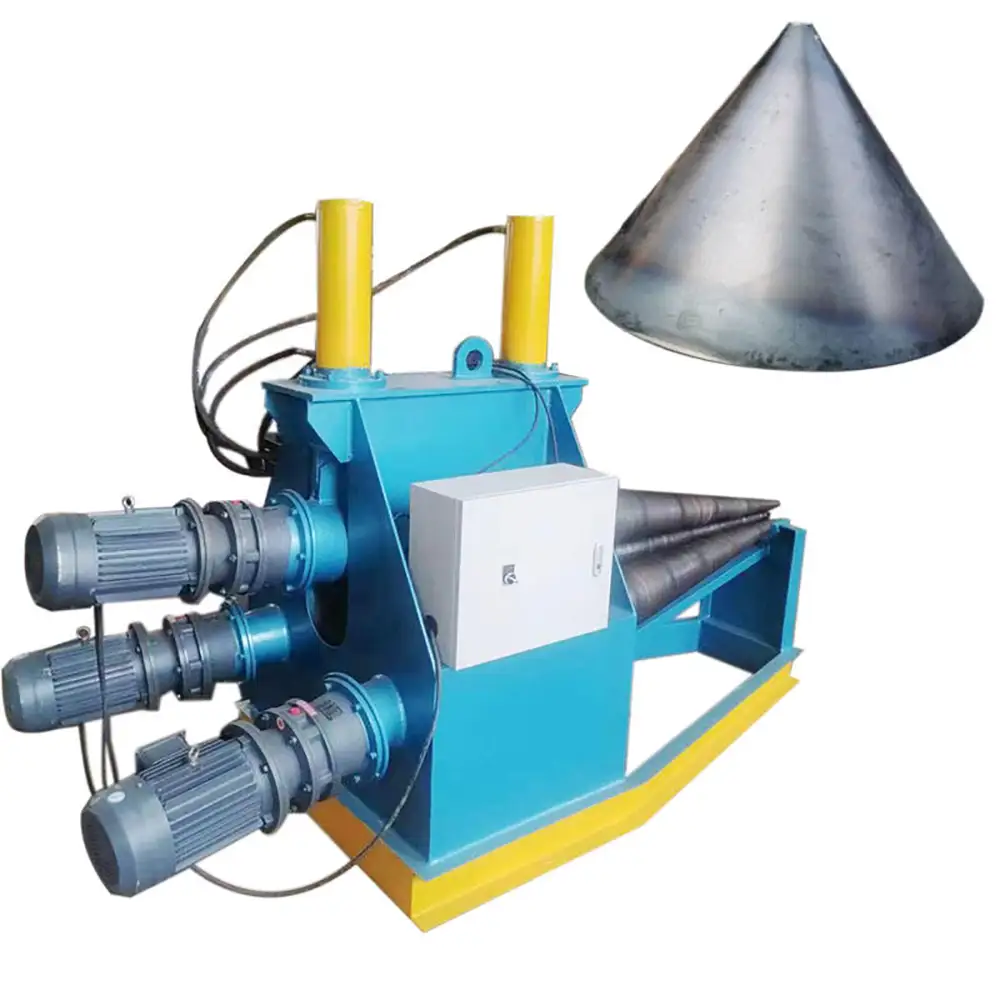
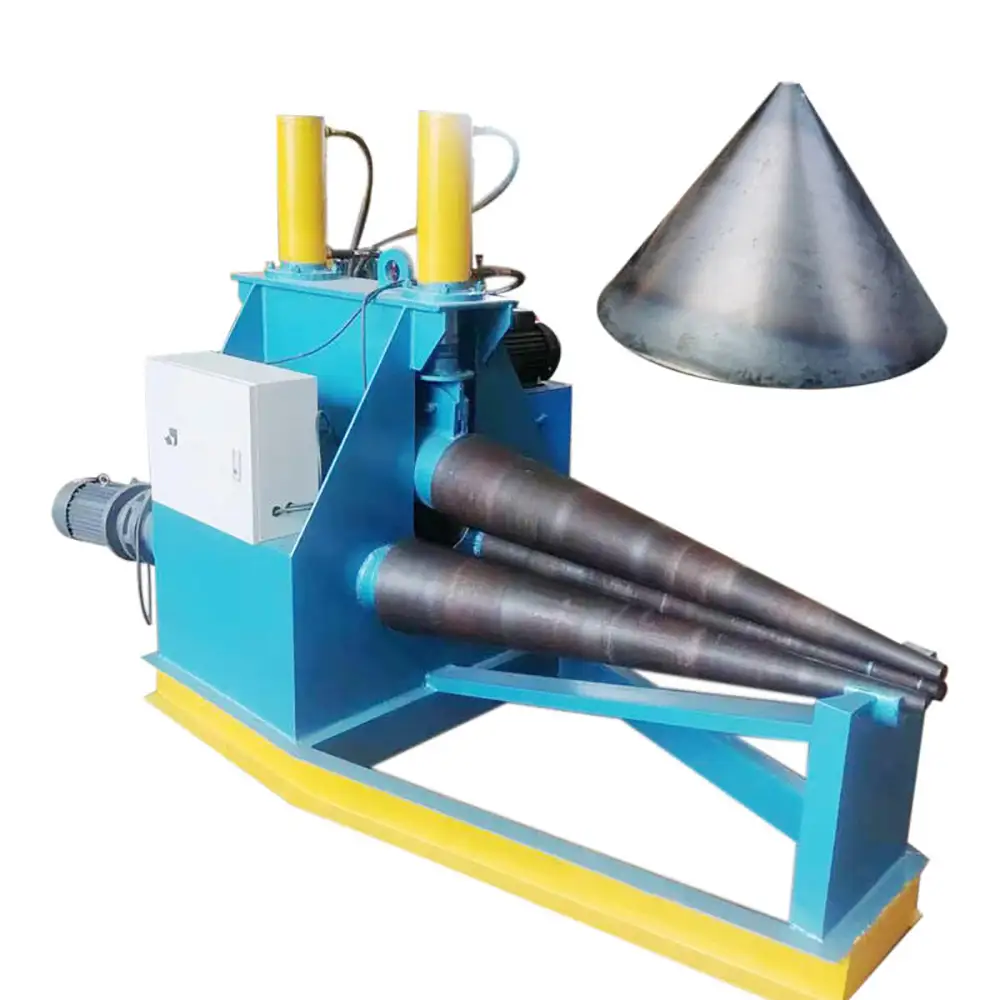
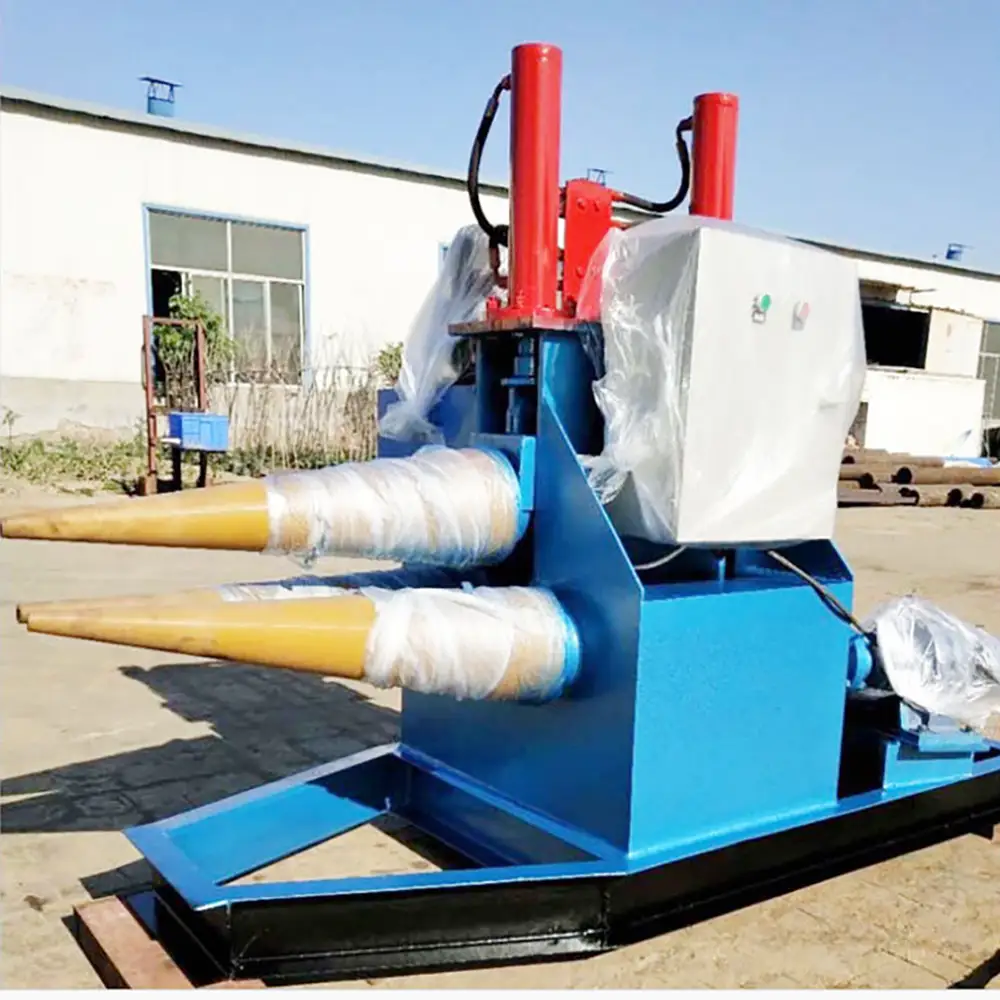
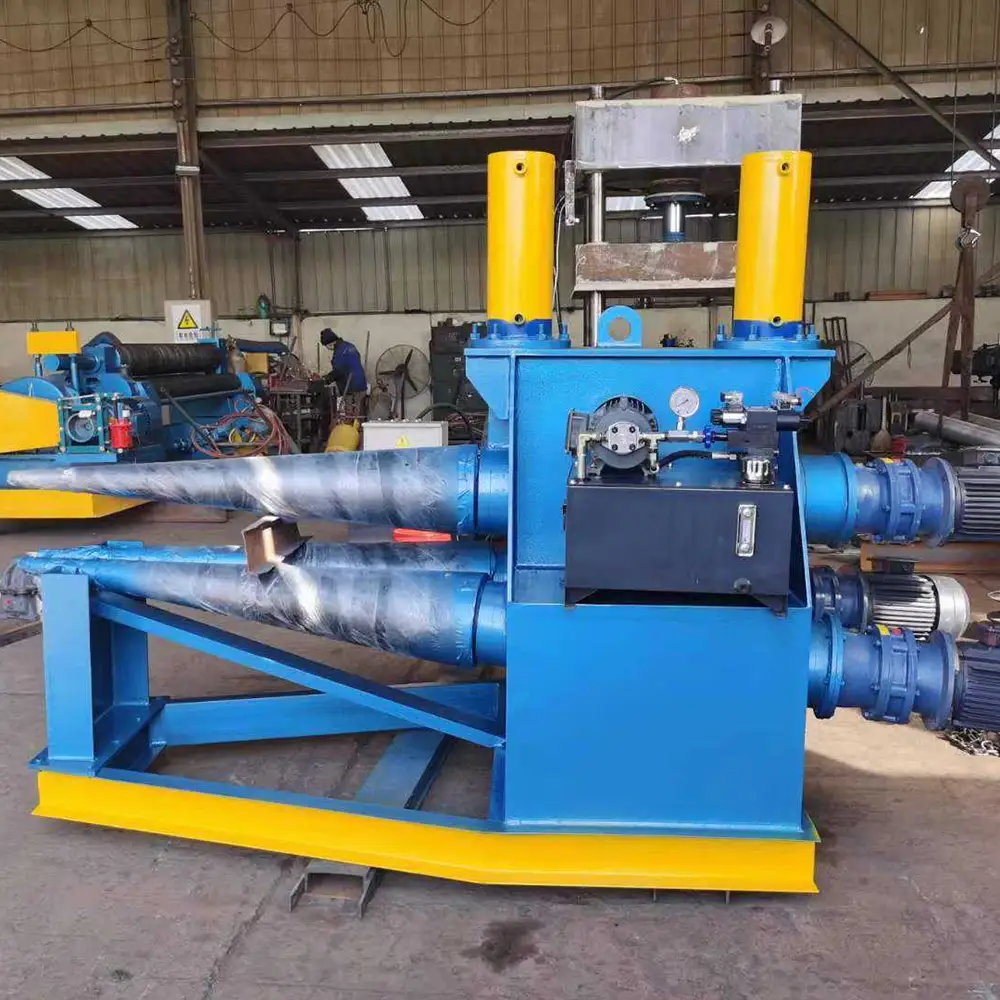
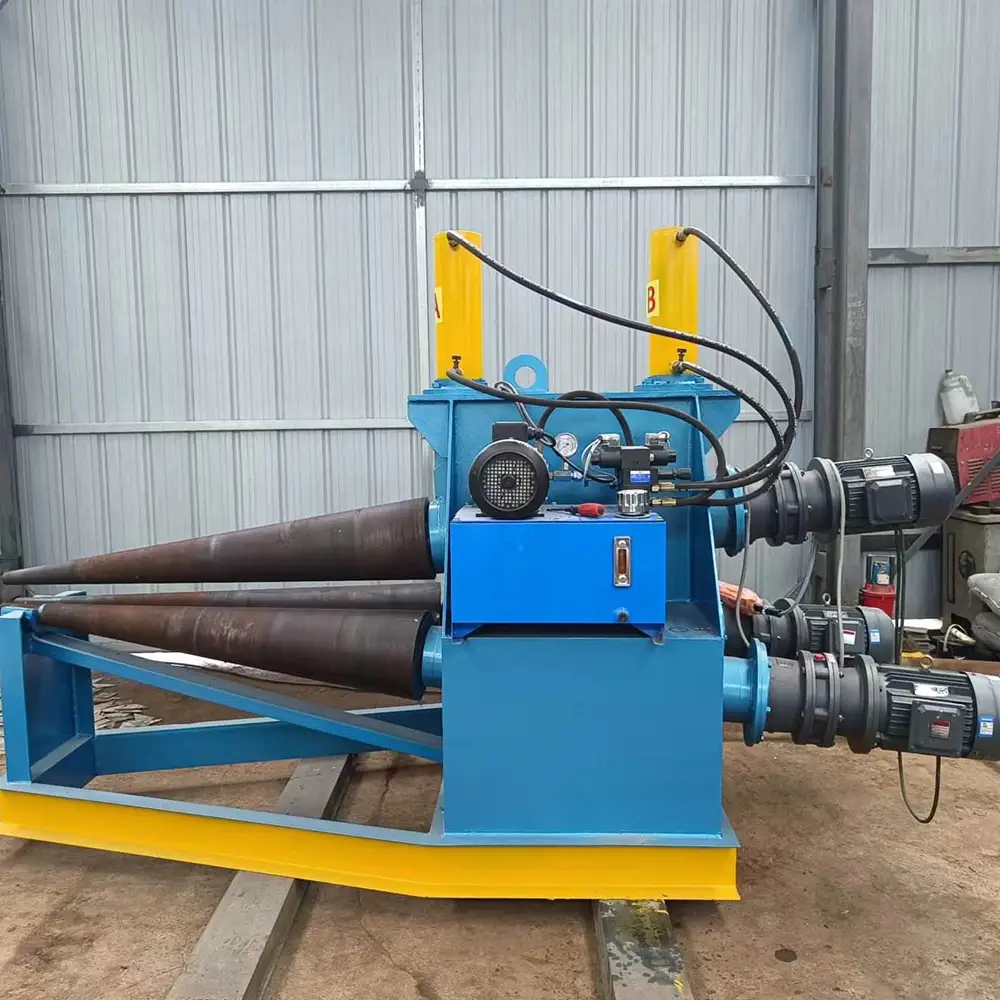
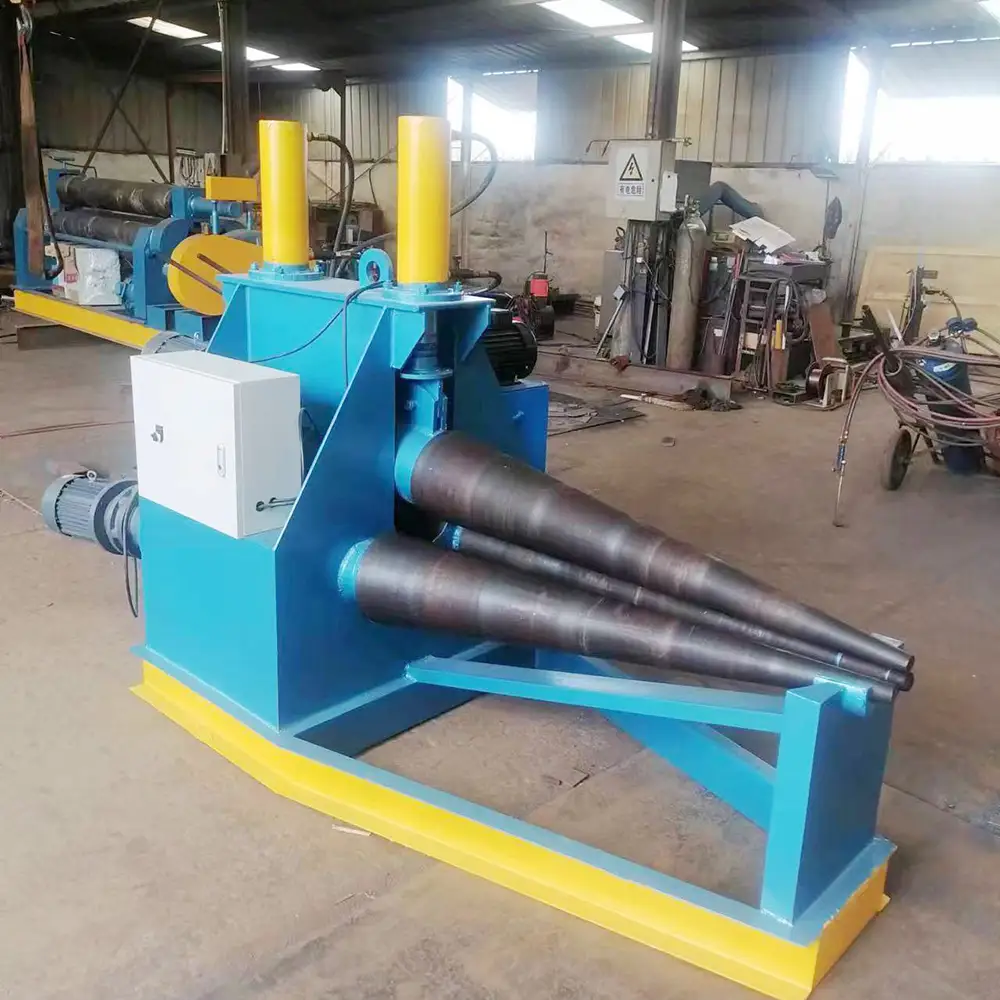
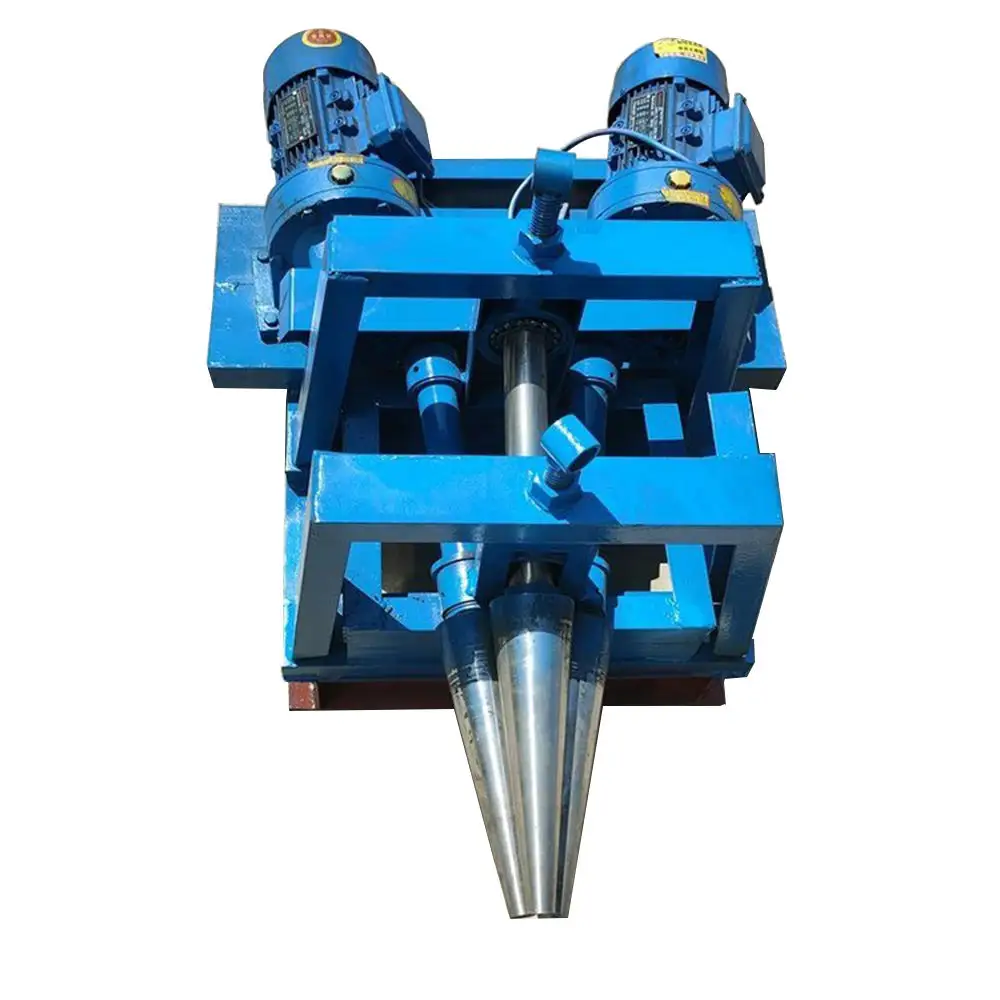
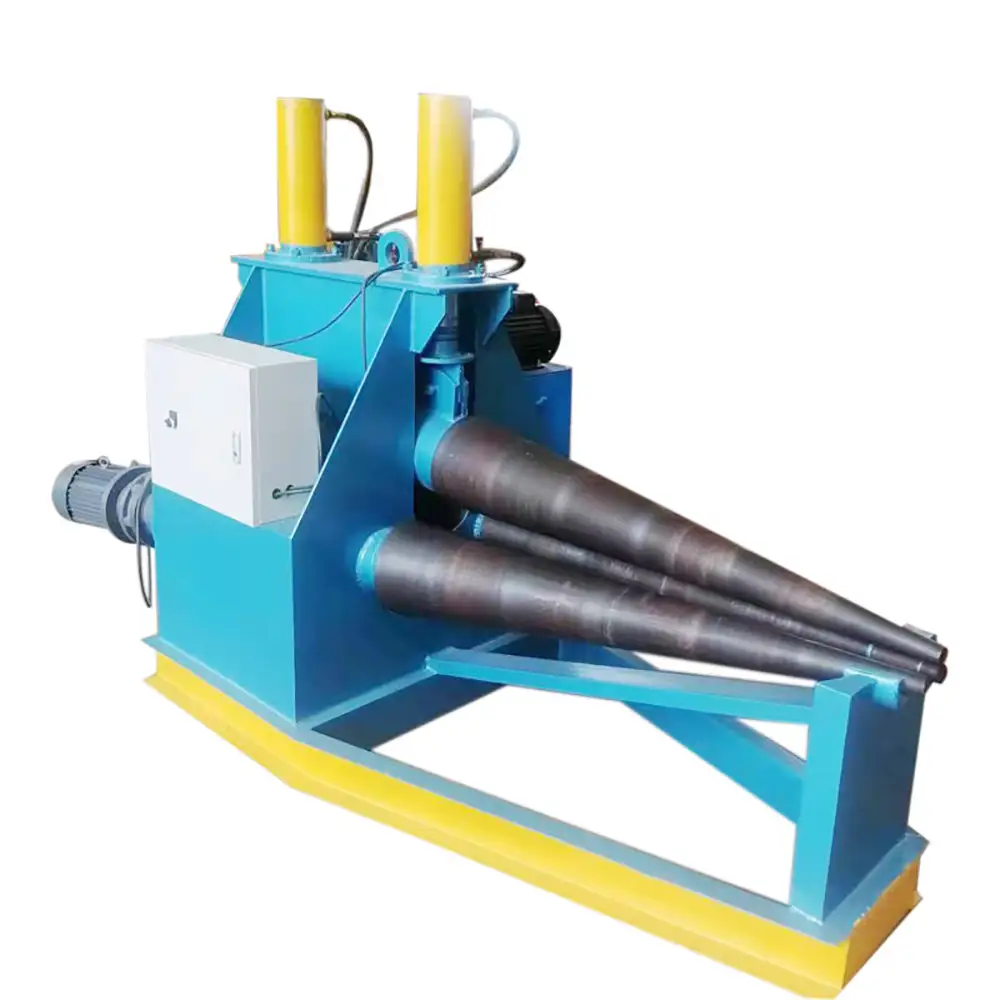
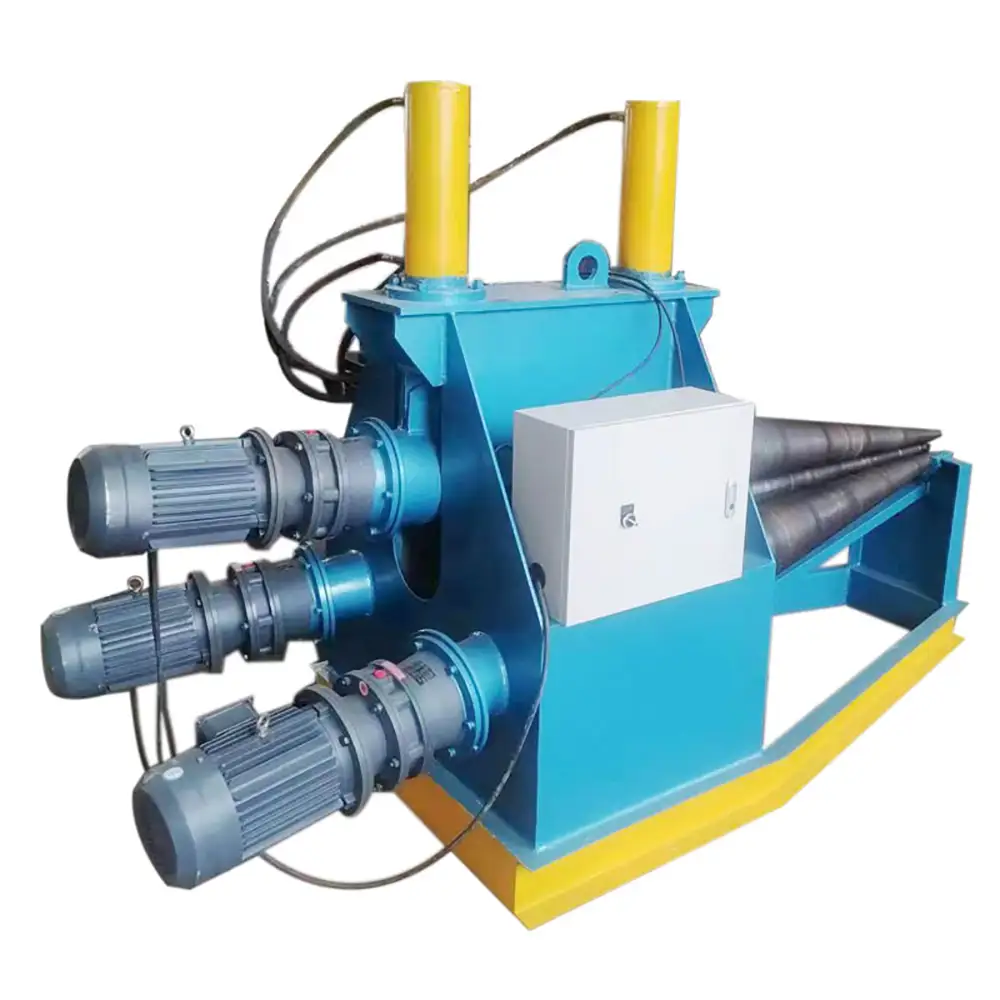
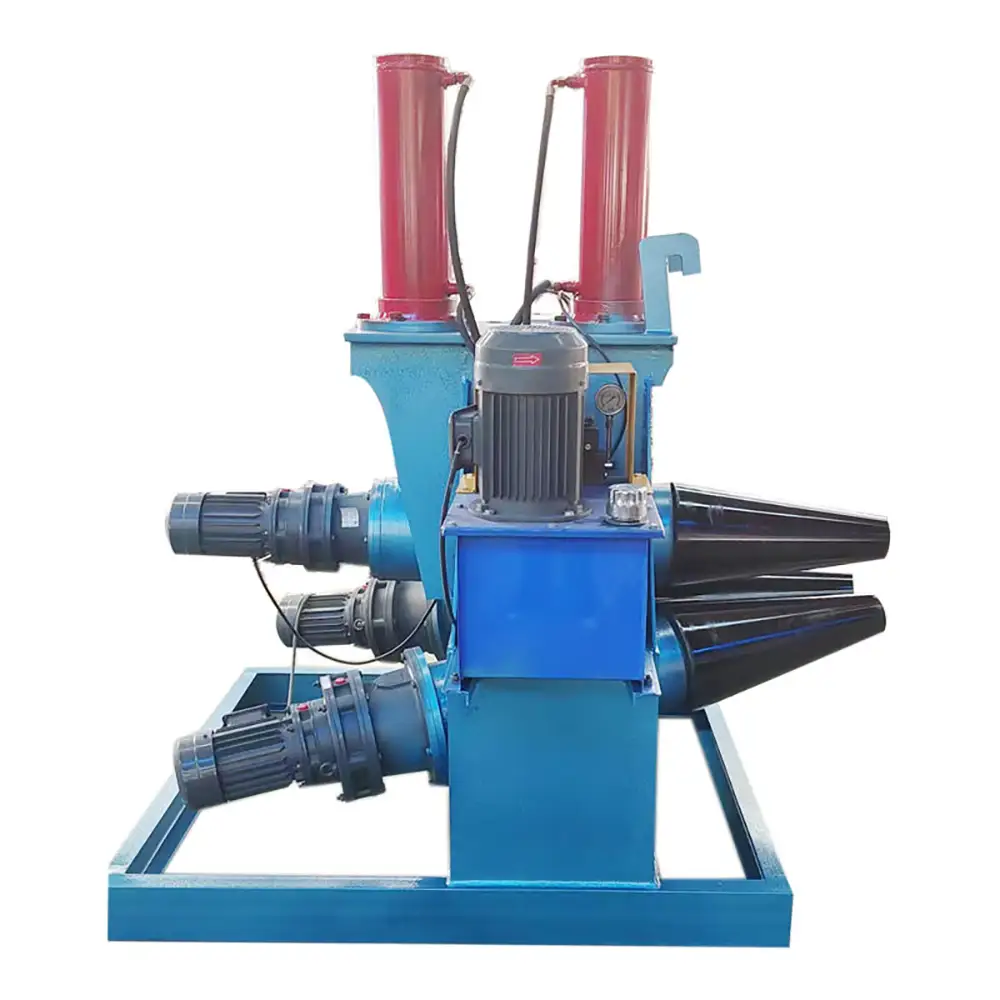
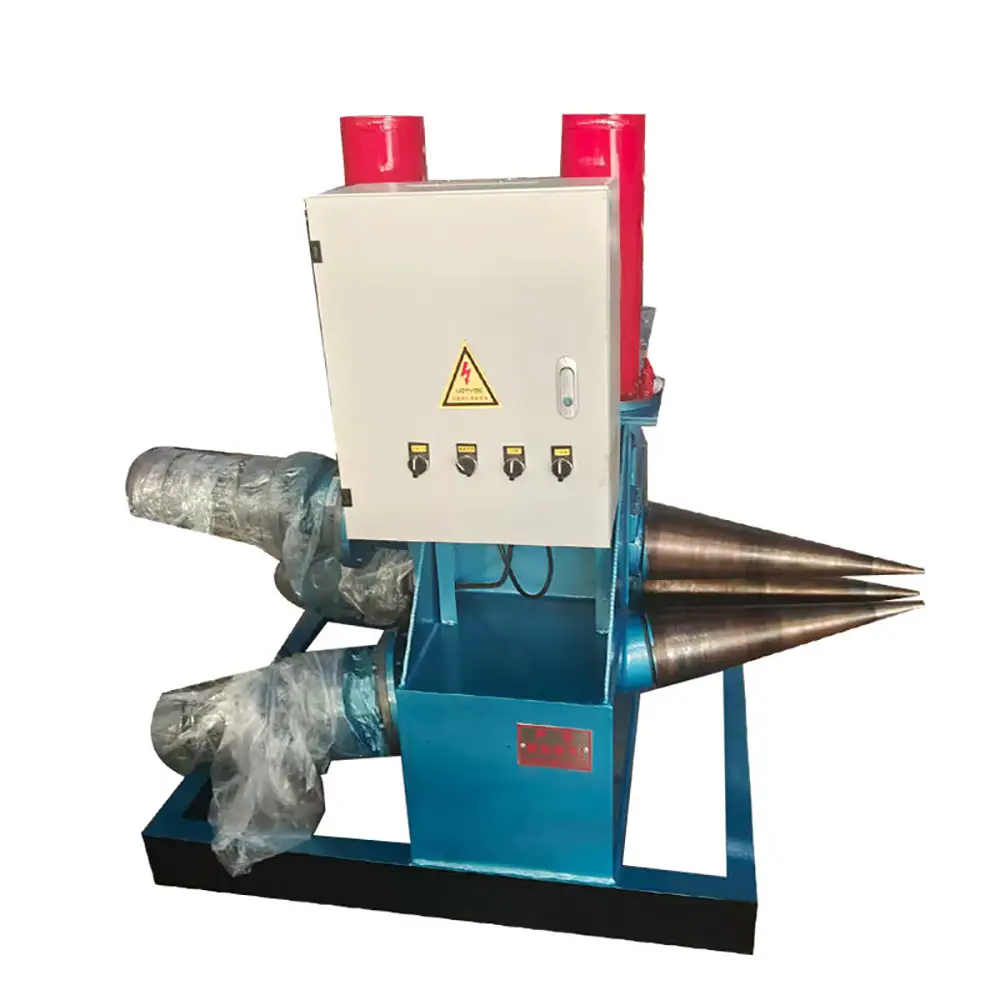
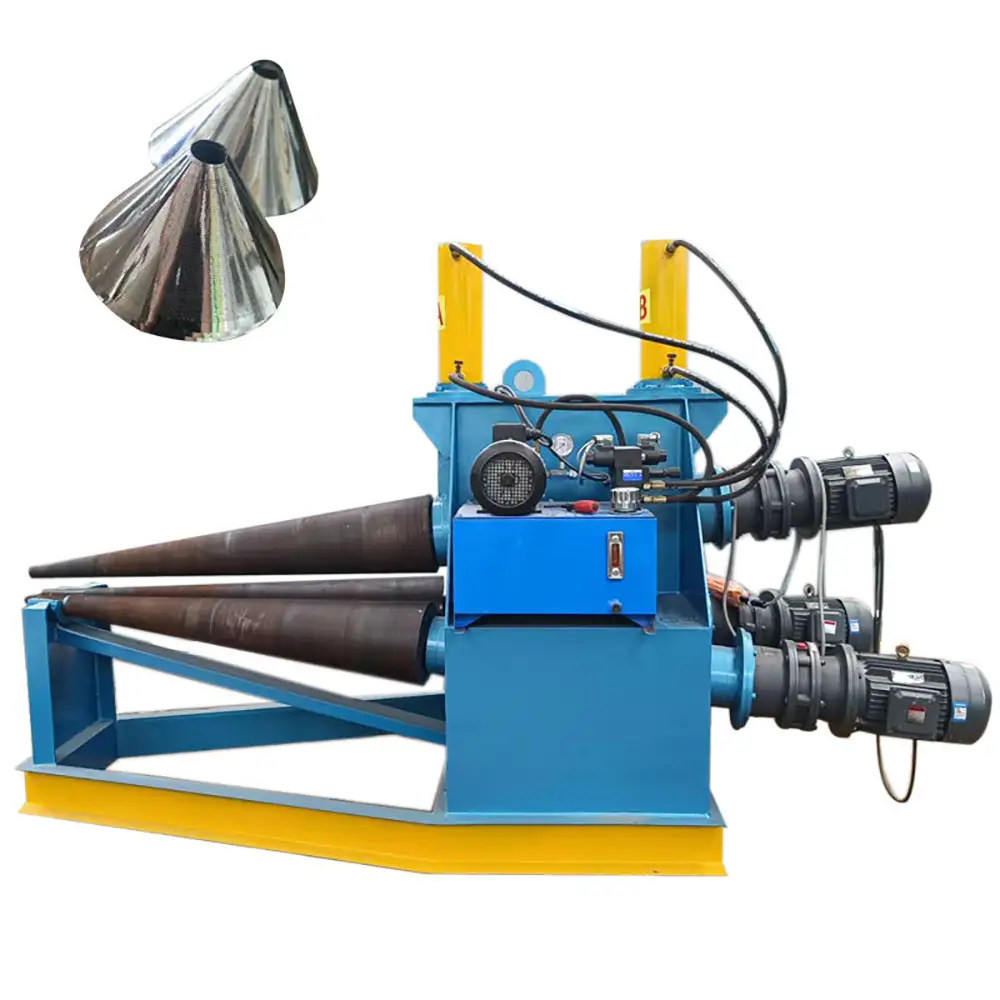
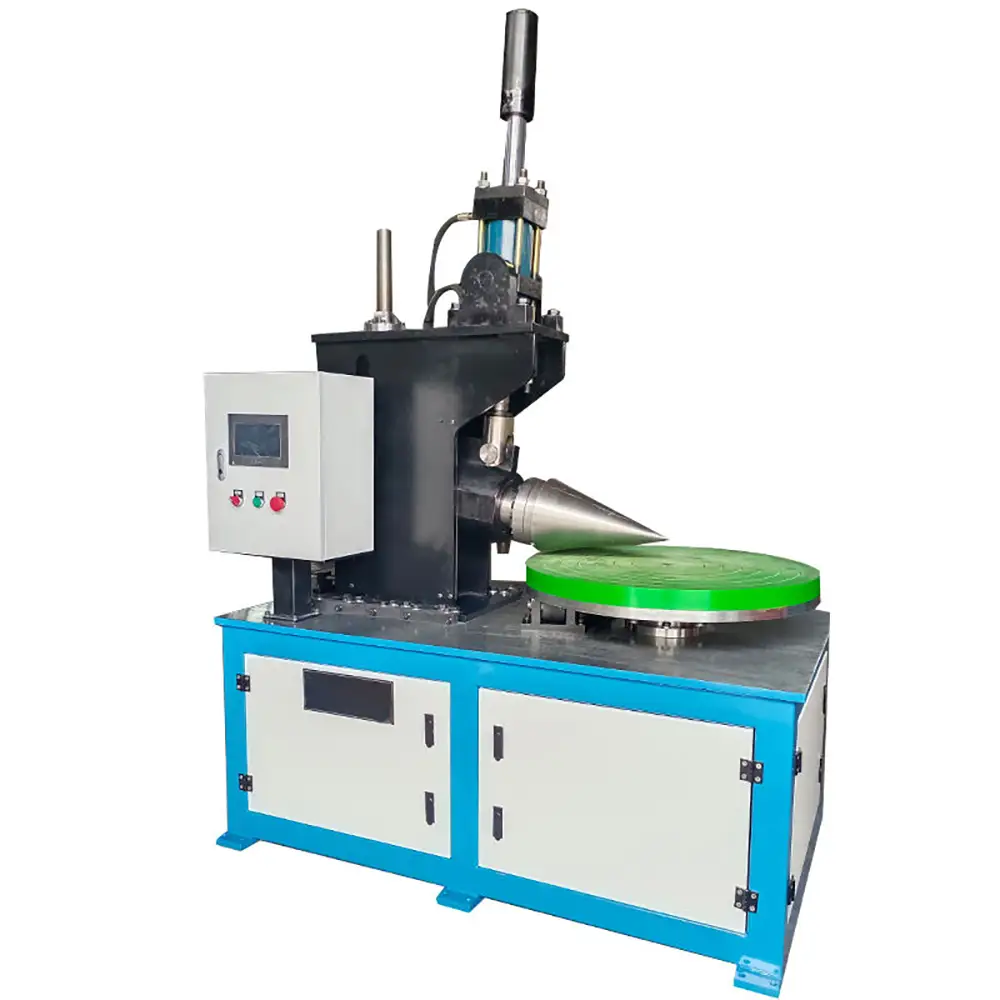
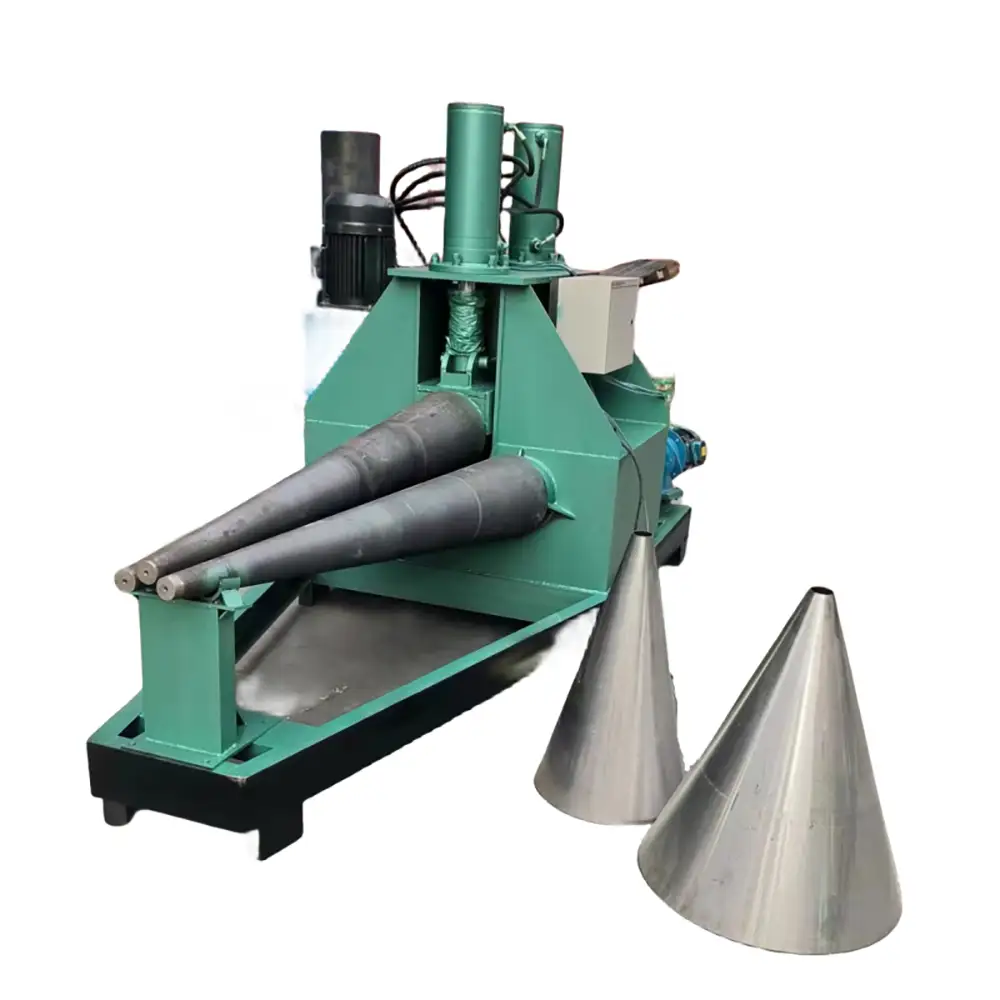
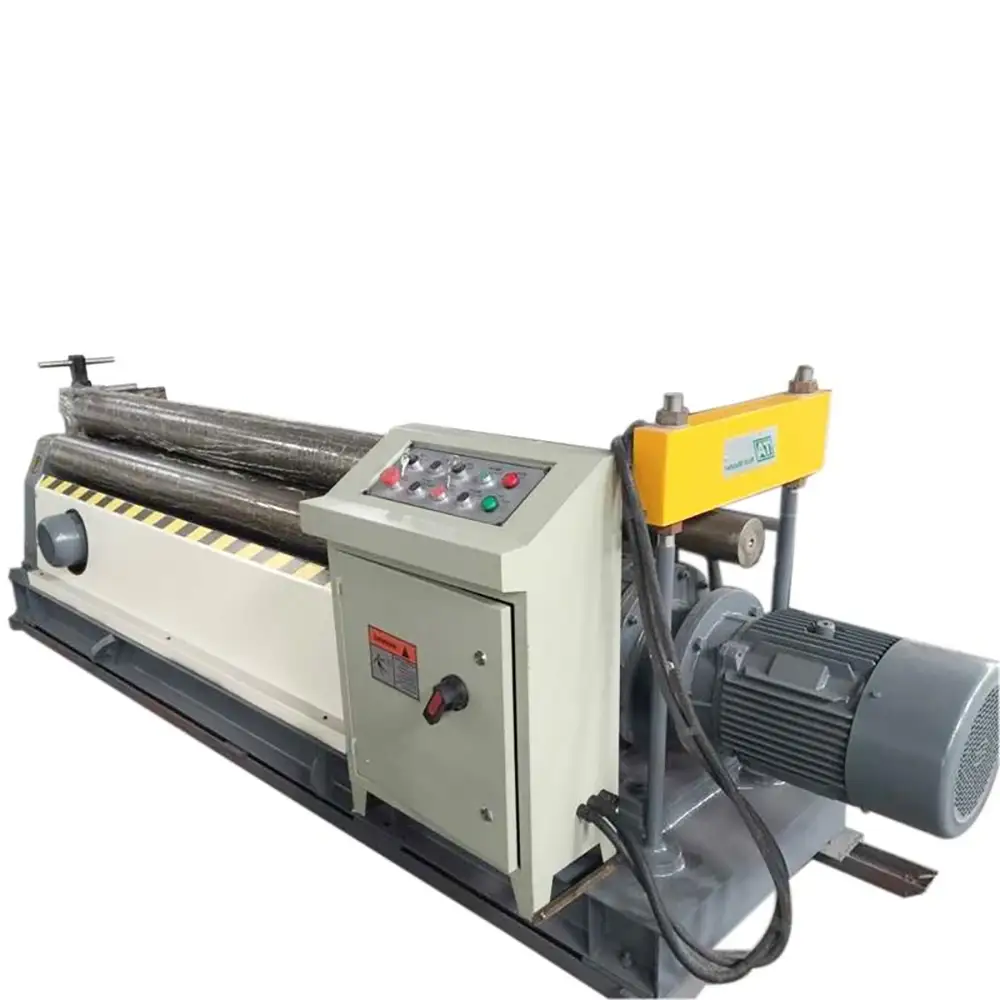
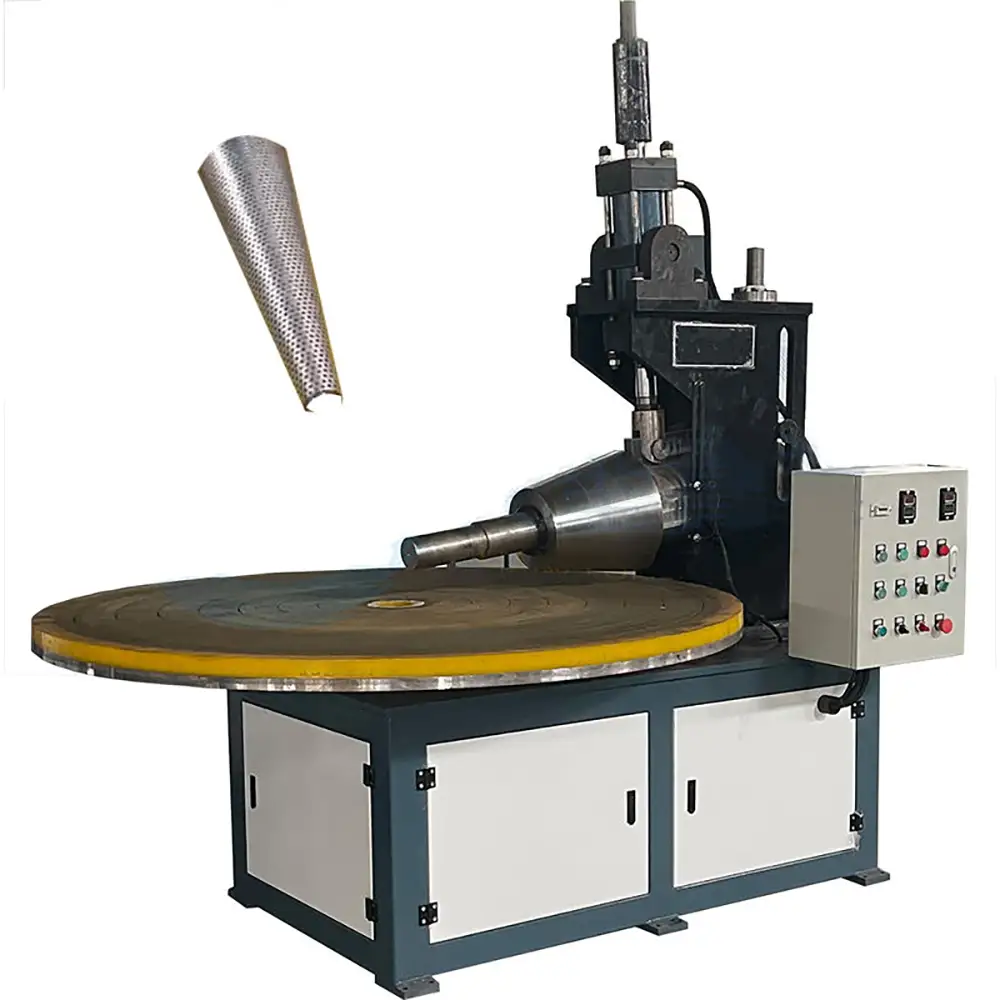
Hydraulic cone rolling machine is used to bend a certain thickness of metal plate into a cone-shaped or tapered part at room temperature. Its working principle is rotational bending deformation. Due to the vertical adjustment of the upper roller, there is no need for additional equipment such as a press. It can be loaded in one go and can complete the forming and bending function of the two ends of the sheet metal without the need to turn the head. It is also used for correcting the formed workpiece. It is an essential equipment for manufacturing machinery and equipment in industries such as petroleum, chemical, cement, shipbuilding, boilers, aviation, water conservancy, and power transmission and transformation towers. This machine has a compact structure and is easy to operate, making it currently one of the better rolling machines in China.
|
model |
6x1200 |
6x1300 |
6x2000 |
6x600 |
|
max plate thickness(mm) |
6(Q235) |
6(Q235) |
6 |
6 |
|
Cone Rolling Length |
1200mm |
1300mm |
2000mm |
600mm |
|
max yield strength of plate(Mpa) |
245 |
245 |
304 |
304 |
|
Upper Roll Diameter (mm) |
240mm |
250mm |
500mm |
10*200mm |
|
Lower Roll Diameter (mm) |
240mm |
250mm |
500mm |
10*200mm |
|
Large End Diameter of Taper Roll |
240mm |
250mm |
500mm |
200mm |
|
Small End Diameter of Taper Roll |
20mm |
40mm |
50mm |
10mm |
|
Rolling Speed(m/min) |
4 |
4 |
4 |
4 |
|
Main Motor Power(KW) |
1.5KW*3 |
1.5KW*3 |
5.5KW*3 |
1.5KW*3 |
|
Hydraulic Motor Power(KW) |
3KW |
3KW |
7.5KW |
3KW |
The Hydraulic 3 Roller Plate Bending Machine is a versatile metal forming machine designed for bending and rolling sheet metal and steel plate into cylindrical,conical,and curved components. With a three-roller configuration and hydraulic adjustment,the machine provides a practical solution for metal fabrication shops,industrial manufacturers,and custom fabrication operations.
A three-roller design allows the workpiece to pass between multiple forming rolls while the roller positions control the desired bending radius. When configured for cone rolling,the machine can accommodate the different circumferential lengths across a tapered workpiece,allowing flat plate to be progressively formed into a conical section.
This makes the machine suitable for both standard plate rolling and specialized Cone Rolling Machine applications.
Hydraulic 3 Roller Plate Bending
Hydraulic power is used to assist roller adjustment and forming operations. Compared with manually adjusted systems,hydraulic roller positioning can make setup more convenient,particularly when processing heavier steel plate.
The actual forming capacity depends on the machine model and the material being processed. Important factors include plate thickness,plate width,material strength,roller diameter,working length,cone geometry,and required bending radius.
Common materials may include:
Carbon steel
Mild steel
Stainless steel
Aluminum
Low-alloy steel
Other formable metal plate
Different materials have different yield strengths and springback characteristics. Stainless steel and high-strength steel may require greater forming force than mild steel of the same nominal thickness. Aluminum may require special attention to roller surfaces and forming conditions to reduce surface marking.
3 Roller Cone Rolling Machine
The 3 Roller Cone Rolling Machine configuration is particularly useful for manufacturers producing tapered components. Unlike simple cylindrical rolling,the cone-forming process requires controlled positioning because the large end and small end of the cone have different circumferences.
During cone rolling,the plate is progressively formed while the roller arrangement creates the required taper. The workpiece may pass through the machine several times depending on its thickness,material,and geometry.
This progressive approach can help control the forming process and achieve a more consistent cone shape.
Typical cone applications include:
Pipe reducers
Conical hoppers
Funnels
Duct transitions
Dust collector cones
Exhaust components
Tank transitions
Vessel sections
Conical roofs
Industrial chutes
Agricultural equipment components
Three Roller Plate Rolling Machine
The machine can also be used as a Three Roller Plate Rolling Machine for conventional cylindrical bending applications. Flat steel plate can be rolled into cylindrical shells,sections,and curved components.
Three-roller plate rolling is widely used in fabrication industries because the machine can support a variety of workpiece sizes within its rated capacity.
Common applications include:
Storage tanks
Cylindrical vessels
Pipes
Ducting
Air receivers
Structural cylinders
Industrial equipment
Machine housings
Metal frames
Fabricated shells
The machine can therefore serve multiple forming requirements within one production environment.
Steel Plate Bending Roller
A Steel Plate Bending Roller uses mechanical force to progressively deform flat plate into a controlled radius. The forming process normally involves positioning the plate between the rollers and adjusting the roller configuration according to the required geometry.
For thicker steel plate,the machine structure and hydraulic system must be sufficiently sized for the required forming load.
The correct machine should be selected according to actual material strength rather than thickness alone. For example,a 12 mm stainless steel plate may require different forming force from a 12 mm mild steel plate.
Customers should provide the manufacturer with detailed material and dimensional information when requesting a machine quotation.
Cone Bending Applications
Cone bending is one of the important applications of this hydraulic three-roller machine. A cone blank has a different radius at each side,and the machine must accommodate this geometry during forming.
The typical process includes:
Preparing the developed cone blank.
Positioning the plate correctly between the rollers.
Performing initial pre-bending when required.
Adjusting the rollers for the desired taper.
Progressively rolling the plate.
Checking cone diameter and angle.
Removing the formed cone.
Performing welding and finishing operations.
The exact process depends on the machine configuration and the workpiece design.
Pipe Reducer Manufacturing
The machine can be used to form blanks for pipe reducers,which connect pipes with different diameters. A flat blank is first developed according to the required reducer geometry and then rolled into a tapered shape.
After rolling,the cone section can be welded along the seam and subsequently trimmed or machined to meet the final dimensions.
Pipe reducer applications can be found in industrial piping,HVAC systems,chemical equipment,water treatment systems,energy equipment,and general fabrication.
Hopper and Funnel Cone Forming
Conical hoppers and funnels are another common application. A hopper may have a wide opening at the top and a smaller discharge opening at the bottom.
The hydraulic three-roller machine can form the tapered shell required for these components. After rolling,the shell can be welded and assembled with supporting structures,flanges,discharge outlets,or other components.
This makes the equipment useful for manufacturers of material handling systems,grain equipment,dust collectors,and industrial processing machinery.
Hydraulic Roller Adjustment
Hydraulic adjustment allows the operator to control roller movement according to the required forming condition. This can be particularly useful for heavier workpieces and production environments where repeatable setup is important.
Depending on the machine configuration,the hydraulic system may control the upper or lower roller positions and may include hydraulic supports or other auxiliary mechanisms.
Advanced configurations can also incorporate programmable controls or CNC-assisted positioning. However,the actual automation level depends on the selected machine.
Hydraulic assistance should not automatically be interpreted as fully automatic operation.
Machine Configuration and Selection
Selecting the correct plate bending machine requires consideration of the complete production requirement.
Important parameters include:
Maximum plate thickness
Maximum plate width
Material type
Material yield strength
Minimum rolling diameter
Maximum rolling diameter
Cone diameter range
Cone angle
Roller diameter
Working length
Production volume
Required automation
For cone rolling applications,it is especially important to provide both the large-end and small-end dimensions. These dimensions help determine whether the proposed roller arrangement can achieve the required geometry.
Custom and OEM Manufacturing
Different customers may require different machine dimensions and forming capabilities. For this reason,customized Hydraulic Plate Rolling Machines can be developed according to actual production requirements.
OEM configurations may include different working lengths,roller diameters,hydraulic capacities,control systems,side supports,and auxiliary equipment.
For manufacturers producing multiple product sizes,a flexible machine configuration can reduce the need for separate forming equipment.
Quality Control and Finished Components
Plate rolling is one stage of the overall fabrication process. After rolling,the workpiece should be checked according to the requirements of the finished component.
Typical inspection items include:
Plate dimensions
Cylinder diameter
Cone diameter
Cone angle
Roundness
Edge alignment
Surface condition
Seam fit-up
For welded components,additional processes such as welding,grinding,trimming,calibration,and final dimensional inspection may be required.
Proper blank preparation and controlled roller adjustment can help improve forming consistency.
Why Choose Us
Hydraulic 3 Roller Technology
Designed for flexible plate rolling and cone forming applications.
Multi-Application Forming
Suitable for cylindrical,tapered,and curved metal components.
Heavy-Duty Steel Plate Capability
Machine configurations can be selected according to material thickness and forming load.
Flexible Cone Rolling
Suitable for reducers,hoppers,funnels,duct transitions,and other tapered components.
Custom Machine Configuration
Working length,roller diameter,hydraulic capacity,and control options can be customized.
OEM Manufacturing
Customized solutions are available according to drawings,materials,and production requirements.
Industrial B2B Supply
Suitable for metal fabrication companies,industrial manufacturers,distributors,and equipment suppliers.
Technical Support
We can assist with machine selection,forming parameters,configuration,and production requirements.
FAQs
1. What is a Hydraulic 3 Roller Plate Bending Machine?
It is a metal forming machine using three rollers and hydraulic adjustment to bend sheet metal and steel plate into cylindrical,conical,and curved shapes.
2. Can this machine roll cones?
Yes. With the appropriate roller configuration and control method,it can be used for tapered and conical plate rolling.
3. Can it roll steel plate?
Yes. The machine can be configured for different steel plate thicknesses and material strengths.
4. What materials can be processed?
Common materials include carbon steel,mild steel,stainless steel,aluminum,and other suitable formable metals.
5. Can it make pipe reducers?
Yes. It can form tapered blanks used to manufacture pipe reducers. Welding and finishing are normally completed after rolling.
6. Can it form cylindrical tanks?
Yes. The three-roller configuration is commonly used for cylindrical shell and tank fabrication within the machine's rated capacity.
7. What is the difference between 3 roller and 4 roller machines?
Both can perform plate rolling,but their roller arrangements and workpiece handling methods differ. Machine selection should be based on the required forming process,production volume,and workpiece geometry.
8. Is hydraulic operation fully automatic?
Not necessarily. Hydraulic roller movement provides powered adjustment,but the actual automation level depends on the machine's control configuration.
9. Can the machine roll stainless steel?
Yes,provided the machine capacity is suitable for the stainless steel grade and thickness being processed.
10. Can the machine be customized?
Yes. Working length,roller diameter,hydraulic capacity,control system,and auxiliary functions can be customized according to requirements.
11. What information is needed to select the machine?
Important information includes material,plate thickness,width,rolling diameter,cone dimensions,cone angle,production quantity,and product drawings.
12. Does cone rolling require pre-bending?
Pre-bending may be required depending on the machine design and workpiece geometry. It helps reduce unformed straight sections at the plate ends.
Prev:
Hydraulic Three Rollers Cone Bending and Forming Machine
Next:
Multifunction Roller Cone Hydraulic Rolling Machine for Pre Rolled Cone Machine
TAG:
Cone Forming Machine,
Sheet Metal Rolling Machine,
Steel Plate Rolling Machine,
Metal Rolling Machine,
Automatic Cone Rolling Machine,
Three Roller Cone Rolling Machine,
Industrial Cone Rolling Machine,
Industrial Cone Forming Machine,
Cone Reducer Forming Machine,
Hopper Cone Forming Machine,
Metal Plate Bending Machine,
Hydraulic Plate Rolling Machine,
CNC Plate Rolling Machine,
Stainless Steel Cone Rolling Machine,
Steel Cone Rolling Machine,
Carbon Steel Cone Rolling Machine,
Steel Cone Forming Machine,
Tapered Metal Forming Machine,
Cone Rolling Machine,
Conical Plate Bending Machine,
CNC Cone Rolling Machine,
Metal Cone Rolling Machine,
Metal Cone Forming Machine,
Hydraulic Cone Rolling Machine,
Cone Bending Machine,
Heavy Duty Plate Rolling Machine,
Hopper Cone Rolling Machine,
Reducer Cone Rolling Machine,
Conical Hopper Forming Machine,
Conical Plate Rolling Machine,
Related Category:
Hydraulic 3 Roller Plate Bending Machine,3 Roller Plate Bending Machine,Cone Rolling Machine,Hydraulic Cone Rolling Mach China, suppliers, manufacturers, factory, customized, wholesale, quotation, made in China