Purified Water And Softened Water Treatment System
Purified Water And Softened Water are two important water treatment concepts used in residential, commercial, industrial, laboratory, food processing, pharmaceutical, and other applications. Although the terms are sometimes used together, purified water and softened water are not the same.
Softened water is primarily treated to reduce hardness caused by minerals such as calcium and magnesium. A conventional cation-exchange water softener replaces hardness ions with sodium or potassium ions. Purified water, by contrast, generally refers to water that has undergone a treatment process intended to remove a broader range of unwanted substances. Reverse osmosis, filtration, deionization, distillation, and combinations of these technologies may be used depending on the required water quality. EPA explains that water softening specifically targets hardness minerals, while RO can remove a broader range of dissolved contaminants.
A complete water treatment system may therefore use softening as a pretreatment step before purification. This configuration can help protect downstream membranes and improve the overall reliability of the treatment process.
What Is Softened Water?
Hard water contains elevated concentrations of calcium and magnesium. These minerals can contribute to scale formation on pipes, heat exchangers, boilers, water heaters, fixtures, and other equipment.
A typical water softener uses a bed of ion-exchange resin. As hard water passes through the resin, calcium and magnesium ions are exchanged for sodium or potassium ions. This reduces hardness and helps control scale-forming minerals.
Softening does not mean that all dissolved contaminants have been removed. The primary objective is hardness reduction.
For industrial facilities, softened water can be used as process water, boiler feed pretreatment, cooling-water makeup, cleaning water, or pretreatment for more advanced purification systems.
What Is Purified Water?
Purified water is water that has undergone one or more treatment processes to achieve a defined quality level.
The appropriate purification process depends on the source-water characteristics and intended application. Common technologies include:
Multimedia Filtration
Activated Carbon Filtration
Water Softening
Reverse Osmosis
Nanofiltration
Ultrafiltration
Electrodeionization
Ion Exchange
Distillation
Ultraviolet Disinfection
Ozone Treatment
No single treatment technology removes every possible contaminant. EPA recommends selecting treatment according to the specific water-quality objective and considering combinations of technologies when necessary.
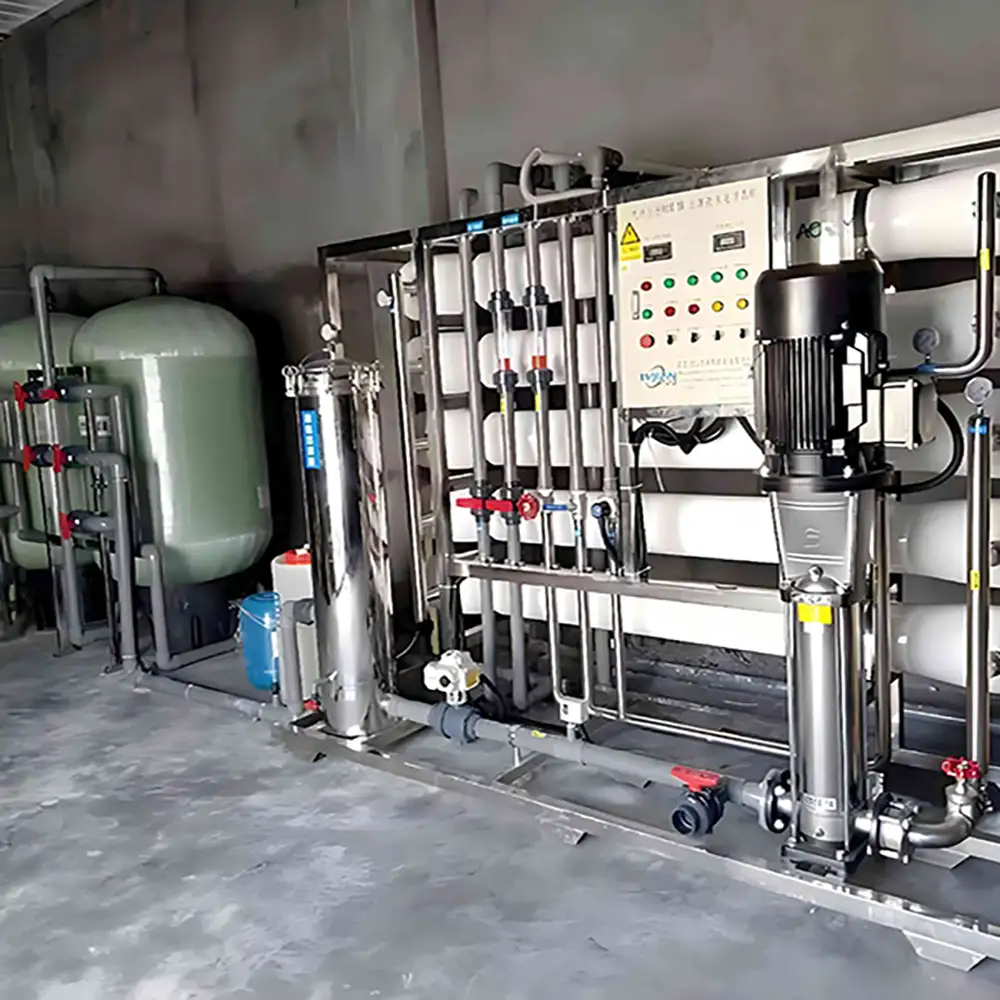
For example, a commercial purification system may combine pretreatment, softening, activated carbon, cartridge filtration, RO, UV, and final polishing.
Purified Water vs. Softened Water
The key difference is the treatment objective.
Softened Water:
Primarily reduces calcium and magnesium hardness.
Purified Water:
Uses one or more treatment processes to reduce specified contaminants and achieve a higher or more controlled water quality.
Softened water can therefore be an important part of a purified-water production system without being equivalent to purified water.
In many industrial installations, the process may follow:
Raw Water → Pretreatment → Softening → Fine Filtration → RO → UV/Other Polishing → Purified Water
The actual configuration should be selected according to raw-water analysis and the required product-water specifications.
Water Softening as RO Pretreatment
Water softening is frequently considered when the feed water has significant hardness.
Hardness can contribute to scaling on RO membranes. A properly designed pretreatment system can reduce the scaling potential and help maintain stable membrane operation.
The pretreatment train may include a multimedia filter, activated carbon filter, water softener, cartridge filter, and chemical dosing before RO.
This approach is especially useful for industrial systems where continuous production and stable water quality are important.
EPA guidance notes that pretreatment processes are frequently required for membrane systems to help prevent fouling or plugging.
Reverse Osmosis Purified Water
Reverse osmosis is one of the most widely used technologies for producing purified water.
In an RO system, pressure forces feed water through a semipermeable membrane. The membrane allows part of the water to pass as permeate while retaining a higher concentration of dissolved substances in the concentrate stream.
RO can reduce many dissolved inorganic substances, salts, and other contaminants. It can also be used in applications involving brackish water and other challenging feed-water conditions.
However, RO systems produce a reject-water stream and require appropriate pretreatment, membrane maintenance, and operating controls.
Commercial and Industrial Applications
Purified and softened water systems can be configured for many industries.
Food and Beverage
Food and beverage facilities may use softened or purified water for ingredient water, equipment cleaning, process water, and utility systems. The required treatment level depends on the production process and applicable quality requirements.
Pharmaceutical and Laboratory Applications
Laboratories and pharmaceutical facilities may require controlled water quality for equipment, cleaning, preparation, or other processes. Higher-purity applications may require RO combined with deionization, UV, filtration, or other polishing technologies.
Boiler Feed Water
Softened water is commonly used as pretreatment for boiler systems because excessive hardness can contribute to scale formation. Additional treatment may be required depending on boiler pressure, feed-water quality, and operating requirements.
Cooling Systems
Water softening and purification can help manage mineral loading in cooling-water applications. The appropriate treatment depends on cooling-system design and water chemistry.
Electronics and Manufacturing
Manufacturing processes may require low-TDS or otherwise controlled water. RO, deionization, and polishing technologies can be combined to meet process-specific requirements.
Hotels and Commercial Buildings
Commercial buildings can use water softeners to control hardness in plumbing and hot-water systems, while purified water systems may be installed for drinking water, kitchens, laboratories, or specialized equipment.
Main Components of a Purified and Softened Water System
A complete system may contain:
Raw Water Pump
Multimedia Filter
Activated Carbon Filter
Water Softener
Brine Tank
Cartridge Filter
High-Pressure RO Pump
RO Membrane Housing
RO Membranes
UV Sterilizer
Ozone System
Water Storage Tank
Pure Water Pump
Control Cabinet
Conductivity or TDS Monitoring
Flow and Pressure Instruments
Not every project requires all components. Equipment selection should be based on water analysis, treatment capacity, required product-water quality, operating hours, and downstream use.
Water Quality and System Design
Proper system design begins with water-quality testing.
Important parameters may include:
TDS
Hardness
Calcium
Magnesium
Iron
Manganese
Silica
Turbidity
pH
Conductivity
Organic Matter
Microbiological Parameters
Specific Contaminants of Concern
The intended use of the treated water should also be defined before equipment selection.
For example, water for general industrial washing may require substantially less treatment than water intended for laboratory processes or high-purity manufacturing.
EPA guidance emphasizes selecting the least intensive treatment necessary to achieve the desired water quality and correctly sizing the system rather than automatically choosing an oversized purification system.
Operation and Maintenance
Water treatment equipment requires routine inspection and maintenance.
Softener systems require monitoring of resin performance, salt or brine conditions, regeneration cycles, valves, and flow rates. EPA recommends demand-initiated regeneration and attention to water and salt efficiency when selecting softeners.
RO systems require monitoring of feed pressure, permeate flow, concentrate flow, conductivity, membrane condition, and pretreatment performance. Cartridge filters and other pretreatment components must be replaced or serviced according to operating conditions.
For commercial RO systems, water recovery is an important consideration because part of the feed water leaves as concentrate. EPA recommends considering high-recovery configurations and optimized pretreatment where appropriate.
Why Choose Us?
Complete Water Treatment Solutions: Purified and softened water systems can be configured as integrated treatment lines.
Application-Based Design: Equipment selection is based on raw-water quality, flow rate, and required treated-water quality.
Flexible Technology Combination: Softening, filtration, RO, UV, ozone, and polishing technologies can be combined where appropriate.
Industrial-Grade Configuration: Suitable for commercial facilities and industrial process-water applications.
Effective Hardness Control: Water softening can help reduce calcium and magnesium hardness and control scale-forming minerals.
Advanced Water Purification: RO and additional polishing technologies can be incorporated when lower dissolved-solids levels or more controlled water quality are required.
Efficient System Layout: Treatment stages can be arranged according to available installation space and process requirements.
Easy Monitoring: Pressure, flow, conductivity, TDS, and other operating parameters can be monitored according to system configuration.
Scalable Capacity: Systems can be designed for different water production capacities and operating schedules.
Integrated Pretreatment: Proper pretreatment can help protect downstream RO membranes and other purification equipment.
FAQs
1. What Is the Difference Between Purified Water and Softened Water?
Softened water is primarily treated to reduce calcium and magnesium hardness, while purified water undergoes one or more processes designed to reduce a broader range of specified contaminants.
2. Is Softened Water Purified Water?
No. Softening mainly targets hardness minerals and does not remove all dissolved contaminants.
3. Can Softened Water Be Used Before RO?
Yes. A water softener can be used as part of RO pretreatment when hardness creates a scaling concern.
4. What Is Used to Produce Purified Water?
Depending on the required quality, systems may use filtration, activated carbon, softening, RO, UV, deionization, distillation, or combinations of these technologies.
5. Does RO Produce Purified Water?
RO can produce highly treated water by reducing many dissolved substances, but the required treatment level depends on the application and feed-water quality.
6. Does a Water Softener Remove TDS?
Conventional cation-exchange softening is designed primarily to reduce calcium and magnesium hardness. It does not function as a general TDS-removal process.
7. Why Is Water Softening Used Before RO?
Softening can reduce hardness and help lower the risk of mineral scaling on RO membranes when the feed water has significant hardness.
8. What Industries Use Purified Water Systems?
Applications include food and beverage, pharmaceutical, laboratory, electronics, manufacturing, healthcare, hospitality, boiler systems, and other commercial or industrial processes.
9. Can One System Produce Both Softened and Purified Water?
Yes. A treatment plant can provide separate softened-water and purified-water outlets, depending on the process design and water-use requirements.
10. How Do I Select the Right System?
Start with a raw-water analysis, required flow rate, operating schedule, intended water use, and target water quality. These factors determine the appropriate treatment technologies and system capacity.
Prev:
Horizontal Flow Dissolved Air Flotation Machine
Next:
Seawater Desalination
TAG:
Industrial Water Purification System,
Water Purification Equipment,
Integrated Water Treatment System,
Reverse Osmosis Water Treatment,
RO Water Purification System,
Pure Water Treatment System,
Industrial Water Treatment,
Water Filtration System,
Ultrafiltration Water Treatment,
Industrial Water Purification,
Water Purification System,
RO Water Treatment Plant,
Industrial RO System,
Process Water Treatment,
Industrial Water Filtration,
Commercial RO System,
Commercial Water Purification,
Drinking Water Purification,
Pure Water Equipment,
Reverse Osmosis Water Purification,
RO Water Purification,
RO Water Treatment,
Reverse Osmosis System,
Water Purification Plant,
RO Water Treatment Equipment,
Demineralized Water Treatment,
Boiler Feed Water Treatment,
Hard Water Treatment,
Water Softener System,
Commercial Water Filtration,
Related Category:
Purified Water And Softened Water,Purified Water System,Softened Water System,Water Purification System China, suppliers, manufacturers, factory, customized, wholesale, quotation, made in China