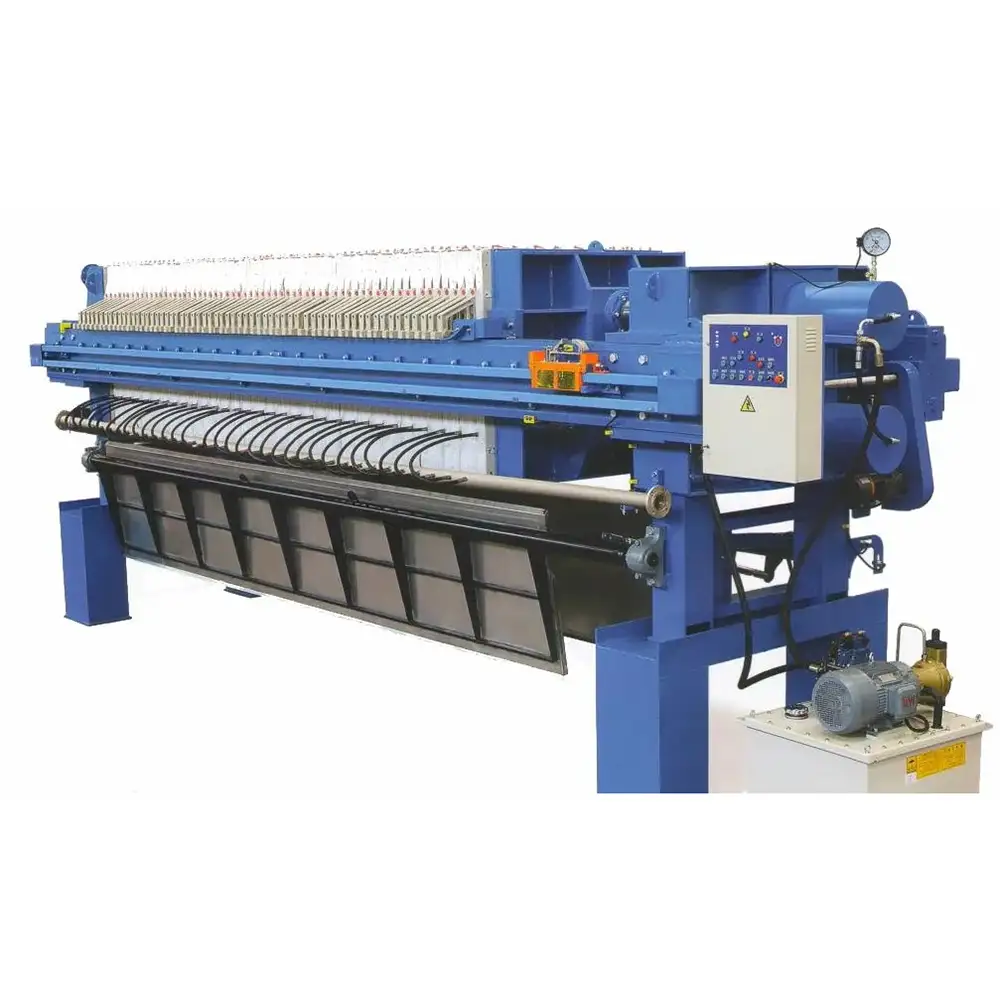
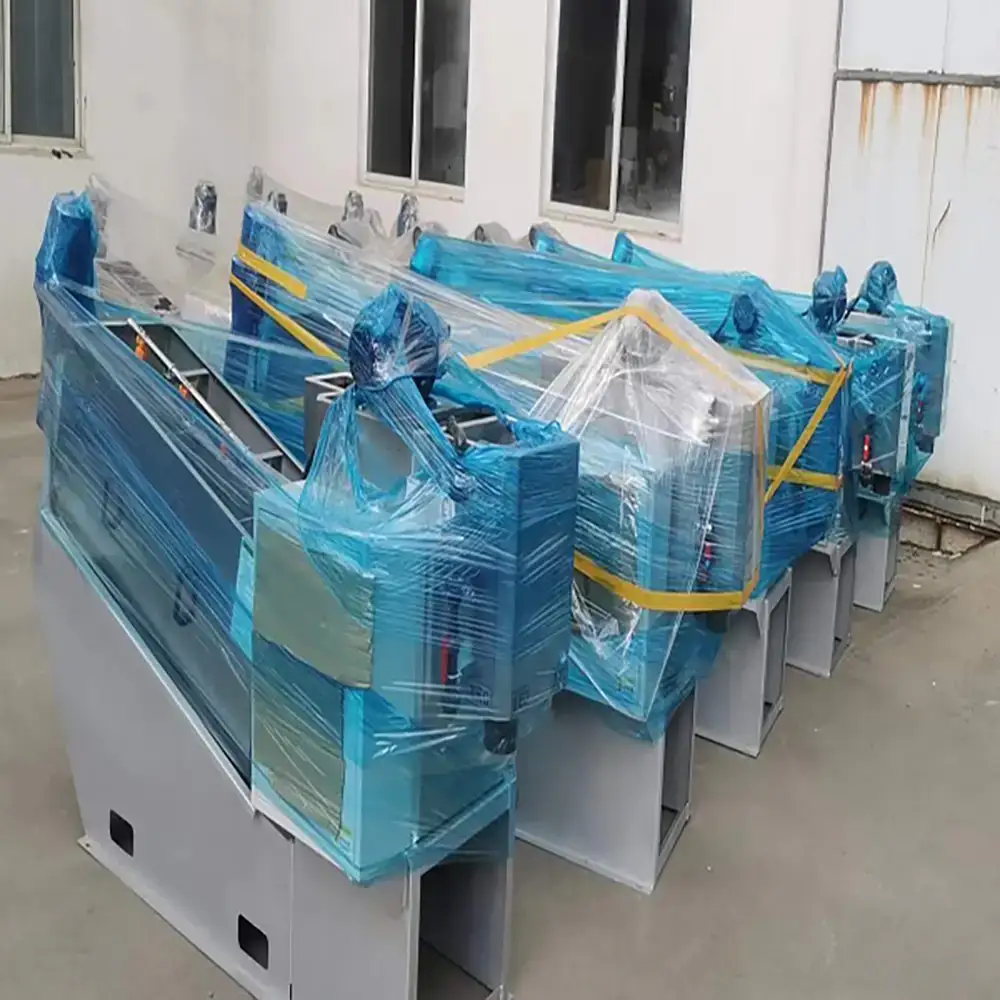
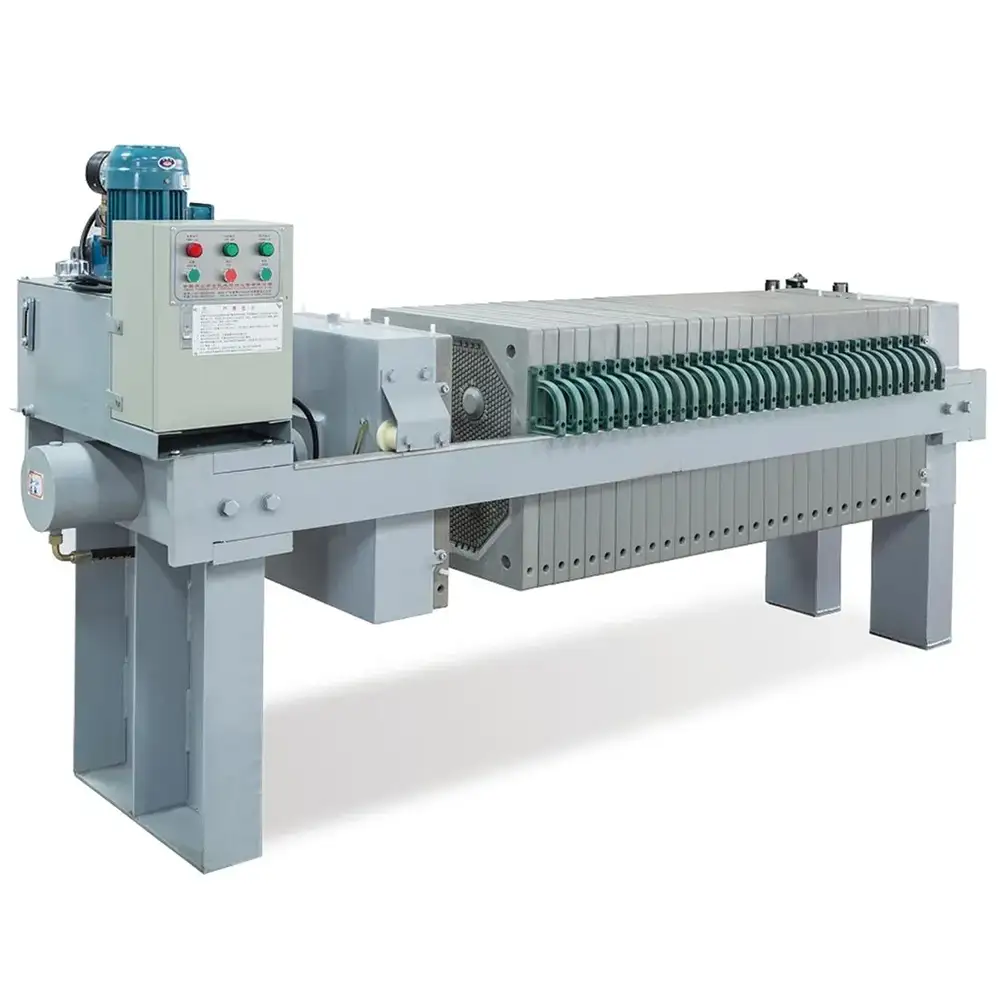
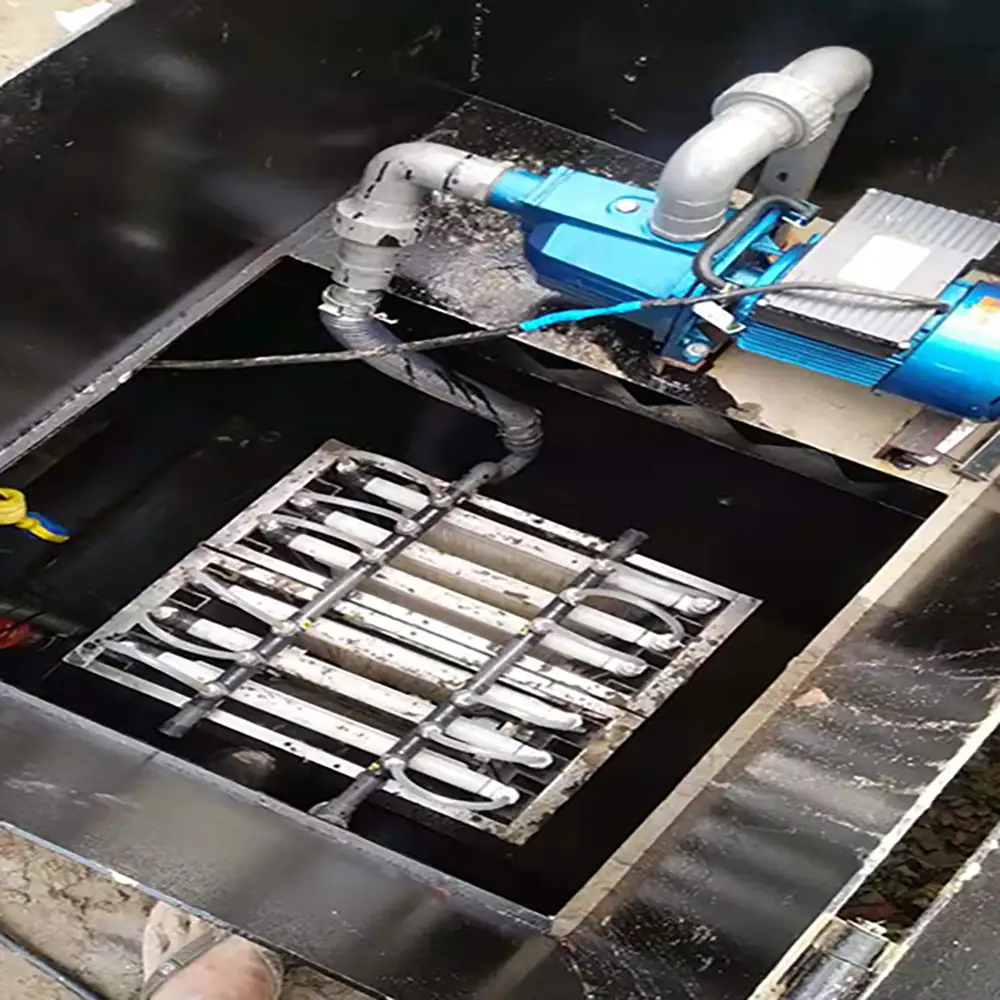
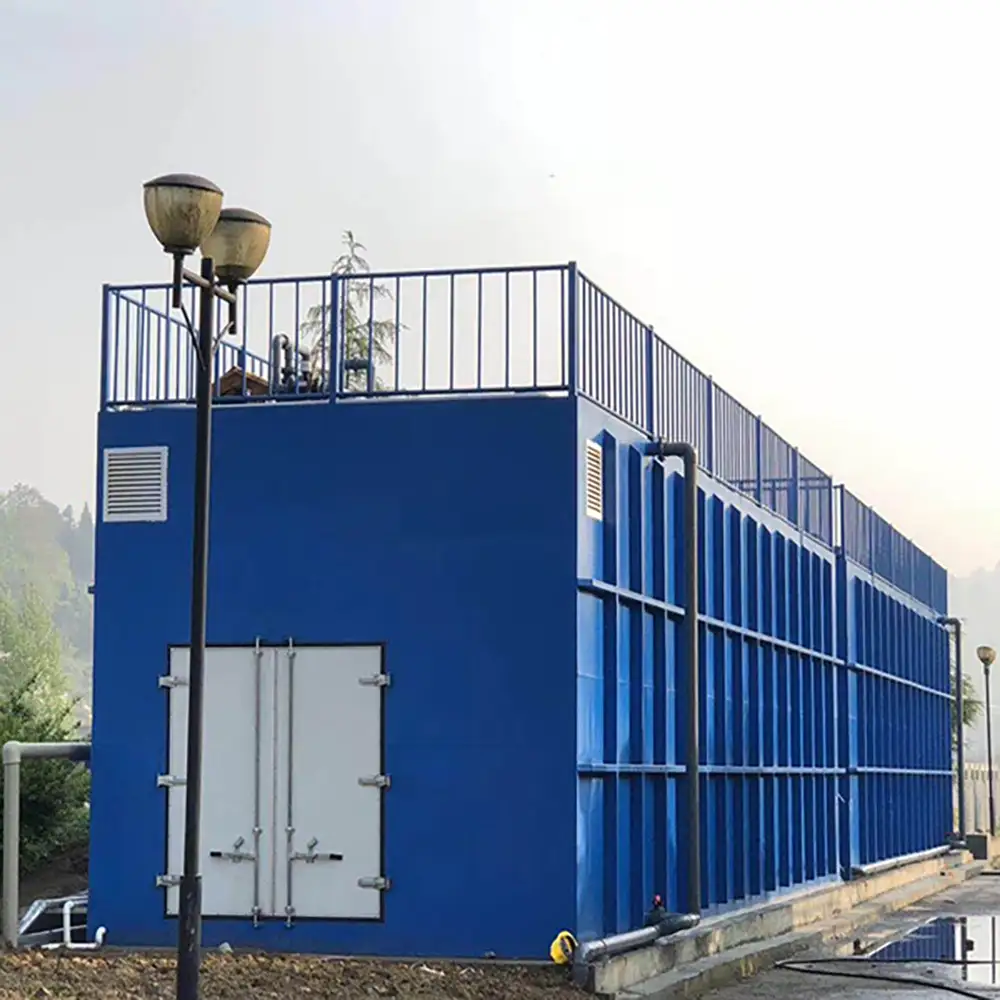
A Plate And Frame Filter Press is a pressure filtration machine designed to separate solids and liquids from industrial slurries, wastewater sludge and other process suspensions. The equipment uses a series of filter plates, frames and filter cloths assembled into a press. During operation, the plates are tightly closed and the feed slurry is pumped into the chambers under pressure. Liquid passes through the filter cloth while solids are retained and gradually form a filter cake.
Plate and frame pressure filtration is a well-established method for industrial solid-liquid separation. EPA technical documentation describes the filter press as a pressure filtration device in which plates and frames create chambers, sludge is introduced under pressure, filtrate passes through the filter media and solids remain in the chambers.
The resulting filter cake can be removed after the filtration cycle and transferred for further treatment, disposal, recycling or resource recovery.
The plate and frame filter press uses pressure difference and filter cloth filtration to separate the solid-liquid mixture. It is mainly composed of a frame, filtration, automatic plate pulling, hydraulic and electrical control parts. It has the advantages of good separation effect, wide application range, high degree of automation, energy saving and environmental protection. It is suitable for sludge dehydration in urban sewage treatment, pharmaceutical, electroplating and other industries. It is an ideal equipment for environmental management and resource recovery.
The plate and frame filter press uses the pressure difference between the plate and frame and the filtration effect of the filter cloth to separate the solids and liquids in the solid-liquid mixture. During the filtration process, by applying a certain pressure and forming a filter cake, Achieve efficient solid-liquid separation.
The filter press is mainly composed of five parts: frame part, filter part, automatic pull plate part, hydraulic part and electrical control part.
Working principle of plate and frame filter press
Pressing the filter plate: First, apply pressure through the hydraulic system to press the filter plate tightly to form a good sealing environment.
Feeding: The suspension to be treated is sent into the filter chamber through a feeding pump, and a filter cake is formed on the filter cloth, while the clear liquid flows out through the gap between the filter cloth and the filter plate to achieve solid-liquid separation.
Filter cake pressing: As the filter cake thickens, the filtration resistance increases. At this time, the pressure can be adjusted to maintain a stable filtration speed.
Filter cake washing: When washing is required, close the water outlet valve of the rinsing plate and open the water outlet valve of the pressure drying plate so that the rinse water can pass through the filter cake under pressure to achieve the washing effect.
Unloading: After the processing is completed, perform the cake unloading operation, that is, open the filter plate and remove the filter cake from the filter cloth.
In addition, the drainage methods of the plate and frame filter press are divided into two types: open flow and undercurrent. The open flow type means that the filtrate is directly discharged out of the machine through the water outlets on both sides of the plate and frame, while the underflow type means that the filtrate passes through the undercurrent of the plate frame and the rear roof. hole discharge.
The entire process realizes solid-liquid separation through pressure difference, which is widely used in solid-liquid separation scenarios in industrial production.
Advantages and features of plate and frame filter press
01Good separation effect
Using high-strength, highly breathable filter cloth as the filter medium can separate fine particles, impurities, etc. in the suspension.
02Wide range of application
It is suitable for suspensions with various properties, such as viscous materials, corrosive materials, high-temperature materials, etc.
03High degree of automation
It can automatically complete various processes such as feeding, filtering, squeezing, washing and unloading, greatly reducing workers' labor intensity and operating difficulty.
04Energy saving and environmental protection
An efficient and energy-saving motor is used as the power source, and the hydraulic system is optimized. The filter chamber adopts a detachable structural design for easy cleaning and maintenance.
Mainly filters impurities and suspended matter, filtration precision 0.1-200μm optional
Plate and frame filter press is suitable for sludge dewatering in wastewater treatment processes in urban sewage treatment plants, pharmaceuticals, electroplating, papermaking, leather, printing and dyeing, metallurgy, chemical industry and environmental protection projects. It can also be used for solid-liquid separation in industrial production. It is an ideal environmental protection Ideal equipment for remediation and resource recovery
How Does a Plate And Frame Filter Press Work?
The basic operating process consists of several stages.
First, the hydraulic or mechanical closing system brings the plates and frames together to form sealed filtration chambers. Filter cloth is positioned between the plates and frames.
Next, a feed pump sends sludge or slurry into the chambers. As the chambers fill, liquid moves through the filter cloth and enters the drainage channels on the plates.
The filtrate is then collected and discharged from the press, while the solids remain inside the chambers. As more slurry enters the press, the solids accumulate and form a compact filter cake.
When the chambers are sufficiently filled and filtrate flow decreases, the feed cycle is stopped. The press is opened, and the filter cake is discharged.
EPA descriptions of plate-and-frame filtration similarly identify chamber filling, filtrate drainage, cake formation, pressure release and cake discharge as the principal operating stages.
Plate And Frame Filter Press for Industrial Sludge Dewatering
One of the primary applications of a Plate And Frame Filter Press is sludge dewatering.
Wastewater treatment processes can generate sludge containing a significant amount of water. Removing part of this water reduces sludge volume and makes subsequent handling easier.
A filter press uses pressure filtration to separate liquid from solids. Depending on sludge characteristics, chemical conditioning, filter cloth selection, feed pressure and operating conditions, the process can produce a relatively dry filter cake.
EPA documentation notes that plate-and-frame pressure filtration can produce a comparatively dry cake and is used for solids removal from waste streams and wastewater sludges.
Typical applications include:
Industrial wastewater sludge
Chemical wastewater sludge
Metal finishing sludge
Electroplating sludge
Mining slurry
Mineral processing slurry
Pharmaceutical sludge
Food processing sludge
Dyeing and textile sludge
Municipal treatment residuals
Process filtration residues
Pressure Filtration and Solid-Liquid Separation
The Plate And Frame Filter Press uses pressure as the primary driving force for filtration.
Unlike gravity settling, pressure filtration actively pushes liquid through the filter media. The solids are retained by the filter cloth and progressively form a cake.
This makes the equipment suitable for slurries where simple sedimentation is insufficient or where a more concentrated solid product is required.
The filter press can also be used for liquid clarification when the feed contains a relatively high concentration of filterable solids. The same fundamental equipment can therefore support both sludge dewatering and solid-liquid separation applications, although sizing and configuration depend on the feed characteristics.
Filter Plates, Frames and Filter Cloth
The filtration chamber is created by the combination of plates, frames and filter cloth.
The filter plates provide structural support and drainage pathways for the filtrate.
The frames create the chamber volume where the slurry enters and where the filter cake accumulates.
The filter cloth acts as the filtration medium. Its pore characteristics, material and weave influence filtrate clarity, cake formation and cake release.
Different sludge characteristics may require different cloth materials and filtration configurations. The cloth should therefore be selected according to particle size, chemical compatibility, operating temperature and required filtration performance.
The number and dimensions of plates determine the available filtration area and chamber volume. EPA technical information notes that filter press capacity is determined by plate and chamber size and quantity.
Hydraulic Closing System
A reliable closing system is essential for maintaining pressure and preventing leakage during filtration.
Industrial Plate And Frame Filter Press systems may use hydraulic cylinders to close and hold the plate pack. The hydraulic system provides the force needed to keep the filtration chambers sealed while the feed pump introduces slurry.
The closing force should be appropriate for the operating pressure and press configuration.
A hydraulic power unit may include a hydraulic pump, cylinder, pressure control components, valves and a control system.
Depending on the equipment configuration, automatic hydraulic plate opening and closing can also be incorporated to reduce operator workload.
Filter Cake Formation and Discharge
As filtration continues, solids accumulate on the filter cloth and form a filter cake.
Cake thickness depends on chamber dimensions, sludge characteristics, feed concentration and the selected filtration cycle.
Once the cycle is completed, the pressure is released and the plate pack is opened. The filter cake separates from the cloth and falls into a hopper, container or conveyor below the press.
The cake can then be transported for further processing or disposal.
EPA documentation describes the opening of the press and gravity discharge of the filter cake as the normal end of a pressure-filtration cycle.
Chemical Conditioning Before Filtration
Some sludges do not filter efficiently without conditioning.
Chemical conditioning can alter particle characteristics and improve the formation of a permeable filter cake. Depending on the sludge, conditioning may involve polymers, coagulants or other treatment chemicals.
The appropriate chemical and dosage depend on the sludge composition and should normally be established through laboratory or pilot testing.
EPA wastewater treatment documentation notes that sludge may be conditioned or thickened before mechanical dewatering to improve dewaterability.
A typical process may therefore be:
Sludge Collection → Thickening → Chemical Conditioning → Plate And Frame Filter Press → Filter Cake Discharge
The exact process varies according to the wastewater treatment system.
Industrial Wastewater Applications
Plate And Frame Filter Press machines are suitable for many industrial applications where concentrated solids must be separated from liquid.
In metal finishing and electroplating, filter presses can be used for dewatering chemically precipitated sludge. In chemical manufacturing, they can separate process solids from liquid streams. In mineral processing, they can dewater mineral concentrates and tailings-related slurries.
Other applications include:
Mining wastewater
Quarry wastewater
Ceramic slurry
Stone processing
Food processing
Pharmaceutical manufacturing
Chemical production
Textile wastewater
Printing and dyeing
Pulp and paper
Metal processing
Industrial wastewater treatment
The actual filtration performance depends heavily on feed solids concentration, particle characteristics, viscosity, chemical conditioning and filter cloth selection.
Advantages of Plate And Frame Filter Press
A major advantage of a Plate And Frame Filter Press is its ability to generate a concentrated filter cake through pressure filtration.
Other benefits include:
High Solid-Liquid Separation:
The press retains solids while allowing liquid to pass through the filter cloth.
Compact Filtration Area:
Multiple plates create a substantial filtration area within a relatively compact footprint.
Flexible Capacity:
Capacity can be adjusted by changing plate quantity, plate dimensions and chamber configuration.
Suitable for Difficult Slurries:
Pressure filtration can be useful for slurries that require more intensive dewatering than gravity separation.
Recoverable Filtrate:
The separated liquid can be collected and returned to the wastewater treatment process or sent to another treatment stage.
Concentrated Filter Cake:
The dewatered solids are easier to transport, store and handle than untreated liquid sludge.
Batch Operation and Process Control
Unlike continuous belt filter presses, a traditional plate and frame filter press operates in cycles.
A typical cycle includes:
Plate closing
Slurry feeding
Pressure filtration
Cake formation
Filtration completion
Pressure release
Plate opening
Cake discharge
Filter cloth cleaning
Plate closing for the next cycle
The cycle duration depends on sludge characteristics and process conditions. EPA sources describe plate-and-frame filtration as a batch process and note that its batch nature can require more operating labor than continuous dewatering systems.
Automation can nevertheless be added for hydraulic closing, feed control, pressure monitoring, cycle timing, plate shifting and other operations.
Filter Cloth Cleaning and Maintenance
Filter cloth condition directly affects filtration performance.
Cloth should be inspected regularly for clogging, damage, chemical degradation and poor cake release. Washing may be performed between cycles or at defined maintenance intervals depending on the application.
Operators should also inspect:
Hydraulic cylinder
Hydraulic hoses
Feed pump
Filter plates
Frames
Filter cloth
Side bars
Plate shifting system
Drip trays
Filtrate channels
Pressure gauges
Safety components
Regular maintenance can help prevent leakage, uneven filtration and premature component wear.
Why Choose Us
Efficient Pressure Filtration: Designed for reliable solid-liquid separation under controlled pressure.
Industrial Sludge Dewatering: Suitable for a wide range of wastewater and process sludges.
Flexible Plate Configuration: Filtration area and chamber volume can be selected according to project requirements.
Hydraulic Closing System: Provides controlled plate compression during filtration.
Multiple Filter Cloth Options: Cloth materials can be selected according to slurry characteristics.
High Cake Concentration Potential: Designed to produce a concentrated filter cake when feed and process conditions are suitable.
Wide Industrial Applications: Suitable for chemical, mining, metal processing, food, pharmaceutical and wastewater treatment applications.
Easy Cake Discharge: Opening the plate pack allows the filter cake to fall or be collected below the press.
Automation Options: Hydraulic controls, pressure monitoring and automatic cycle functions can be integrated.
Project-Based Selection: Equipment can be configured according to slurry concentration, flow, filtration area and desired cake characteristics.
Frequently Asked Questions
1. What Is a Plate And Frame Filter Press?
A Plate And Frame Filter Press is a batch pressure filtration machine that separates solids from liquids using filter plates, frames and filter cloth.
2. What Is a Plate And Frame Filter Press Used For?
It is commonly used for sludge dewatering, industrial wastewater treatment, process slurry filtration and solid-liquid separation.
3. How Does a Plate And Frame Filter Press Work?
Slurry is pumped into chambers formed by the plates and frames. Liquid passes through the filter cloth while solids remain inside the chambers and form a filter cake.
4. What Is the Difference Between a Plate And Frame Press and a Belt Filter Press?
A plate and frame press is generally a batch pressure filtration system, while a belt filter press is a continuous dewatering system that uses moving filter belts. The better choice depends on sludge characteristics, capacity and operating requirements.
5. Can It Be Used for Industrial Wastewater Sludge?
Yes. Industrial wastewater sludge is one of the major applications of pressure filter presses, particularly where concentrated solids and effective liquid separation are required.
6. Can a Filter Press Produce a Dry Filter Cake?
It can produce a relatively dry and concentrated cake, but the final solids content depends on sludge characteristics, conditioning, filtration pressure, cycle time, filter cloth and other operating factors. EPA sources report typical cake solids varying substantially by application.
7. Is Chemical Conditioning Required?
Not always. Some sludges filter effectively without conditioning, while others benefit from polymers or coagulants. Laboratory or pilot testing is recommended to determine the appropriate conditioning method.
8. How Many Plates Does a Filter Press Need?
The required number of plates depends on the desired filtration area, chamber volume, feed solids concentration, treatment capacity and cycle requirements.
9. What Filter Cloth Should Be Used?
Filter cloth selection depends on particle size, sludge characteristics, chemical compatibility, temperature, required filtrate quality and cake-release performance.
10. Is the Filter Press Automatic?
It can be configured with automatic hydraulic closing, pressure control, cycle control, plate shifting, cake discharge and other automation functions.
11. How Is the Filter Cake Removed?
After the filtration cycle, the plates are separated and the accumulated cake is released from the filter cloth. It can then fall into a hopper, container or conveyor system.
12. What Information Is Needed to Select a Filter Press?
Important information includes sludge type, feed flow, solids concentration, moisture content, particle characteristics, desired cake solids, operating hours, available space and whether chemical conditioning is available.
Prev:
Quartz Sand, Activated Carbon Filter
Next:
Core Part of Sewage Treatment Equipment/Efficient Mbbr Media
TAG:
Industrial Wastewater Treatment Equipment,
Industrial Wastewater Treatment,
Industrial Sludge Dewatering,
Sludge Filtration Equipment,
Mechanical Sludge Dewatering,
Sludge Dewatering System,
Food Processing Sludge Dewatering,
Sludge Dewatering Equipment,
Wastewater Sludge Dewatering,
Slurry Dewatering Equipment,
Textile Sludge Dewatering,
Chemical Sludge Dewatering,
Pressure Filtration Machine,
Pressure Filtration Equipment,
Mining Sludge Dewatering,
Slurry Filter Press,
Pressure Filter Press,
Sludge Treatment Equipment,
Sludge Treatment System,
Sludge Cake Filter Press,
Sewage Sludge Dewatering,
Wastewater Filter Press,
Industrial Wastewater Filter Press,
Wastewater Filter Press Machine,
Wastewater Sludge Filter Press,
Solid Liquid Separation Equipment,
Solid Liquid Separation Machine,
Sludge Dewatering Press,
Hydraulic Filter Press,
Hydraulic Plate Filter Press,
Related Category:
Plate And Frame Filter Press,Plate And Frame Filter Press Machine,Filter Press Machine,Plate Filter Press,Frame Filter P China, suppliers, manufacturers, factory, customized, wholesale, quotation, made in China