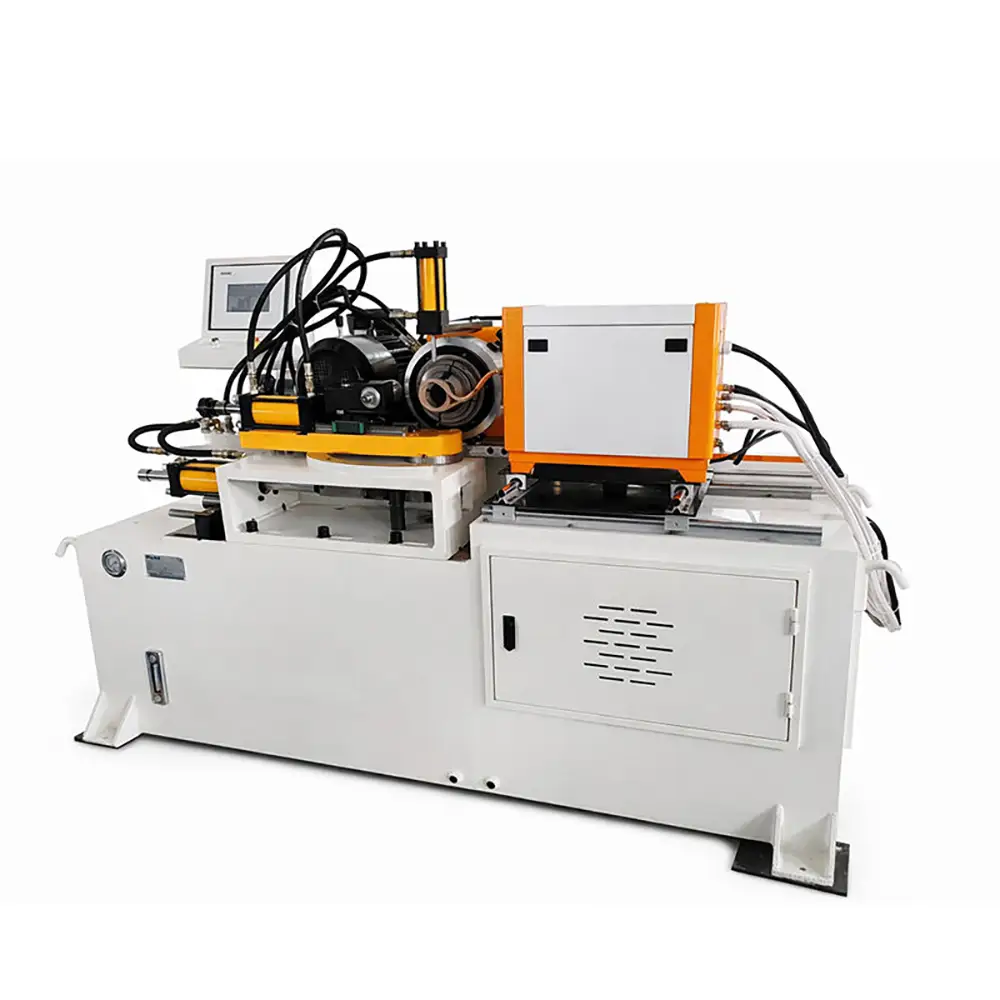
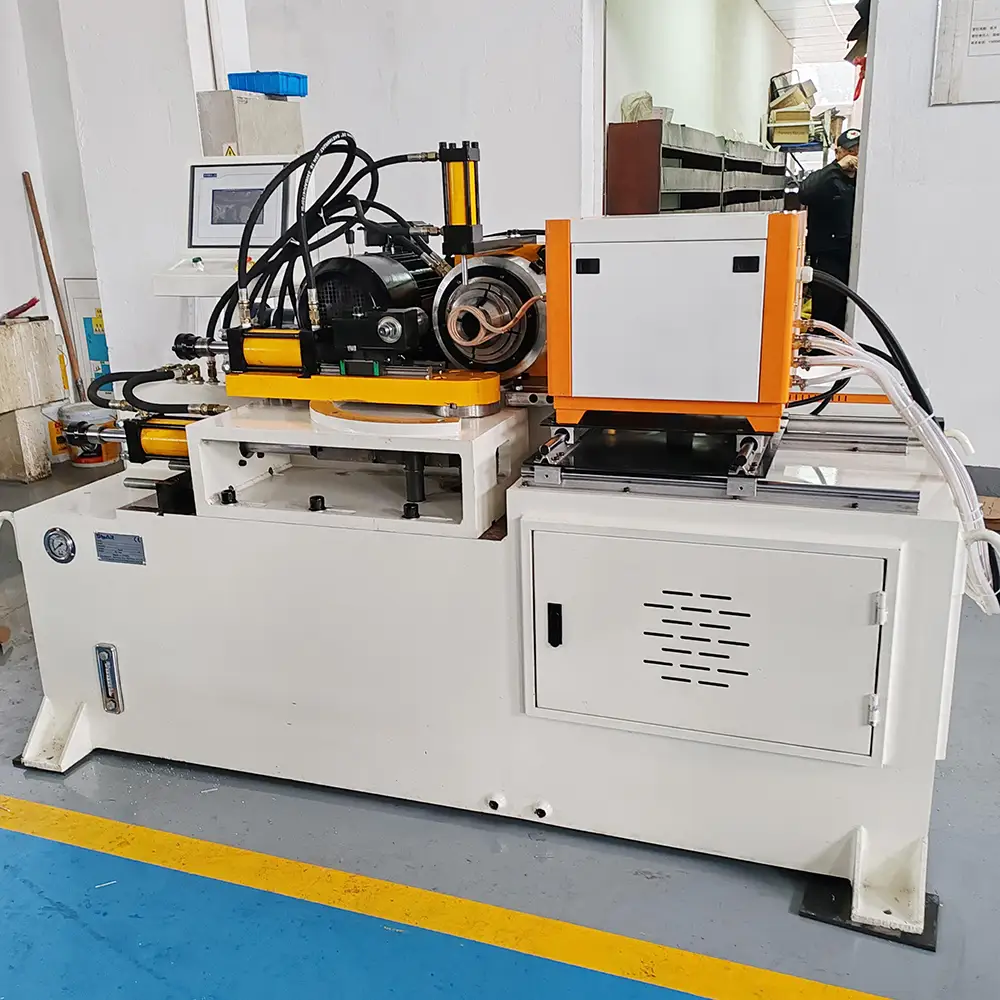
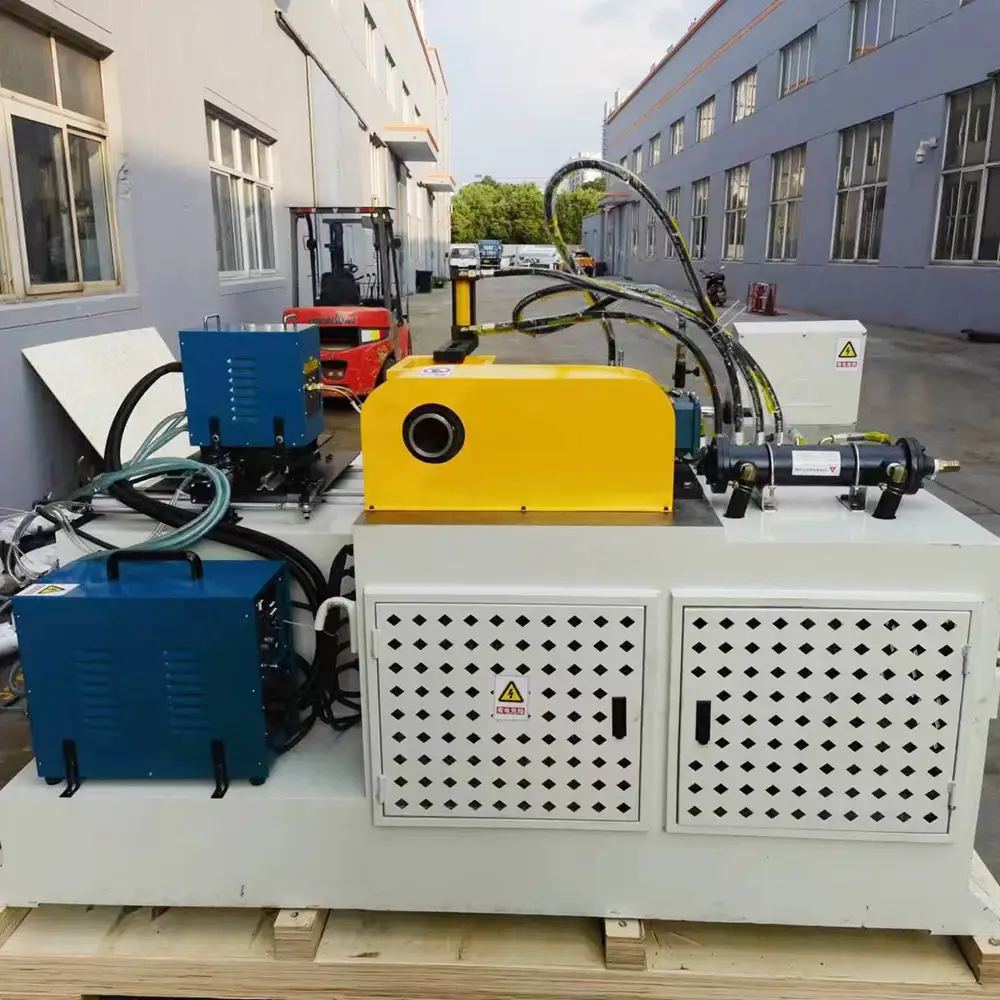
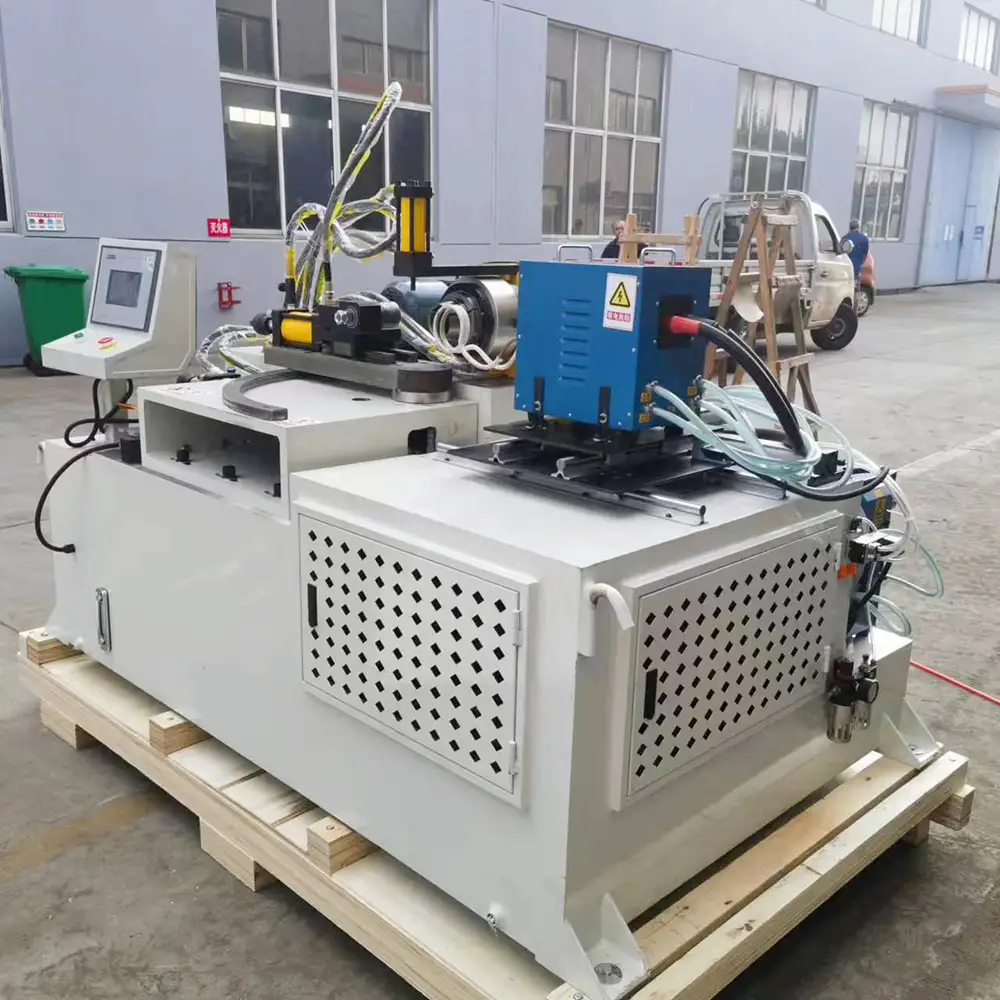
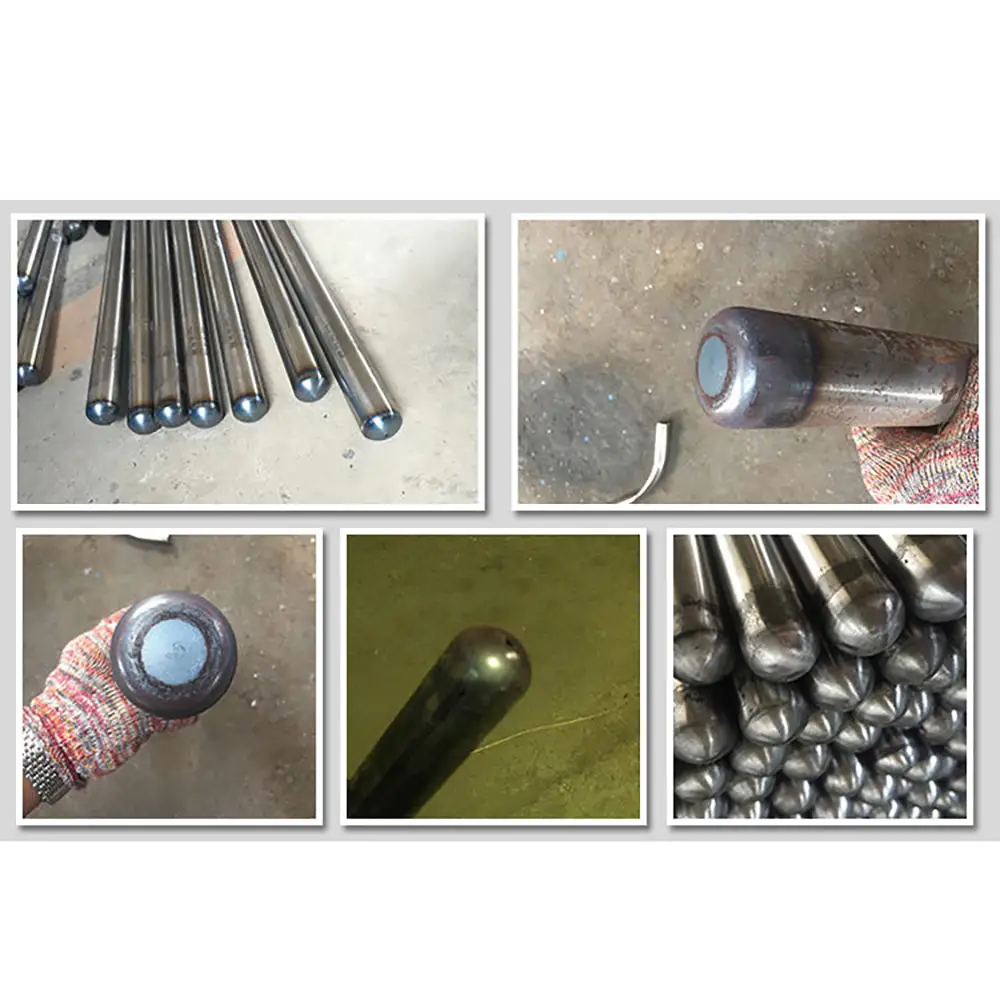
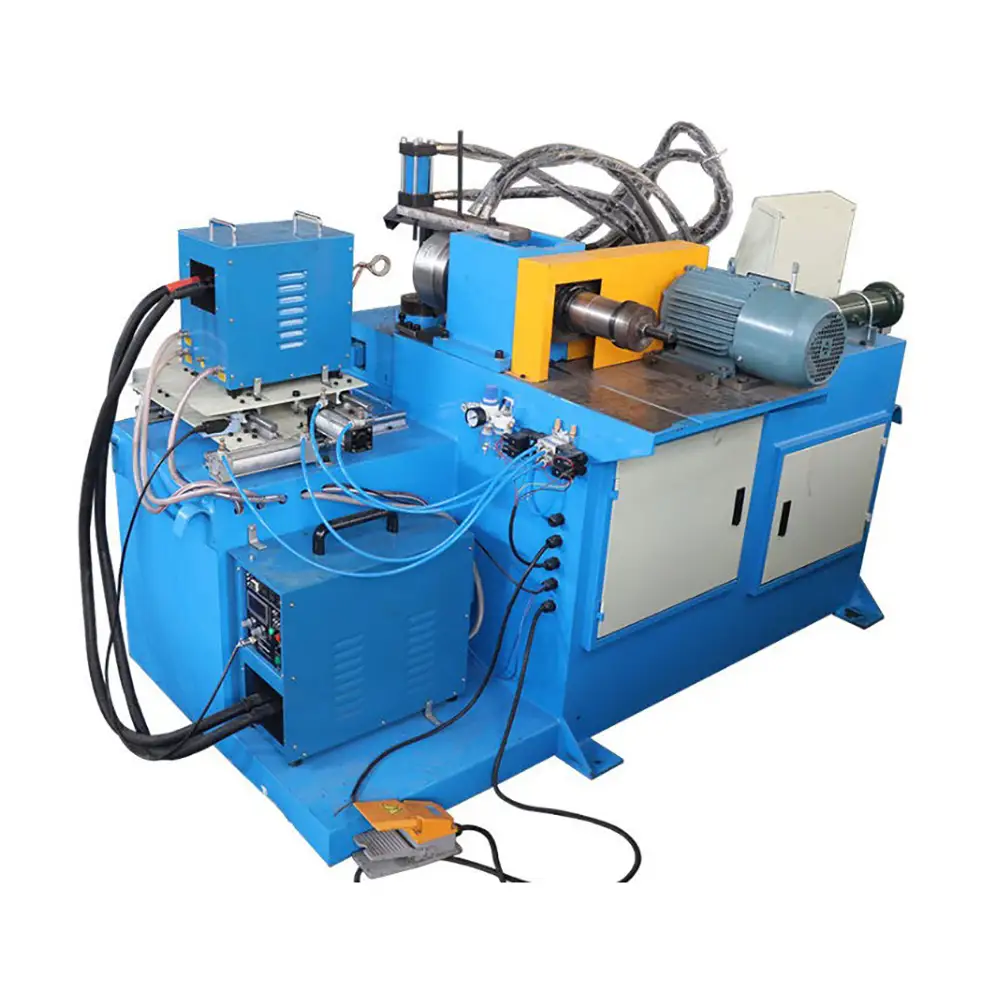
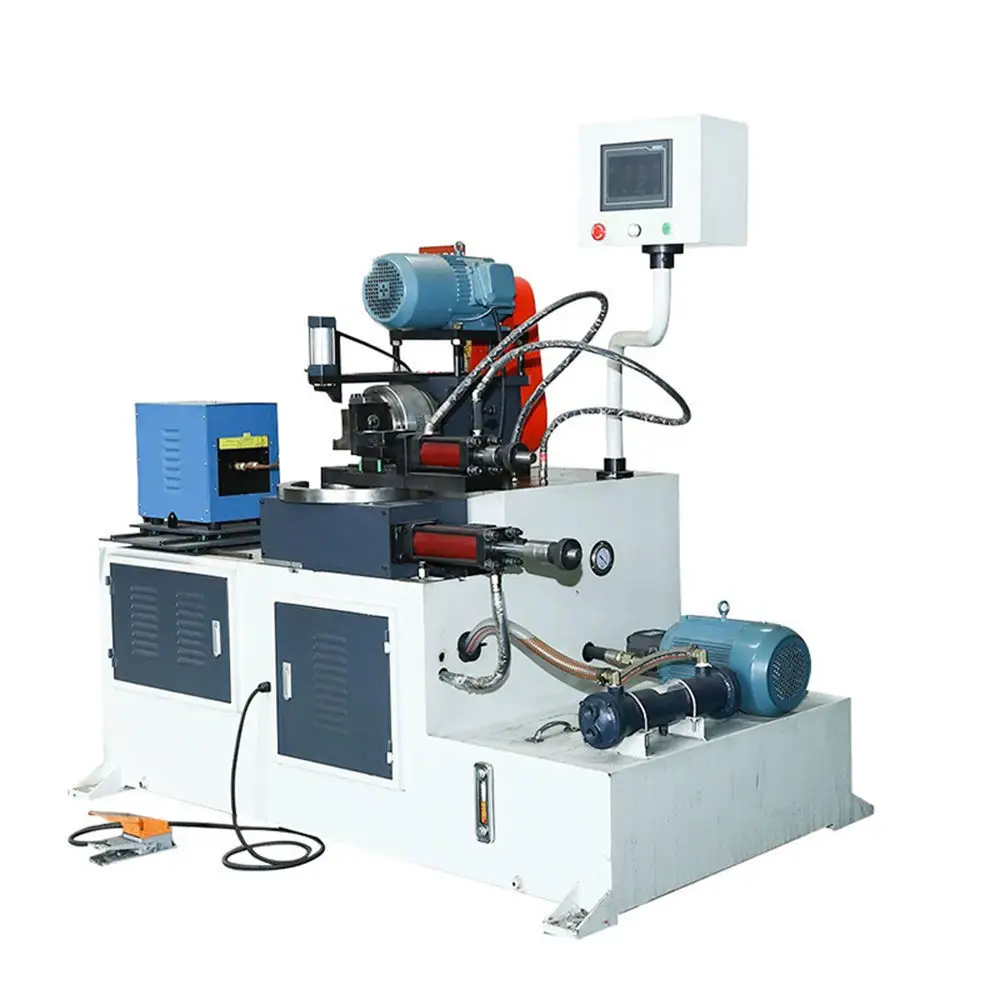
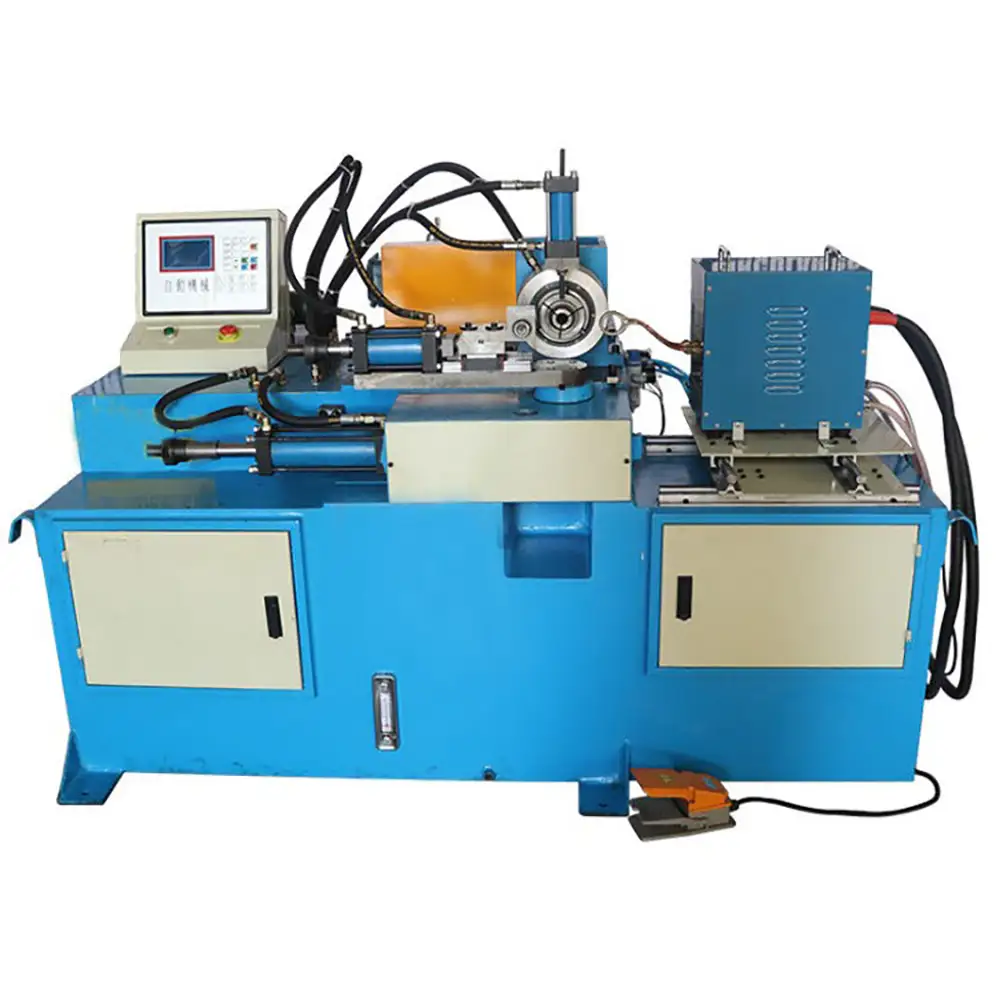
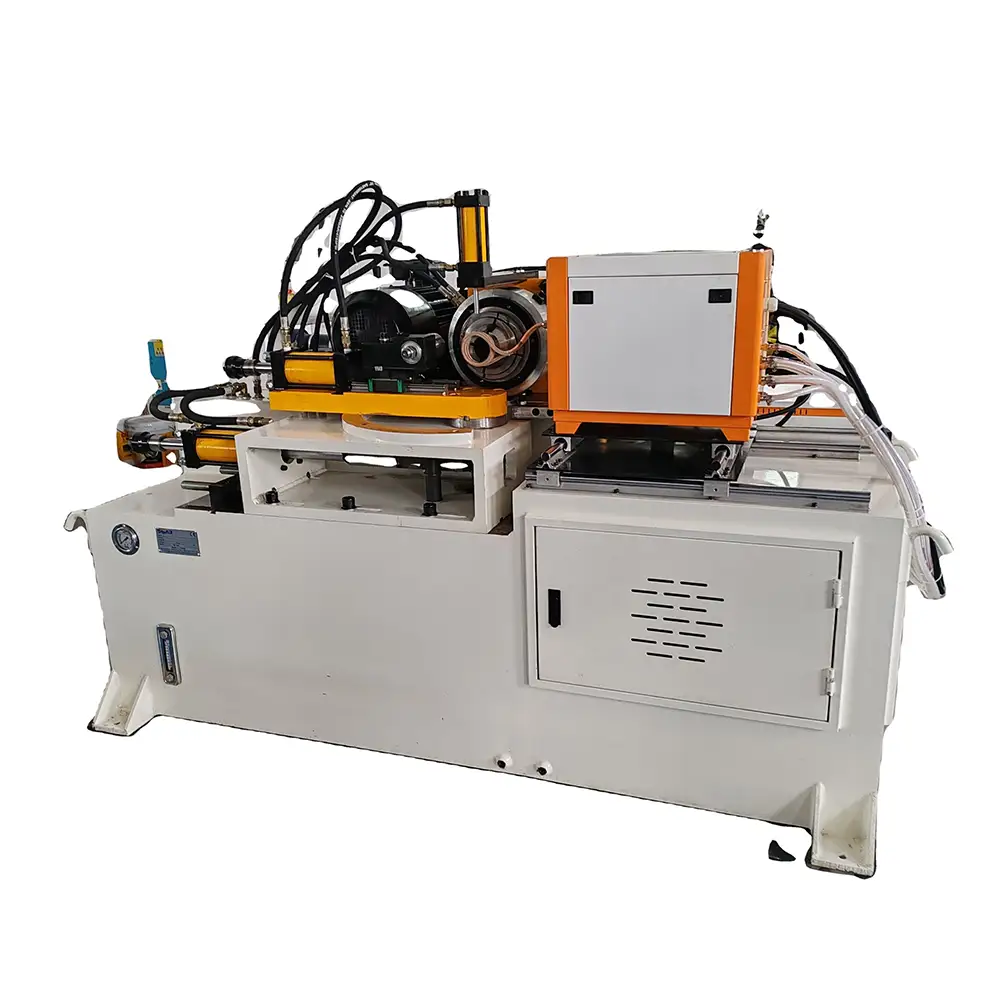
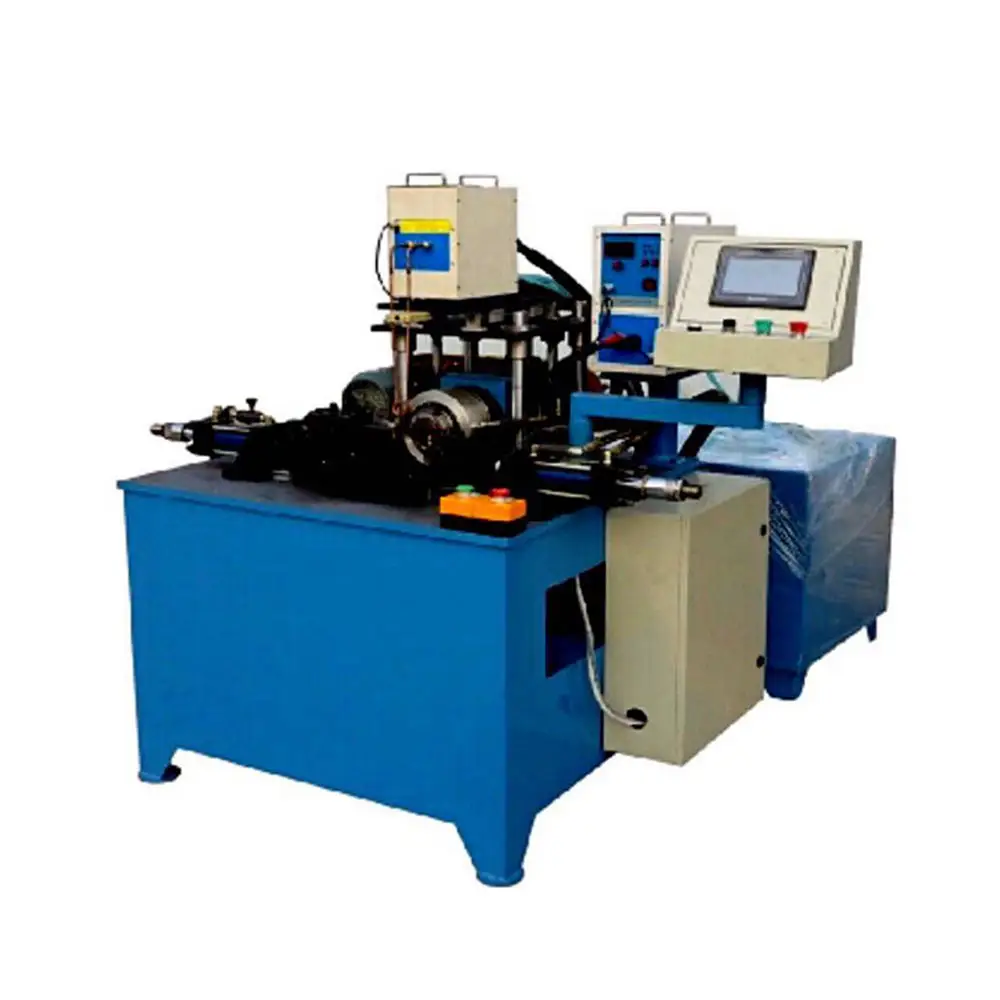
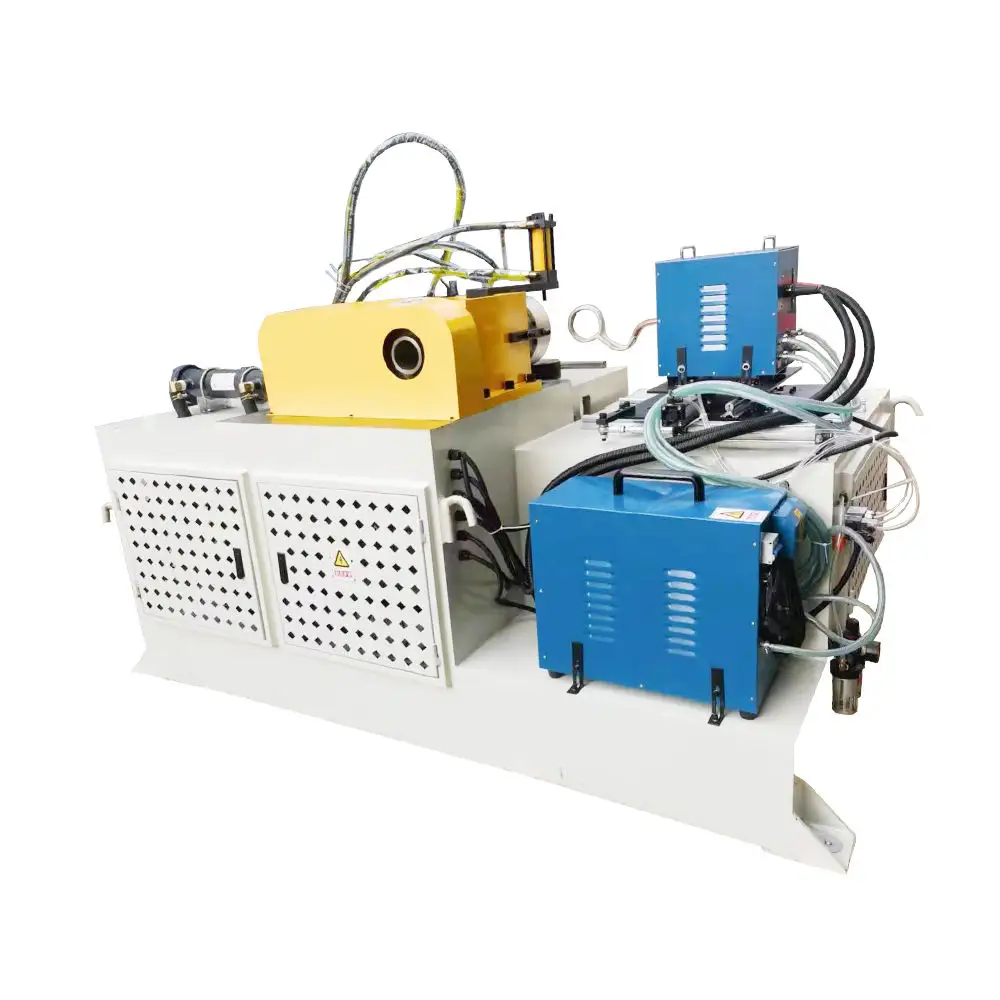
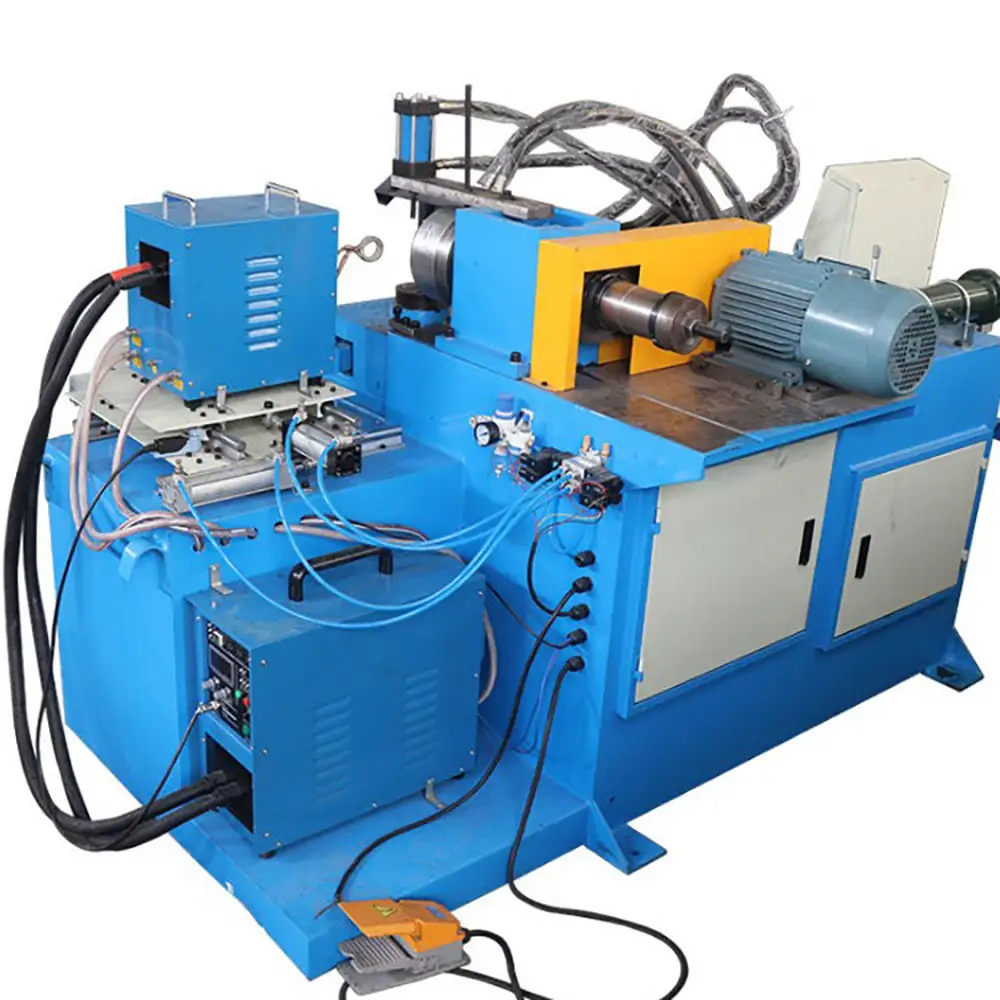
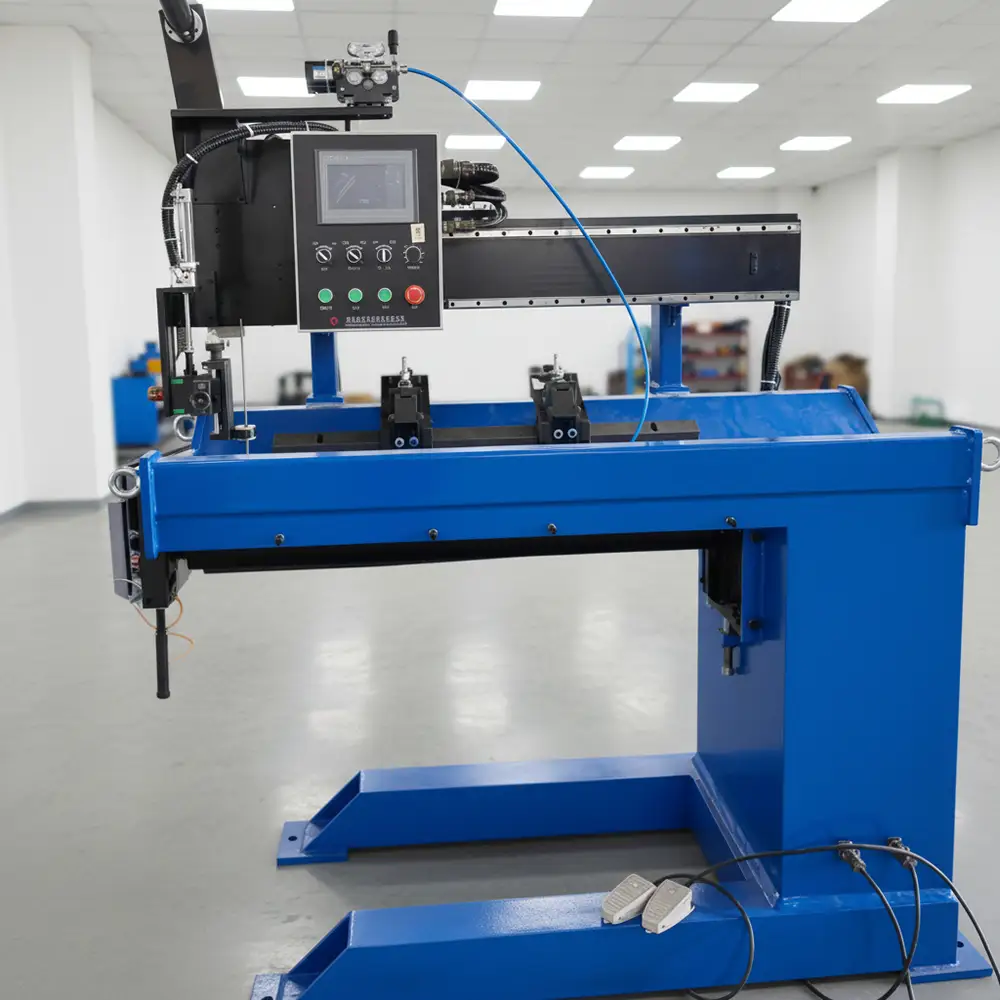
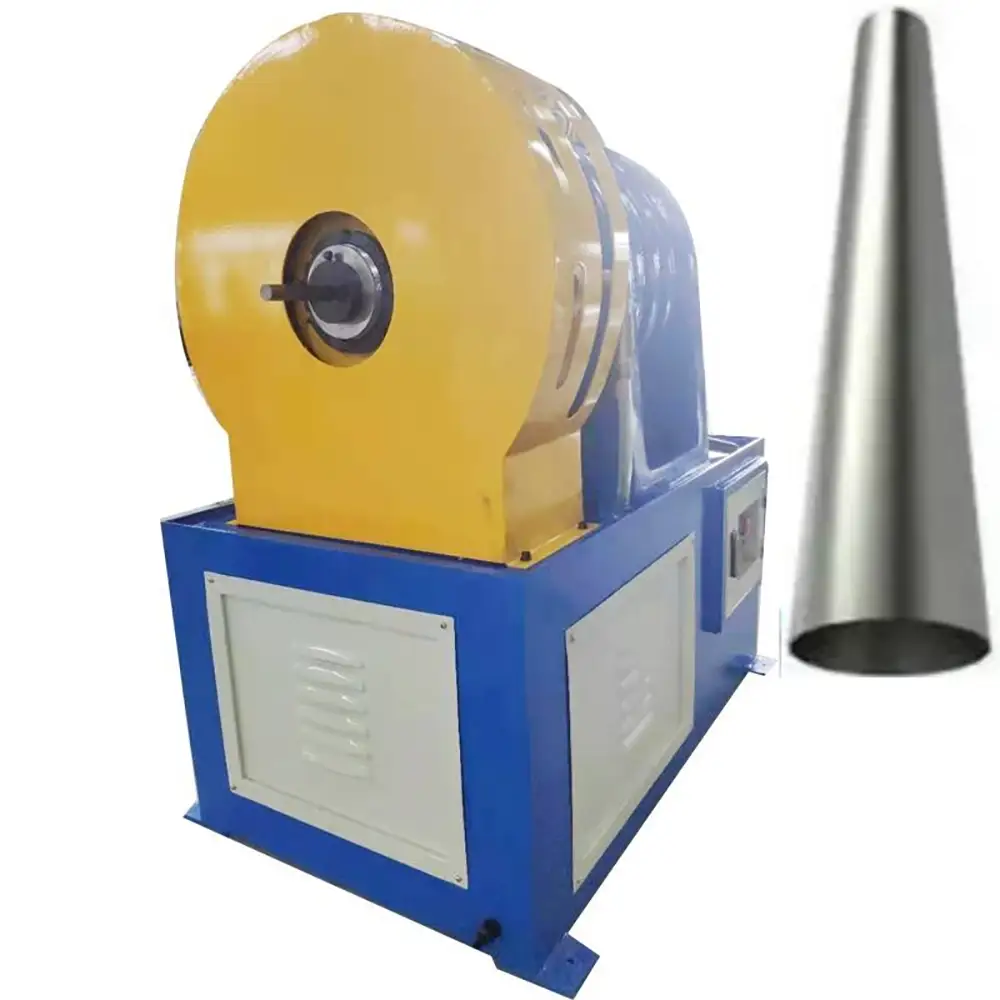
High-Frequency Heating: Ensures precise sealing and positioning in one step.
Pneumatic Control: Facilitates smooth and efficient movement of the high-frequency heater.
Automatic Rotary Sealing: Simplifies the process for seamless end closing.
Multiple Models Available: Select from 40NC, 70NC, 90NC, and 120NC models.
Durable Construction: Designed for long-term use with robust materials.
High Efficiency Pipe End Sealing: Hydraulic driven system ensures fast and stable pipe end sealing, greatly improving production efficiency and reducing labor cost.
Wide Material Compatibility: Suitable for various metal tubes such as carbon steel, stainless steel, aluminum, and alloy pipes, meeting different industrial production needs.
Precision Forming Technology: Advanced forming structure ensures smooth and uniform pipe end sealing without cracks or deformation, guaranteeing high product quality.
Easy Operation: Equipped with PLC control system and user-friendly interface, operators can easily adjust parameters for different pipe sizes.
Customizable Molds: Different molds can be customized according to pipe diameter, thickness, and sealing shape, suitable for various production requirements.
Wide Application: Widely used in industries such as automobile exhaust systems, muffler manufacturing, furniture tubes, and metal pipe processing.
Hydraulic Pipe End Sealing Machine for Metal and Steel Tube Processing
The Hydraulic Pipe End Sealing Machine is an industrial tube-processing solution designed for closing,forming,reducing,and sealing the ends of suitable metal and steel tubes. Using hydraulic forming force and application-specific tooling,the machine can transform an open tube end into a closed,flattened,reduced,or otherwise formed profile according to the required product design.
Also known as a tube end closing machine,pipe end forming machine,metal tube end forming equipment,or hydraulic tube end forming machine,this equipment is widely applicable to manufacturers that need repeatable end processing of tubular metal components.
Tube-end forming is used in many industries where the end of a pipe or tube needs to be modified before welding,assembly,testing,or final use. Depending on the tooling,the process may include closing,flattening,necking,reducing,expanding,beading,or other forming operations.
The actual forming capability depends on the hydraulic force,tooling design,tube material,diameter,wall thickness,and required end geometry.
Hydraulic Tube End Forming Technology
Hydraulic power provides the forming force required to deform the tube end against a dedicated mold or forming die.
Compared with purely manual forming methods,hydraulic operation can provide a more controlled and repeatable forming process for suitable production applications.
The hydraulic cylinder applies force to the tooling while the tube is securely positioned in a fixture. The forming die determines the final shape of the tube end.
Depending on the machine design,the operator may adjust forming position,stroke,pressure,and other parameters according to the workpiece requirements.
The appropriate hydraulic capacity should be selected based on the tube material,wall thickness,diameter,and forming geometry rather than relying on tube diameter alone.
Tube End Closing Machine
The Tube End Closing Machine is designed to modify the open end of a tubular workpiece.
Closing operations can be used when manufacturers need to create a partially or fully closed tube end. Depending on the application,the resulting end may be prepared for welding,sealing,assembly,or further machining.
Typical products may include:
Steel Tube Components
Metal Frames
Exhaust Tubes
Furniture Tubes
Automotive Tubular Parts
Hydraulic Components
Structural Tubes
Heat Exchanger Components
Machinery Parts
Custom Tubular Products
The final geometry depends on the selected forming tooling.
For applications requiring a specific shape,customers should provide drawings or samples before selecting the machine.
Metal Pipe End Forming
Pipe end forming allows manufacturers to create a variety of geometries without replacing the entire tube.
Depending on the tooling and machine configuration,the end can potentially be:
Closed
Flattened
Reduced
Expanded
Necked
Beaded
Flared
Prepared For Welding
Not every machine configuration performs every operation. The tooling and hydraulic system must be selected according to the desired process.
For example,a reduced tube end may be formed by gradually decreasing the outside diameter,while a flattened end uses tooling to compress the tube into a flatter geometry.
Steel Tube End Processing
Steel tubes are commonly used in structural,automotive,industrial,and fabrication applications. Their strength makes controlled forming force important when modifying the tube end.
The machine can be configured for suitable carbon steel,mild steel,stainless steel,and other compatible tubular materials.
Different steel grades have different yield strengths and forming characteristics. Stainless steel may also exhibit different work-hardening behavior compared with mild steel.
Therefore,the same forming parameters should not automatically be applied to every material.
Testing representative samples can help determine suitable pressure,stroke,tooling,and forming sequence.
Tube End Sealing Applications
End sealing is useful when a tube needs to be closed to prevent material from passing through the opening or to prepare the component for a subsequent process.
Potential applications include:
Exhaust Components
Automotive Tubes
Steel Furniture
Metal Frames
Handrails
Heat Exchanger Components
Industrial Equipment
Agricultural Machinery
Hydraulic Tubing
Custom Metal Components
The sealing process can be permanent or may serve as a preparation step,depending on the product design.
If the finished tube must withstand internal pressure,the sealing method and finished geometry should be evaluated against the actual operating requirements.
Tooling and Forming Dies
Tooling is one of the most important components of a pipe end forming machine.
The forming die determines the geometry of the finished tube end. Different tube diameters,wall thicknesses,and end shapes may require different molds or tooling sets.
Customized tooling can be developed for applications involving specific dimensions or unusual end profiles.
When requesting a quotation,customers should provide drawings showing the original tube dimensions and the desired finished-end geometry.
Suitable tooling helps maintain consistent contact between the workpiece and forming components and can reduce unwanted deformation.
Tube Diameter and Wall Thickness
Tube dimensions have a direct effect on the forming process.
Important parameters include:
Outside Diameter
Inside Diameter
Wall Thickness
Tube Length
Material Grade
End Shape
Forming Length
Required Tolerance
Thin-wall tubing can be more sensitive to buckling or deformation,while thicker-wall tubes may require greater forming force.
Long tubes may also require additional support to maintain stable positioning during end forming.
The actual machine capacity should therefore be confirmed using the customer's specific tube dimensions.
Hydraulic Forming Force and Control
Hydraulic forming provides controlled mechanical force through the hydraulic cylinder and associated system.
Depending on the machine design,the hydraulic system may include a pump,motor,valves,cylinder,and pressure-control components.
Stable hydraulic pressure can help maintain repeatable forming conditions.
Regular inspection of hydraulic hoses,connections,oil level,and cylinder operation is important for reliable machine performance.
Hydraulic components should be maintained according to the manufacturer's recommendations,and the system should be operated within its rated pressure range.
Automatic and Semi-Automatic Operation
The machine can be configured for different levels of operator involvement.
A manual configuration may require the operator to load the tube,position it,activate the forming cycle,and remove the finished workpiece.
A semi-automatic configuration can automate the forming cycle after the tube has been correctly positioned.
More advanced configurations may integrate automatic feeding,clamping,forming,and unloading.
The exact automation level depends on the selected model. Buyers should confirm which operations are automated before purchasing.
Production Efficiency and Repeatability
Hydraulic tube end forming can be suitable for both custom fabrication and repetitive production.
Once the appropriate tooling and forming parameters have been established,similar workpieces can be processed using a repeatable forming procedure.
Production output depends on tube dimensions,forming stroke,material characteristics,tooling,loading and unloading time,and operator workflow.
For high-volume production,the machine can be integrated with automatic tube cutting,feeding,inspection,and other downstream equipment.
Industrial Applications
Hydraulic pipe end sealing and forming equipment can be used across a wide range of industries.
Typical applications include:
Automotive Parts Manufacturing
Exhaust System Production
Steel Furniture Manufacturing
Bicycle And Fitness Equipment
Agricultural Machinery
Construction Equipment
HVAC Components
Industrial Machinery
Metal Frame Production
General Tube Fabrication
The machine is particularly useful where tube ends need to be formed into a repeatable geometry before assembly or welding.
Welding and Assembly Preparation
Tube end forming can also prepare tubular components for subsequent welding and assembly.
A formed end may be designed to fit another component,provide a welding interface,or create a specific connection geometry.
Accurate end dimensions can help simplify downstream assembly.
However,the required forming tolerance depends on the final product. Customers should provide the mating component dimensions and assembly requirements when precision is important.
Custom OEM and ODM Solutions
Different applications require different tube end shapes and tooling.
OEM and ODM solutions can be evaluated for:
Custom Forming Dies
Special Tube Fixtures
Hydraulic Systems
Automatic Feeding
Tube Positioning
Control Systems
Multiple Forming Stations
Automatic Unloading
When requesting a customized machine,provide the tube material,diameter,wall thickness,length,desired end shape,and production volume.
Drawings or physical samples can significantly improve the accuracy of machine configuration and tooling design.
Maintenance and Safety
Hydraulic pipe end forming machines generate substantial mechanical force and contain moving tooling. Operators should keep hands away from forming areas and follow appropriate machine safety procedures.
The machine should be installed and operated according to the manufacturer's instructions.
Routine maintenance may include checking hydraulic oil,hoses,cylinders,valves,fixtures,forming dies,and electrical components.
Tooling should be inspected for wear or damage because worn dies can affect the finished tube geometry.
Before changing tooling or performing maintenance,the hydraulic system should be safely depressurized and the machine isolated according to the applicable procedure.
Why Choose Us
Hydraulic Tube End Forming
Provides controlled forming force for suitable metal and steel tube end-processing applications.
Multiple End-Processing Options
Suitable tooling can support closing,reducing,flattening,expanding,or other tube-end forming operations.
Steel and Metal Tube Applications
Designed for compatible carbon steel,stainless steel,mild steel,and other tubular materials.
Custom Forming Tooling
Dies and fixtures can be evaluated according to the required tube-end geometry.
Controlled Hydraulic Operation
Hydraulic force can provide a stable forming process when correctly configured.
Flexible Production Use
Suitable for custom fabrication,small batches,and repetitive industrial tube processing.
Automation Options
Manual,semi-automatic,and more automated configurations can be considered according to production requirements.
OEM And B2B Manufacturing Support
Suitable for manufacturers,distributors,and international industrial buyers requiring customized pipe end forming equipment.
FAQs
1. What is a hydraulic pipe end sealing machine?
It is a hydraulic tube-processing machine designed to close,seal,reduce,flatten,or otherwise form the end of a suitable metal pipe or tube.
2. What materials can it process?
Depending on the machine configuration,it can process suitable carbon steel,mild steel,stainless steel,and other compatible metal tubes.
3. What is a tube end closing machine used for?
It is used to modify an open tube end into a closed or partially closed shape for sealing,assembly,welding,or other downstream applications.
4. Can it form steel tubes?
Yes. Suitable steel tubes can be processed when their diameter,wall thickness,and material properties are within the machine's forming capability.
5. Can the machine flatten tube ends?
With suitable flattening tooling,the machine can be configured for compatible tube-end flattening applications.
6. Can it reduce pipe ends?
Yes. Suitable reduction dies can be used to decrease the diameter of a compatible tube end according to the required geometry.
7. Does every machine perform all tube-end operations?
No. The available operations depend on the machine design and tooling. Customers should specify the required end shape before purchasing.
8. What affects tube-end forming quality?
Material grade,diameter,wall thickness,forming force,die geometry,fixture alignment,forming stroke,and lubrication or process conditions can affect the finished result.
9. Can different tube sizes be processed?
Depending on the machine configuration,different tube sizes may be processed using interchangeable or customized tooling.
10. Is the machine fully automatic?
Not necessarily. Models may be manual,semi-automatic,or integrated with automatic feeding and handling systems. The exact configuration should be confirmed before ordering.
11. Can custom molds be supplied?
Yes. Custom forming dies can be evaluated when a customer requires a specific tube-end geometry or production specification.
12. What information should I provide for a quotation?
Provide tube material,outer diameter,inner diameter,wall thickness,tube length,required end shape,forming length,production volume,and desired automation level. Drawings or samples are recommended.
Prev:
Fully Automatic Steel Pipe Longitudinal Seam Welding Machine Customizable for Various Pipe Sizes
Next:
High-Frequency Pipe End Sealing Machine for Refrigeration & Pressure Leak Testing
TAG:
Pipe End Processing Machine,
Automatic Tube End Forming Machine,
Tube End Processing Machine,
Industrial Tube End Forming Machine,
Industrial Pipe End Forming Machine,
Semi Automatic Tube End Forming Machine,
Exhaust Pipe End Forming Machine,
Automotive Tube End Forming Machine,
Metal Tube Reducing Machine,
Hydraulic Tube Forming Machine,
Tube End Forming Equipment,
Hydraulic Pipe Forming Machine,
Pipe End Forming Equipment,
Pipe End Reducing Machine,
Tube End Reducing Machine,
Pipe End Expanding Machine,
Tube End Forming Machine,
Pipe End Forming Machine,
Tube End Expanding Machine,
Hydraulic Tube End Forming Machine,
Hydraulic Pipe End Forming Machine,
Metal Tube Processing Machine,
Pipe Fabrication Machine,
Tube Fabrication Machine,
Metal Pipe End Forming Machine,
Exhaust Tube End Forming Machine,
Precision Tube End Forming Machine,
Steel Tube Reducing Machine,
Automatic Pipe End Forming Machine,
Metal Pipe End Forming Equipment,
Related Category:
Hydraulic Pipe End Sealing Machine,Tube End Closing Machine,Metal Pipe End Forming Equipment,Steel Tube End Forming Mach China, suppliers, manufacturers, factory, customized, wholesale, quotation, made in China