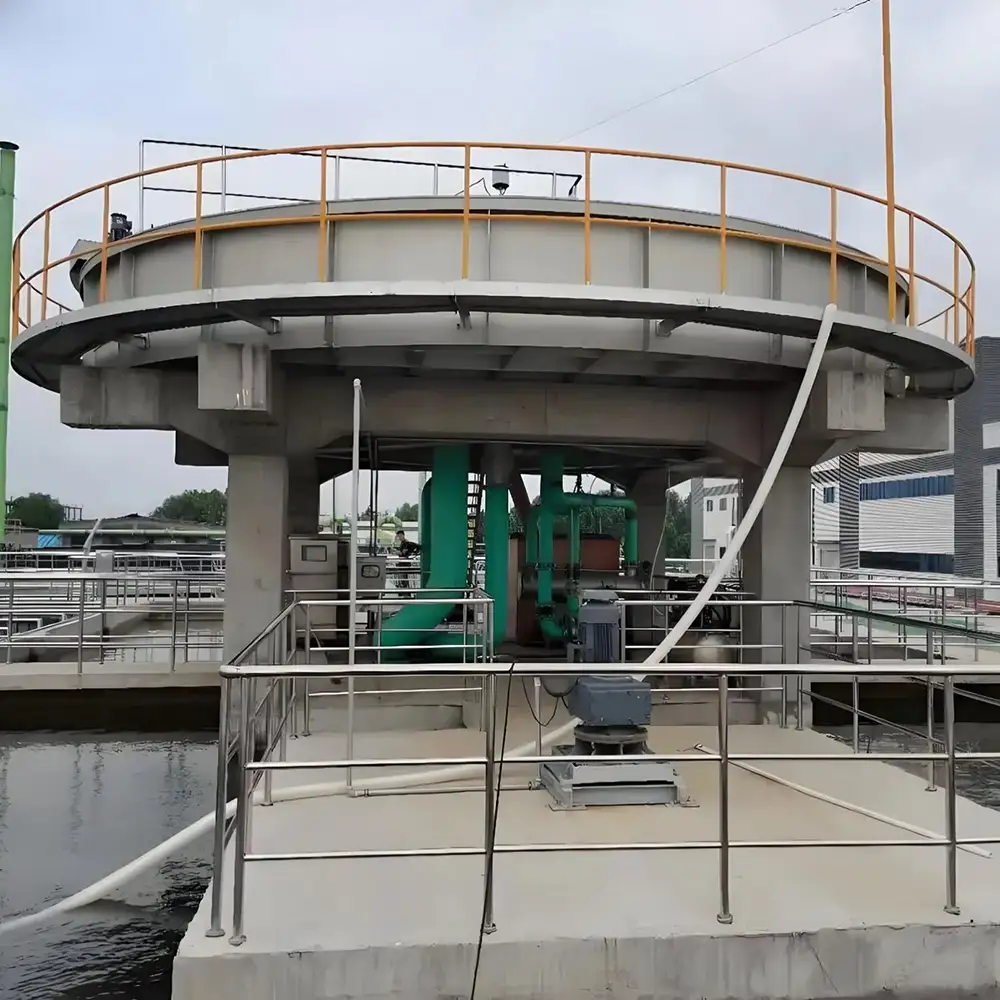
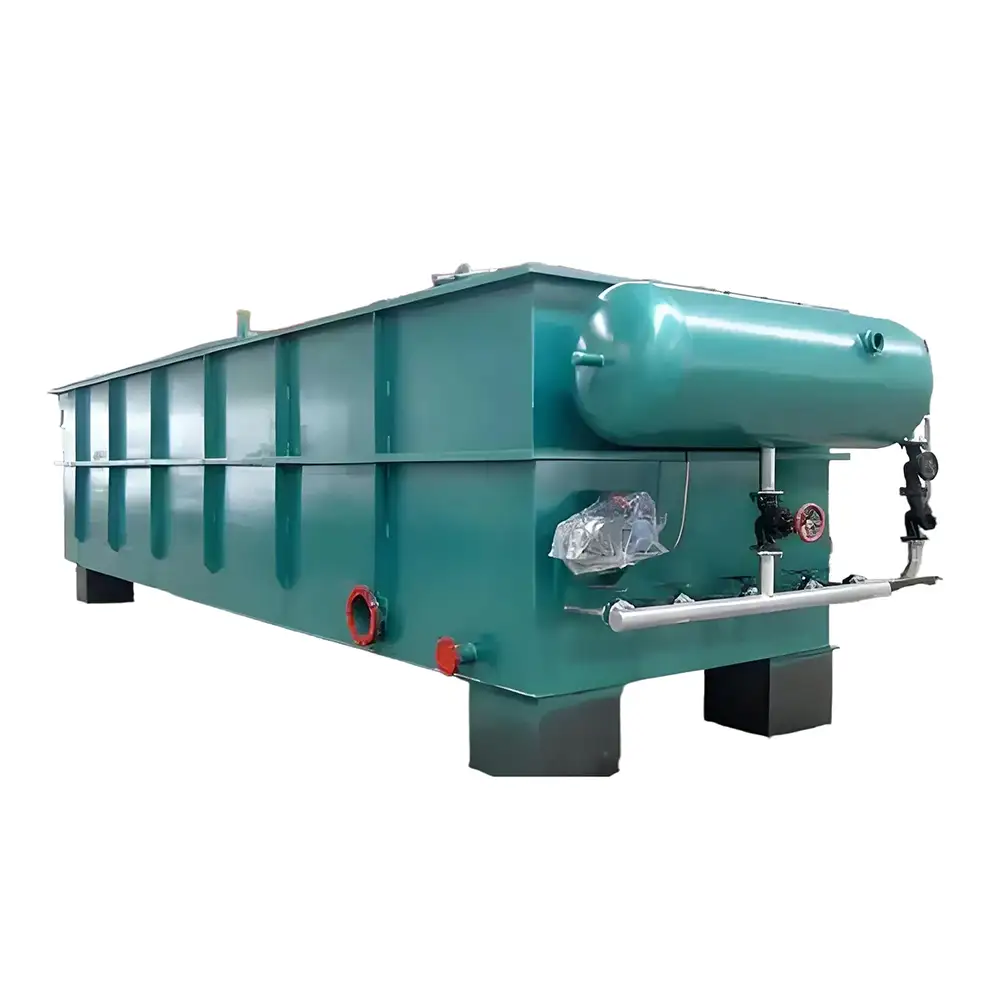
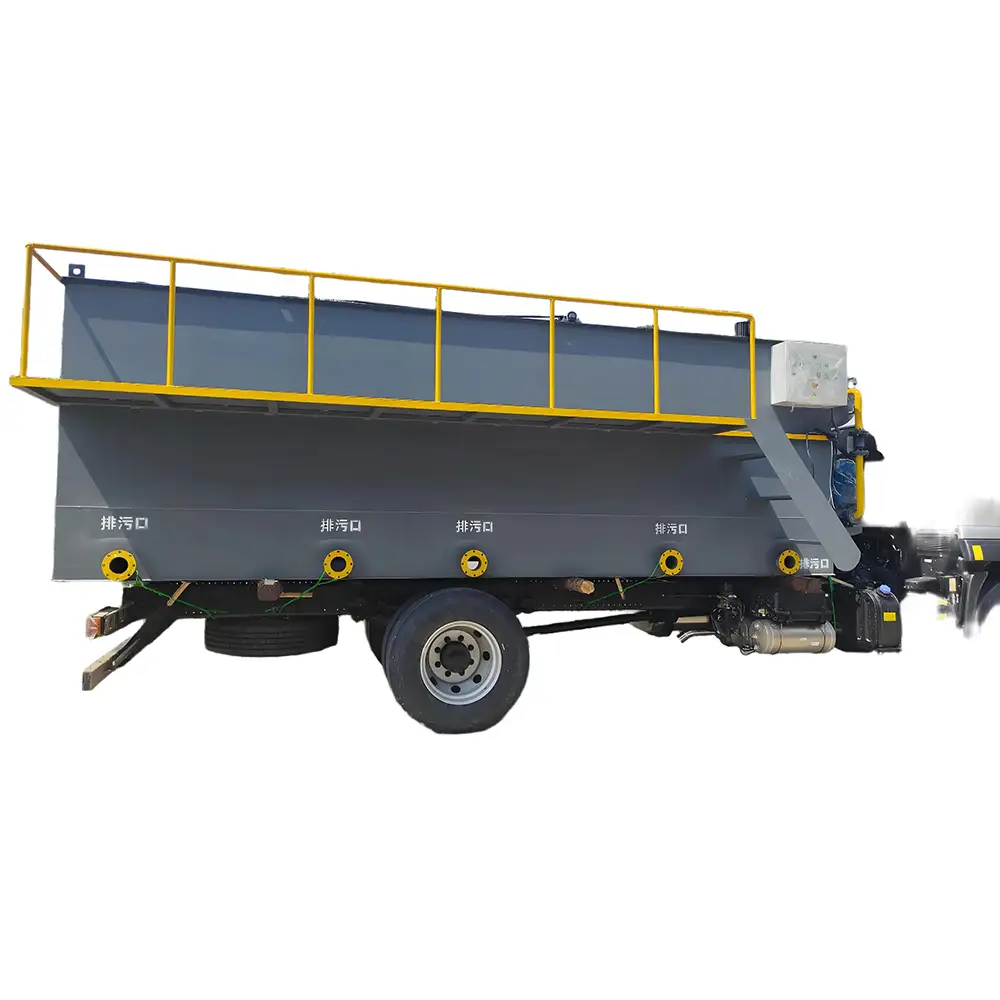
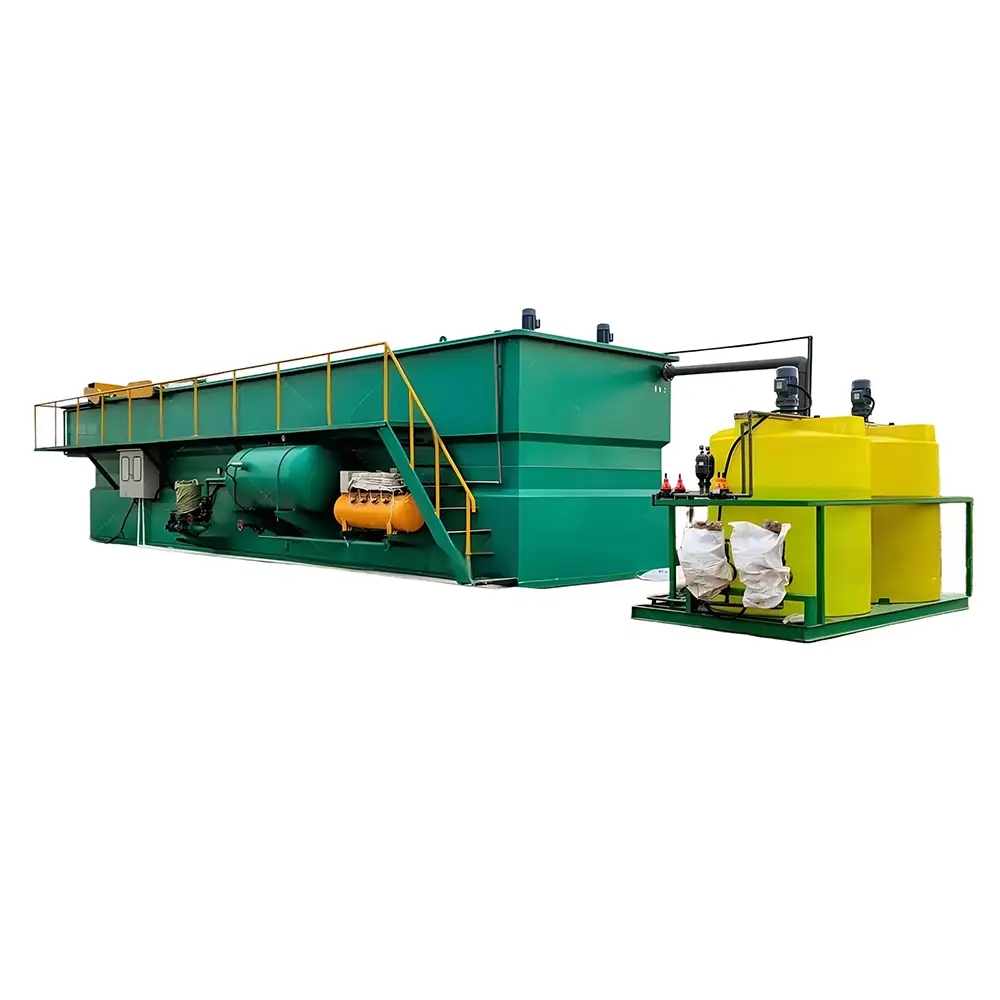
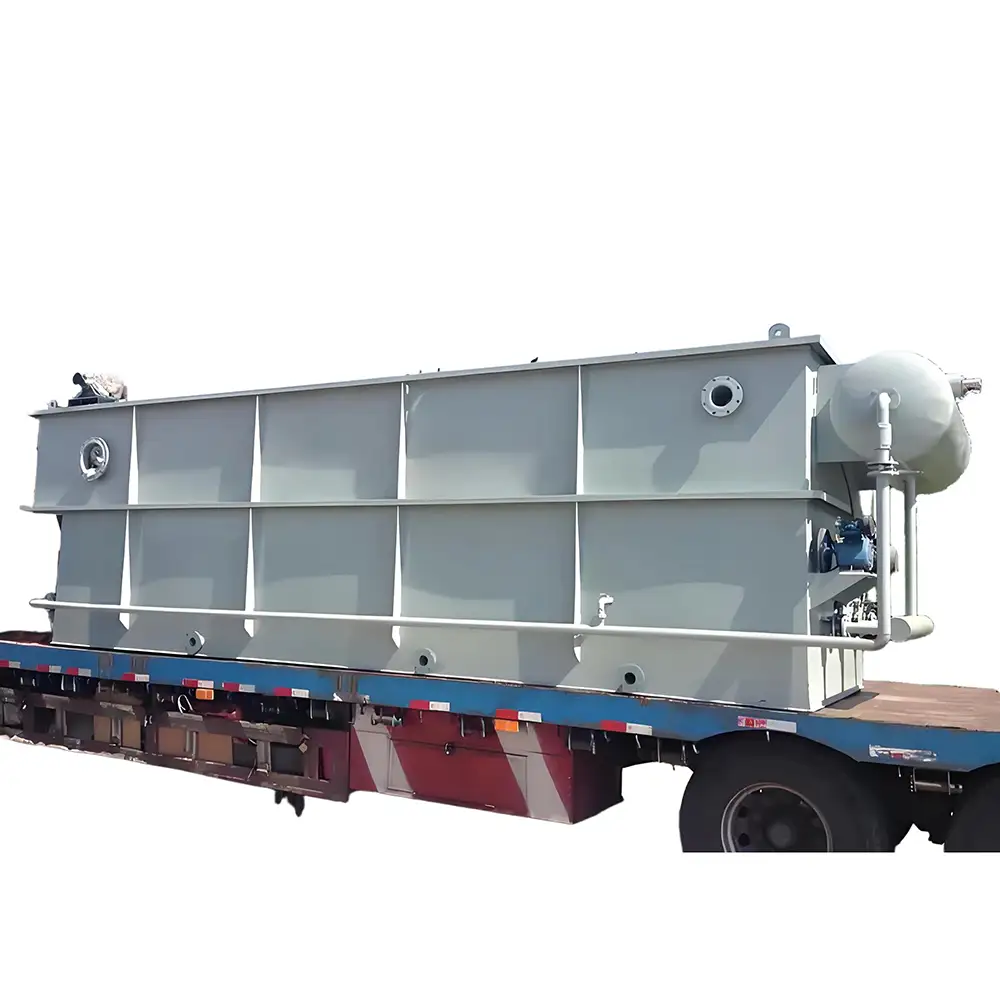
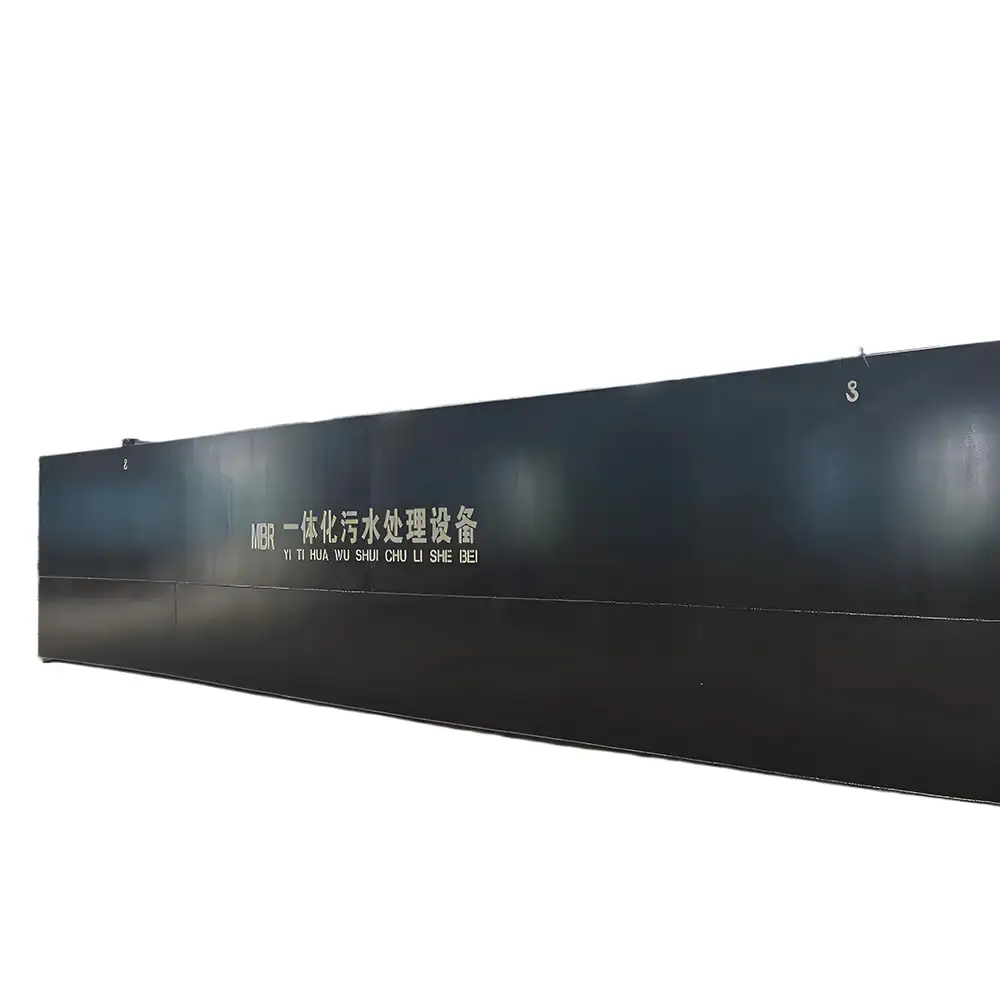
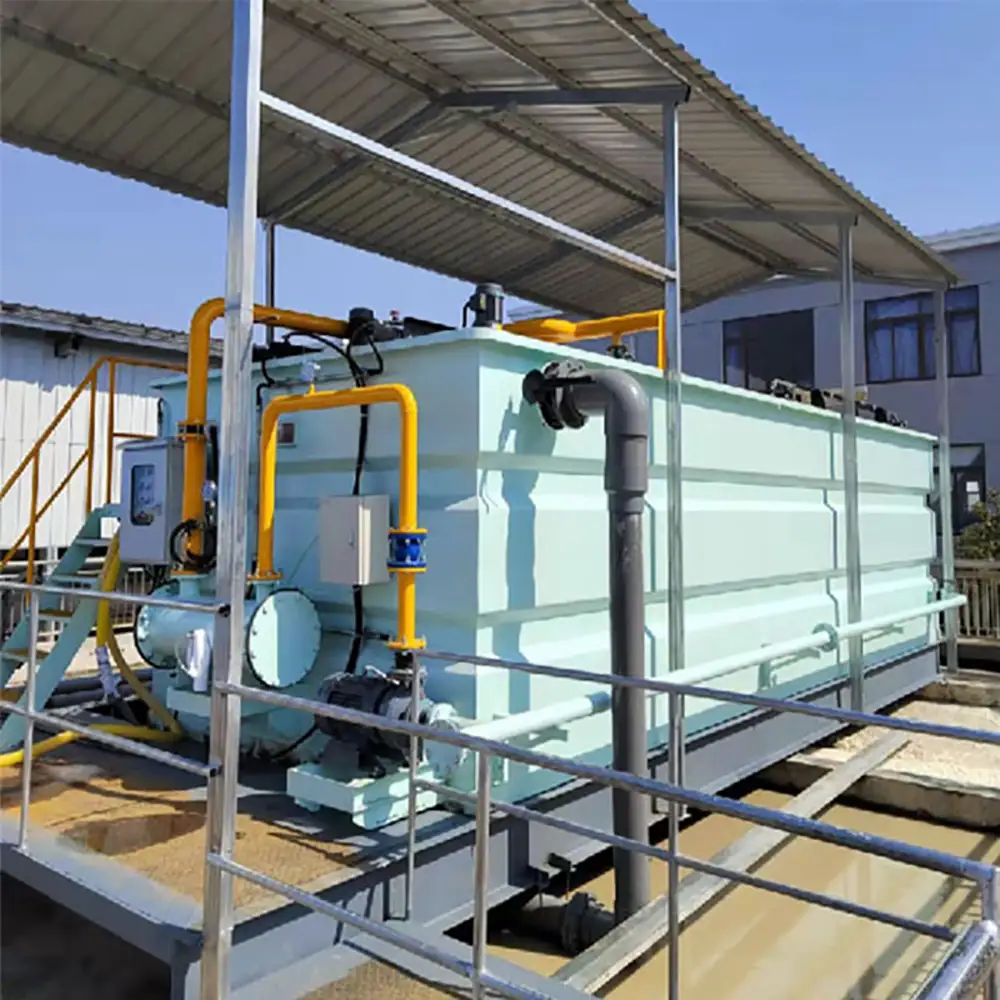
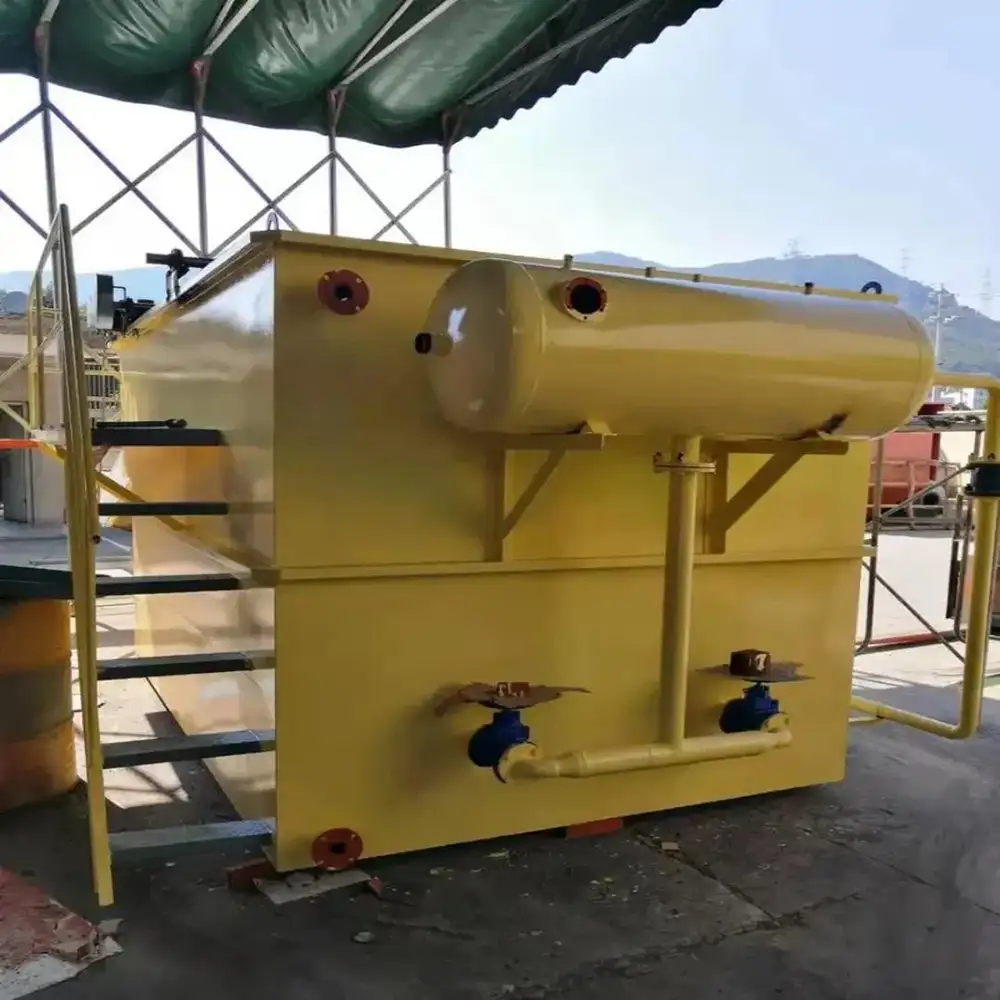
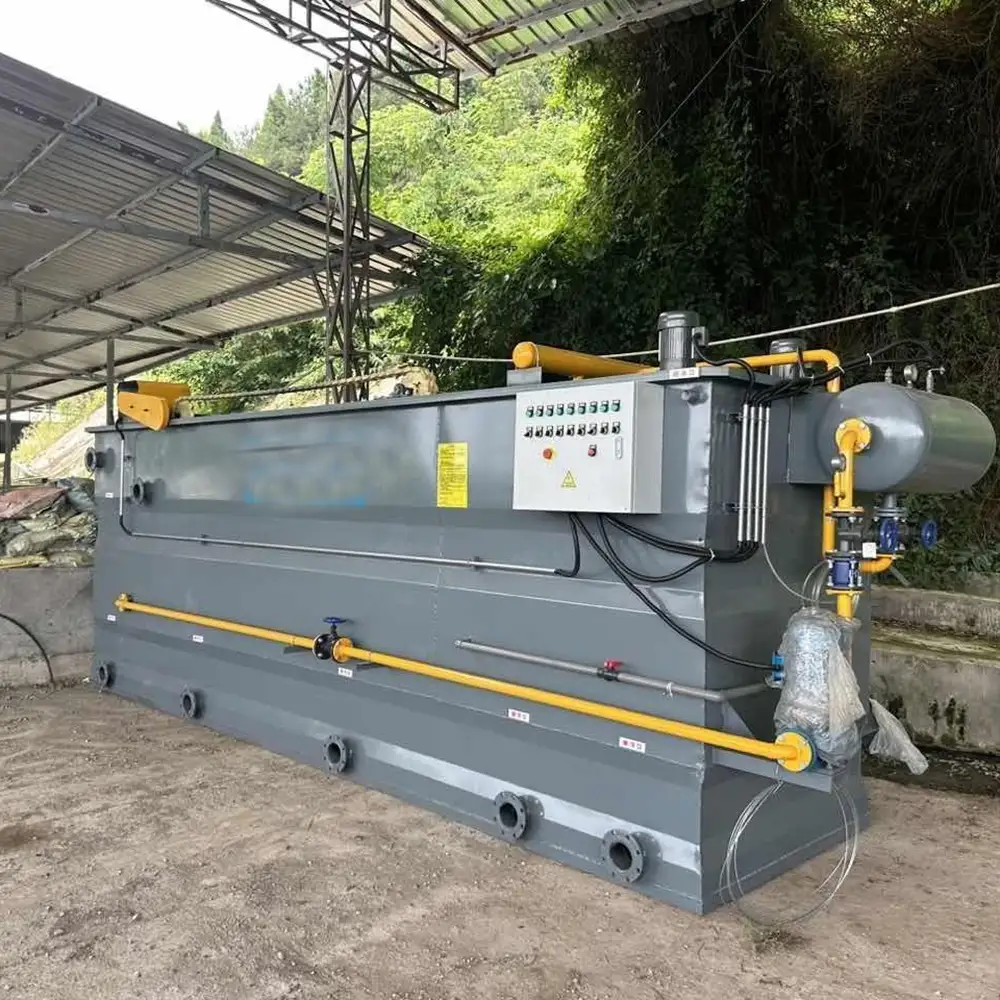
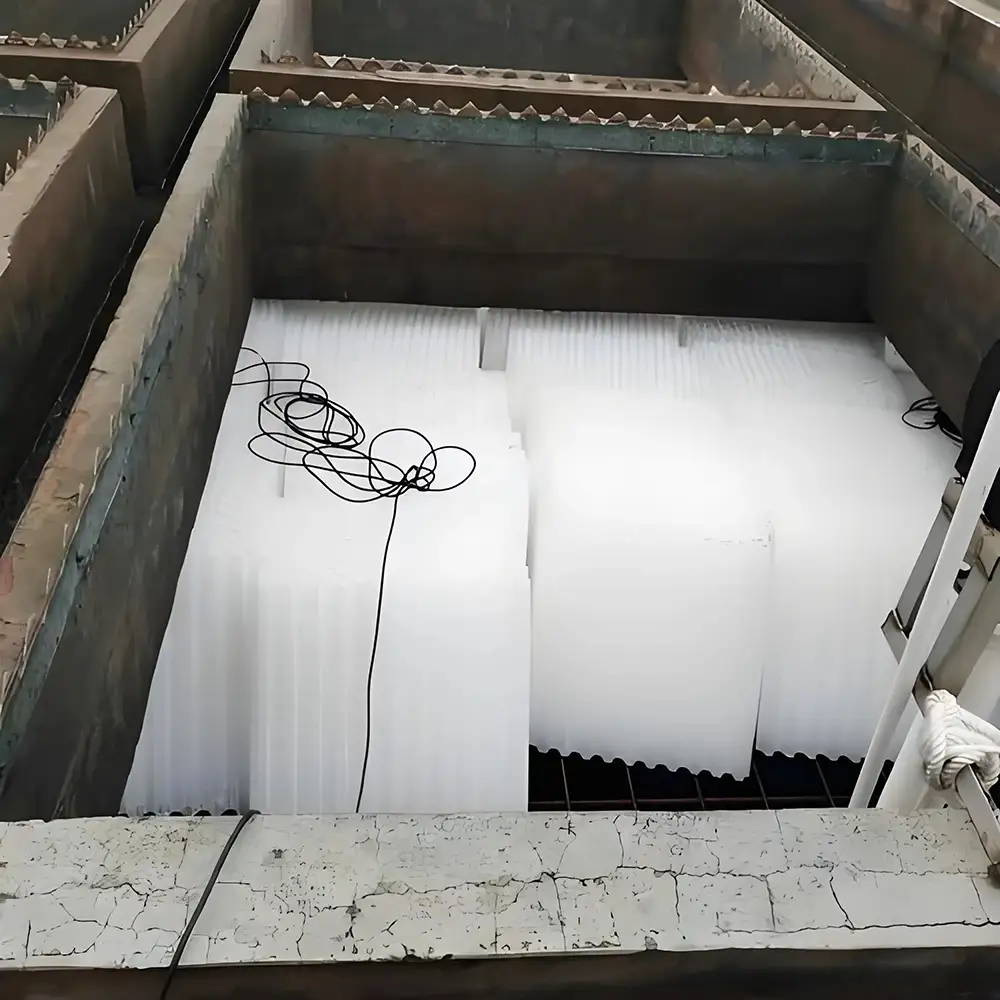
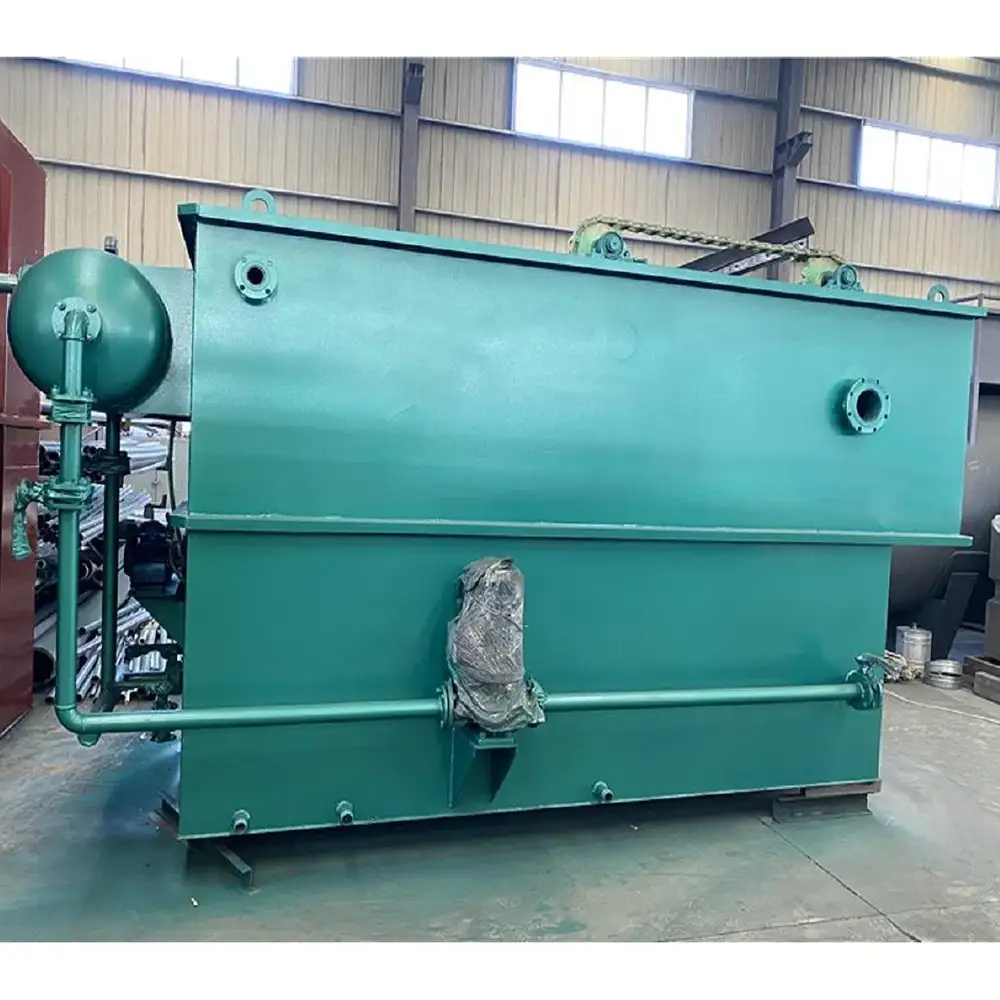
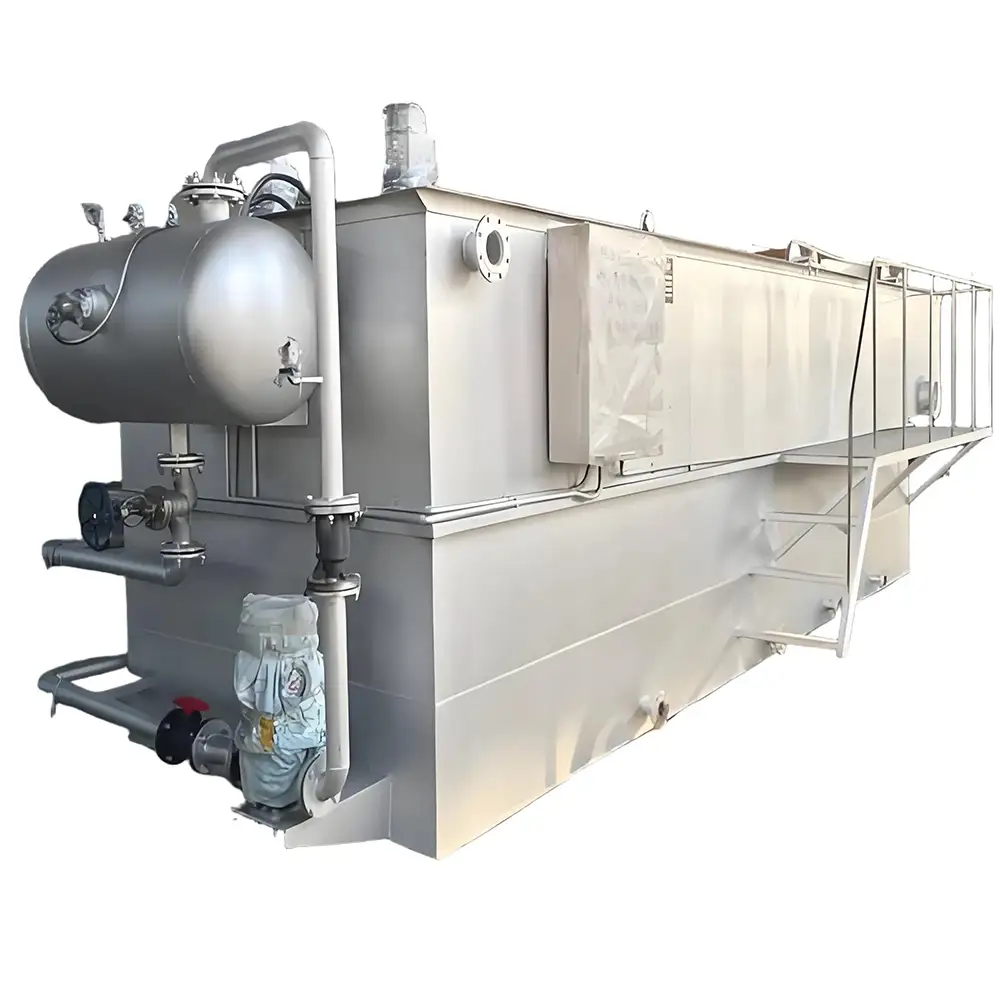
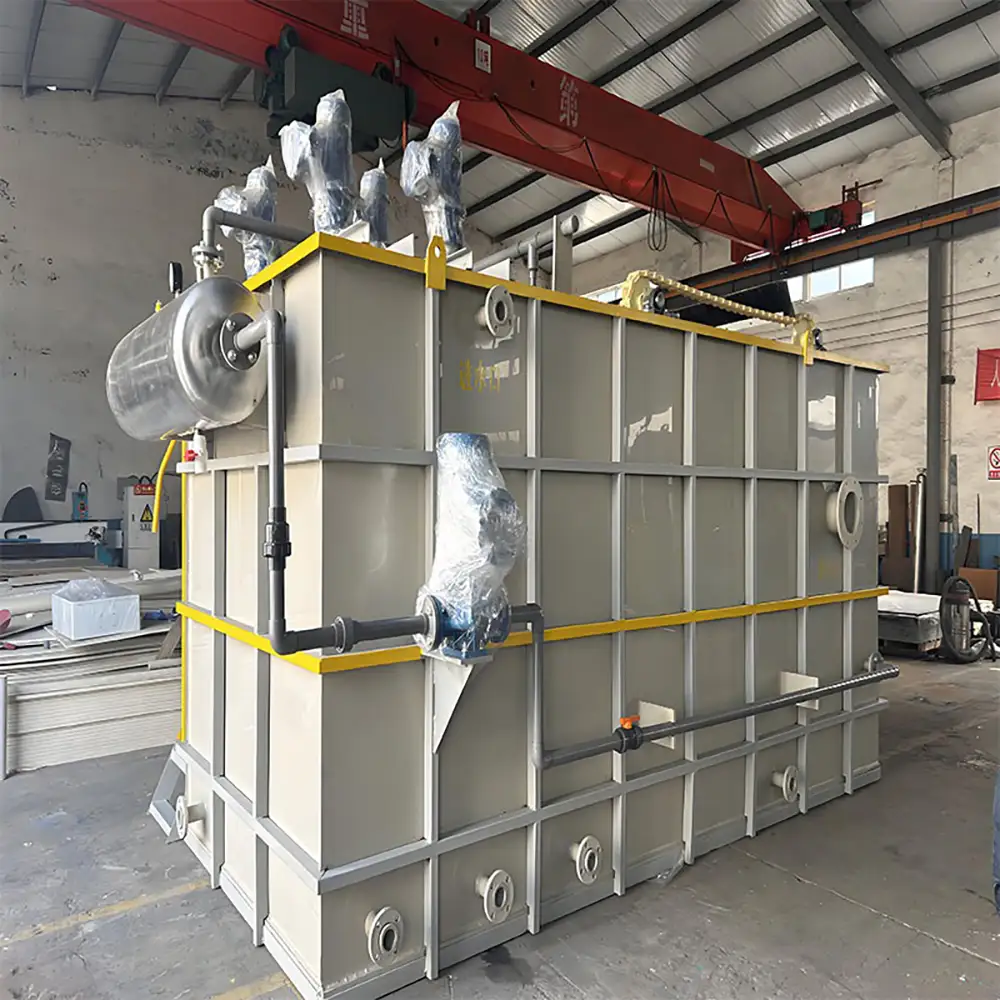
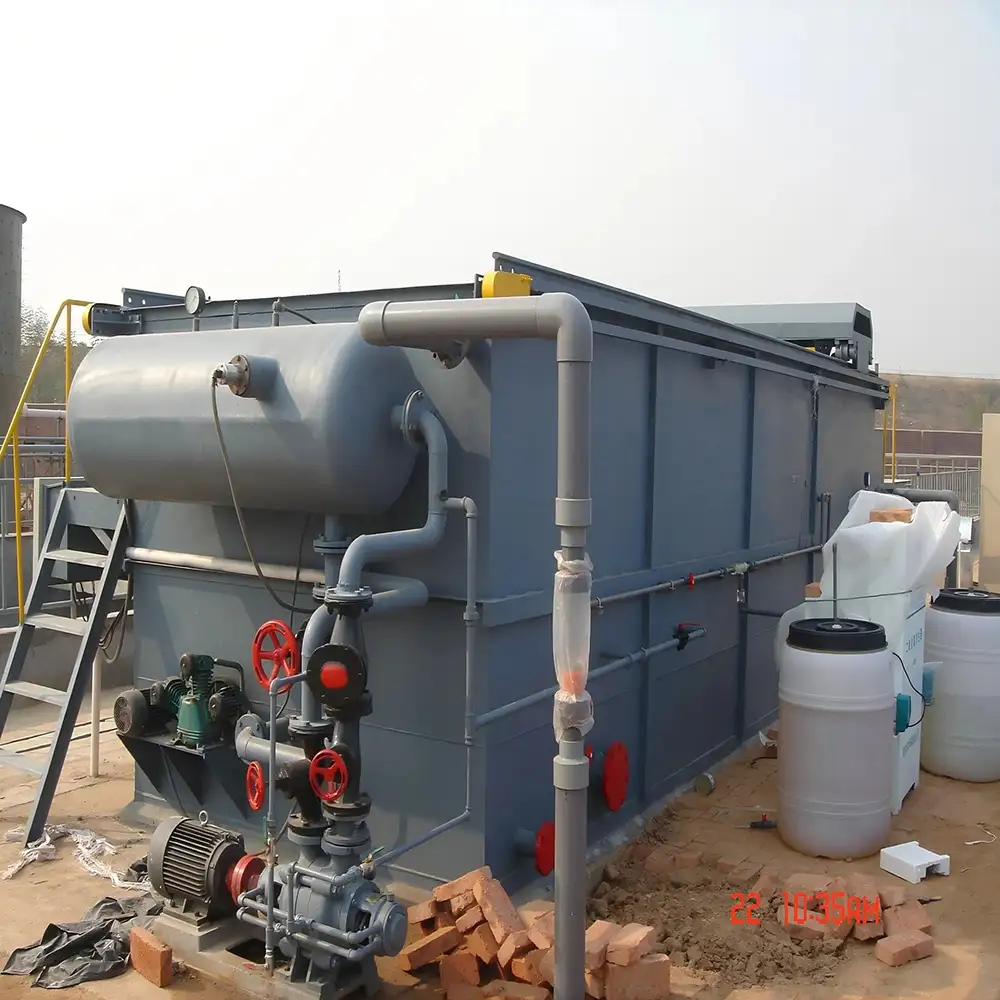
Air flotation technology has been widely used in water supply, drainage and wastewater treatment in recent years. It can effectively remove the light floc which is difficult to precipitate in wastewater. With decades of technical experience accumulation and strong independent research and development ability, the company has devoted itself to developing a new type of air float, with stable effect, lower failure rate, easier operation and maintenance, and lower construction and operating costs.
2. Application
(1) Remove oil and TSS.
(2) Separate small particles and algae in groundwater.
(3) Recover valuable products in industrial sewage such as paper pulp.
(4) Act as secondary sedimentation tank to separate and concentrate suspended particles and sludge.
3. Features
(1) Large capacity, high efficiency and small occupying space.
(2) Compact structure, easy operation and maintenance.
(3) Silt expansion elimination.
(4) Aerate to the water while air floating, it has an obvious effect to the elimination of active agent and foul smell in water. Meanwhile, the increased dissolved oxygen provides a favorable condition to the follow-up process.
(5) It can achieve the best effect in adopting this method when disposing the water with lower temperature, lower turbidity and more algae.
Suitable area:
slaughtering, starch, pharmaceuticals, papermaking, printing and dyeing,
leather and tannery, petrochemical industry, domestic wastewater, etc.
High Suspended Solids Wastewater Flotation Machine Water Treatment Plant
The High Suspended Solids Wastewater Flotation Machine Water Treatment Plant is a dissolved air flotation system designed for wastewater streams containing high concentrations of suspended solids, fine particles, oil, grease, and other flotation-friendly contaminants. By using fine air bubbles to increase the buoyancy of suspended matter, the system separates solids from water and produces clarified effluent for downstream treatment.
Dissolved air flotation, commonly known as DAF, is widely used for industrial wastewater clarification and solid-liquid separation. In the DAF process, air is dissolved into water under pressure and then released at atmospheric pressure. The resulting fine bubbles attach to suspended particles, causing them to rise to the water surface where they can be removed by a skimming mechanism.
This type of wastewater flotation machine is particularly useful when wastewater contains fine or lightweight particles that are difficult to remove efficiently through conventional gravity sedimentation.
High Suspended Solids Wastewater Treatment Principle
The treatment process normally begins with wastewater entering an equalization, mixing, or pretreatment section. Depending on the characteristics of the wastewater, coagulants and polymers may be added to destabilize colloidal particles and promote the formation of larger flocs.
A portion of the treated or clarified water can be recycled through a pressurization system. Air is introduced into the recycle stream under pressure, allowing the water to become saturated with dissolved air.
When the pressurized water enters the flotation chamber and pressure is reduced, the dissolved air comes out of solution as numerous fine bubbles. These bubbles attach to suspended solids and flocs, reducing their apparent density and causing them to float upward.
The floated solids accumulate at the surface as a sludge or froth layer. A mechanical scraper continuously or periodically moves the floating material toward the sludge collection area. Clarified water is collected below the flotation layer and discharged for further treatment or reuse.
Effective Suspended Solids Removal
The main purpose of this flotation machine is to provide efficient separation of suspended solids from wastewater. DAF is especially useful for particles whose density is close to that of water and for lightweight materials that may settle slowly.
Potentially removable contaminants include:
Suspended solids
Fine suspended particles
Colloidal flocs after chemical conditioning
Oil and grease
Floating solids
Fibers
Organic particles
Precipitated solids
Lightweight sludge
EPA documentation identifies DAF as a treatment process for suspended solids, oil, and grease removal and notes that it can be advantageous for lighter suspended materials that are difficult to remove through conventional settling.
Actual removal performance depends on wastewater composition, particle characteristics, hydraulic loading, air-to-solids ratio, chemical conditioning, and equipment design. Therefore, wastewater testing or pilot testing is recommended when designing a system for a specific application.
Main Components of the DAF Flotation Machine
A complete high-suspended-solids DAF treatment system may include a wastewater feed pump, coagulation tank, flocculation tank, chemical dosing system, recycle pump, air compressor or air injection system, pressure vessel or retention tank, flotation chamber, pressure-release device, surface scraper, sludge collection system, and treated-water outlet.
The flotation chamber provides the primary solid-liquid separation area. Its internal distribution system is designed to distribute wastewater and microbubbles evenly to maximize contact between bubbles and suspended particles.
The recycle and air saturation system is also important because stable bubble formation directly influences flotation performance. A properly controlled recycle flow helps maintain consistent flotation conditions as wastewater loading changes.
Wastewater Applications
The High Suspended Solids Wastewater Flotation Machine can be incorporated into many industrial wastewater treatment plants.
Food Processing Wastewater
Food processing wastewater can contain suspended organic matter, fats, oils, grease, proteins, and fine solids. DAF can provide an effective primary or pretreatment separation stage before biological treatment.
Dairy Wastewater
Dairy wastewater may contain milk solids, fats, oils, grease, proteins, and suspended organic particles. A DAF unit can help reduce the solids and organic loading entering downstream biological treatment.
Slaughterhouse Wastewater
Meat and poultry processing wastewater commonly contains suspended organic solids, fats, blood-related solids, oil, and grease. DAF can be integrated into pretreatment systems to remove flotation-friendly contaminants.
Paper and Pulp Wastewater
Paper manufacturing wastewater may contain fibers, fillers, fine suspended solids, and other lightweight materials. DAF can assist in recovering or separating these materials from process water.
Textile and Dyeing Wastewater
DAF can be used after appropriate coagulation and flocculation to separate color-associated flocs, suspended solids, and other particulate contaminants.
Chemical and Industrial Wastewater
Industrial process wastewater may contain suspended solids, precipitated chemicals, emulsified oil, and other contaminants. Chemical conditioning followed by DAF can provide an effective solid-liquid separation stage where appropriate.
High-Capacity Flotation for High Solids Loading
When wastewater contains high suspended solids, proper hydraulic and solids loading design becomes especially important. Excessive solids loading can increase float production and affect scraper operation, recycle requirements, and downstream sludge handling.
The system should therefore be selected according to actual wastewater flow, suspended solids concentration, oil and grease loading, particle characteristics, chemical requirements, and required treated-water quality.
DAF can be particularly useful when the wastewater contains solids that settle poorly or when available installation space is limited. EPA documentation notes that flotation can offer higher surface loading in certain applications and may be useful for solids that are difficult to settle.
Coagulation and Flocculation
Chemical pretreatment is often an important part of high-suspended-solids DAF operation. Coagulants can destabilize particles, while polymers can help combine smaller particles into larger and stronger flocs.
The appropriate chemical program depends on wastewater chemistry and treatment objectives. Common coagulants can include aluminum- or iron-based products, while polymers may be used as flocculation aids.
Chemical selection should not be based solely on generic wastewater categories. Jar testing, laboratory analysis, or pilot testing can help determine the appropriate chemical type and dosage for a specific wastewater stream.
Automatic Operation and Control
The flotation machine can be equipped with PLC-based automatic control for pumps, scraper operation, recycle flow, pressure regulation, chemical dosing, and other process functions.
Automatic controls help maintain stable operation when wastewater flow and pollutant loading fluctuate. Instrumentation can also be used to monitor water levels, pump status, pressure, and other operating parameters.
For larger wastewater treatment plants, the DAF unit can be integrated with upstream screening, equalization, chemical treatment, biological treatment, filtration, membrane treatment, or sludge dewatering equipment.
Sludge Collection and Maintenance
The floating sludge generated by DAF is normally collected from the water surface by a scraper or skimming system. The collected sludge can then be transferred to a sludge tank, thickening system, dewatering machine, or other residuals-handling process.
Routine inspection should include the recycle pump, pressure components, air injection system, valves, scraper mechanism, sludge outlet, chemical dosing equipment, and internal flotation components.
Surface sludge should be removed at an appropriate frequency. Excessive accumulation can destabilize the flotation layer and potentially allow captured particles to return to the water phase.
Why Choose Us?
The High Suspended Solids Wastewater Flotation Machine is designed as a practical solution for wastewater streams where efficient suspended solids separation is a key treatment requirement.
Its DAF technology combines dissolved-air generation, microbubble flotation, surface sludge collection, and clarified-water separation in one treatment process. The system can be configured for different wastewater flow rates, solids concentrations, pretreatment requirements, and installation conditions.
For industrial wastewater projects, selecting the correct DAF configuration is more important than simply choosing a nominal capacity. Wastewater analysis, flow variation, suspended solids characteristics, chemical requirements, sludge production, and downstream treatment should all be considered.
With an appropriate process configuration, the DAF flotation machine can serve as a primary clarification, pretreatment, polishing, or solid-liquid separation stage within a larger wastewater treatment plant.
Frequently Asked Questions
1. What is a high suspended solids wastewater flotation machine?
It is a wastewater treatment system designed to separate high concentrations of suspended solids using flotation, commonly through dissolved air flotation technology.
2. How does a DAF machine remove suspended solids?
Fine air bubbles attach to suspended particles and flocs, increasing their buoyancy and causing them to rise to the water surface for mechanical removal.
3. Can DAF handle high suspended solids wastewater?
Yes, DAF can be designed for wastewater with significant suspended solids loading, provided the hydraulic, solids, recycle, chemical, and sludge-handling systems are properly sized.
4. What other pollutants can DAF remove?
Depending on wastewater characteristics and pretreatment, DAF can remove suspended solids, oil, grease, floating matter, fibers, and flocculated contaminants.
5. Does high-solids wastewater require chemical treatment?
Chemical conditioning is often beneficial because coagulation and flocculation can improve particle size and flotation performance.
6. Is DAF better than a settling tank?
Neither technology is universally better. DAF can be advantageous for lightweight, fine, or poorly settling particles, while sedimentation may be preferable for readily settleable solids.
7. Can DAF be used for food processing wastewater?
Yes. DAF is commonly considered for food-processing wastewater containing suspended organic matter, fats, oils, grease, and other flotation-friendly solids.
8. Can DAF treat slaughterhouse wastewater?
Yes. It can be used as part of slaughterhouse wastewater pretreatment for separating suspended solids, fats, oils, grease, and flocculated organic matter.
9. Can DAF be used before biological treatment?
Yes. DAF can reduce suspended solids and other loads before downstream biological treatment when appropriate for the specific wastewater.
10. How is DAF sludge removed?
A surface scraper or skimmer collects the floating sludge and transfers it to a sludge collection or dewatering system.
11. What determines the capacity of a DAF system?
Flow rate, suspended solids concentration, particle characteristics, oil and grease concentration, chemical conditioning, hydraulic loading, recycle ratio, and required effluent quality are important factors.
12. Can the DAF machine be automatically controlled?
Yes. PLC controls can be used for pumps, scraper operation, chemical dosing, pressure control, alarms, and other operating functions.
Prev:
DAF Systems Dissolved Air Flotation Cells for Wastewater Treatment Daf Flotation Cells
Next:
High Efficiency Dissolved Air Flotation Daf Wastewater Treatment Plant Water Clarifier
TAG:
Industrial Wastewater Treatment Equipment,
Suspended Solids Removal,
Food Industry Wastewater Treatment,
Dairy Wastewater Treatment,
Meat Processing Wastewater Treatment,
Food Processing Wastewater Treatment,
Industrial Wastewater Treatment System,
DAF Wastewater Treatment System,
Industrial Wastewater Treatment,
Wastewater Treatment Equipment,
Wastewater Treatment Plant,
Solid Liquid Separation Equipment,
Solid Liquid Separation System,
Chemical Wastewater Treatment,
Wastewater Treatment System,
Industrial Water Treatment Equipment,
Industrial Water Treatment,
Suspended Solids Removal Equipment,
Wastewater Pretreatment Equipment,
Water Treatment Plant,
Water Treatment Equipment,
Industrial Effluent Treatment,
Process Water Treatment,
Process Wastewater Treatment,
Advanced Wastewater Treatment,
Slaughterhouse Wastewater Treatment,
Factory Wastewater Treatment,
Oil Wastewater Treatment,
Suspended Solids Separation,
DAF Sludge Removal,
Related Category:
High Suspended Solids Wastewater Treatment,High Suspended Solids Flotation Machine,DAF Wastewater Flotation Machine China, suppliers, manufacturers, factory, customized, wholesale, quotation, made in China