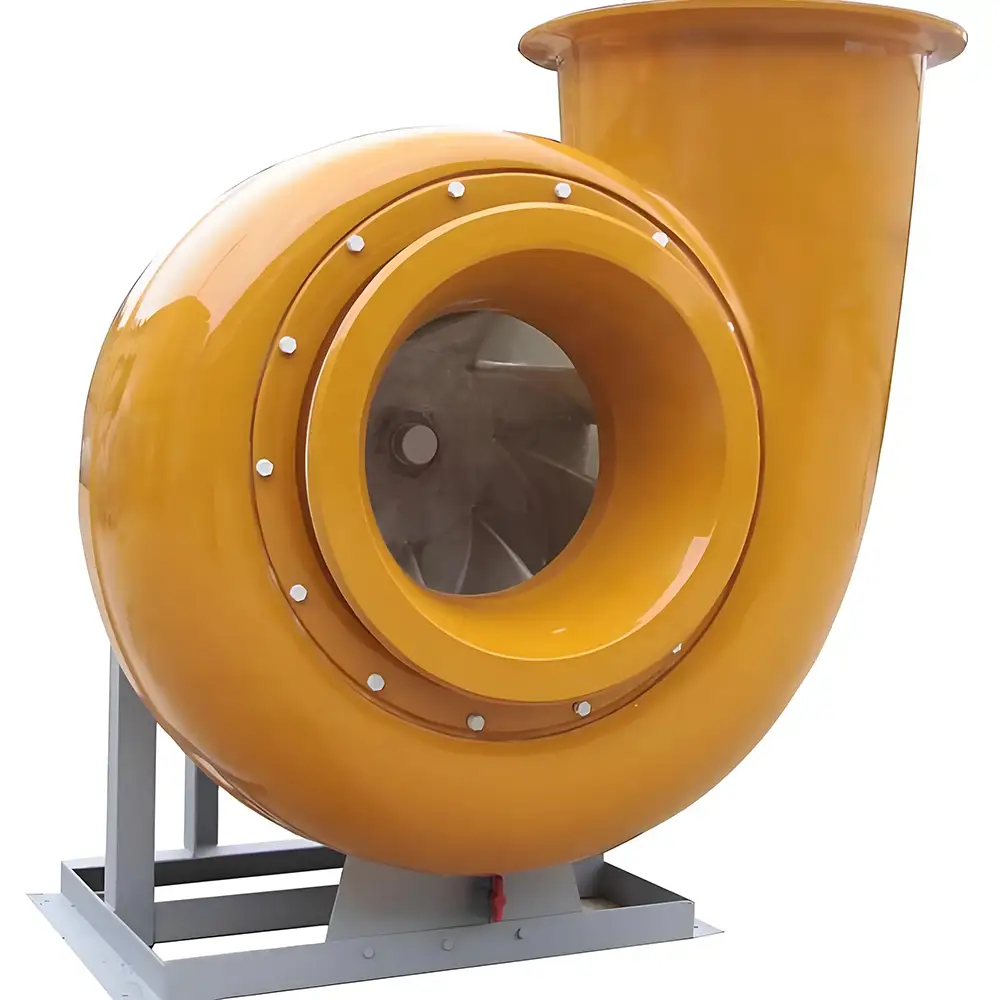
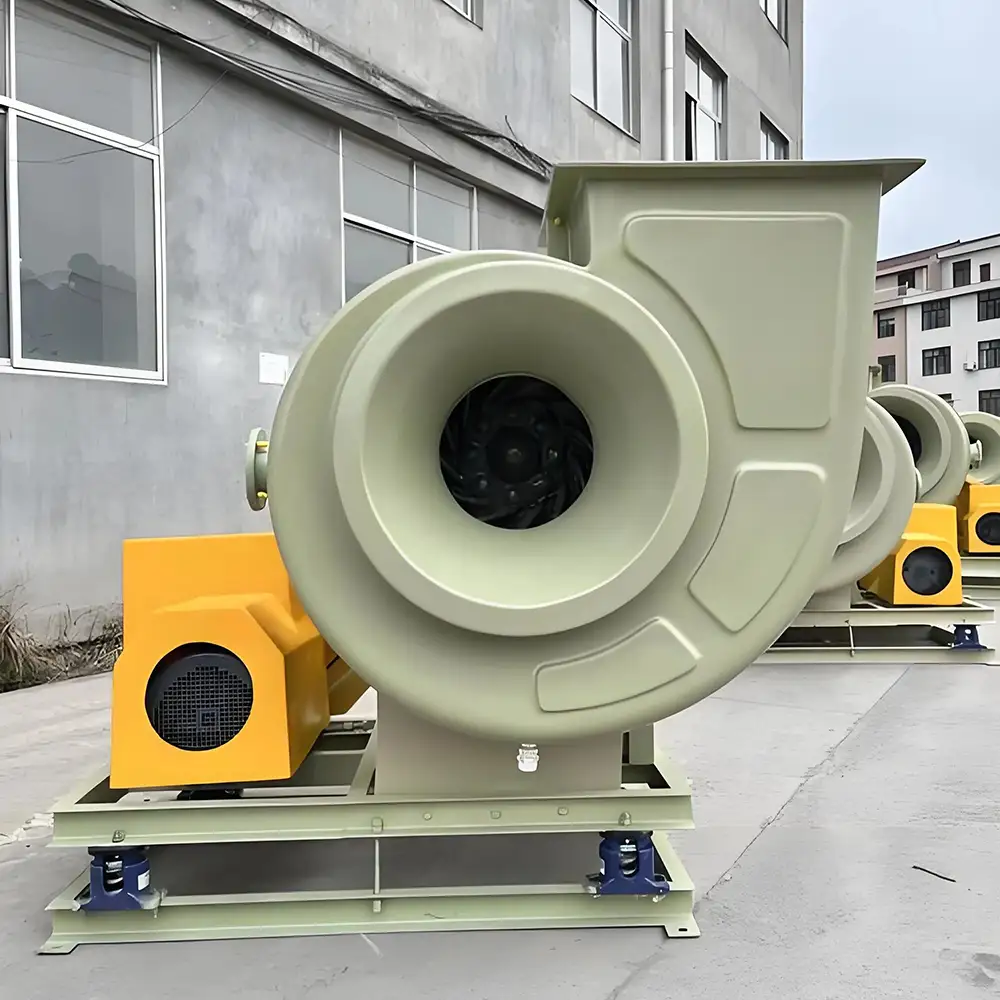
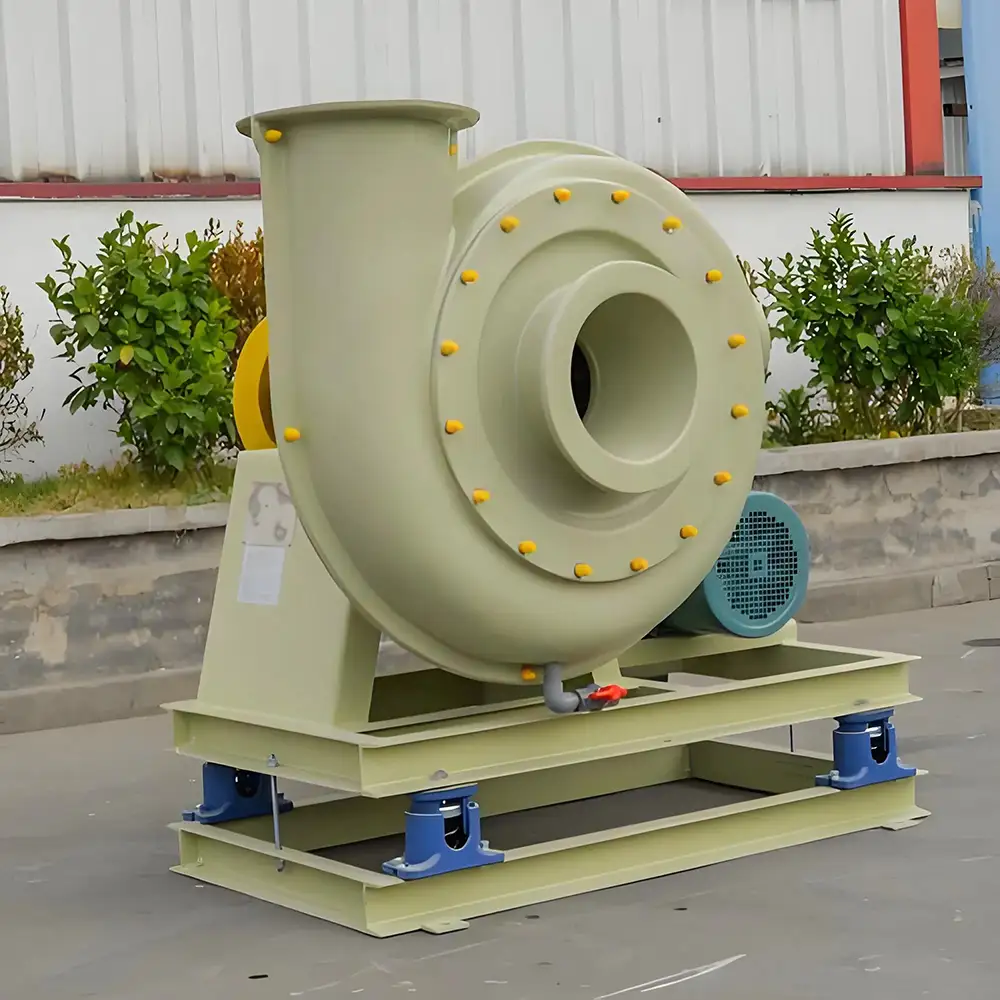
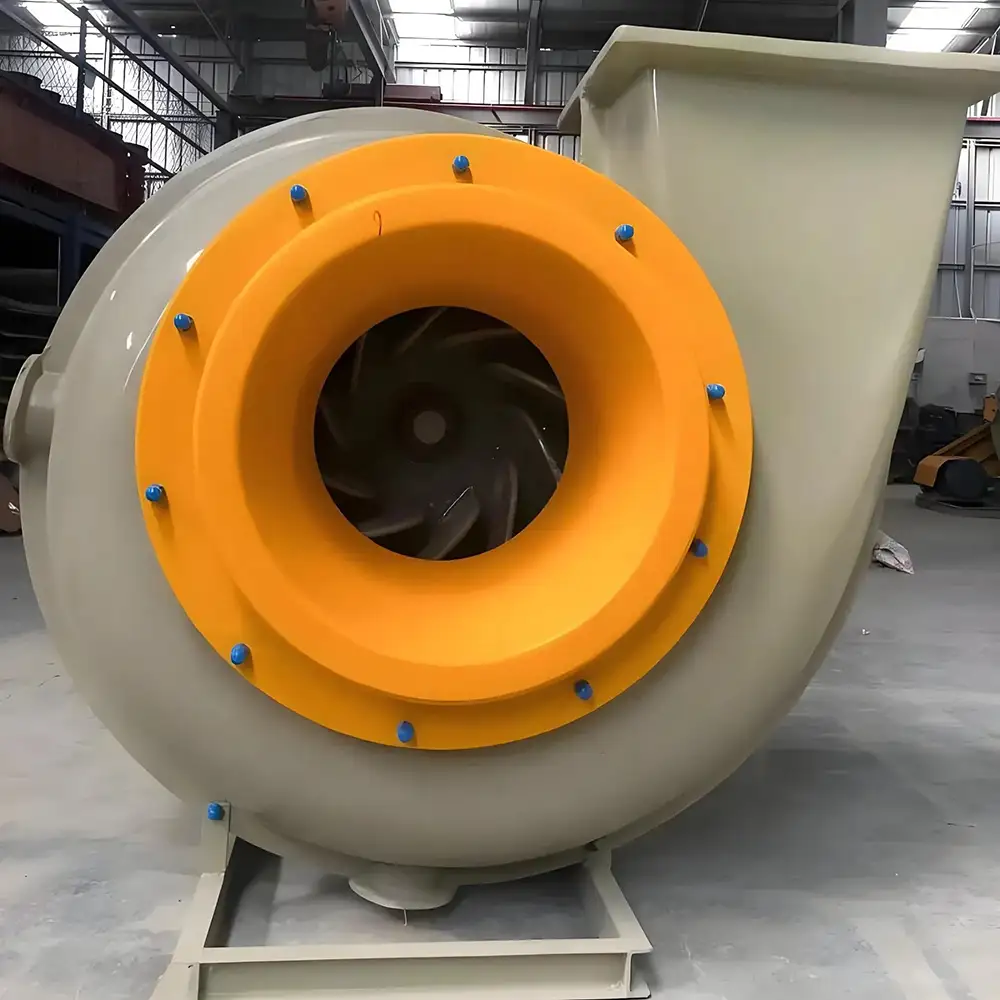
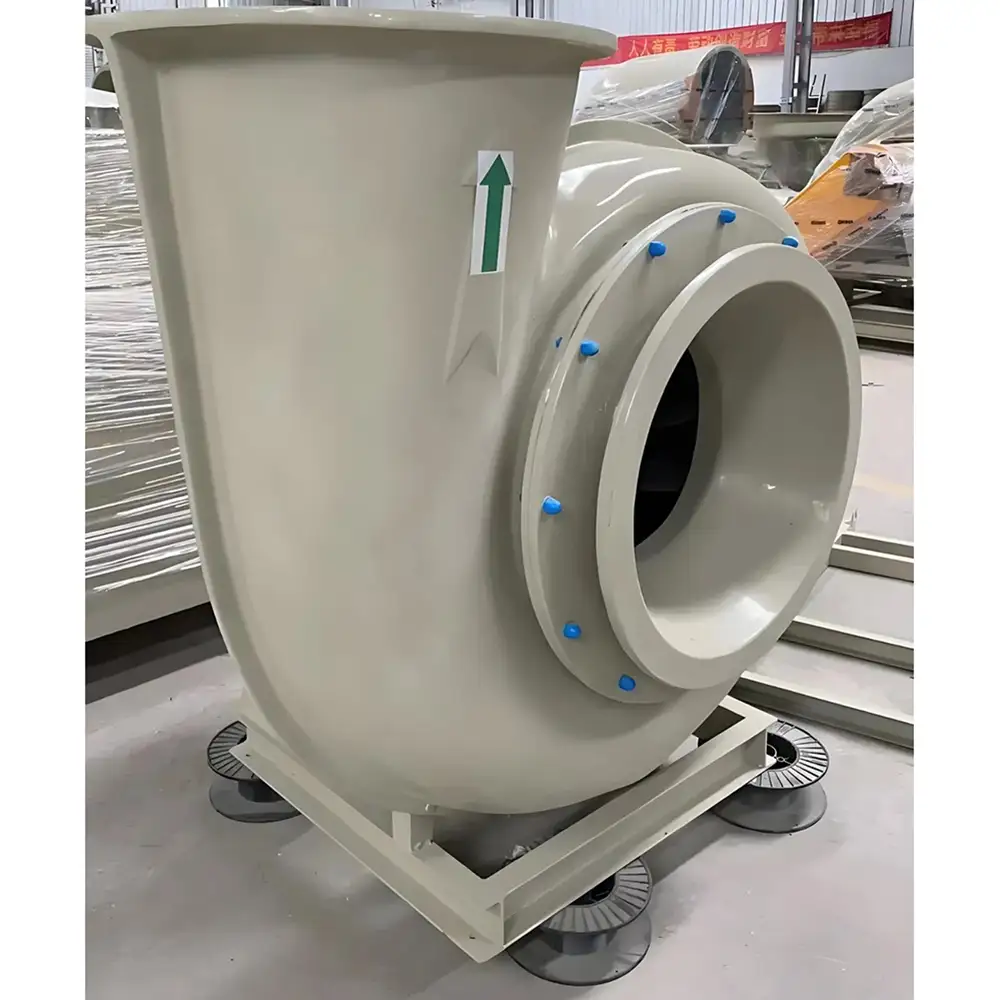
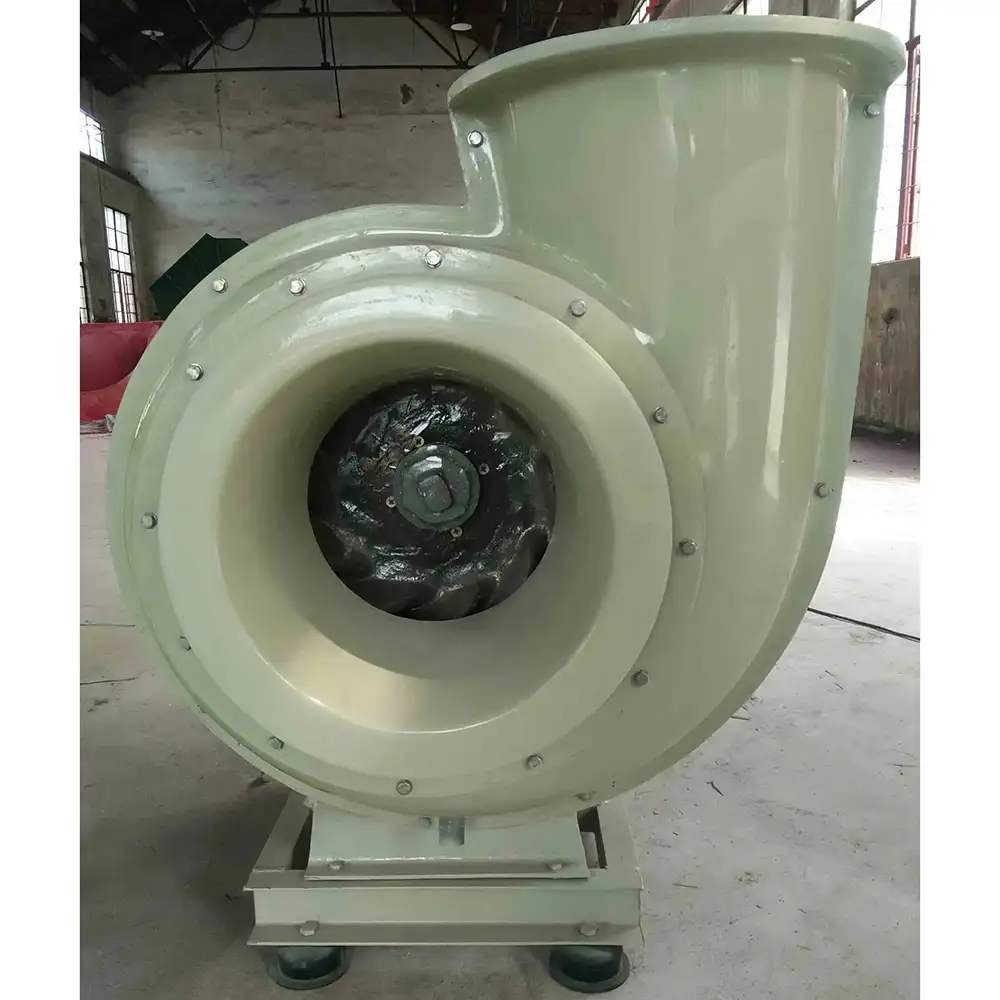
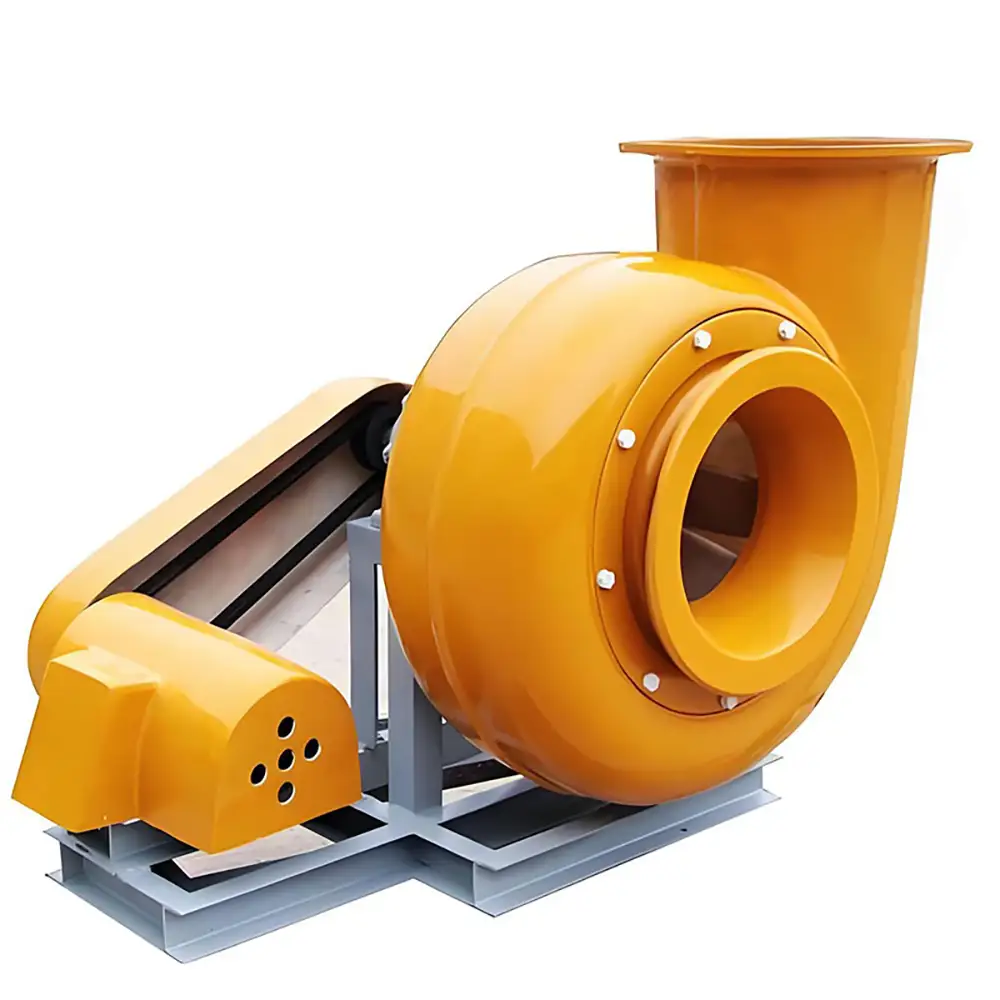
FRP centrifugal fan
Product Features
Impeller: The impeller is made of resin glass fiber composite (frp), which has good corrosion resistance, strength and light weight. It can be flexibly proportioned for different gas environments. Through three
-dimensional design and the use of relevant software strength mechanical analysis , it has excellent quality. 802 and 806 resins are used in combination through multiple processes to achieve better strength.
Bearing box: The cast oil bath bearing seat can effectively lubricate and cool the axis bearing. Simple and easy maintenance is the guarantee of long-term operation of the fan.
Bearings : High-quality self-aligning rolling bearings, C&U brand guarantee, SKF, NSK and other well-known brand bearings can be configured according to customer needs
Spindle: Made of high-quality 45# steel, precision-machined to ensure spindle size and shape tolerances, durable
Balance : Each impeller is dynamically balanced before assembly. The balance accuracy meets the G2.5 standard of ISO1940 and AMCA standards.
Centrifugal Induced Draft Dust Sawdust High Pressure Industrial Air Suction Exhaust Blower
The Centrifugal Induced Dust Sawdust Force Draft Fan High Pressure Blower Industrial Air Suction Exhaust Blower is a heavy-duty industrial air-moving solution designed for dust collection, sawdust extraction, material handling, forced draft, induced draft and high-pressure ventilation systems.
This type of centrifugal blower is commonly used where the ventilation system requires strong suction or pressure to move air through ducts, cyclones, bag filters, cartridge collectors, scrubbers and other equipment. Typical applications include woodworking plants, furniture factories, sawmills, biomass processing, metalworking, grinding, manufacturing facilities, industrial boilers and general process ventilation.
Industrial centrifugal fans can be configured for forced-draft or induced-draft service depending on their position in the system. An induced-draft fan typically creates negative pressure that pulls air or gas through upstream equipment, while a forced-draft fan supplies air into a process or system.
High-Pressure Centrifugal Blower Design
A centrifugal blower converts the rotational energy of the motor into airflow and pressure. Air enters through the inlet, passes into the rotating impeller and is accelerated outward before entering the scroll housing and leaving through the discharge.
The resulting pressure allows the blower to overcome resistance from:
Long Duct Runs
Multiple Elbows
Branch Ducts
Cyclone Separators
Baghouse Filters
Cartridge Filters
Dampers
Scrubbers
Exhaust Stacks
Process Equipment
For this reason, industrial fan selection should be based on both required airflow and static or total pressure. A high airflow number alone does not guarantee adequate dust collection performance.
Induced Draft Fan for Dust Collection
An induced-draft centrifugal fan is frequently installed on the clean-air side of a dust collection system. In this arrangement, the fan pulls contaminated air from extraction points through the ductwork and dust collector.
A typical system can be arranged as:
Dust Source → Extraction Hood → Ductwork → Cyclone/Baghouse → Centrifugal Fan → Exhaust
The fan creates negative pressure throughout the upstream system, helping maintain suction at individual collection points.
This configuration is widely used for woodworking, grinding, machining and other industrial processes that generate airborne particles. Industrial dust collection fan systems can handle applications ranging from sawdust and wood chips to metal dust and welding smoke, depending on the fan design and system configuration.
Sawdust and Woodworking Dust Extraction
Sawdust extraction is one of the important applications for industrial centrifugal fans.
Woodworking equipment such as:
Table Saws
Panel Saws
CNC Routers
Sanders
Planers
Jointers
Wood Chippers
Cutting Machines
Grinding Equipment
can generate airborne sawdust, chips and fine wood particles.
A properly designed extraction system uses hoods or machine connections to capture the material, ducts to transport it and a cyclone, baghouse or cartridge collector to separate the particles.
The centrifugal fan provides the airflow and negative pressure required to move the contaminated air through the system.
For sawdust applications, fan selection should consider particle size, concentration, moisture, material density and whether the fan is positioned before or after the dust separator.
High-Pressure Dust Collection
High-pressure centrifugal blowers are useful when the system contains substantial resistance.
For example, a centralized dust collection system may have a long duct network combined with several elbows, dampers, cyclone separators and filters. As filter loading increases, pressure resistance can also increase.
The blower therefore needs sufficient pressure reserve to maintain the required airflow.
High-pressure centrifugal fans are commonly used with baghouse and cartridge dust collectors, especially where the system requires additional static-pressure capability.
Forced Draft Fan Applications
A Forced Draft Fan, or FD fan, supplies air into a process rather than primarily pulling contaminated air out.
Typical applications include:
Industrial Boilers
Furnaces
Kilns
Drying Equipment
Combustion Systems
Thermal Processing
Industrial Heating
Combustion-Air Supply
The fan pushes combustion or process air toward the equipment, helping maintain the required airflow and pressure.
In contrast, an induced-draft fan is normally positioned downstream and pulls gases through the process. Both FD and ID fans can work together in industrial combustion systems to control airflow and pressure.
Industrial Air Suction Blower
The industrial air suction blower can be used wherever a process requires negative pressure or continuous air extraction.
Applications include:
Industrial Dust Collection
Fume Extraction
Welding Smoke Removal
Sawdust Extraction
Grinding Dust Removal
Material Handling
Process Ventilation
Factory Exhaust
Air Pollution Control
Boiler Draft
Furnace Exhaust
The actual blower configuration depends on whether the transported medium is clean air, light dust, sawdust, abrasive particles, hot gas or corrosive gas.
Radial and Backward-Curved Impeller Options
Different impeller designs are suited to different operating conditions.
Backward-inclined impellers are commonly selected where efficient airflow and stable pressure characteristics are important. Radial-blade or straight-blade designs can be considered for applications involving certain particulate loads and material handling requirements.
Industrial centrifugal fan manufacturers offer different impeller types according to airflow, pressure, particle loading and application.
For abrasive dust, the impeller material and wear protection may require special consideration. Cement, mineral and metal dust can have significantly different wear characteristics from sawdust or light wood fibers.
Dust Collector and Baghouse Integration
The blower can be integrated with a complete dust collection system.
A typical industrial configuration may include:
Machine → Hood → Main Duct → Cyclone/Pre-Separator → Baghouse → Induced Draft Fan → Exhaust
Depending on the process, a cartridge filter, wet scrubber or other air-treatment device may replace the baghouse.
The fan should be selected according to the pressure drop of the entire system, including the expected filter loading condition. This is particularly important for systems where filter resistance increases during operation.
Material Conveying Applications
High-pressure centrifugal blowers can also support pneumatic or air-assisted material conveying.
Potential materials include:
Wood Chips
Sawdust
Paper Trim
Fibers
Plastic Pellets
Light Industrial Particles
However, the fan should not automatically be used as a material-handling fan for every solid material. Particle density, size, hardness, concentration and conveying velocity need to be evaluated.
Abrasive materials such as mineral dust, cement or metal particles may require wear-resistant impellers, replaceable wear plates or upstream separation.
Direct Drive, Belt Drive and Coupling Drive
Industrial centrifugal blowers can use different transmission arrangements.
Direct Drive: The impeller is connected directly to the motor shaft. This configuration is compact and mechanically simple.
Belt Drive: A belt and pulley arrangement allows flexibility in selecting the fan speed and transmission ratio.
Coupling Drive: The motor transfers power through a coupling and is suitable for larger industrial configurations.
The appropriate arrangement depends on fan size, operating speed, motor power, temperature, installation space and maintenance requirements.
Some FRP and industrial centrifugal fan configurations use direct, belt and coupling drive arrangements for different operating conditions.
VFD and Variable-Speed Control
A Variable Frequency Drive can be used where the required airflow changes according to production conditions.
VFD control can help regulate:
Airflow
Static Pressure
Suction Level
Production Load
Number of Active Collection Points
Filter Resistance
Process Demand
A pressure sensor can provide feedback to the control system so that the fan speed is adjusted according to actual system requirements.
Energy performance depends on the complete fan system, operating point, motor efficiency, duct resistance and control strategy.
Industrial Construction and Reliability
A heavy-duty industrial blower may include a reinforced scroll housing, dynamically balanced impeller, industrial bearings, robust shaft and structural base.
For continuous-duty systems, attention should be given to:
Impeller Balance
Bearing Selection
Shaft Alignment
Housing Strength
Motor Power
Vibration
Operating Temperature
Dust Loading
Wear Protection
Dynamic balancing helps reduce vibration and mechanical stress during operation. Some industrial fan systems use precision balancing to support stable long-term operation.
Maintenance and Inspection
Regular maintenance helps maintain airflow and blower reliability.
Recommended inspection points include:
Check fan vibration.
Inspect the impeller for dust buildup.
Check bearings and lubrication.
Inspect the shaft and coupling.
Check belt tension on belt-driven models.
Inspect the motor and electrical connections.
Check duct and flange connections.
Inspect wear on dust-handling components.
Clean accumulated deposits when necessary.
Check airflow and pressure periodically.
Inspect VFD alarms where applicable.
Verify the dust collector and filter condition.
For abrasive or dusty applications, maintenance intervals should be established according to actual operating conditions rather than using a fixed generic schedule.
Why Choose Us
The Centrifugal Induced Draft Dust Sawdust High Pressure Industrial Air Suction Exhaust Blower is designed for demanding air-moving applications where strong suction, pressure performance and continuous industrial operation are required.
Key advantages include:
High-Pressure Performance: Designed for systems with significant duct and equipment resistance.
Dust Collection Capability: Suitable for compatible sawdust, wood-chip, fiber and industrial dust applications.
Induced Draft Operation: Creates negative pressure to pull air through upstream collection and treatment equipment.
Forced Draft Capability: Can also be configured for process-air and combustion-air applications.
Industrial Construction: Heavy-duty components support demanding operating environments.
Flexible Impeller Selection: Radial, backward-curved and other configurations can be considered according to the application.
Multiple Drive Options: Direct-drive, belt-drive and coupling arrangements provide installation flexibility.
VFD Compatibility: Variable-speed control can match airflow to changing process requirements.
Dust Collector Integration: Suitable for baghouse, cartridge, cyclone and other dust-control systems.
Application-Based Selection: Fan capacity can be matched to airflow, pressure, temperature, dust characteristics and system resistance.
FAQs
1. What Is an Induced Draft Centrifugal Fan?
An induced-draft centrifugal fan pulls air or gas through an upstream process or filtration system by creating negative pressure at the inlet.
2. What Is the Difference Between Forced Draft and Induced Draft?
A forced-draft fan pushes air into a process, while an induced-draft fan pulls air or gas through the process. Both can be used together in industrial boiler and furnace systems.
3. Can This Fan Be Used for Sawdust?
Yes, an appropriately designed centrifugal fan can be used in sawdust and woodworking dust extraction systems. The particle size, concentration, moisture and fan position should be considered during selection.
4. Can It Be Used With a Baghouse Dust Collector?
Yes. Industrial centrifugal fans are commonly used to create the airflow and negative pressure required for baghouse and cartridge dust collection systems.
5. Why Is High Pressure Important for Dust Collection?
The blower must overcome resistance from hoods, ducts, elbows, filters, cyclones, dampers and other equipment. Higher system resistance requires an appropriately selected pressure capability.
6. Can the Fan Handle Wood Chips?
Some industrial material-handling fan designs can transport light wood chips and similar materials. However, larger or heavier particles require specific impeller and wear considerations.
7. Can It Be Used for Pneumatic Conveying?
Yes, suitable high-pressure centrifugal blowers can be used for certain pneumatic conveying applications. Material density, particle size, conveying velocity and pressure requirements must be evaluated.
8. Can the Fan Be Equipped With a VFD?
Yes. A VFD can adjust motor speed and help regulate airflow or pressure according to changing operating requirements.
9. Which Is Better, Radial or Backward-Curved Impeller?
Neither is universally better. Backward-curved designs can offer efficient operation for many clean-air and light-dust applications, while radial designs may be preferred for certain dust or material-handling duties.
10. Can This Blower Handle Abrasive Dust?
It can be configured for selected abrasive applications, but abrasive particles may require wear-resistant materials, protective liners or upstream separation. Cement and mineral dust should not be treated the same as sawdust.
11. How Do I Select the Right Industrial Blower?
Provide required airflow, static or total pressure, dust type, particle size, dust concentration, temperature, duct length, filter type, fan position, motor voltage and operating schedule.
12. Where Are Industrial Suction and Exhaust Blowers Used?
Common applications include woodworking, furniture production, sawmills, metal grinding, manufacturing, dust collection, pneumatic conveying, boilers, furnaces, kilns and industrial process ventilation.
Prev:
Mbbr Media,Moving Bed Biofilm Reactor Media,Bio-Reactor Media
Next:
High Efficiency Centrifugal Fan/High Temperature Resistance/Explosion Proof/Smoke Exhaust/Industrial Equipment
TAG:
VFD Centrifugal Fan,
Variable Speed Exhaust Fan,
Kiln Exhaust Fan,
Combustion Air Blower,
Combustion Air Fan,
Industrial Furnace Blower,
Industrial Boiler Blower,
Variable Frequency Centrifugal Blower,
Variable Speed Industrial Blower,
Direct Drive Centrifugal Blower,
Belt Driven Centrifugal Blower,
Coupling Drive Centrifugal Fan,
Radial Blade Centrifugal Fan,
Backward Curved Centrifugal Fan,
Industrial Radial Fan,
High Pressure Radial Blower,
Cyclone Dust Collector Fan,
Cartridge Dust Collector Fan,
Cyclone Exhaust Fan,
Baghouse Induced Draft Fan,
Cartridge Filter Exhaust Fan,
Dust Collector Induced Draft Fan,
Dust Collector Suction Fan,
Dust Collector Exhaust Blower,
Dust Collection System Fan,
Dust Extraction System Blower,
Dust Removal System Fan,
Material Handling Fan,
Material Handling Blower,
Material Conveying Fan,
Related Category:
Centrifugal Induced Draft Fan,Dust Collection Centrifugal Fan,Sawdust Extraction Fan,High Pressure Centrifugal Blower China, suppliers, manufacturers, factory, customized, wholesale, quotation, made in China