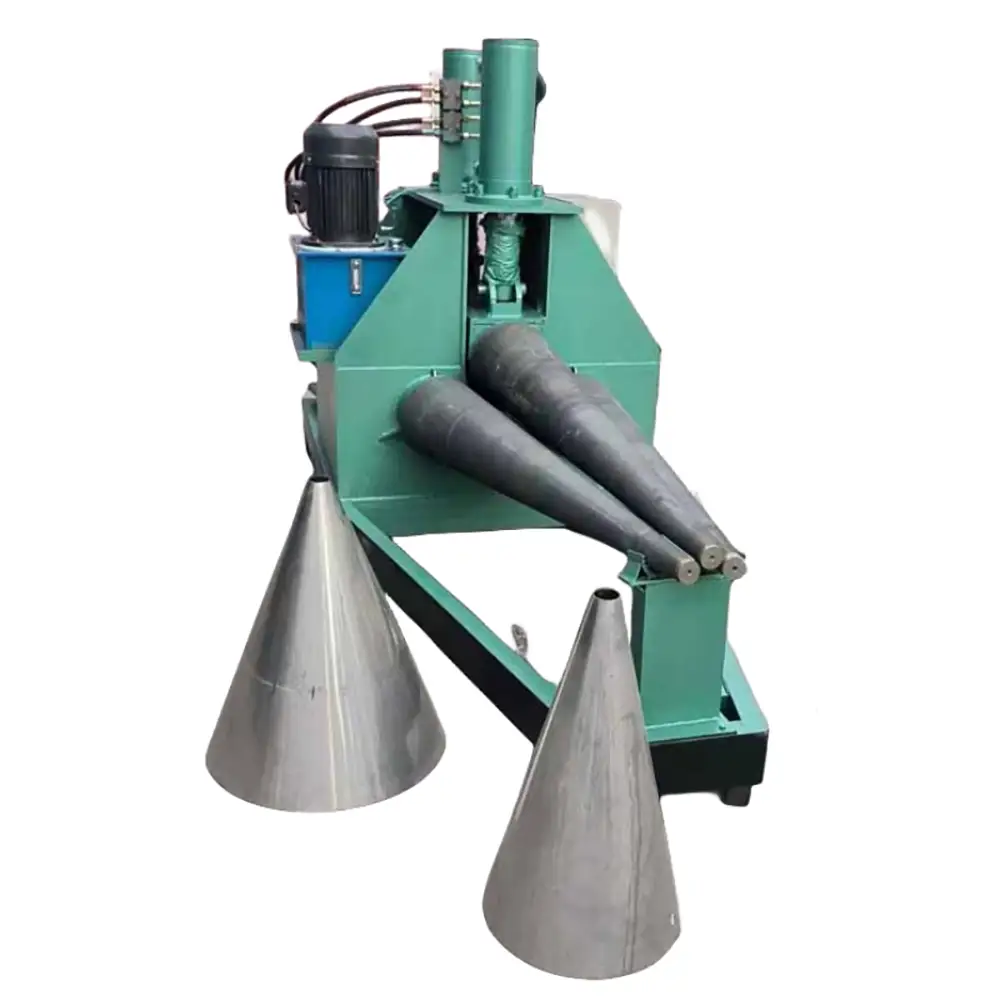
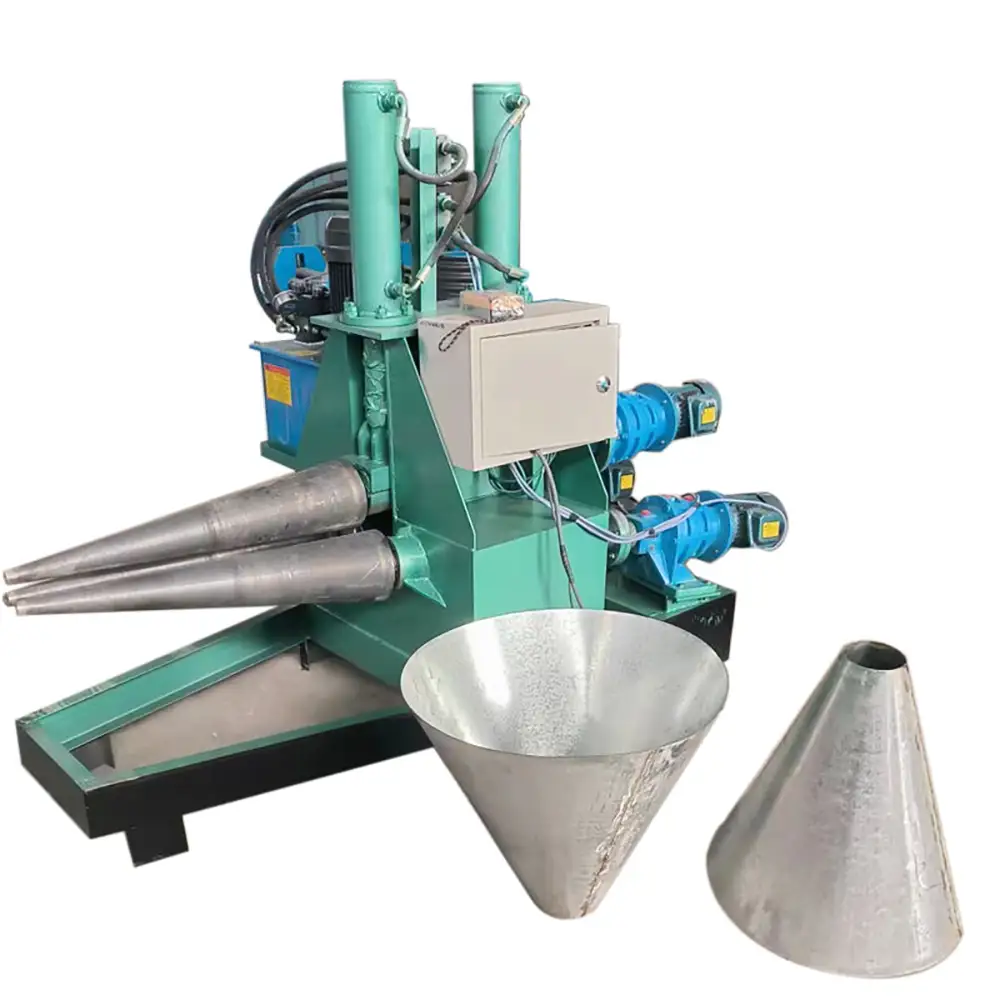
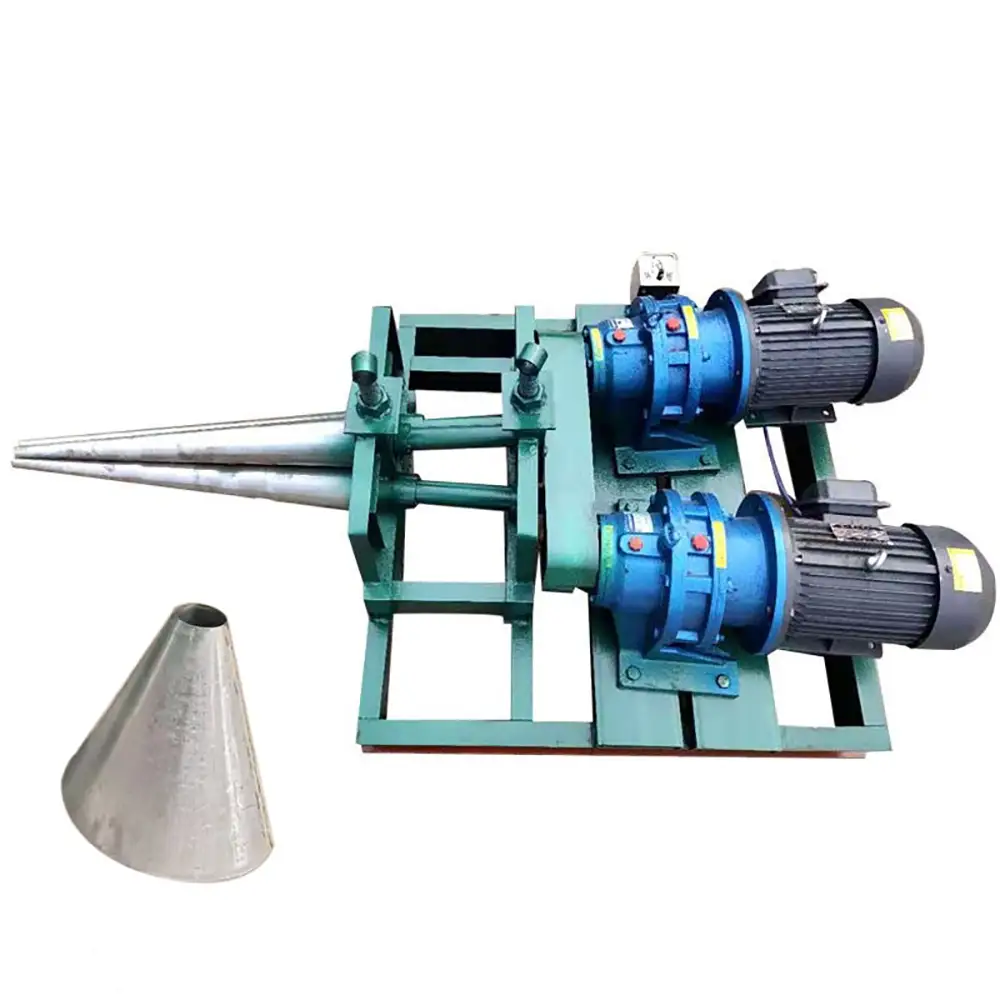
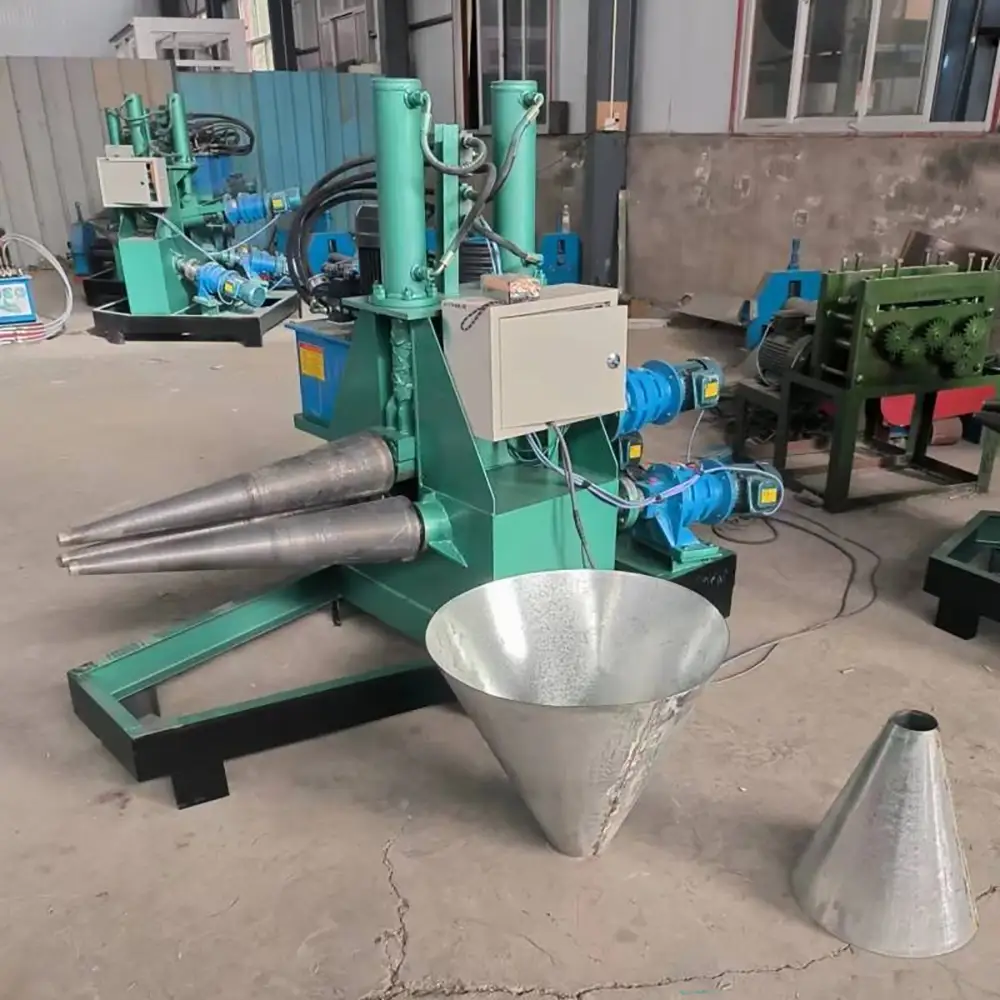
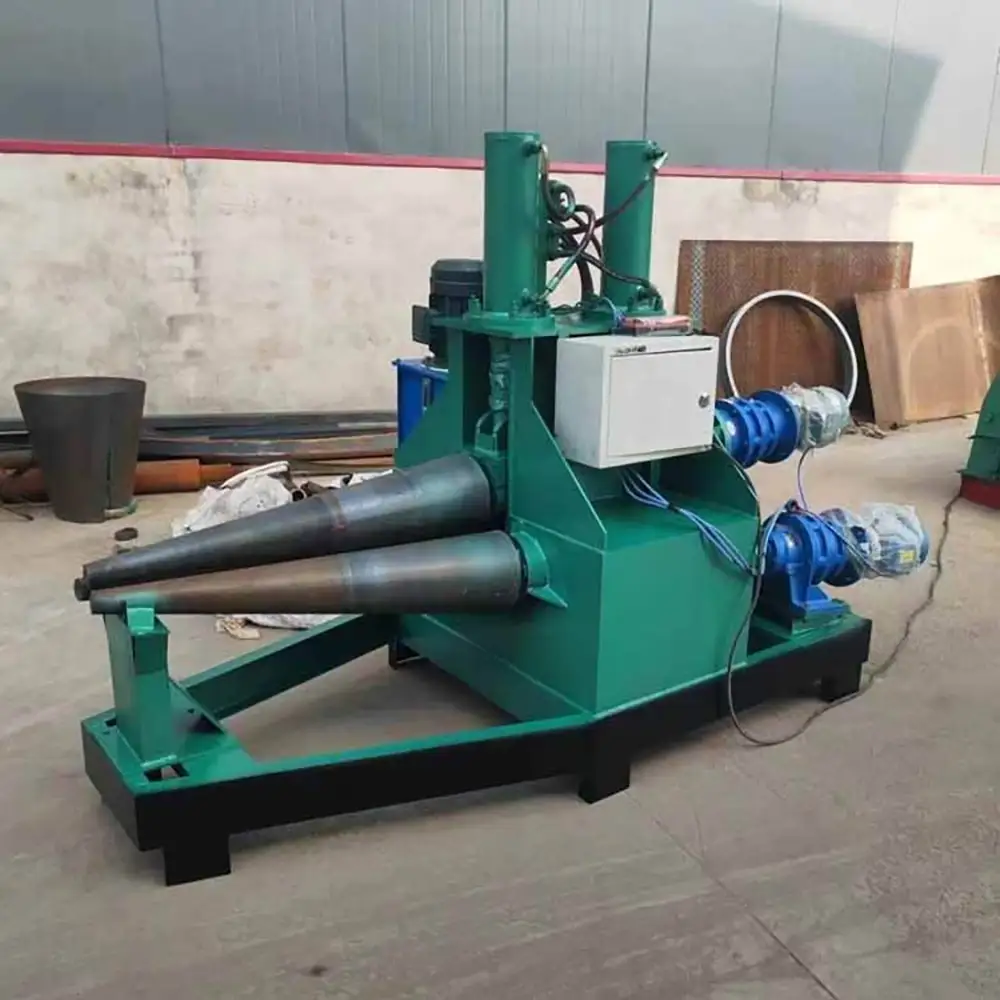
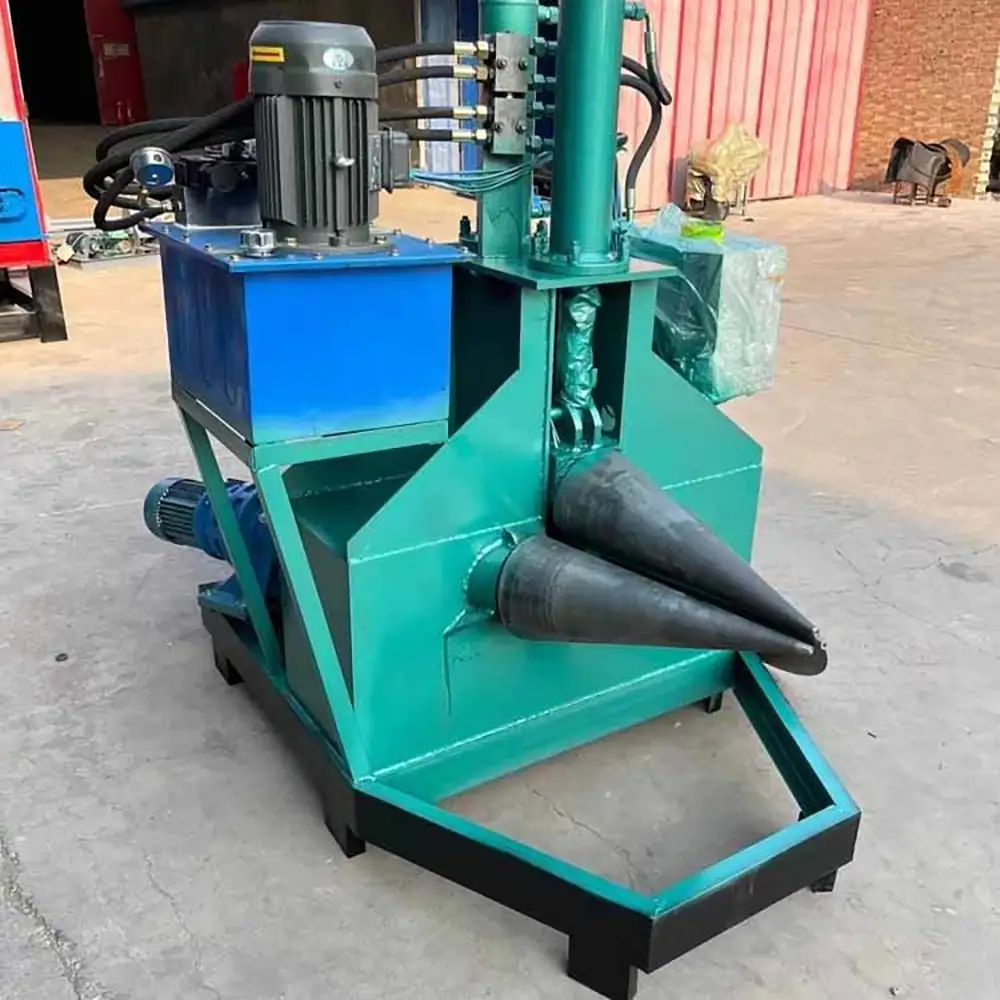
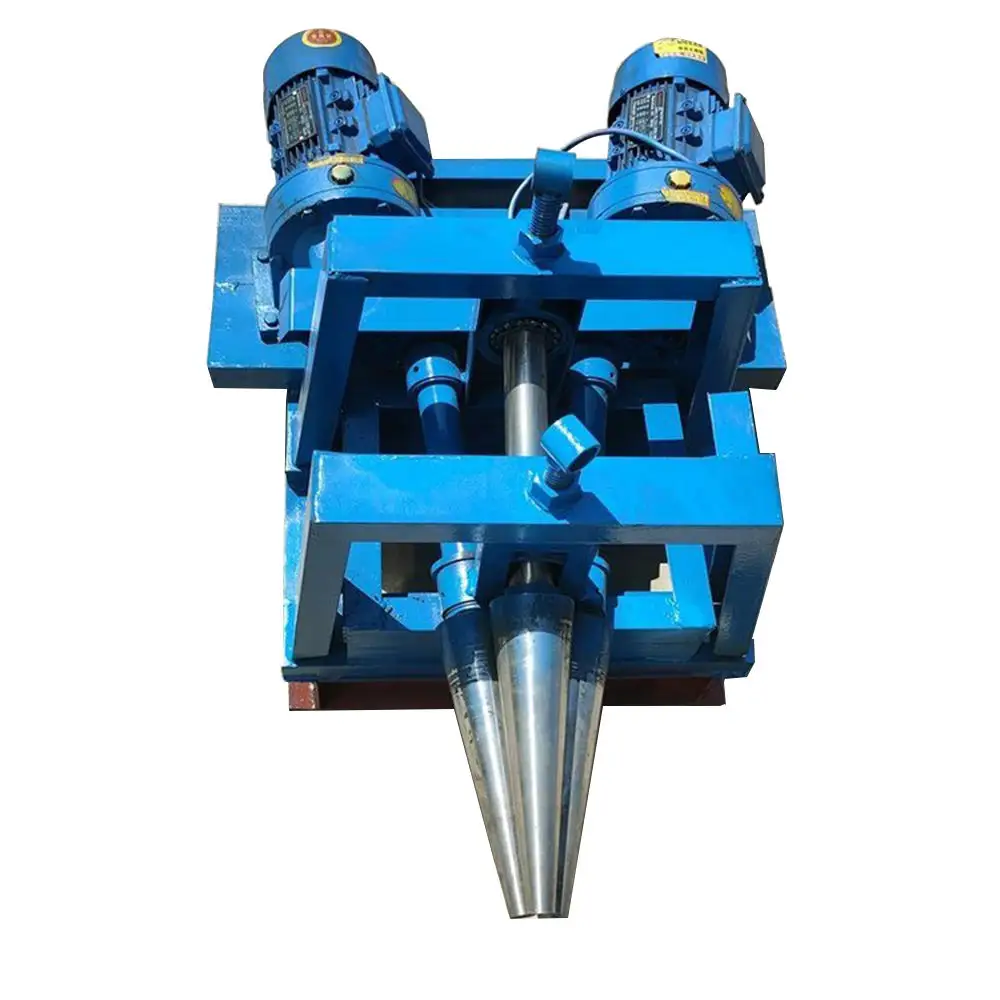
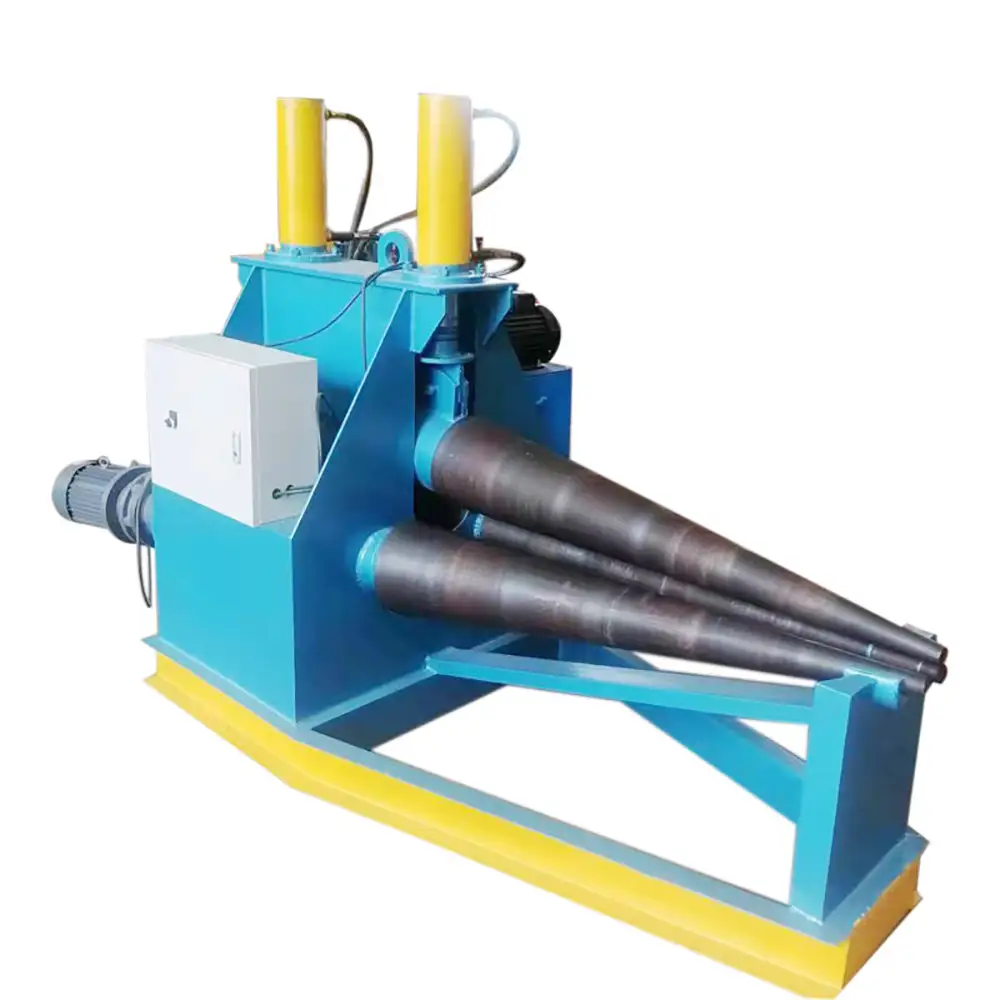
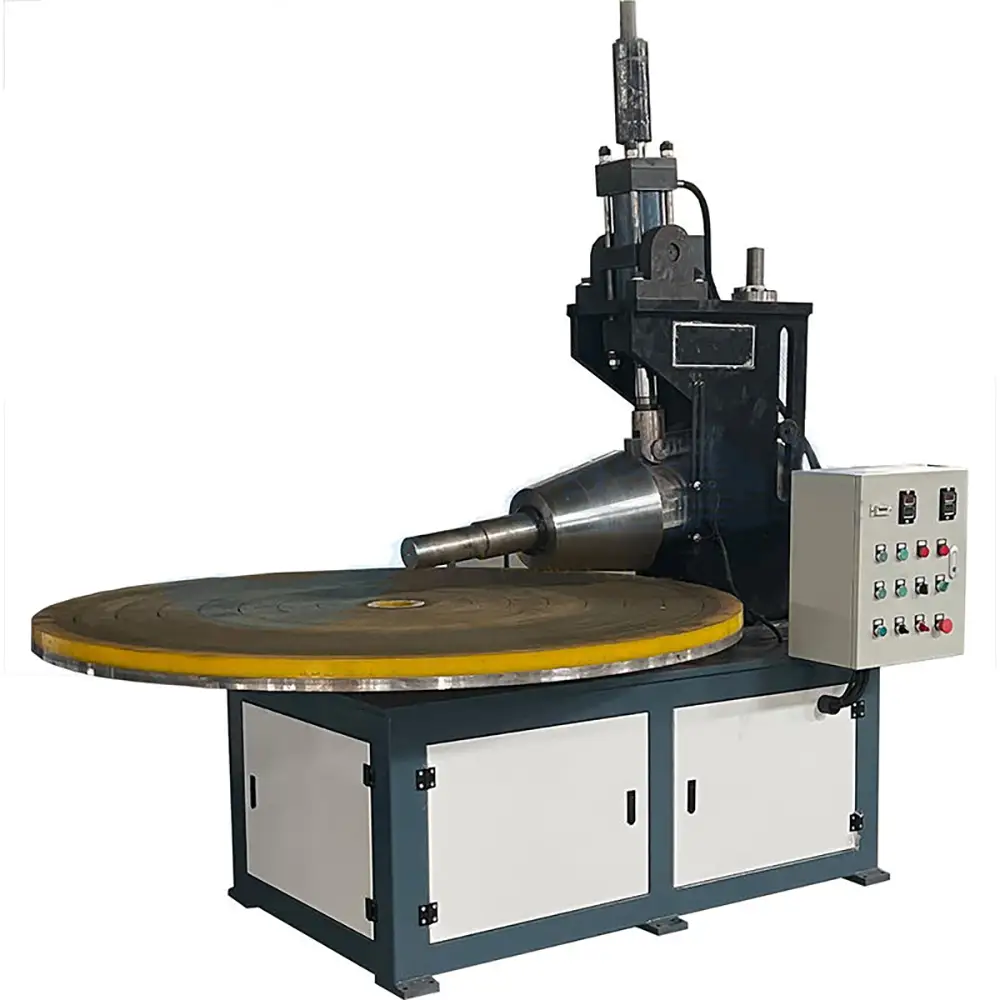
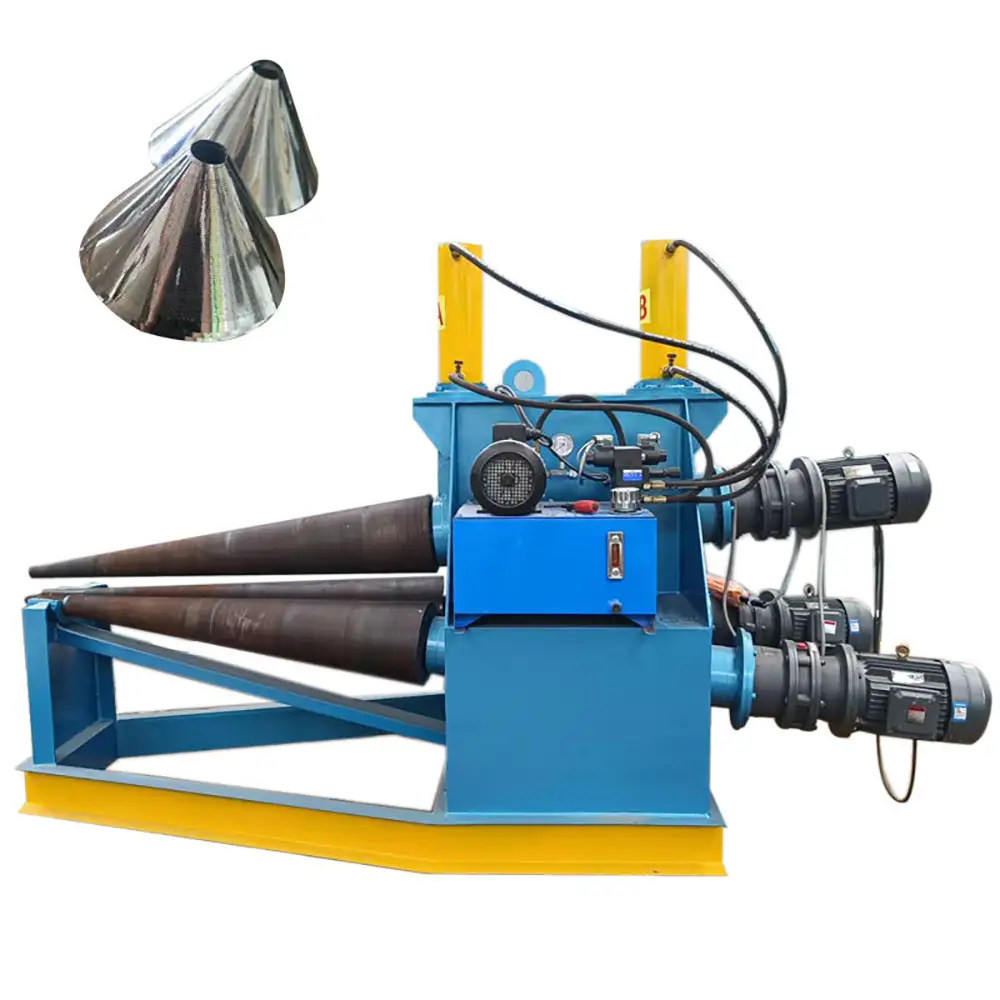
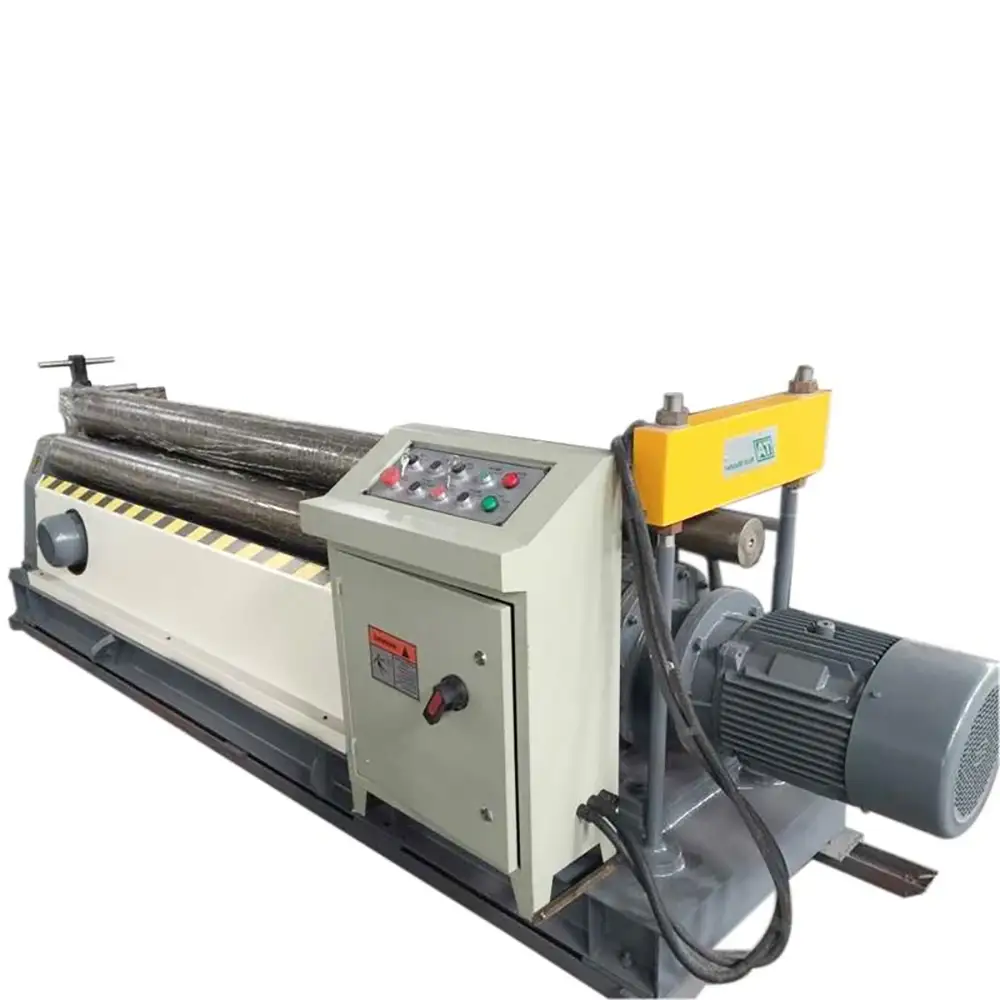
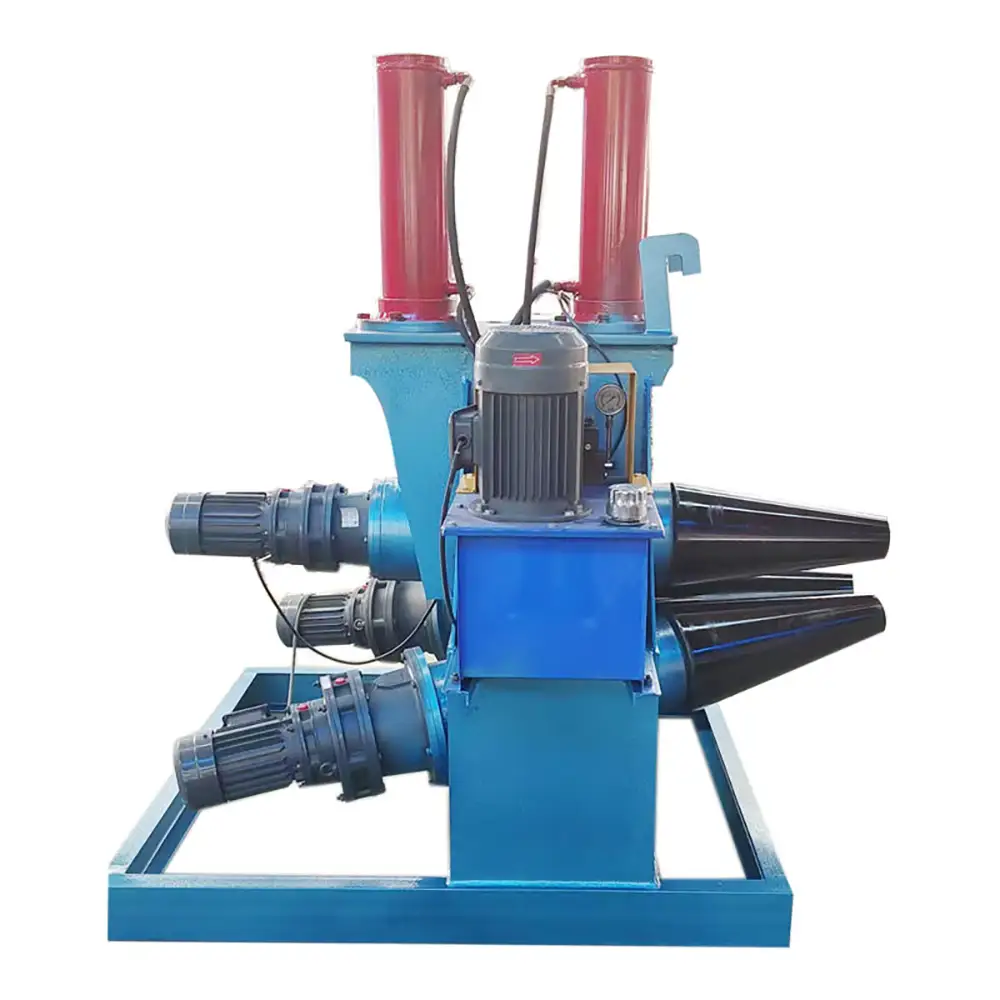
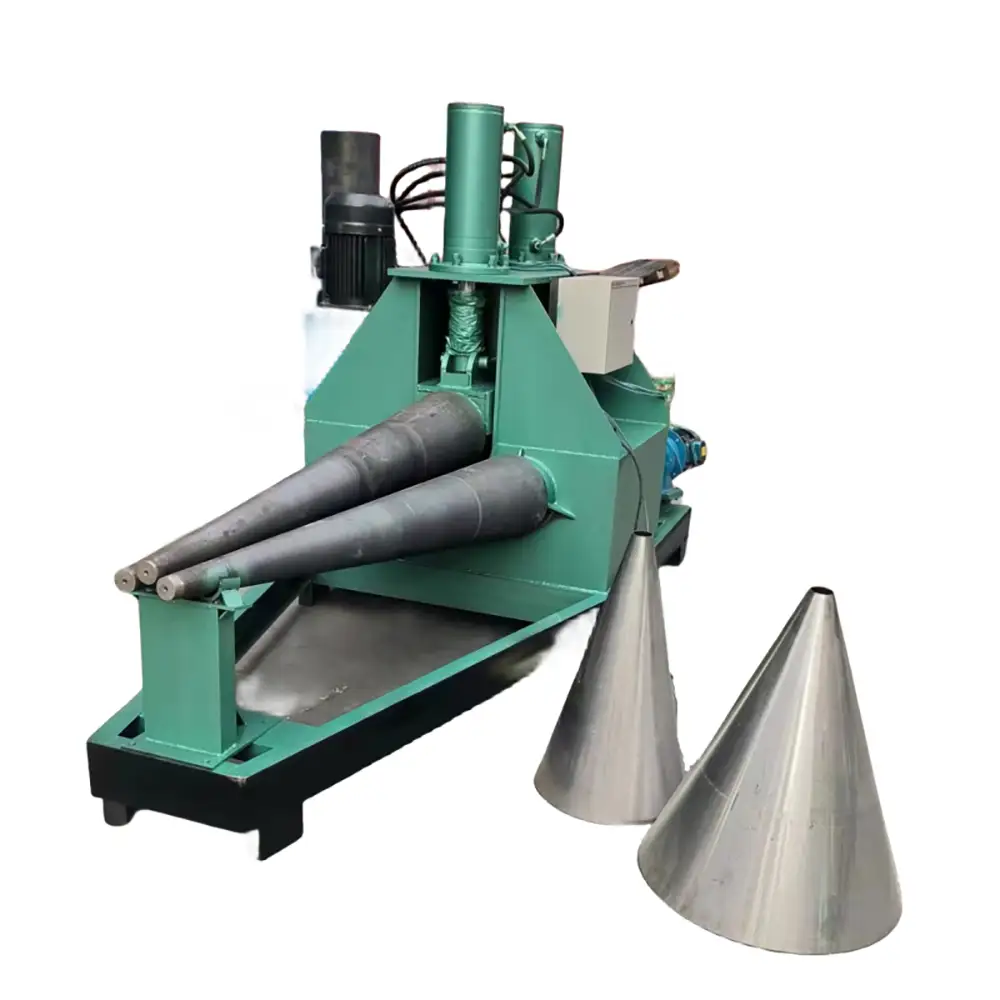
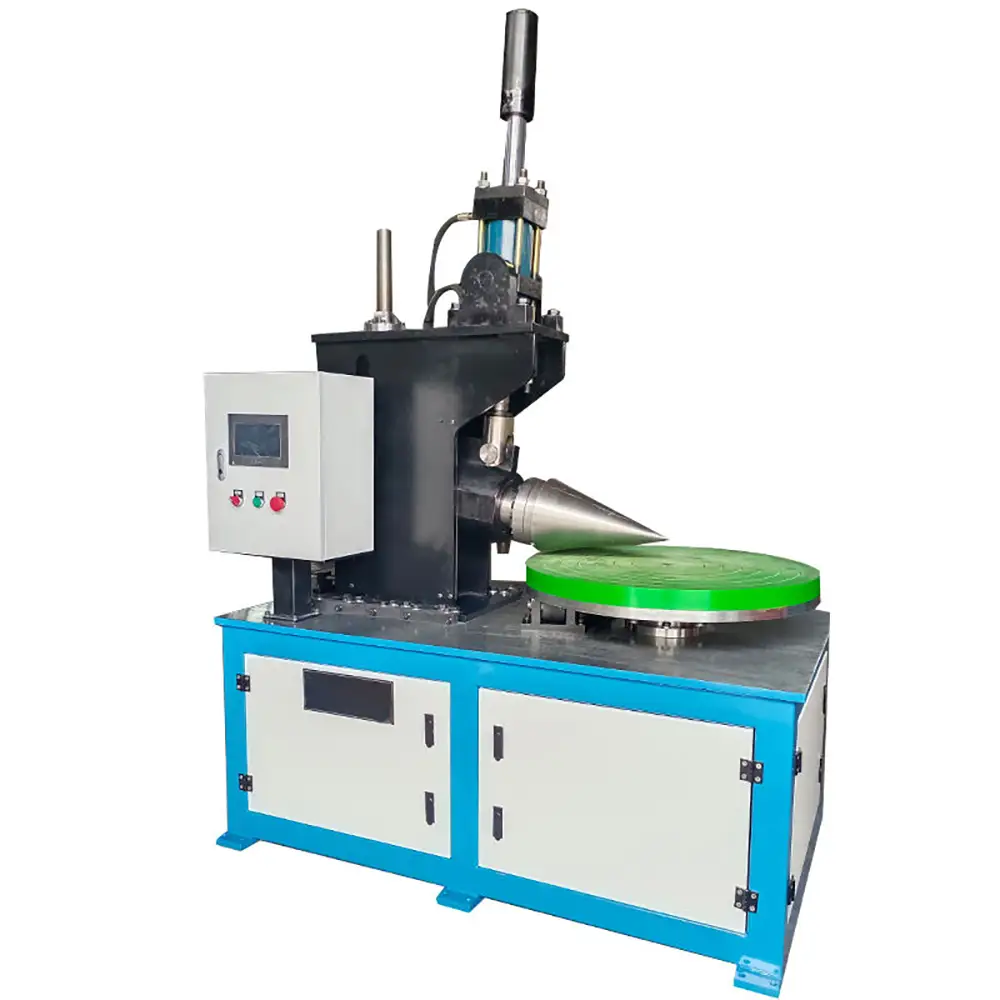
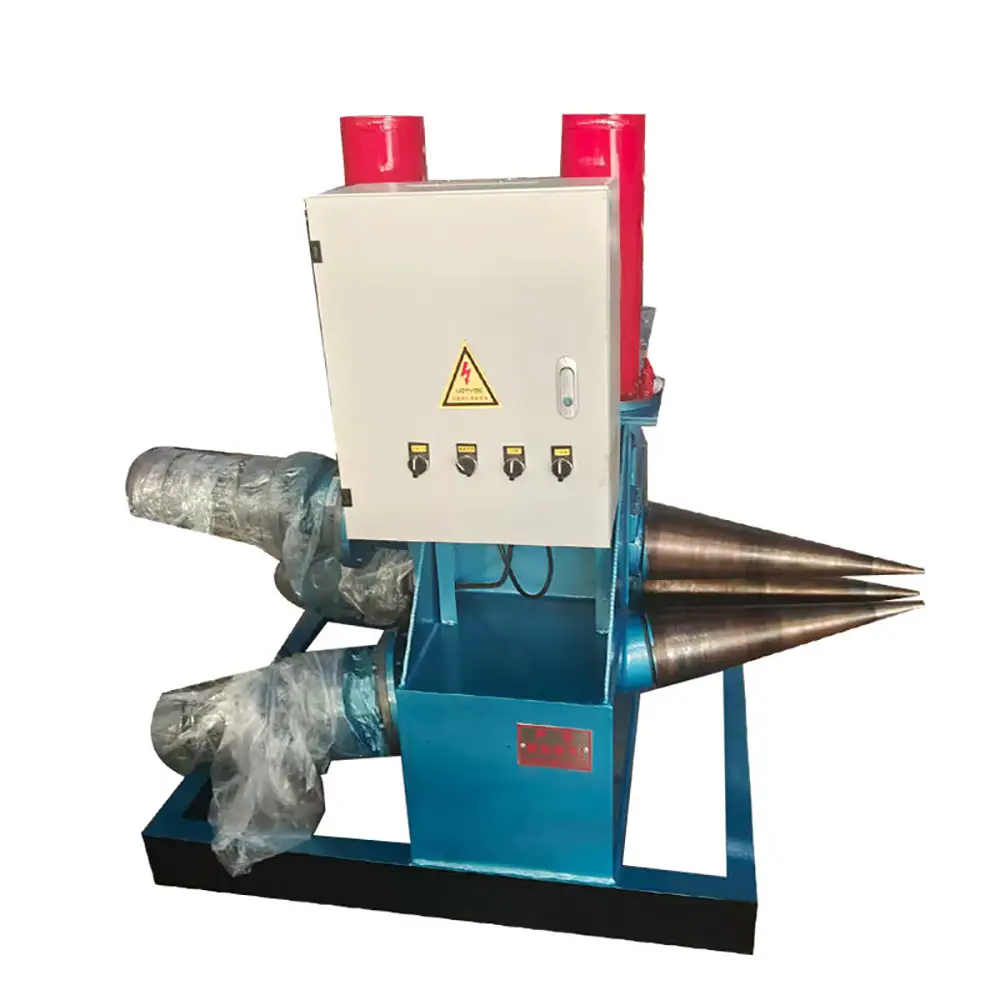
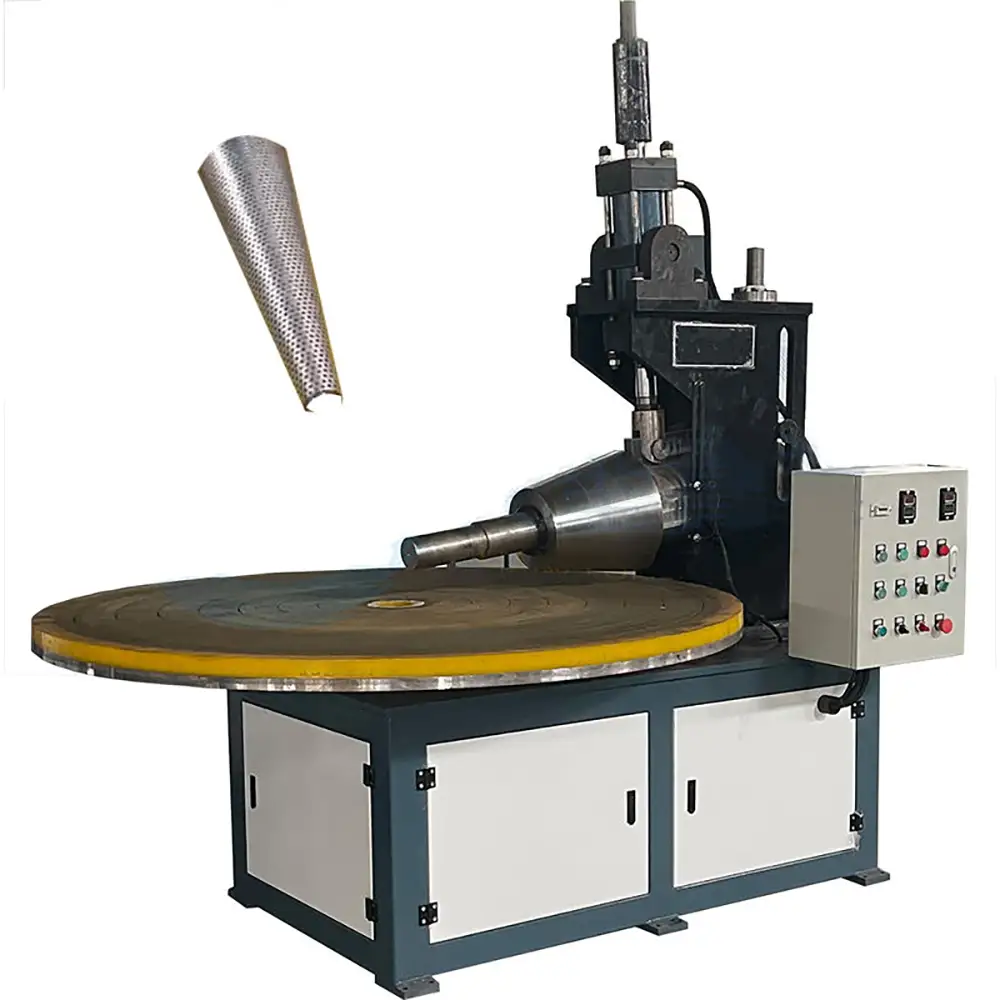
The plate rolling machine is a hydraulic three-roller cone plate rolling machine. The upper roller moves up and down at the symmetrical position in the center of the two bottom rollers, and adjustment power is obtained through hydraulic cylinder, and front and rear parts can be adjusted freely to make cones of different sizes. The bottom tapered rollers are respectively driven by a motor reducer (or driven by tow motors) to provide power for the sheet metal to run. The machine is electric rolling and hydraulic pressing.
|
Model |
3*500 |
4*1000 |
|
Roller big head diameter |
170mm |
220mm |
|
Roller small head diameter |
20 |
52 |
|
Roller length |
500mm |
1000mm |
|
Motor power |
3*750W |
3*1000w |
|
Oil station power |
3kw |
3kw |
|
Cylinder diameter |
110mm |
140mm |
|
Processing range |
Processable plate thickness stainless steel 2mm, Q235 plate 3mm |
High-frequency quenching treatment of roller
Machinable plate thickness stainless steel 3mm, Q235 plate 4mm |
|
Size |
1900x1500x1520mm |
2600x1200x1500 |
|
weight |
800kg |
1300kg |
A Taper Cone Rolling Machine is a specialized metal forming solution designed to roll flat sheet metal and steel plate into tapered,conical,and truncated-cone shapes. By combining controlled roller movement with hydraulic adjustment,the machine can produce consistent cone sections for fabrication shops,industrial manufacturers,and custom metalworking applications.
Unlike conventional cylindrical plate rolling machines,cone rolling equipment is designed to accommodate the different circumferential lengths that occur across a tapered workpiece. This makes the machine suitable for forming conical shells,transition sections,pipe reducers,hoppers,funnels,and other components where one end is larger or smaller than the other.
This Sheet Metal Cone Rolling Machine can be configured for different material types,plate thicknesses,and cone dimensions. Depending on the machine model and configuration,it may process carbon steel,stainless steel,aluminum,and other formable metals. Actual capacity depends on material yield strength,plate thickness,plate width,cone diameter,cone angle,and machine configuration.
Hydraulic Cone Rolling for Tapered Metal Sections
The hydraulic system provides controlled adjustment of the forming rolls and supports repeatable cone-forming operations. Hydraulic control can make setup and positioning more convenient,especially when processing heavier steel plate or larger workpieces.
A Hydraulic Cone Rolling Machine is particularly useful for manufacturers that need to produce tapered components in different sizes. Controlled roller positioning helps operators establish the required forming geometry before progressive rolling. The workpiece is normally formed through several controlled passes rather than being forced into the final cone shape in a single operation.
For production environments,the machine can be configured according to the required working length,plate thickness,roller diameter,maximum cone diameter,minimum cone diameter,and cone angle. These parameters should be confirmed against actual production drawings before selecting the machine.
Sheet Metal and Steel Plate Bending Roller
The machine functions as a specialized Steel Plate Bending Roller for conical applications. During the forming process,the sheet or plate passes between the forming rolls while the roller positions are adjusted to create the desired tapered geometry.
This design is suitable for processing:
Carbon steel plate
Stainless steel sheet and plate
Mild steel
Aluminum sheet and plate
Low-alloy steel
Other formable metal materials
Material behavior varies significantly between different alloys. Stainless steel may require different forming conditions than carbon steel because of its strength and springback characteristics. Aluminum can also require different roller settings to prevent surface damage or excessive deformation.
Cone Rolling Machine for Industrial Fabrication
A Cone Rolling Machine can be used in many industries where tapered metal sections are required. Typical applications include:
Pipe reducer fabrication
Hopper manufacturing
Funnel production
Dust collector components
Industrial duct transitions
Exhaust system components
Tank and vessel fabrication
Chemical equipment
Food processing equipment
Agricultural machinery
HVAC components
Mining equipment
Construction machinery
Custom metal fabrication
For example,a fabricated reducer may require a larger opening on one side and a smaller opening on the other. A cone rolling machine can form the flat blank into the required tapered section before longitudinal or circumferential welding and subsequent finishing operations.
Taper Cone Forming Process
The cone-forming process generally begins with a properly prepared flat plate blank. The blank should be cut according to the required development dimensions and checked for burrs,edge quality,and dimensional accuracy.
The workpiece is then positioned in the rolling machine. Initial pre-bending may be performed where required to reduce flat ends. The forming rolls are adjusted to establish the taper,and the plate is progressively rolled through the machine.
Several passes may be required depending on the material,plate thickness,cone diameter,and desired cone angle. Operators can gradually increase the forming deformation while monitoring the shape of the workpiece.
After rolling,the formed cone can undergo additional fabrication processes such as welding,trimming,edge preparation,grinding,calibration,and dimensional inspection.
Hydraulic Roller Design and Production Control
Hydraulic roller adjustment provides useful control during cone forming. Depending on the machine design,the hydraulic system can control roller movement and assist with workpiece positioning.
For industrial production,this can help reduce manual adjustment and improve repeatability between batches. However,actual automation level depends on the selected machine configuration. Some systems are manually operated with hydraulic assistance,while more advanced configurations can integrate CNC control,programmable positioning,and automated sequences.
Manufacturers should select the appropriate control system based on production volume,part variety,operator skill,and required dimensional consistency.
Applications for Pipe Reducers and Conical Components
One of the most common applications is forming pipe reducers and tapered transition sections. These components are used to connect different pipe diameters in industrial piping systems.
The rolling machine can also form conical sections for hoppers and funnels. In material handling equipment,a tapered hopper can guide bulk materials toward a smaller discharge opening. In industrial ventilation and dust collection systems,conical transitions can connect components with different diameters or cross-sectional dimensions.
For tank and vessel fabrication,the machine may be used to produce conical roofs,transition sections,and other tapered shell components. The final design and forming method should always be evaluated according to the material,dimensions,and applicable fabrication requirements.
Custom Cone Rolling Machine Solutions
Different customers have different cone dimensions and production requirements. A machine suitable for thin stainless steel sheet may not be appropriate for heavy carbon steel plate. For this reason,cone rolling equipment should be selected based on actual drawings and material specifications.
Custom configurations may include different roller diameters,working lengths,hydraulic capacities,control systems,side supports,and auxiliary equipment. OEM manufacturing can also be considered when a customer requires a machine designed around a specific production process.
Before ordering,it is recommended to provide the manufacturer with information such as:
Maximum plate thickness
Maximum plate width
Material type
Maximum cone diameter
Minimum cone diameter
Cone angle
Required production volume
Finished component drawings
Required automation level
This information helps the manufacturer recommend a suitable configuration rather than relying only on nominal machine capacity.
Quality and Precision Considerations
Successful cone rolling depends on more than machine capacity. Plate preparation,material properties,blank dimensions,roller adjustment,and forming sequence all affect the final geometry.
Proper pre-bending is important because unformed straight ends can affect the finished cone. Consistent plate thickness and accurate blank cutting can also improve repeatability.
After forming,the cone should be checked for diameter,angle,roundness,edge alignment,and other dimensions required by the application. When the component requires welding,the rolled shape may also need adjustment before final welding and inspection.
B2B Manufacturing and OEM Supply
For distributors,metal fabrication companies,and industrial equipment manufacturers,a cone rolling machine can be supplied as part of a complete metal forming solution. Factory-direct purchasing can provide options for machine customization,technical consultation,spare parts,and after-sales support.
OEM and Custom manufacturing are available for customers with special dimensions,control requirements,or production processes. Technical drawings,material information,and sample workpieces can be used to evaluate the appropriate machine configuration.
Whether you need a compact cone rolling machine for smaller fabrication work or a hydraulic steel plate rolling machine for heavy industrial production,the machine should be matched to your actual forming requirements.
Why Choose Us
Specialized Cone Rolling Solutions
We focus on metal forming equipment for tapered,conical,and cylindrical workpieces.
Hydraulic Forming Technology
Hydraulic roller adjustment provides controlled positioning for demanding cone-forming applications.
Flexible Machine Configuration
Working length,roller dimensions,hydraulic capacity,and control options can be selected according to production requirements.
Wide Material Compatibility
Machines can be configured for carbon steel,stainless steel,aluminum,and other suitable sheet and plate materials.
Custom OEM Manufacturing
We can develop customized machine configurations based on drawings,dimensions,and production requirements.
Industrial B2B Experience
Our equipment is designed for manufacturers,metal fabricators,distributors,and industrial equipment suppliers.
Technical Support
We can assist with machine selection,forming requirements,configuration,and operating considerations.
Factory-Direct Supply
Direct factory sourcing supports customized specifications,spare parts,and long-term cooperation for international customers.
FAQs
1. What is a Taper Cone Rolling Machine?
A Taper Cone Rolling Machine is designed to form flat metal sheet or plate into tapered and conical sections. It is commonly used for reducers,hoppers,funnels,transitions,and other conical components.
2. What materials can the cone rolling machine process?
Depending on the machine configuration,it can process carbon steel,stainless steel,aluminum,mild steel,and other formable metals.
3. Can it roll stainless steel plate?
Yes. Stainless steel can be processed when the machine capacity and roller configuration are suitable for the required thickness and material grade.
4. Can this machine make pipe reducers?
Yes. Cone rolling machines are commonly used to form tapered blanks for pipe reducers. Additional welding,trimming,and finishing may be required after rolling.
5. What is the difference between cone rolling and normal plate rolling?
Normal plate rolling is generally optimized for cylindrical or curved sections with relatively consistent geometry. Cone rolling accommodates the changing radius of a tapered workpiece.
6. Is the machine fully automatic?
Automation depends on the selected configuration. Hydraulic assistance can reduce manual adjustment,while CNC or programmable systems can provide more advanced positioning and process control.
7. Can it form large steel plates?
Yes,depending on the machine model. Large-plate applications require appropriate roller diameter,working length,hydraulic capacity,and structural strength.
8. Can the machine produce small cones?
Yes. The minimum cone diameter depends on the machine design,roller diameter,plate thickness,and material properties. These parameters should be confirmed before ordering.
9. Can you customize the cone rolling machine?
Yes. Custom and OEM configurations can be developed according to plate dimensions,material,cone geometry,production requirements,and control preferences.
10. What information is needed for machine selection?
Important information includes plate thickness,width,material type,maximum and minimum cone diameters,cone angle,production volume,and component drawings.
11. Does the machine require pre-bending?
Pre-bending may be required to improve the final geometry and reduce unformed straight sections. The exact process depends on the machine configuration and workpiece design.
12. What industries use cone rolling machines?
They are used in metal fabrication,pipe manufacturing,tank and vessel production,HVAC,dust collection,chemical equipment,agricultural machinery,construction equipment,and many other industrial applications.
Prev:
Multifunction Roller Cone Hydraulic Rolling Machine for Pre Rolled Cone Machine
Next:
Automatic Taper Cone Rolling Machine Cone Bending Roller Roll Forming Machines for Pre Rolled Cones
TAG:
Cone Forming Machine,
Sheet Metal Rolling Machine,
Steel Plate Rolling Machine,
Automatic Cone Rolling Machine,
Three Roller Cone Rolling Machine,
Industrial Cone Rolling Machine,
Industrial Cone Forming Machine,
Cone Reducer Forming Machine,
Hopper Cone Forming Machine,
Metal Plate Bending Machine,
Hydraulic Plate Rolling Machine,
Stainless Steel Cone Rolling Machine,
Steel Cone Rolling Machine,
Carbon Steel Cone Rolling Machine,
Steel Cone Forming Machine,
Sheet Metal Cone Bending Machine,
Cone Rolling Machine,
Conical Plate Bending Machine,
Metal Sheet Bending Machine,
CNC Cone Rolling Machine,
Metal Cone Rolling Machine,
Metal Cone Forming Machine,
Hydraulic Cone Rolling Machine,
Cone Bending Machine,
Hopper Cone Rolling Machine,
Reducer Cone Rolling Machine,
Conical Hopper Forming Machine,
Conical Plate Rolling Machine,
Taper Cone Rolling Machine,
Taper Cone Bending Machine,
Related Category:
Taper Cone Rolling Machine,Sheet Metal Cone Rolling Machine,Steel Plate Bending Roller,Cone Hydraulic Rolling Machine,Hy China, suppliers, manufacturers, factory, customized, wholesale, quotation, made in China