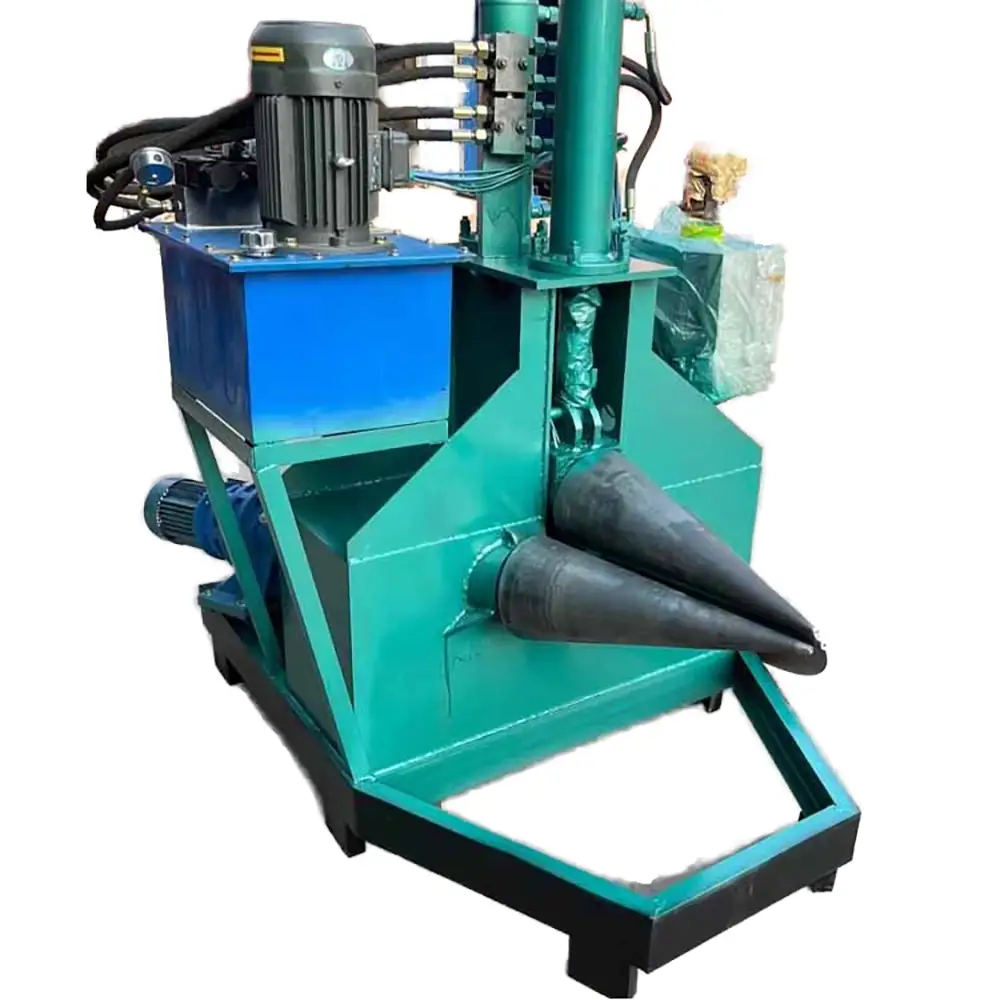
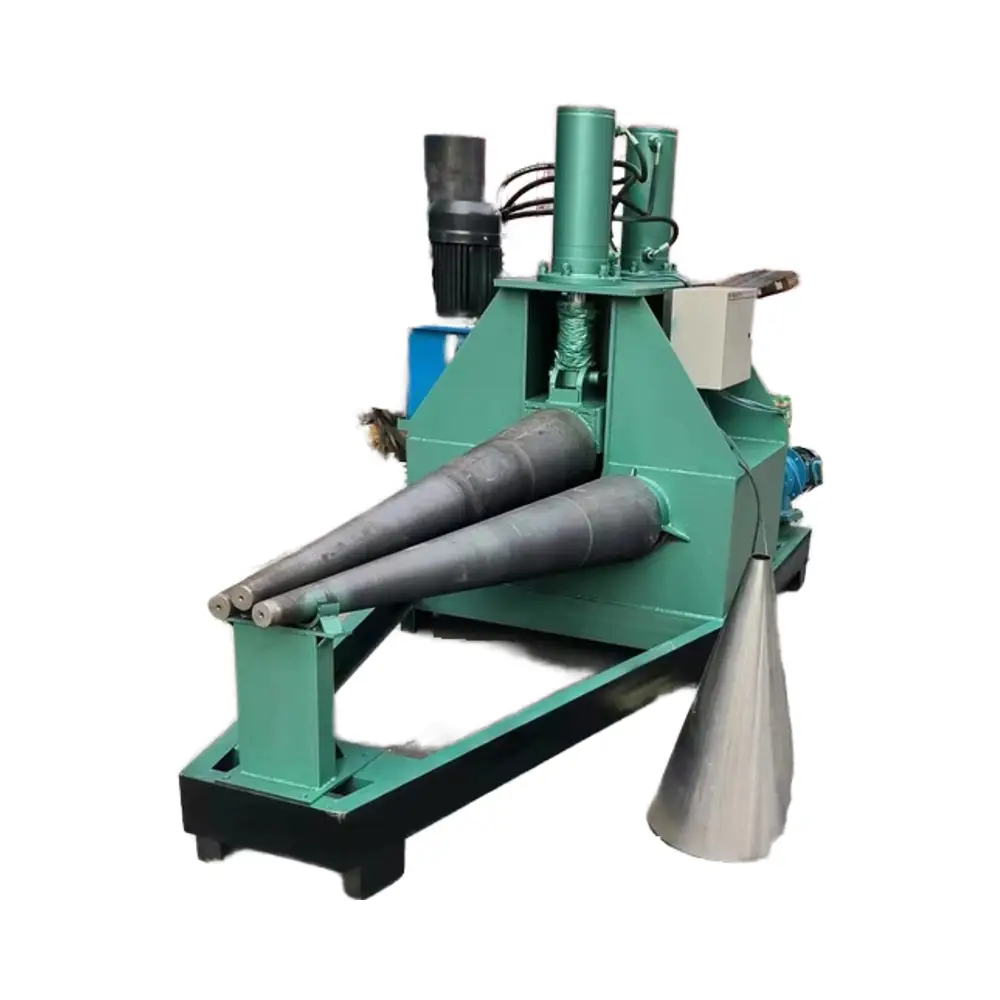
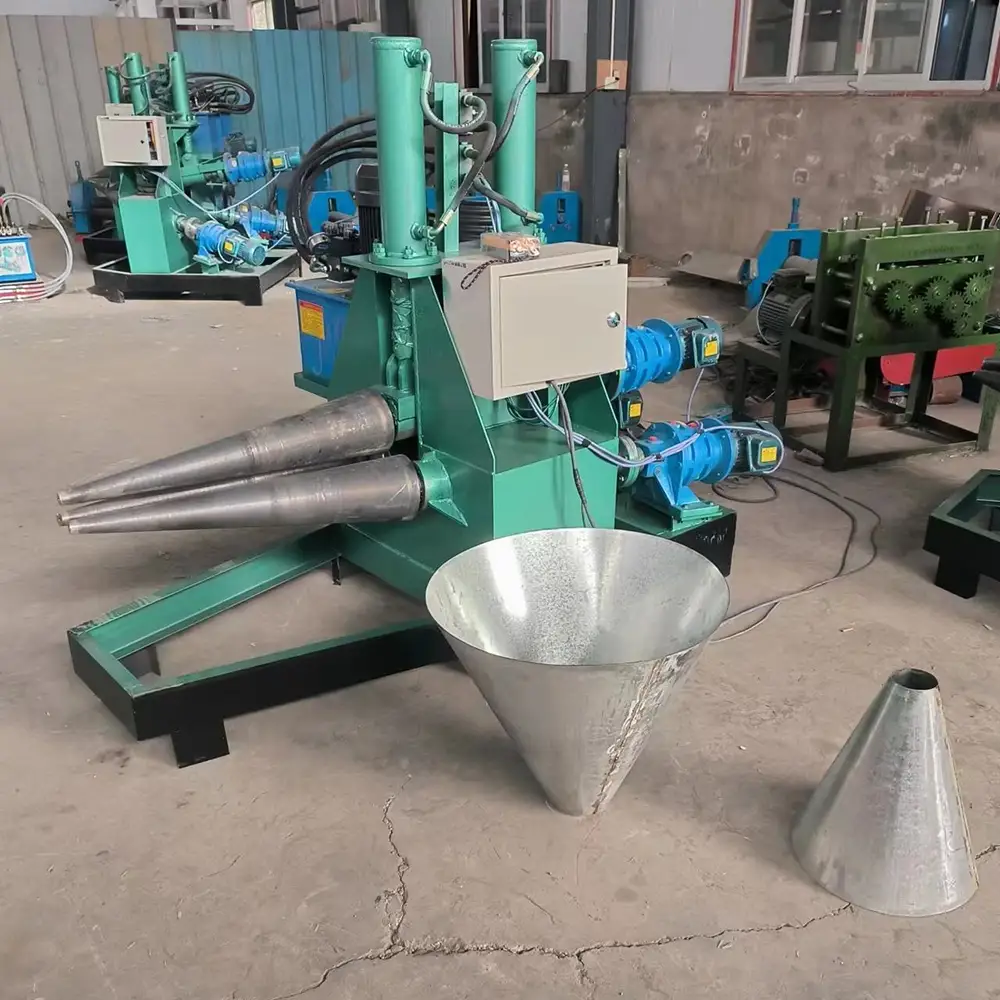
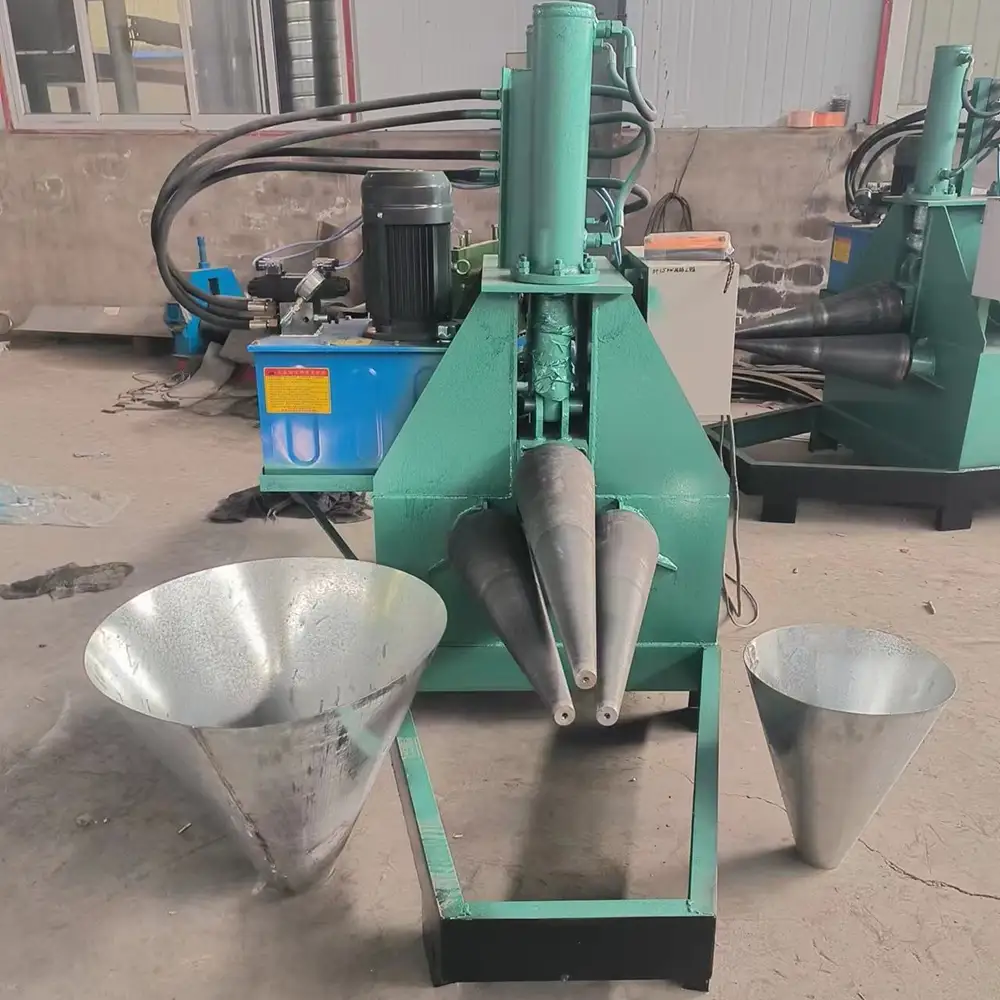
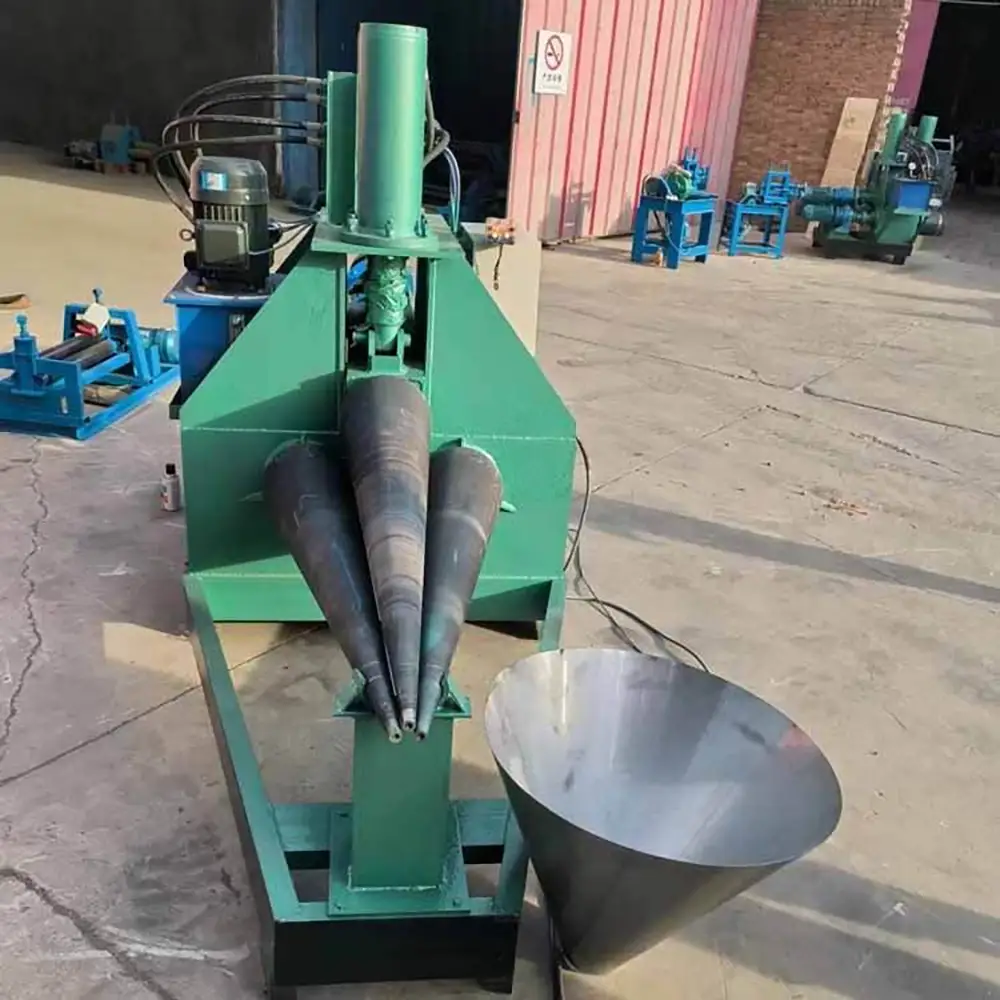
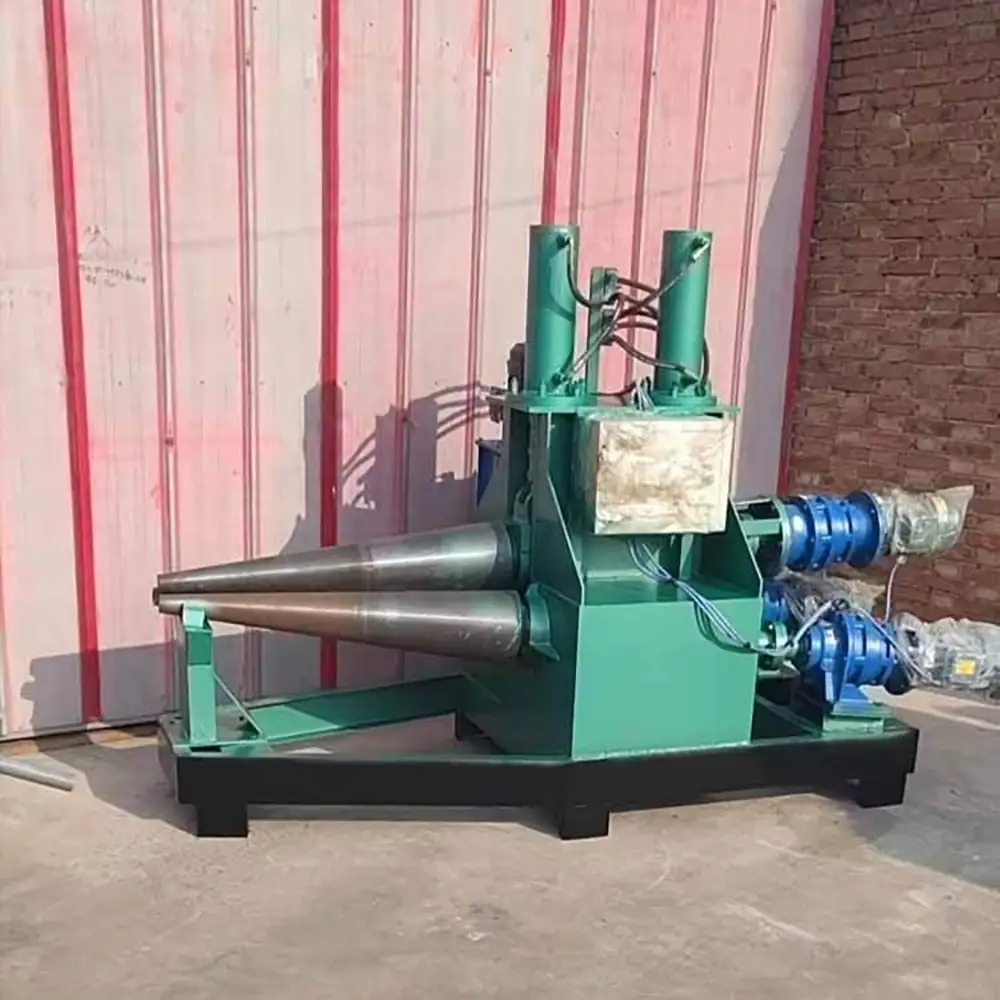
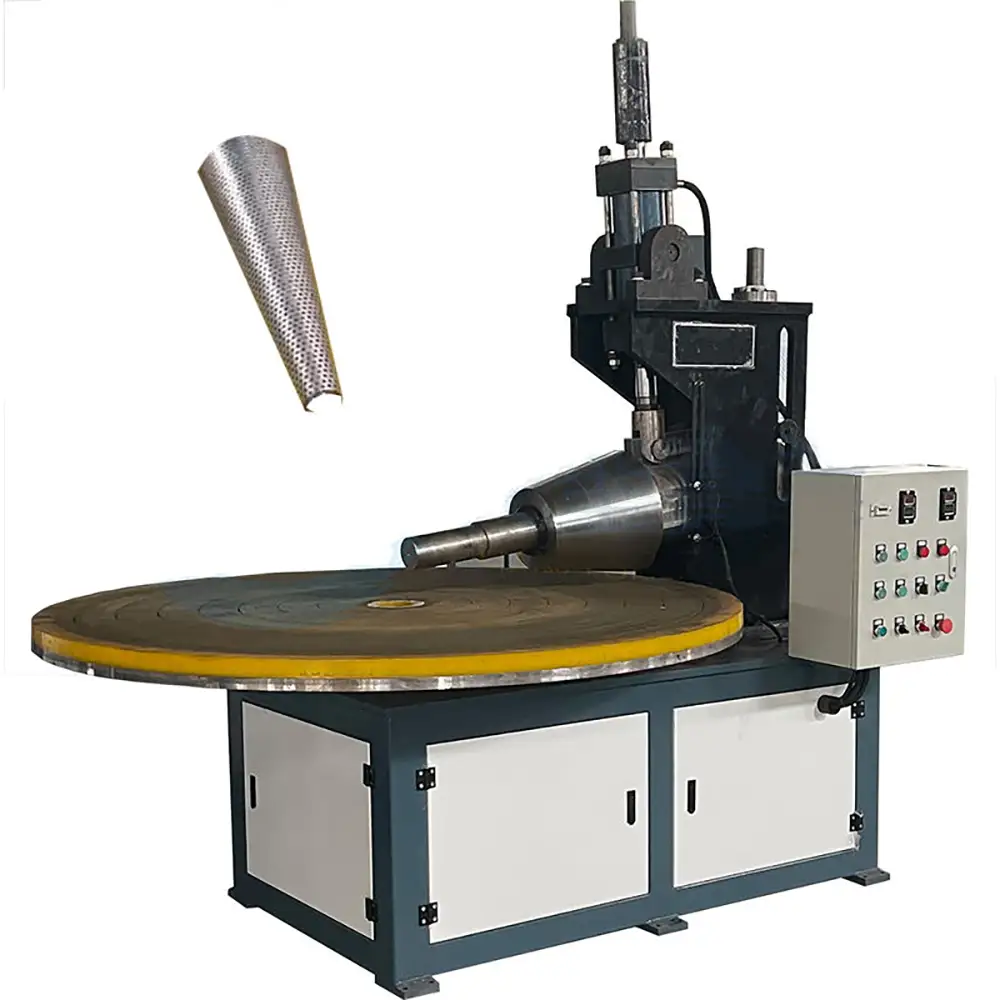
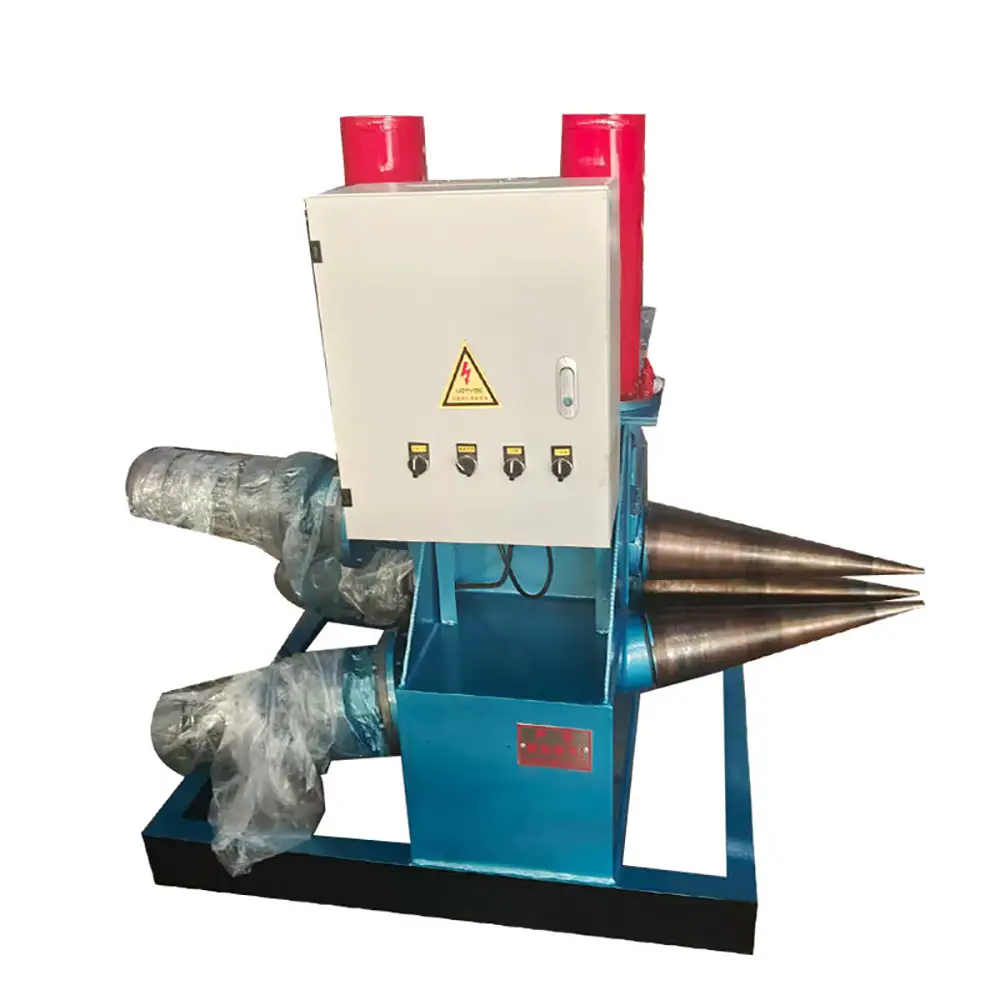
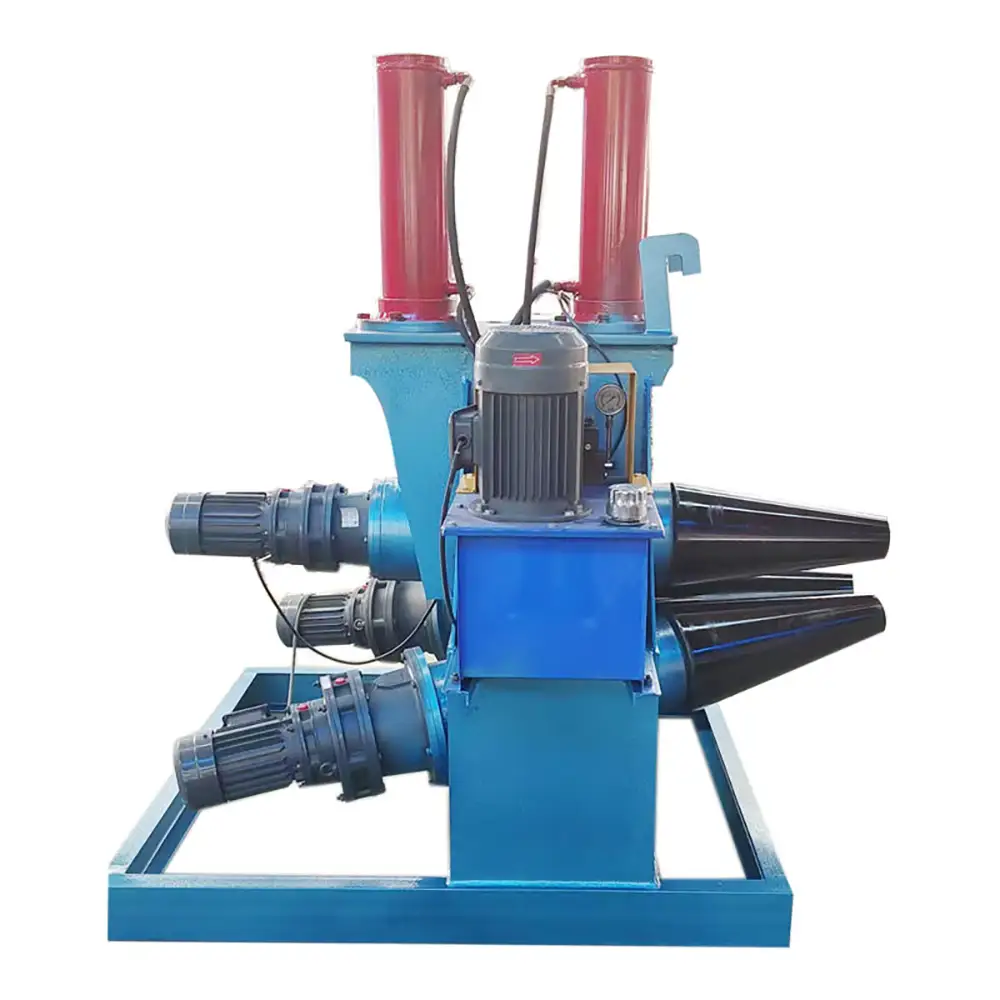
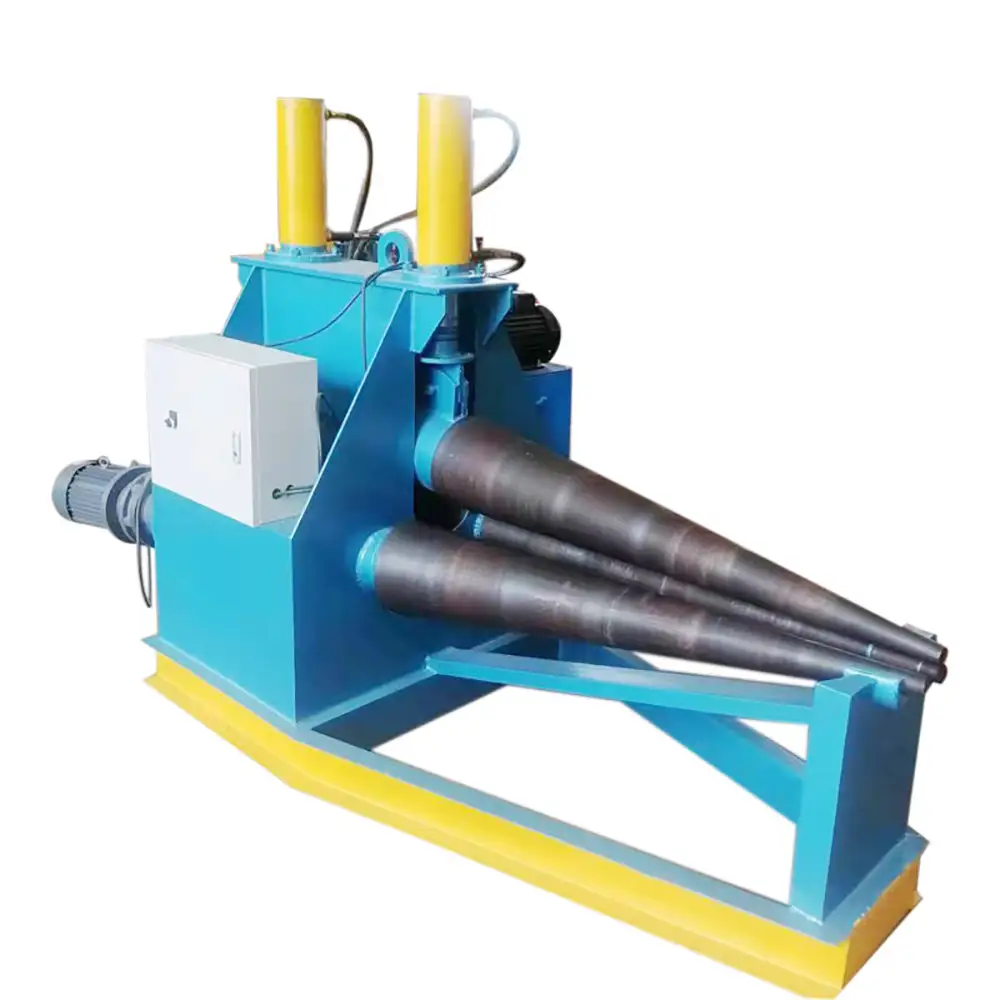
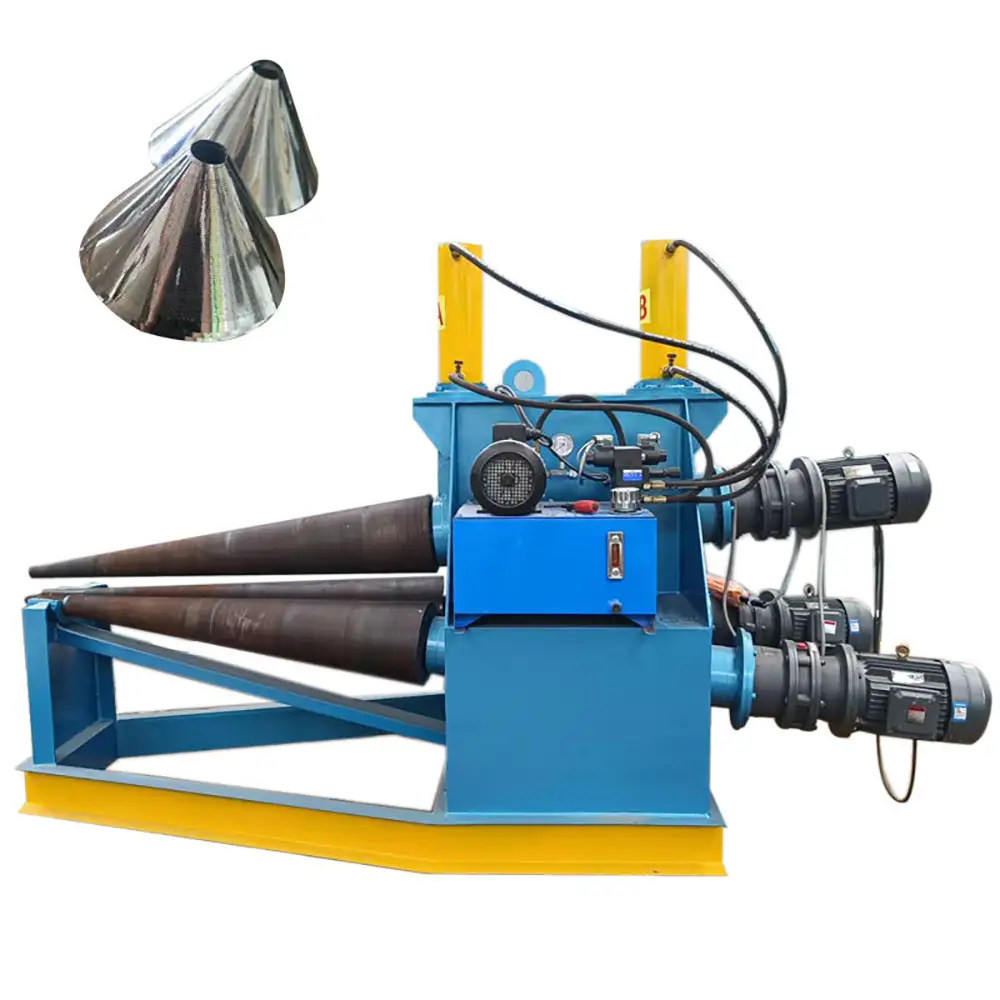
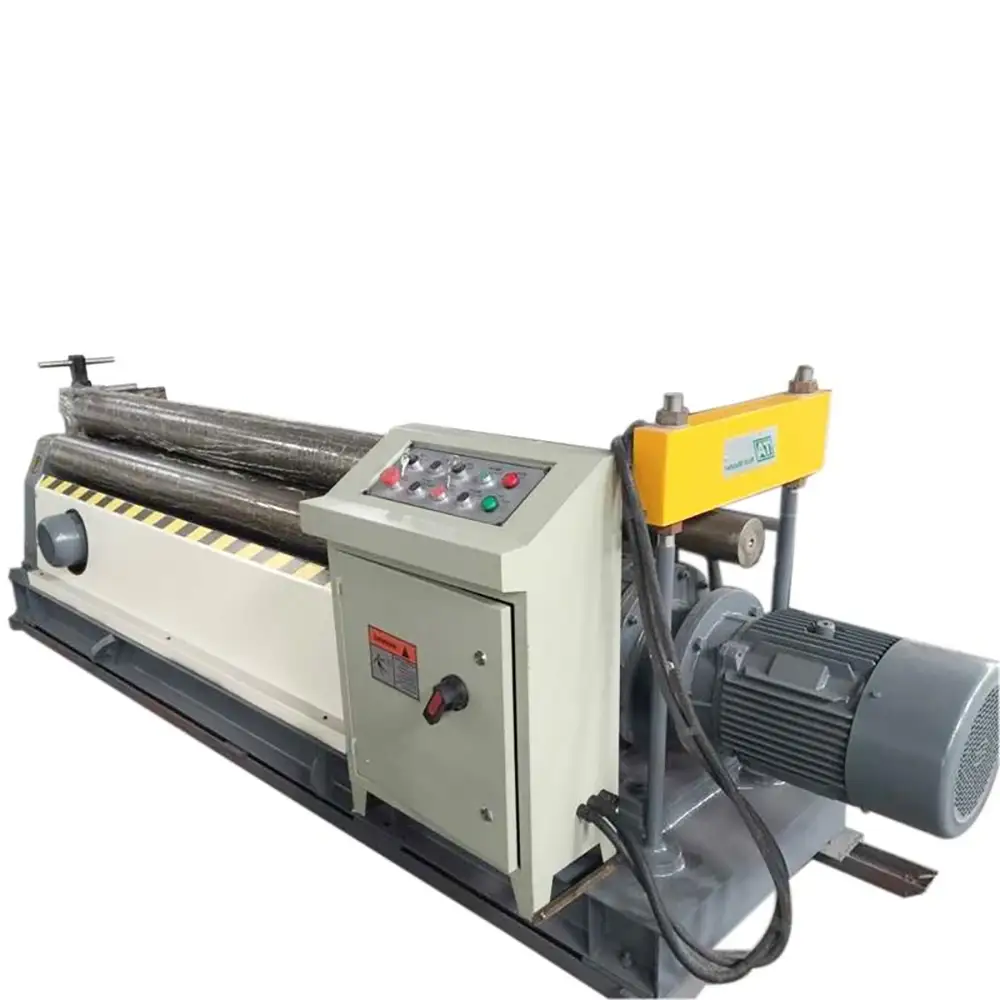
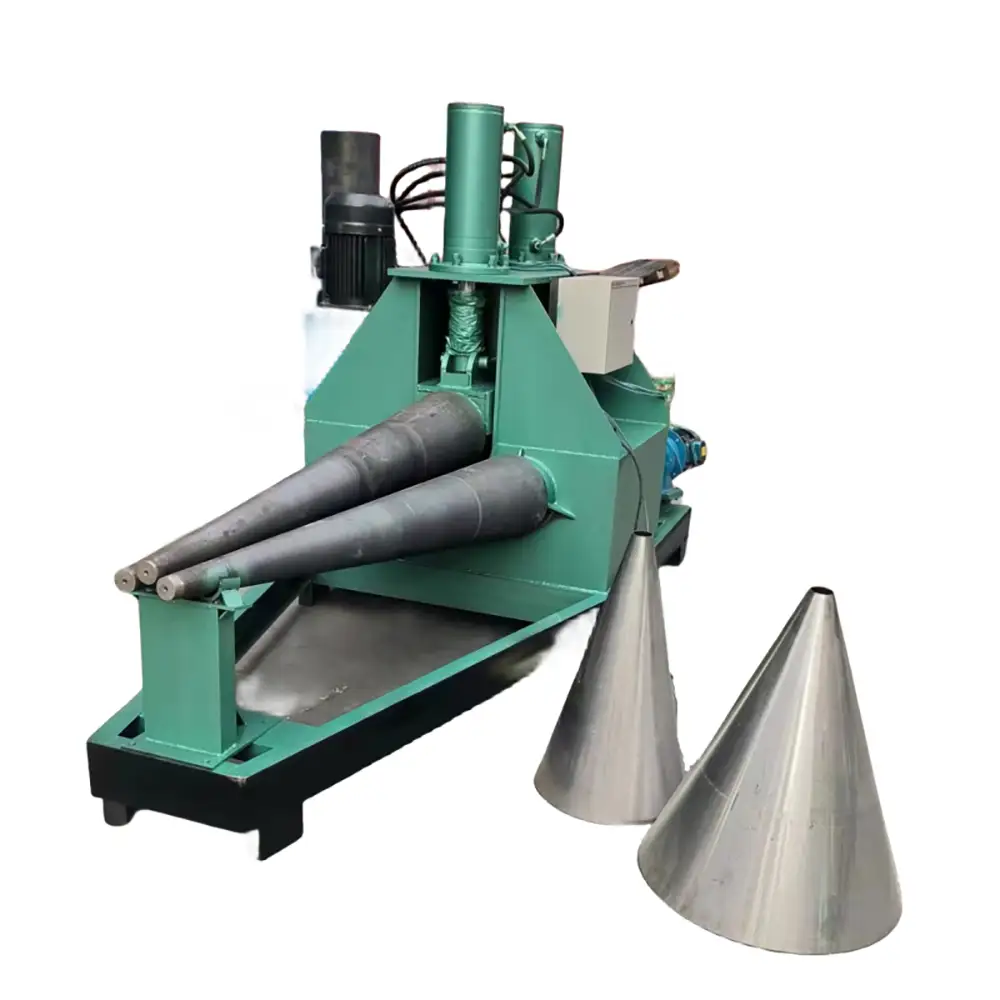
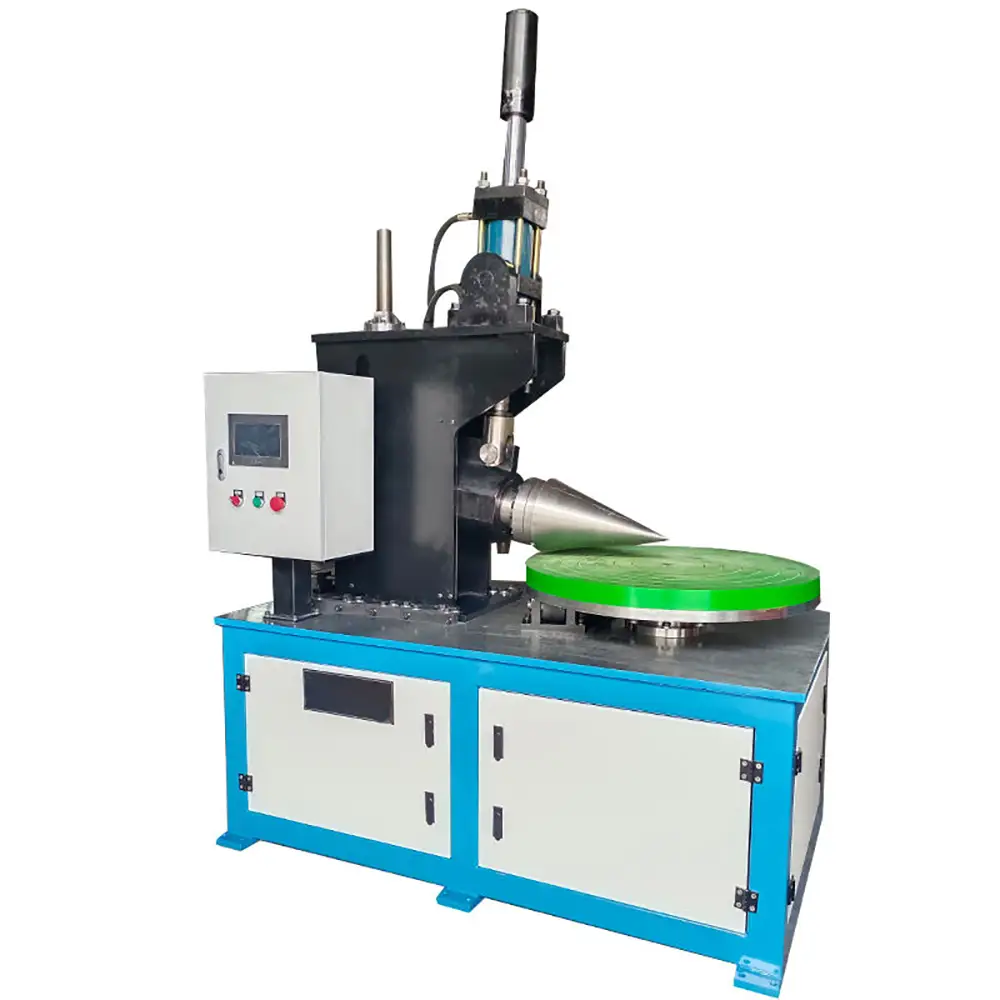
The plate rolling machine is a hydraulic three-roller cone plate rolling machine. The upper roller moves up and down at the symmetrical position in the center of the two bottom rollers, and adjustment power is obtained through hydraulic cylinder, and front and rear parts can be adjusted freely to make cones of different sizes. The bottom tapered rollers are respectively driven by a motor reducer (or driven by tow motors) to provide power for the sheet metal to run. The machine is electric rolling and hydraulic pressing.
The Small Three-Axis Taper Forming Plate Bending Rolls Machine is a compact metal-forming solution designed for producing tapered, conical, and curved sheet metal components. With a three-axis forming configuration, the machine provides controlled roller movement for applications that require more flexibility than conventional cylindrical plate rolling.
This equipment is suitable for workshops, custom metal fabricators, machinery manufacturers, prototype development, maintenance departments, and small-batch production environments. It can be configured for suitable carbon steel, stainless steel, aluminum, and other compatible metal sheets or plates.
The machine is particularly useful for producing cones, tapered shells, transition sections, reducers, funnels, hoppers, duct components, and other conical or curved workpieces. Its smaller format can help reduce workshop space requirements while providing controlled forming capability for appropriately sized components.
Actual forming capacity depends on the machine configuration, material strength, plate thickness, plate width, roller diameter, cone geometry, and required forming process.
|
item |
value |
|
Max. working length (mm) |
2000 |
|
Max. plate thickness (mm) |
4 |
|
No. of roller |
3 |
|
Material / metal processed |
Aluminum, Carbon Steel, Brass / Copper, Alloy, Stainless Steel |
|
Core components |
Engine, motor |
|
Weight (kg) |
1300 |
|
Motor power (kw) |
4.5 |
|
Warranty |
2 years |
|
Video outgoing-inspection |
Provided |
|
Machinery test report |
Provided |
|
Place of origin |
SHANDONG,CHINA |
|
Brand name |
SOAR |
|
Automation |
Automatic |
|
Extra services |
Machining |
|
Machine type |
Roller-Bending Machine |
|
Key selling points |
Competitive Price |
|
After-sales Service Provided |
Online Support |
|
Raw Material |
Metal Stainless Steel Carbon Steel |
|
Application |
Steel Plate Sheet Rolling |
|
Power |
1.5-4kw |
6X1300 Max bending sheet thickness 6mm Adjust way Hydraulic Max processing capacity Steel 8mm, stainless steel 5mm Max motor power 2.2kw x3picec Oil pump motor power 2.2kw Total power 8.8kw Roller quantity 3 solid rollers R0ller length 2000mm Roller data Small DIA40mm,big DIA 1300mm Measure 2800x1200x1600 Weight 2000kg
|
model |
6x1200 |
6x1300 |
6x2000 |
6x600 |
|
max plate thickness(mm) |
6(Q235) |
6(Q235) |
6 |
6 |
|
Cone Rolling Length |
1200mm |
1300mm |
2000mm |
600mm |
|
max yield strength of plate(Mpa) |
245 |
245 |
304 |
304 |
|
Upper Roll Diameter (mm) |
240mm |
250mm |
500mm |
10*200mm |
|
Lower Roll Diameter (mm) |
240mm |
250mm |
500mm |
10*200mm |
|
Large End Diameter of Taper Roll |
240mm |
250mm |
500mm |
200mm |
|
Small End Diameter of Taper Roll |
20mm |
40mm |
50mm |
10mm |
|
Rolling Speed(m/min) |
4 |
4 |
4 |
4 |
|
Main Motor Power(KW) |
1.5KW*3 |
1.5KW*3 |
5.5KW*3 |
1.5KW*3 |
|
Hydraulic Motor Power(KW) |
3KW |
3KW |
7.5KW |
3KW |
Three-Axis Taper Forming Technology
The three-axis configuration is designed to provide controlled movement of the forming rolls during the plate bending process. By adjusting the position of the forming rolls, operators can create the conditions required for cylindrical, tapered, or conical forming within the machine's intended operating range.
Taper forming is different from conventional cylindrical rolling because the two sides of a conical workpiece travel different distances during rotation. The larger end has a greater circumference than the smaller end, requiring differential forming across the width of the plate.
The three-axis configuration can provide additional flexibility for controlling this differential forming process. Depending on the machine model, the axes may be controlled mechanically, hydraulically, electronically, or through CNC-assisted functions.
The actual axis functions and control method vary by machine configuration and should be confirmed according to the selected model.
Small Plate Rolling Machine Design
The compact design makes this three-axis plate bending machine suitable for workshops where production space is limited. It can provide practical forming capability without requiring the footprint of a large industrial plate roller.
A small plate rolling machine can be useful for prototype work, custom orders, repair operations, small-batch production, and manufacturers producing components in different dimensions.
The compact format can also simplify machine placement and workflow in smaller fabrication facilities. However, machine size should never be selected based on footprint alone. The required plate thickness, width, material strength, cone diameter, and forming force must also be considered.
Taper and Cone Forming Applications
One of the primary applications of this machine is producing tapered and conical metal sections.
Typical components include:
Steel cones
Stainless steel cones
Aluminum cones
Pipe reducers
Conical transition sections
Hoppers
Funnels
Duct transitions
Exhaust transitions
Tank sections
Machinery components
Custom tapered shells
After rolling, the formed component may require additional welding, trimming, grinding, calibration, or dimensional inspection.
For example, a conical blank can be rolled into a tapered shell and then transferred to a welding station for longitudinal seam welding. The completed component can subsequently be inspected and assembled into a larger industrial product.
Materials for Taper Forming
The machine can be configured for a variety of metal materials depending on the required forming force and machine capacity.
Carbon steel is widely used for industrial cones, hoppers, reducers, tanks, and structural components. It provides a common application for general-purpose plate rolling.
Stainless steel is suitable for applications requiring corrosion resistance, cleanability, or an improved surface appearance. Because stainless steel can exhibit significant work hardening and springback, forming parameters should be selected carefully.
Aluminum provides a lightweight alternative for suitable components. Its lower density and different mechanical characteristics require different forming considerations compared with steel.
Other compatible sheet and plate materials may also be processed depending on their mechanical properties and the machine's rated specifications.
CNC-Assisted Three-Axis Operation
A CNC or digital control system can be used on selected configurations to assist with axis positioning and repeatable forming operations.
For manufacturers producing multiple components with similar dimensions, CNC-assisted positioning can help reduce setup variation. Operators may be able to establish repeatable parameters for roller positions and forming sequences.
However, the term "three-axis" does not automatically mean that every machine function is fully automated. Depending on the model, the operator may still need to load the material, position the blank, monitor the forming process, inspect dimensions, and make adjustments.
Actual CNC functions, positioning accuracy, automation level, and repeatability depend on the machine configuration and control system.
Plate Bending and Cone Rolling Process
The forming process normally begins with preparing a metal blank according to the required workpiece geometry. Accurate blank development is particularly important for tapered parts because the large and small ends have different circumferential dimensions.
The blank is positioned between the forming rolls, and the machine applies controlled bending force. The workpiece is progressively rolled while roller positions are adjusted according to the forming sequence.
Multiple passes may be required depending on plate thickness, material properties, cone angle, diameter, and target shape.
Operators can inspect the workpiece during production and make adjustments when necessary. The final result depends on machine alignment, roller condition, blank accuracy, material properties, forming sequence, and operator technique.
Industrial Applications
The Small Three-Axis Taper Forming Plate Bending Rolls Machine can be used in many industries.
Applications include:
Metal Fabrication:
Custom cones, curved plates, reducers, and tapered components.
Pipe and Duct Manufacturing:
Pipe transitions, duct reducers, conical sections, and fabricated fittings.
HVAC Systems:
Tapered duct transitions and airflow-related components.
Chemical Equipment:
Suitable tank sections, hoppers, funnels, and conical shells.
Material Handling:
Hoppers, chutes, funnels, and discharge components.
Exhaust Systems:
Tapered exhaust transitions and other fabricated metal sections.
Agricultural Machinery:
Custom formed components and material-handling parts.
General Machinery:
Tapered housings, covers, transition components, and custom machine parts.
Production Efficiency
A three-axis forming machine can provide a flexible solution for manufacturers producing different tapered components. The ability to adjust forming conditions can reduce the need for dedicated tooling for every individual cone size.
For repeated production, operators can standardize blank preparation, roller settings, forming passes, and inspection procedures. This can improve consistency between similar workpieces.
Actual production speed depends on plate thickness, material type, cone dimensions, number of passes, loading method, machine configuration, and operator experience.
For higher-volume production, the plate roller can be integrated with CNC cutting, edge preparation, welding, grinding, inspection, and assembly processes.
Quality Control
Quality control starts before the plate enters the machine. Material grade, thickness, blank dimensions, and workpiece drawing should be verified before forming.
During rolling, the developing cone or tapered section should be monitored for uneven curvature, incorrect taper, surface damage, and excessive deformation.
After forming, important dimensions may include the larger diameter, smaller diameter, cone height, cone angle, roundness, and seam alignment.
For applications with tighter tolerances, digital measuring equipment or additional inspection procedures may be used.
The final dimensional accuracy depends on the machine structure, roller alignment, control system, material characteristics, blank accuracy, and forming procedure.
Maintenance and Safe Operation
Regular maintenance is important for maintaining stable machine performance. Rollers, bearings, drive components, hydraulic systems if equipped, electrical connections, fasteners, and other mechanical components should be inspected according to the manufacturer's maintenance schedule.
Roll surfaces should be kept clean and free from metal debris or contaminants that could affect forming quality.
Operators should be trained before using the equipment. Hands, clothing, and tools must remain clear of rotating rollers and other moving parts.
Depending on configuration, safety features may include emergency-stop devices, protective guards, electrical protection, and other safety-oriented systems. The machine should always be operated within its rated capacity and according to the manufacturer's instructions.
OEM and Custom Solutions
Different customers may require different plate widths, material thicknesses, cone angles, roller diameters, and production volumes. A professional manufacturer can evaluate the machine configuration according to actual workpieces.
For machine selection, customers should provide material type, thickness, maximum plate width, large and small cone diameters, cone height or angle, production quantity, and drawings when available.
OEM and custom options may include roller dimensions, machine size, drive system, hydraulic configuration, CNC control, electrical standards, tooling, documentation, and other production requirements.
This makes the small three-axis plate bending rolls machine a practical option for B2B manufacturers seeking flexible equipment for tapered and conical metal forming.
Why Choose Us
Three-Axis Forming Capability
The machine provides controlled multi-axis forming for suitable tapered and conical metal components.
Compact Machine Design
Its smaller format is suitable for workshops, prototype operations, custom fabrication, and limited production spaces.
Taper and Cone Forming
Designed for cones, reducers, transition sections, hoppers, funnels, and other tapered components.
Multiple Material Applications
Suitable configurations can be selected for carbon steel, stainless steel, aluminum, and other compatible metals.
CNC-Assisted Options
Selected configurations can incorporate CNC or digital positioning functions for repeatable forming.
Flexible Production
Suitable for custom orders, prototypes, small batches, and repeated production of appropriately sized components.
OEM and Custom Support
Machine capacity, roller dimensions, controls, drive systems, and other features can be discussed according to customer requirements.
International B2B Service
We support overseas customers with technical communication, machine configuration, documentation, packaging, shipping coordination, and after-sales assistance.
FAQs
1. What is a three-axis plate bending rolls machine?
It is a metal-forming machine with three controlled forming axes or movement directions designed to provide flexible plate bending and tapered forming capability.
2. Can this machine roll cones?
Yes. When configured for conical forming, it can produce suitable cones, tapered shells, reducers, funnels, hoppers, and transition sections.
3. What materials can it process?
Depending on the machine configuration, suitable materials may include carbon steel, stainless steel, aluminum, and other compatible metal sheets or plates.
4. Is it suitable for stainless steel?
Yes. Stainless steel can be formed when the machine has sufficient capacity for the selected grade, thickness, width, and cone geometry.
5. What is the advantage of three-axis forming?
Three-axis control can provide additional flexibility for roller positioning and differential forming, which is useful for tapered and conical workpieces.
6. Is the machine fully automatic?
Not necessarily. A three-axis machine may use CNC or digital control while still requiring operator involvement for loading, positioning, monitoring, and inspection.
7. Can it make pipe reducers?
Yes. Suitable pipe reducer blanks can be rolled into tapered sections when their dimensions fall within the machine's rated forming range.
8. Can it produce cylindrical components?
Depending on the machine configuration, it may be capable of cylindrical as well as tapered rolling. Specific capabilities should be confirmed for the selected model.
9. What determines the maximum plate thickness?
Material strength, plate width, roller diameter, machine structure, forming force, cone diameter, and other design parameters determine the practical forming capacity.
10. Does cone rolling require multiple passes?
It may. Multiple passes are commonly used when forming thicker material or when controlled shaping is required.
11. What information is needed for a quotation?
Provide material type, thickness, maximum plate width, large diameter, small diameter, cone height or angle, production volume, and drawings if available.
12. Can the machine be customized?
Yes. Depending on the model, working dimensions, roller specifications, drive system, hydraulic configuration, CNC control, electrical standards, and other features can be customized.
Prev:
Tank Vessel Fabrication Machine Hydraulic Cone Roller for Oil Gas Chemical Industry Applications
Next:
Semi-Automatic Cone Rolling Machine for Forming Conical and Tapered Metal Sections for Bending Pipes
TAG:
Cone Forming Machine,
Sheet Metal Rolling Machine,
Taper Forming Machine,
Steel Plate Rolling Machine,
Three Roller Plate Rolling Machine,
Three Roller Cone Rolling Machine,
Industrial Cone Rolling Machine,
Industrial Cone Forming Machine,
Metal Plate Bending Machine,
Hydraulic Plate Rolling Machine,
Stainless Steel Cone Rolling Machine,
Steel Cone Rolling Machine,
Carbon Steel Cone Rolling Machine,
Steel Cone Forming Machine,
Tapered Metal Forming Machine,
Cone Rolling Machine,
Conical Plate Bending Machine,
CNC Cone Rolling Machine,
Metal Cone Rolling Machine,
Metal Cone Forming Machine,
Hydraulic Cone Rolling Machine,
Cone Bending Machine,
Conical Plate Rolling Machine,
Conical Metal Forming Machine,
Steel Plate Bending Machine,
Metal Plate Rolling Machine,
Hydraulic Plate Bending Machine,
Three Roll Plate Rolling Machine,
Three Roll Cone Rolling Machine,
Sheet Metal Bending Machine,
Related Category:
Small Three-Axis Taper Forming Plate Bending Rolls Machine,Three-Axis Plate Bending Machine,Three-Axis Cone Rolling Mach China, suppliers, manufacturers, factory, customized, wholesale, quotation, made in China