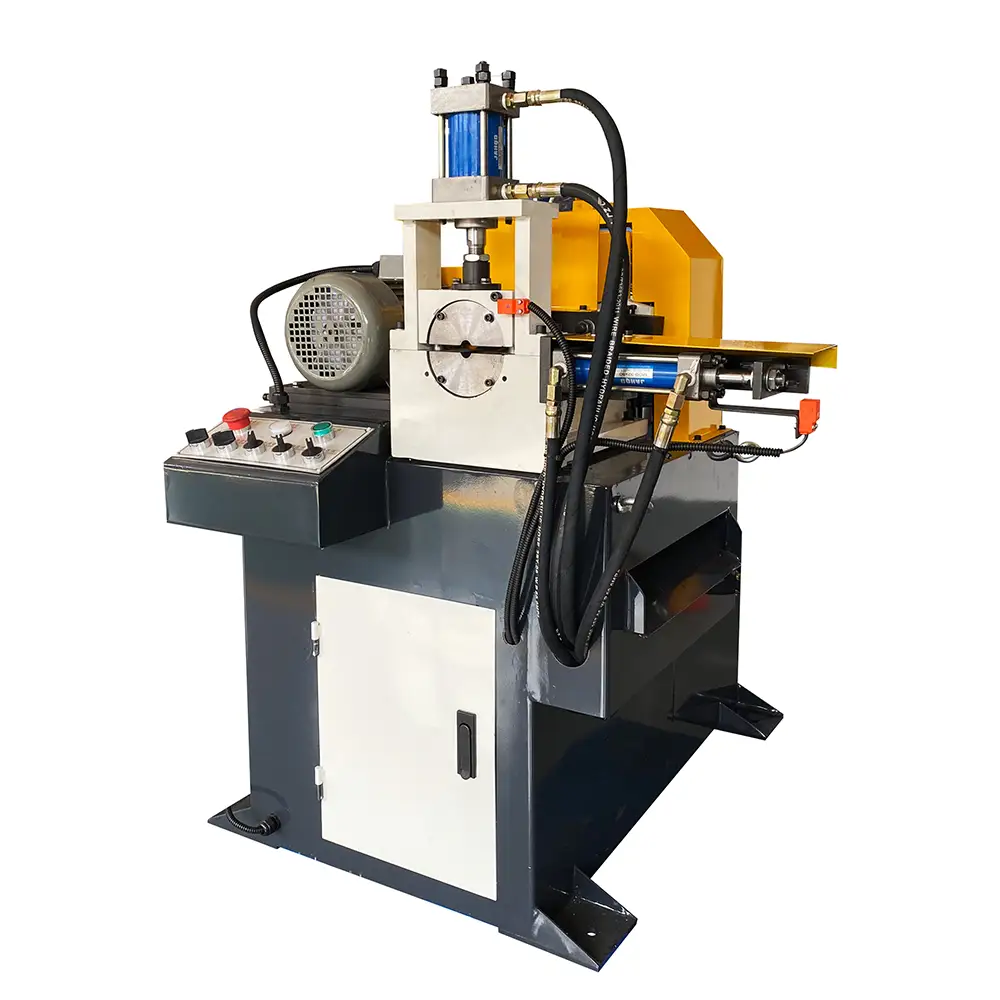
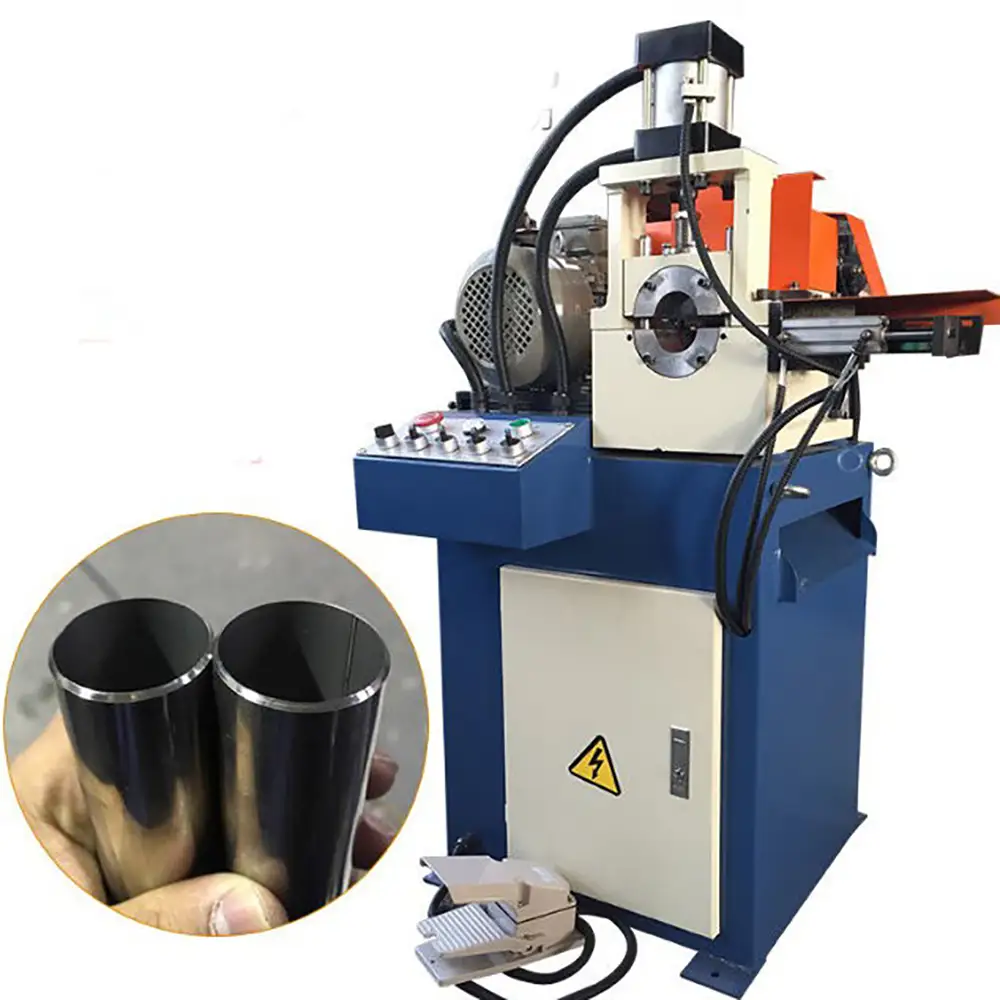
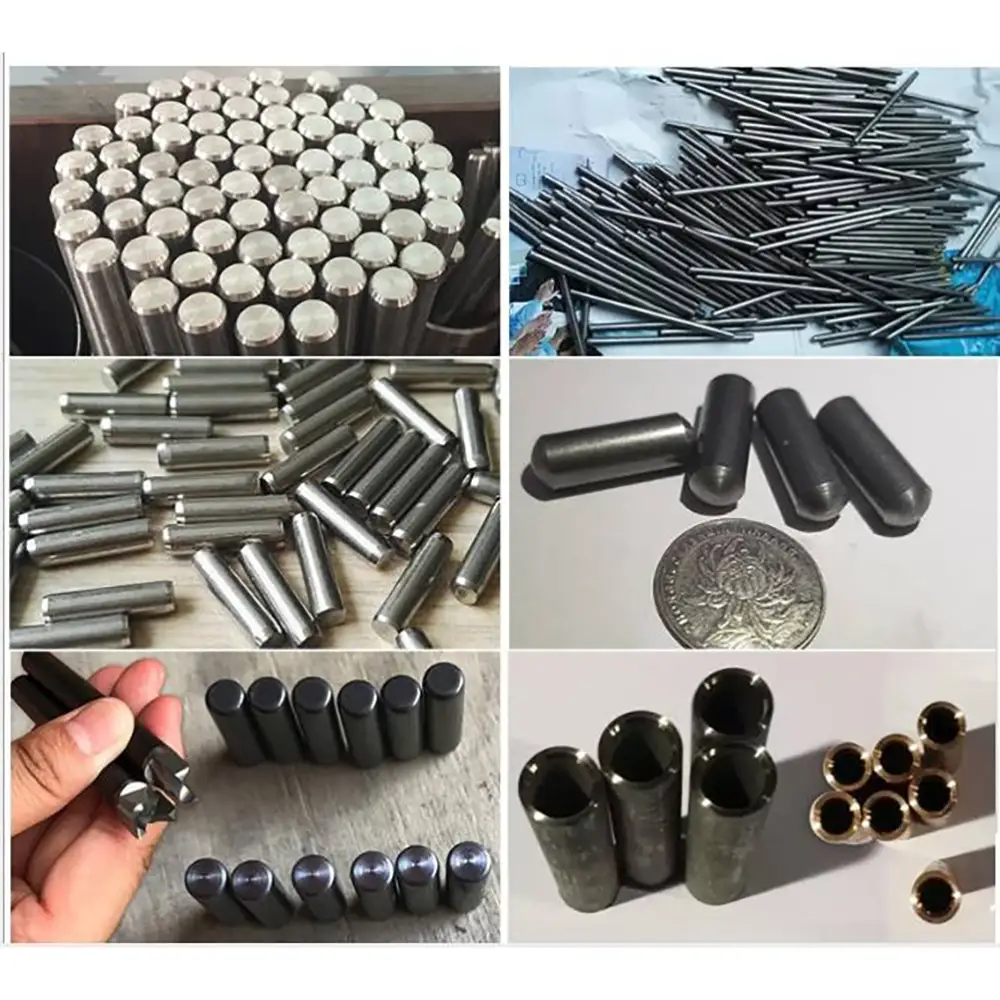
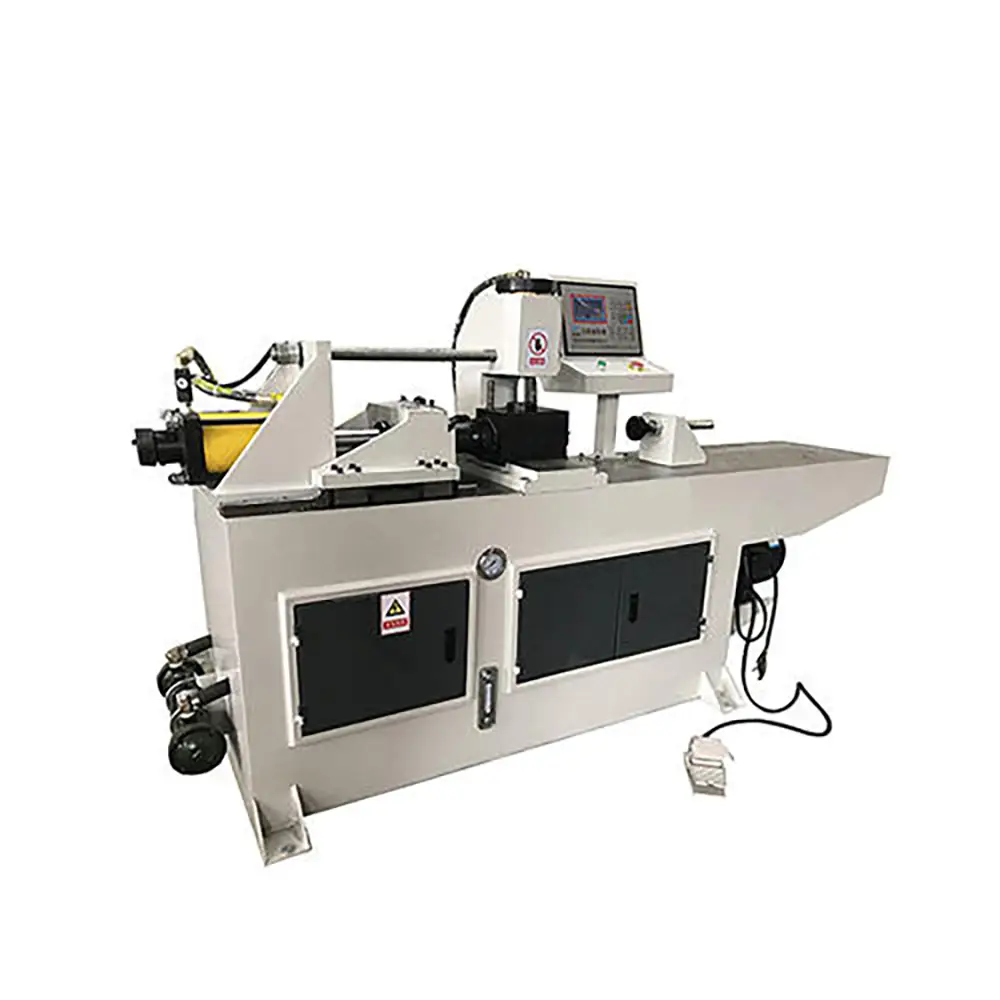
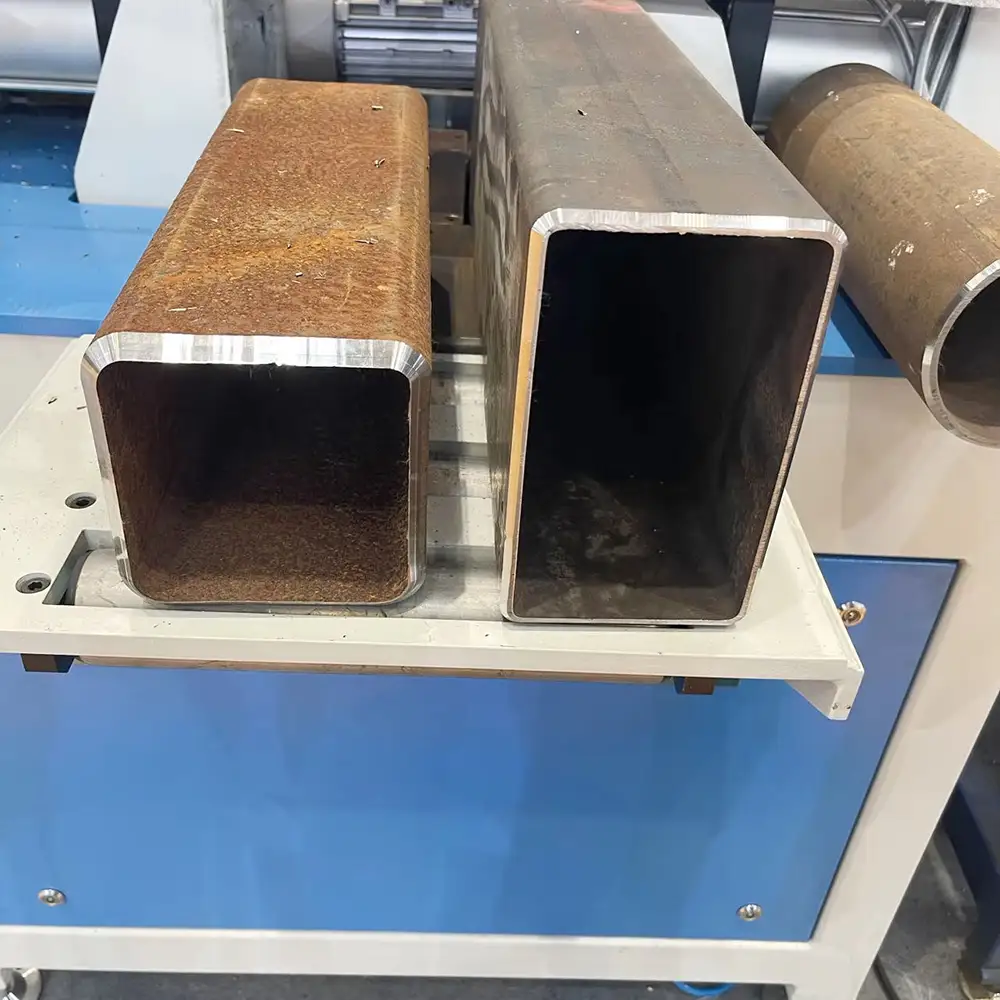
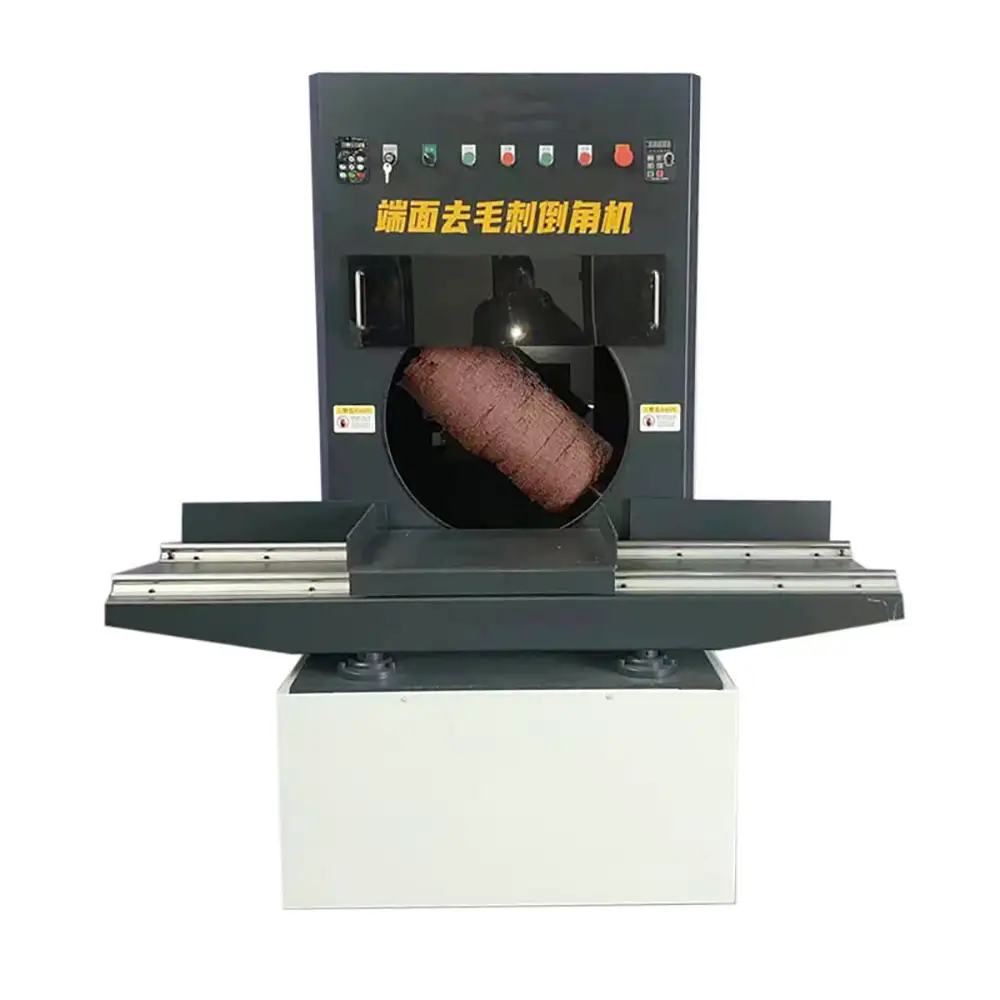
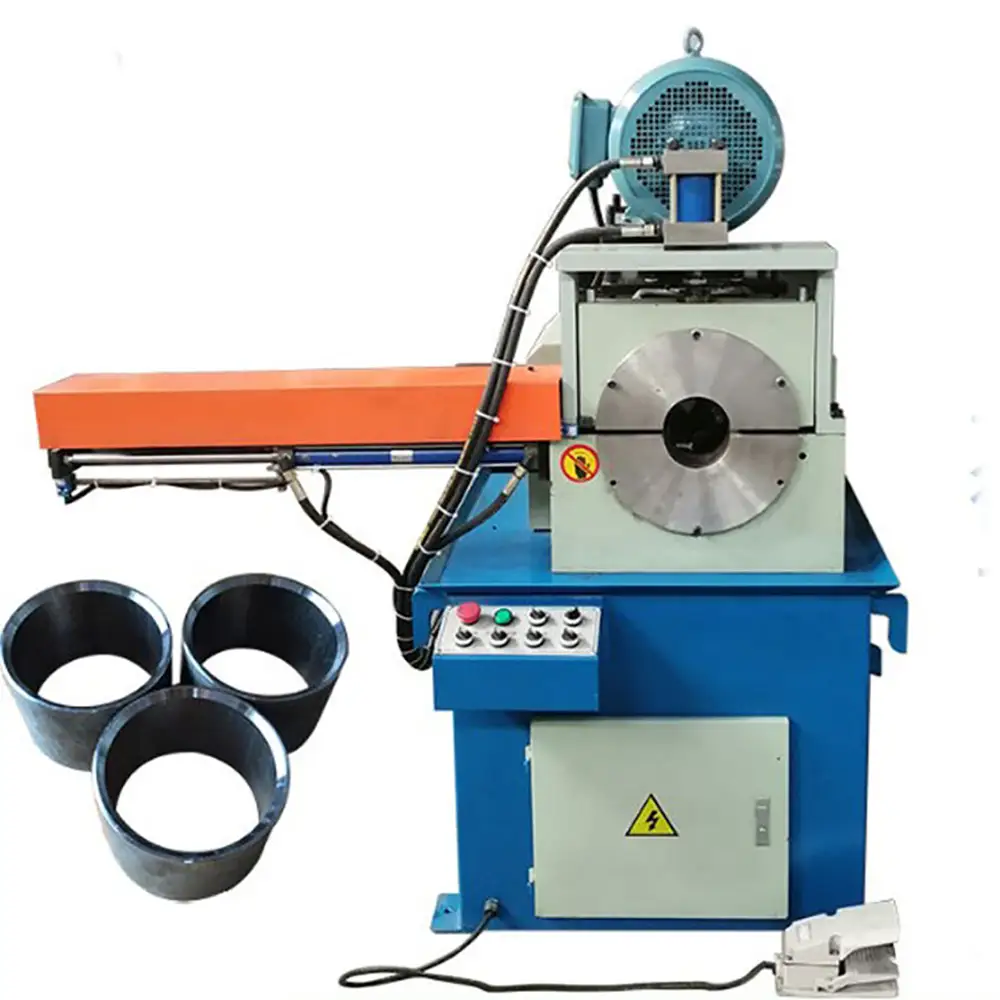
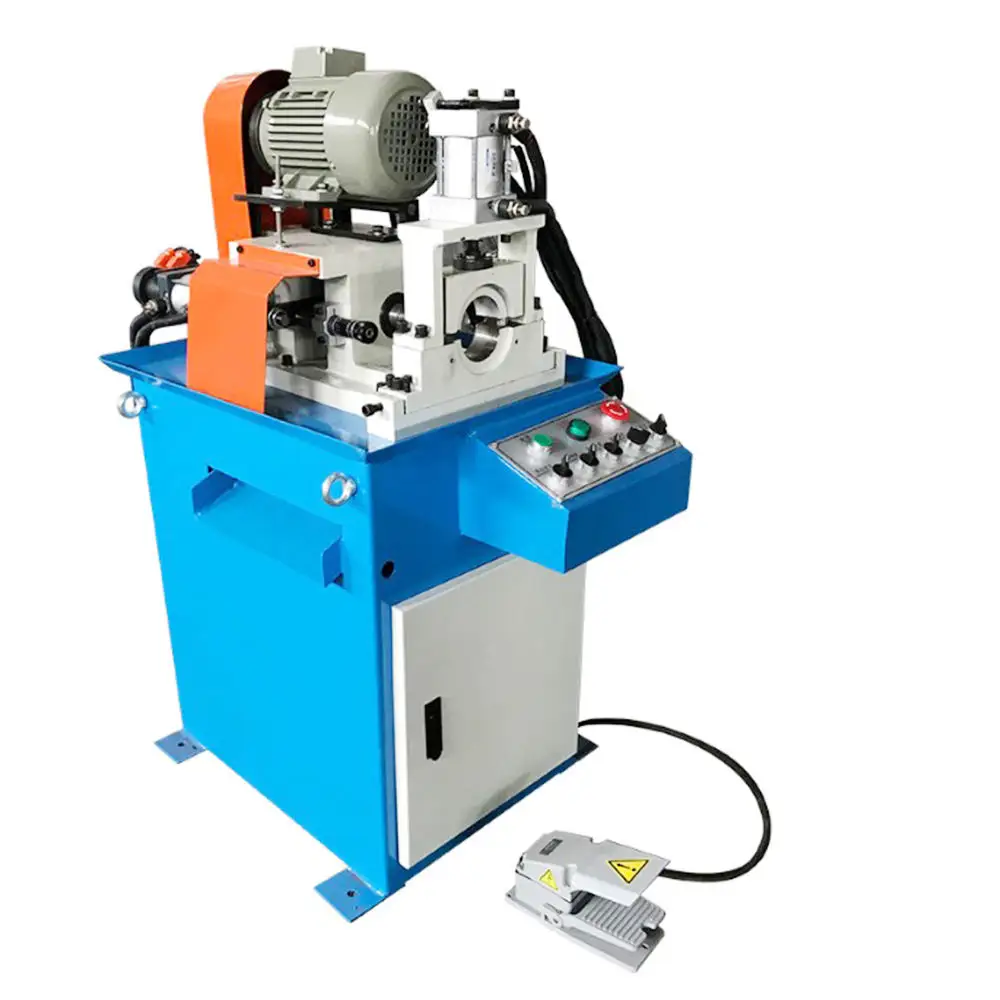
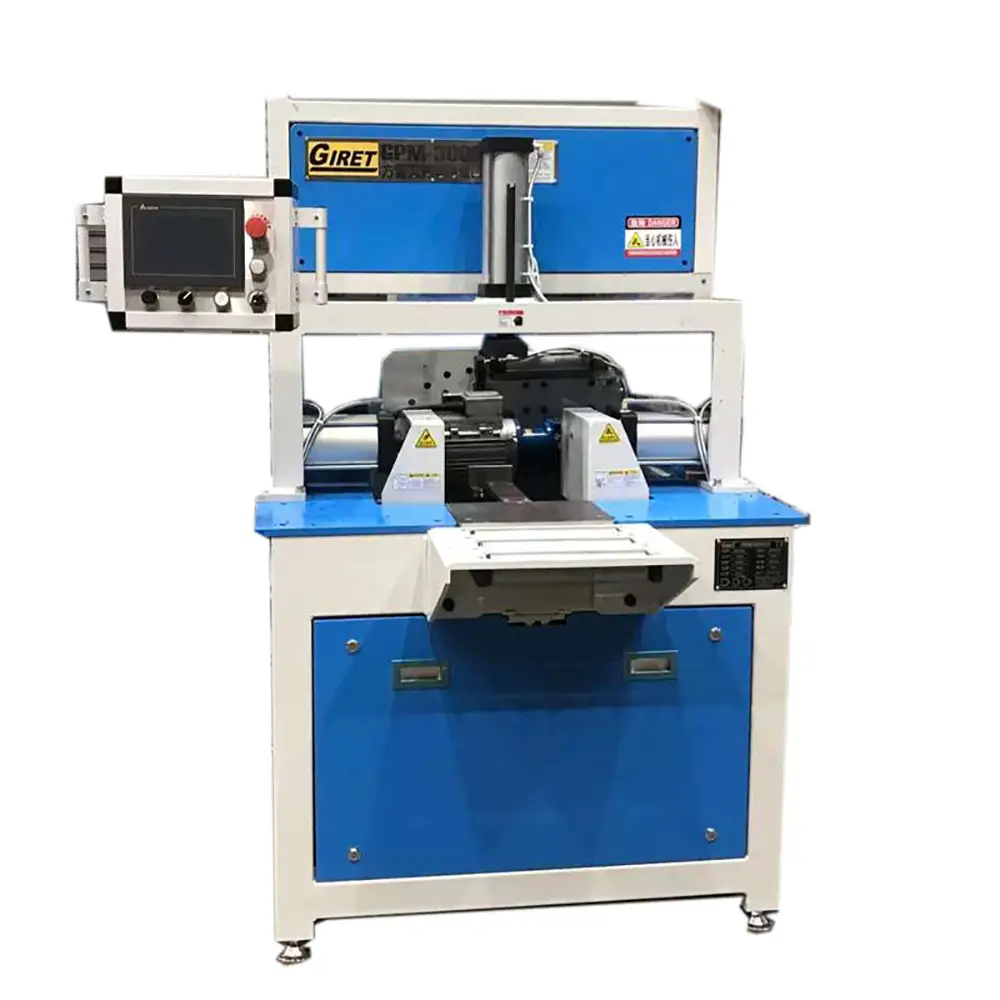
Product Application: 1 This machine can complete the chamfering and trimming of the inner and outer corners of the end surface of the round tube and the round bar at one time, fast and accurate.
2 The clamping die and the cutter head are precisely designed, and the center line of the processing object and the cutter head is accurate and unchanged.
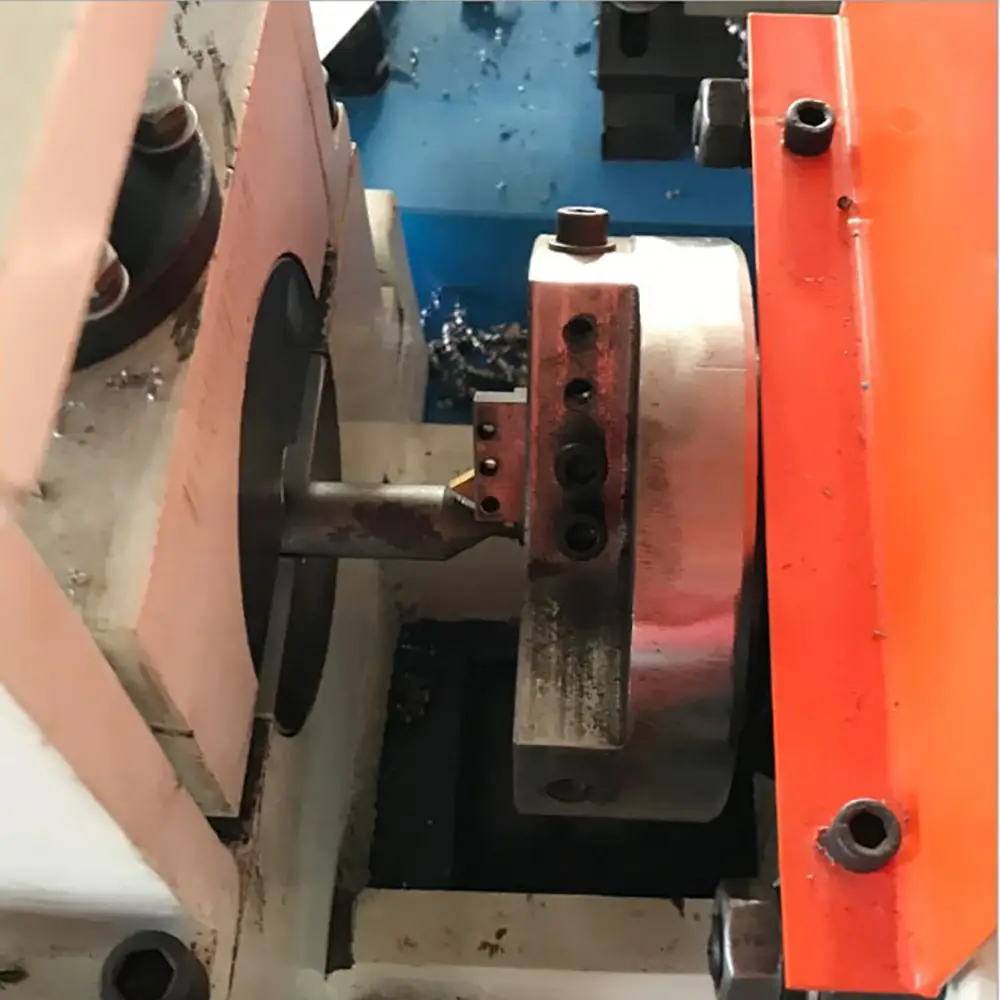
3 The cutter head is specially designed, the blade is standardized, and the adjustment of the cutter is easy and fast.
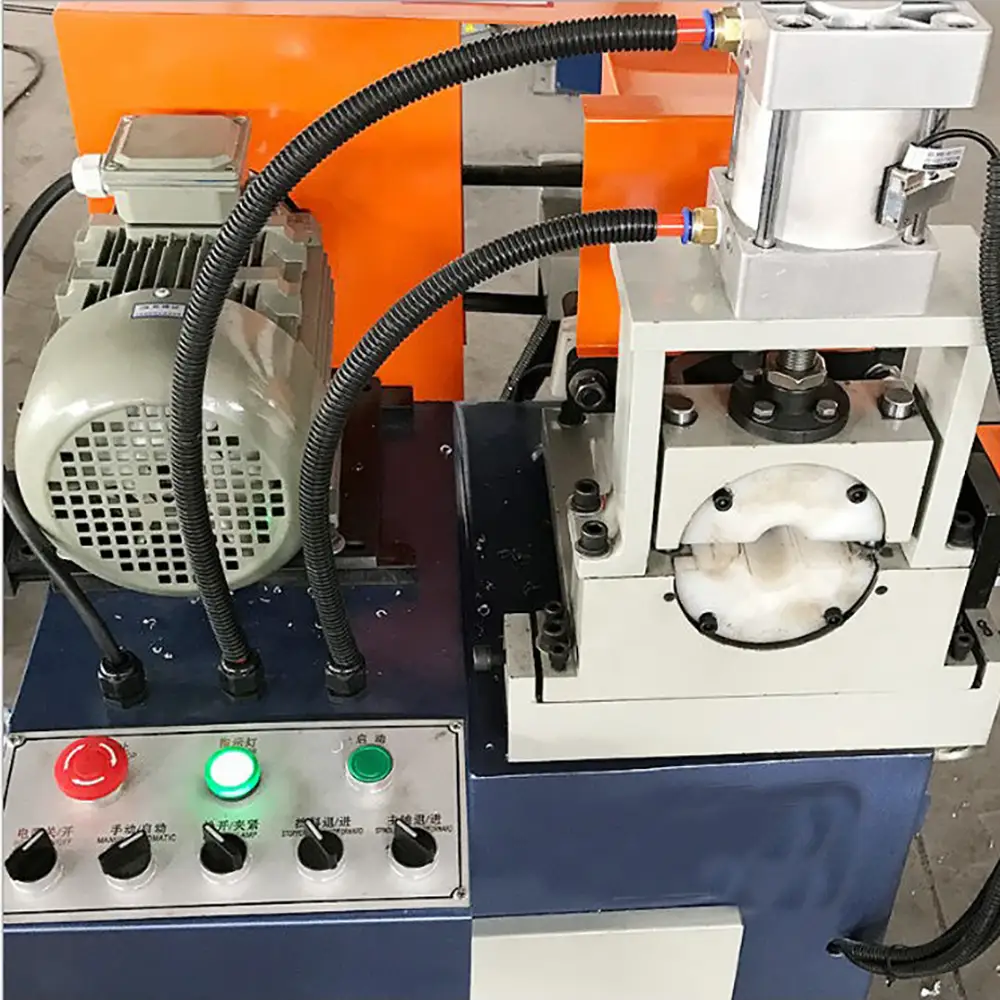
4 Manual feeding, automatic clamping, automatic advance and retreat, fast speed
5 To replace the workpieces of different sizes, only need to replace the clamping die and adjust the cutter head.
6 Applicable materials: steel pipe, iron pipe, aluminum pipe, copper pipe, stainless steel, bar material, PVC pipe, round rod and nylon pipe.
|
Model |
80AC Single-head Hydraulic |
|
Main motor power |
2.2KW/380V/50HZ |
|
Oil pump motor power |
0.75KW /380V/50HZ |
|
Bearing brand |
NTN |
|
Cylinder brands |
Customized |
|
Cylinder specifications |
Autonomous |
|
Yuken Valve Specifications |
DSG-01-2B2-A110-N1 |
|
Vane pump |
VP-20 |
|
Electric appliance |
CHINT |
|
Working pressure |
MPA6-8KG |
|
Outer diameter |
round tube: φ6-φ80mm,
round bar: φ2-φ25mm |
|
Processing length |
≧35mm |
|
Machining precision |
±0.1mm |
|
Machining speed |
3-6 pieces/minute |
|
Applicable materials |
Steel Tube, Iron Tube, Stainless Steel Tube, Aluminium Tube, Copper Tube, Plastic Tube, Nylon Tube, Round Bar |
|
Machine external dimensions |
L*W*H: 1100x1400x1400mm |
Multifunction Hydraulic Single-Head Pipe Beveling,Edge Deburring & Chamfering Machine
The Multifunction Hydraulic Single-Head Pipe Beveling,Edge Deburring & Chamfering Machine is designed for efficient end processing of metal pipes and tubes. Combining hydraulic workpiece positioning or clamping with beveling,chamfering,and edge deburring functions,the machine provides a practical solution for manufacturers that require consistent pipe-end preparation.
Pipe ends can contain sharp edges,burrs,and uneven surfaces after sawing,cutting,or other fabrication operations. These conditions may affect welding,assembly,threading,coating,and general handling. A dedicated pipe-end processing machine can provide a more controlled alternative to manual grinding and edge finishing.
The multifunction configuration allows suitable workpieces to be processed according to the required end geometry. Depending on the tooling and machine configuration,the operation may include chamfering,beveling,edge deburring,or other selected pipe-end finishing processes.
Actual pipe diameter range,wall thickness,bevel angle,chamfer dimensions,hydraulic force,and production capacity depend on the specific machine model,tooling,and workpiece requirements.
Hydraulic Pipe Processing System
Hydraulic operation can provide controlled force for workpiece clamping,positioning,or other machine movements according to the equipment configuration.
Stable workholding is particularly important during pipe beveling and chamfering because movement or vibration can affect the finished edge.
The hydraulic system can help maintain consistent clamping pressure for suitable workpieces. However,the required pressure and clamping arrangement depend on pipe diameter,wall thickness,material,and machine design.
When selecting a hydraulic pipe-processing machine,buyers should evaluate the complete hydraulic system rather than considering hydraulic power alone.
Single-Head Chamfering Design
The single-head configuration provides a focused processing arrangement for pipe-end machining.
The cutting or forming head can be equipped with suitable tooling according to the required chamfer,bevel,or deburring operation. A single-head design can be practical for manufacturers that need controlled processing of one pipe end at a time.
The operator can load and position the workpiece,secure it with the appropriate clamping system,and perform the programmed or selected end-processing operation.
For applications requiring both ends to be processed,the workpiece can be repositioned according to the production workflow.
The actual operating sequence depends on the machine configuration and selected tooling.
Pipe Beveling
Pipe beveling creates an angled surface at the end of a pipe. It is commonly used when a controlled pipe-end geometry is required for welding preparation or other fabrication processes.
The required bevel angle and dimensions depend on the pipe material,wall thickness,joint design,and downstream welding requirements.
Suitable tooling can be selected according to the desired geometry. For specialized applications,customers should provide technical drawings or sample pipes so the required bevel profile can be evaluated.
Bevel quality depends on tool condition,workpiece stability,machine rigidity,cutting parameters,and material characteristics.
Pipe Chamfering
Chamfering generally involves removing or breaking the sharp edge of the pipe end to create a controlled angled transition.
Compared with a larger welding bevel,chamfering is often used for general edge finishing,assembly preparation,and burr removal.
A clean chamfer can make tube insertion or component assembly easier while also improving the visual appearance of the finished pipe.
The actual chamfer width and angle should be specified according to the application.
Edge Deburring
Pipe cutting can produce burrs or sharp edges around the end of the workpiece.
The edge deburring function helps remove unwanted material from the cut edge and can be combined with chamfering to produce a cleaner finished end.
Deburring performance depends on the original cutting method. Saw cutting,laser cutting,plasma cutting,and other processes can create different types and amounts of burrs.
The machine should therefore be configured according to the existing pipe-end condition and the required finished edge quality.
Multifunctional Pipe End Processing
The multifunction design allows manufacturers to perform several related pipe-end preparation operations within one machine.
Potential operations may include:
Pipe End Chamfering
Pipe End Beveling
Edge Deburring
Sharp Edge Removal
Welding Preparation
Tube End Finishing
Selected Profile Preparation
The exact functions available depend on the machine structure and tooling.
Combining multiple operations can reduce the need to transfer workpieces between separate processing stations and may simplify production flow.
Suitable Metal Materials
The machine can be configured for a range of compatible metal pipes and tubes.
Typical materials may include:
Carbon Steel
Mild Steel
Stainless Steel
Alloy Steel
Aluminum
Galvanized Steel
Other Compatible Metal Tubes
Material hardness and mechanical properties affect tool selection and processing parameters.
Stainless steel may require suitable wear-resistant tooling,while aluminum may require tool geometry and cutting conditions designed to minimize material buildup.
Before production,the material grade,pipe dimensions,and required finish should be considered when selecting tooling.
Stable Pipe Clamping
Accurate end processing requires stable workpiece positioning.
The hydraulic clamping system can help secure the pipe during the machining operation,depending on the machine design.
Proper clamping can reduce vibration and movement while maintaining the relationship between the pipe axis and processing head.
Different pipe diameters may require different clamping positions,fixtures,or tooling.
For manufacturers processing multiple pipe sizes,adjustable or interchangeable fixtures can help simplify machine setup when supported by the selected configuration.
Production Efficiency
A dedicated pipe-end finishing machine can help improve production efficiency by reducing manual grinding and repetitive edge-processing work.
A typical workflow may include loading the pipe,positioning the workpiece,hydraulically securing it,performing the selected beveling or chamfering operation,and removing the finished pipe.
For repeated production,the machine can provide a more consistent process compared with completely manual edge finishing.
Actual productivity depends on pipe diameter,wall thickness,material,bevel dimensions,tooling,clamping time,operator workflow,and machine configuration.
Applications
The multifunction hydraulic pipe beveling and chamfering machine can be used in various industries,including:
Steel Pipe Fabrication
Pipeline Components
Machinery Manufacturing
Automotive Components
Agricultural Machinery
Construction Equipment
Steel Structures
Boiler And Pressure Equipment Components
Hydraulic Equipment
Pneumatic Equipment
Metal Furniture
General Tube Fabrication
For welding applications,the beveling function can help prepare suitable pipe ends for subsequent welding operations.
For general fabrication,the chamfering and deburring functions can improve the finished edge condition before assembly or coating.
Tooling and Chamfer Quality
Tooling has a direct influence on pipe-end processing quality.
The selected tool should match the pipe material,diameter,wall thickness,and required edge geometry.
A worn tool may produce inconsistent chamfers,excessive burrs,poor surface finish,or dimensional deviations.
Operators should regularly inspect the cutting edge and replace or maintain tooling according to actual operating conditions.
Custom tooling can be developed for specialized pipe profiles,bevel angles,and chamfer dimensions.
Quality Control
Quality inspection should verify the finished pipe-end geometry according to the application requirements.
Inspection may include:
Bevel Angle
Chamfer Width
Edge Condition
End Face Quality
Burr Condition
Pipe Diameter
Wall Thickness
Overall Dimensional Consistency
For critical production,first-piece inspection can help confirm machine settings and tooling before processing a complete batch.
Periodic inspection is also useful for identifying tool wear or changes in workpiece positioning.
Maintenance and Safety
Regular maintenance helps maintain stable machine performance.
Operators should inspect hydraulic hoses,fittings,clamps,cutting tools,guide components,drive systems,and electrical components according to the machine configuration.
Metal chips and debris should be removed from the working area regularly to prevent interference with clamping and machine movement.
Operators should wear suitable eye protection,protective clothing,and other PPE required for the operation.
Depending on the machine configuration,guards,emergency-stop systems,and other protective features may be included. Operators should follow the manufacturer's operating instructions and applicable workplace safety requirements.
Custom & OEM Solutions
Different pipe-processing applications require different diameters,wall thicknesses,materials,bevel angles,and production volumes.
The machine can be configured according to the intended application. Custom options may include hydraulic clamping systems,processing tools,fixtures,feeding arrangements,control systems,and workpiece supports.
For OEM and ODM projects,customers can provide pipe drawings,samples,material specifications,required bevel geometry,and production quantities.
This information helps determine the appropriate machine structure and tooling configuration.
Why Choose Us
Multifunction Pipe End Processing — Combines beveling,chamfering,and edge deburring functions in one pipe-processing solution.
Hydraulic Workholding — Hydraulic clamping can provide stable workpiece positioning during end processing.
Single-Head Configuration — Provides a focused and practical setup for controlled pipe-end machining.
Clean Edge Finishing — Helps remove sharp edges and burrs from suitable pipe ends.
Welding Preparation — Beveling can prepare compatible pipe ends for subsequent welding operations.
Flexible Material Compatibility — Can be configured for suitable carbon steel,stainless steel,alloy steel,aluminum,and other metal pipes.
Production-Oriented Design — Suitable for repetitive pipe fabrication and industrial tube-processing applications.
OEM & ODM Support — Tooling,clamping systems,fixtures,and machine configurations can be customized according to customer requirements.
FAQs
1. What is a hydraulic pipe beveling and chamfering machine?
It is a pipe-processing machine that uses hydraulic workholding or machine movement together with suitable tooling to bevel,chamfer,and deburr metal pipe ends.
2. What is the purpose of pipe beveling?
Pipe beveling creates an angled surface that can be used for welding preparation or other applications requiring a specific pipe-end geometry.
3. What is pipe chamfering used for?
Chamfering removes or breaks a sharp pipe edge and can improve assembly,handling,and overall edge quality.
4. Can the machine remove pipe-end burrs?
Yes. The machine can be configured for edge deburring and chamfering to reduce sharp edges and burrs created by previous cutting operations.
5. What materials can it process?
Depending on the tooling and configuration,it can process carbon steel,mild steel,stainless steel,alloy steel,aluminum,galvanized steel,and other compatible metal pipes.
6. Is it suitable for welding preparation?
Yes. The beveling function can be used for suitable pipe-end welding preparation. The required angle and geometry should be specified according to the welding application.
7. Why use hydraulic clamping?
Hydraulic clamping can provide controlled and stable workholding for suitable pipe dimensions,helping reduce movement during machining.
8. Can it process different pipe sizes?
Yes,within the configured operating range. Different diameters may require different clamping positions,fixtures,or tooling.
9. Is the machine fully automatic?
Not necessarily. The operating method depends on the machine configuration. Loading,unloading,and certain setup operations may still require an operator.
10. What affects beveling and chamfering accuracy?
Tool condition,pipe alignment,clamping stability,machine rigidity,material properties,cutting parameters,and tooling design all affect the finished result.
11. Can custom tooling be supplied?
Yes. Custom beveling and chamfering tools,fixtures,and hydraulic clamping arrangements can be developed for specific pipe dimensions and end geometries.
12. What information should I provide for a quotation?
Provide pipe material,outer diameter,wall thickness,required bevel angle,chamfer dimensions,production volume,and drawings or sample pipes if available.
Prev:
Double Head Double End Automatic Pipe Tube Chamfering Machine
Next:
Square Rectangle Tube and Round Pipe Beveling Charmfering Machine
TAG:
Metal Tube Processing Machine,
Pipe Processing Machine,
Tube Processing Machine,
Metal Pipe Processing Machine,
Pipe End Processing Equipment,
Pipe End Beveling Machine,
Pipe Edge Chamfering Machine,
Tube Edge Chamfering Machine,
Tube End Beveling Machine,
Metal Tube Beveling Machine,
Automatic Pipe Beveling Machine,
Steel Pipe Beveling Machine,
Pipe End Finishing Machine,
Tube End Finishing Machine,
Metal Tube End Finishing Machine,
Tube Deburring Machine,
Pipe Deburring Machine,
Metal Pipe Deburring Machine,
Pipe End Chamfering Machine,
Tube End Chamfering Machine,
Steel Tube Chamfering Machine,
CNC Pipe Chamfering Machine,
Precision Pipe Chamfering Machine,
Industrial Pipe Chamfering Machine,
Metal Tube Chamfering Machine,
Steel Pipe Chamfering Machine,
Stainless Steel Pipe Chamfering Machine,
Metal Pipe Chamfering Machine,
Carbon Steel Pipe Chamfering Machine,
Automatic Pipe Chamfering Machine,
Related Category:
Multifunction Hydraulic Pipe Beveling Machine,Single-Head Pipe Beveling Machine,Hydraulic Pipe Chamfering Machine China, suppliers, manufacturers, factory, customized, wholesale, quotation, made in China