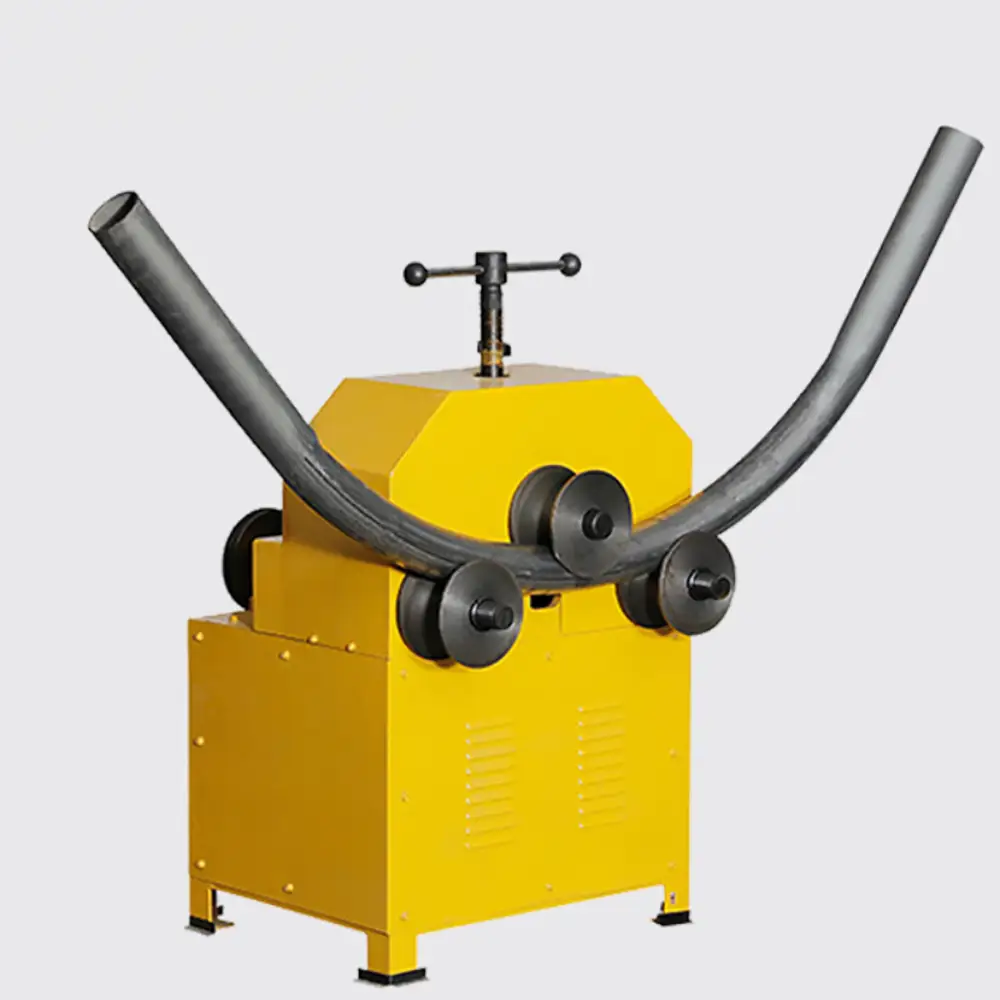
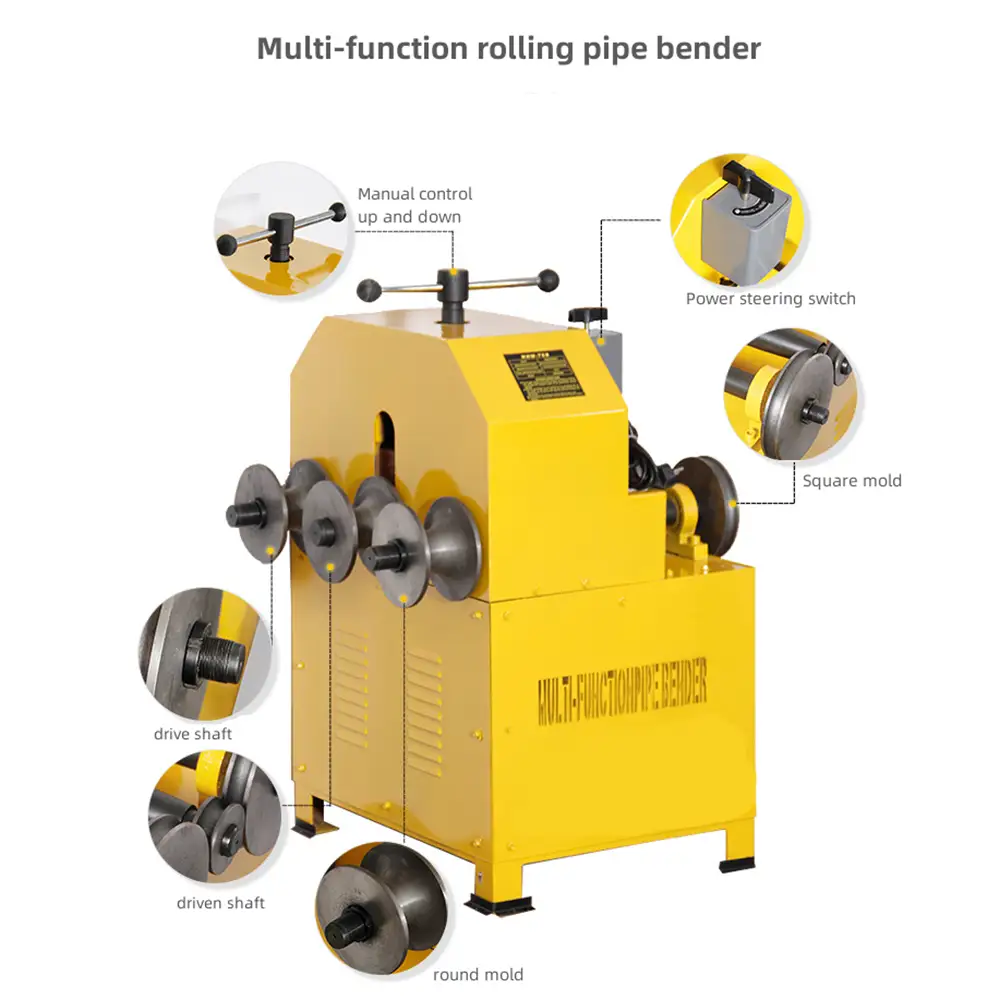
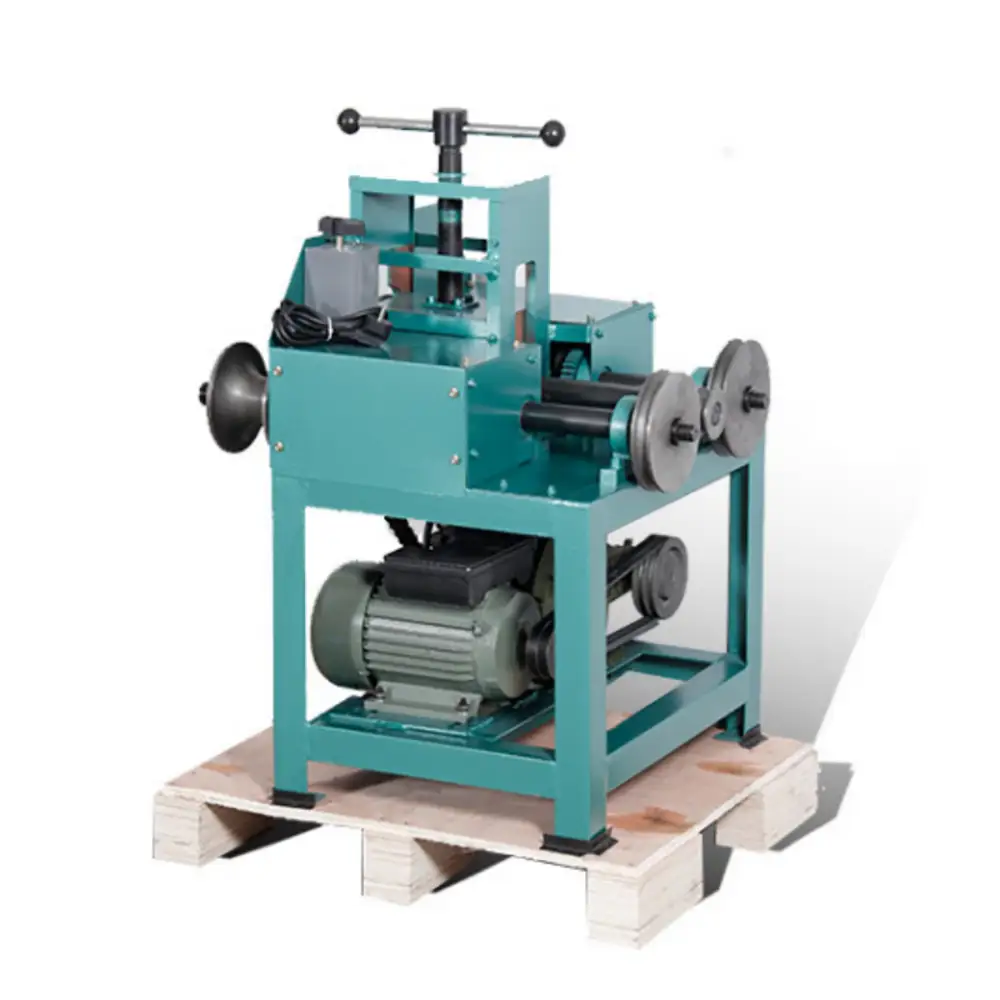
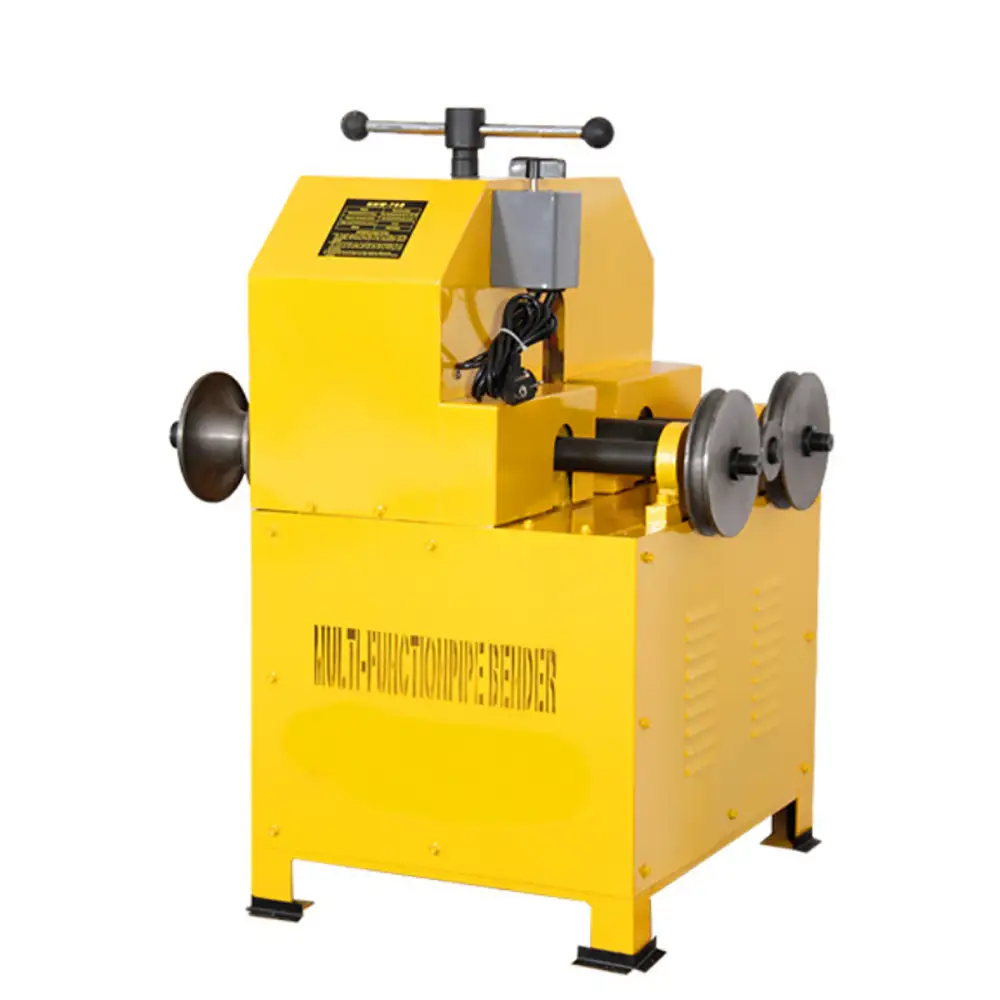
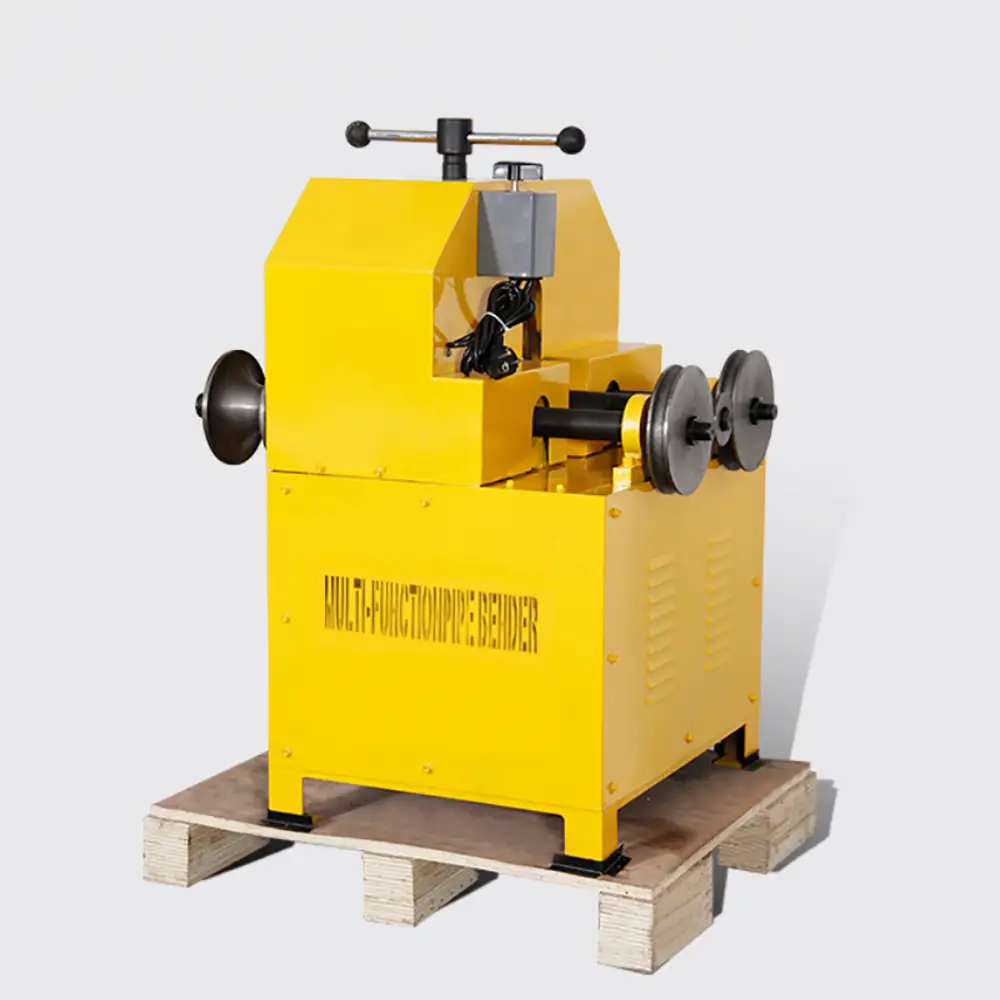
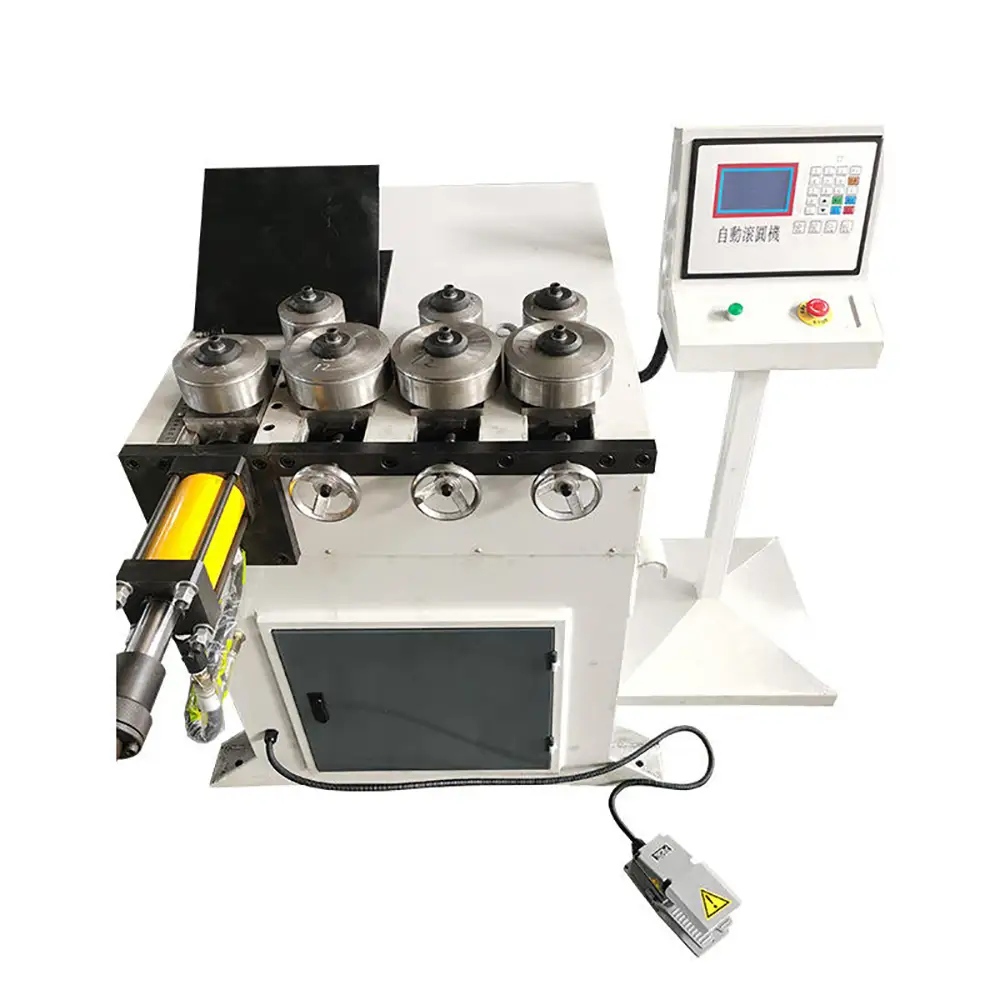
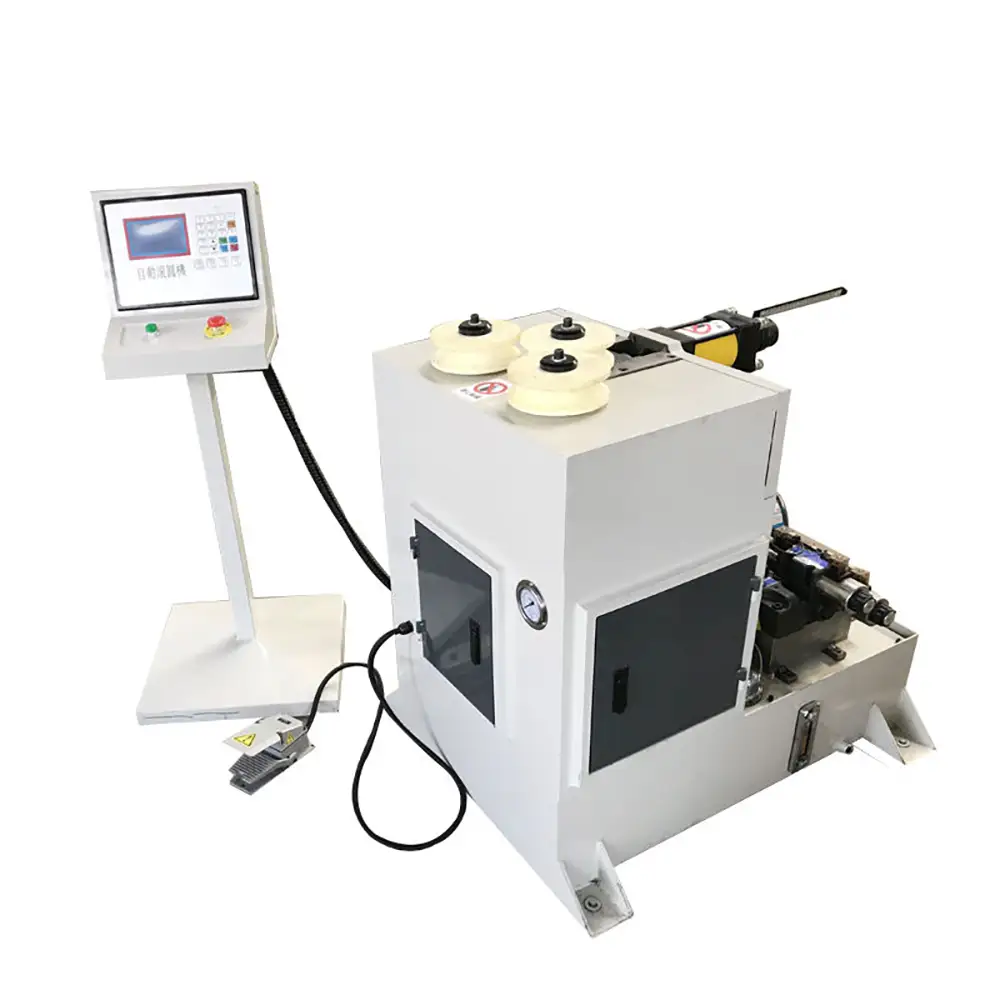
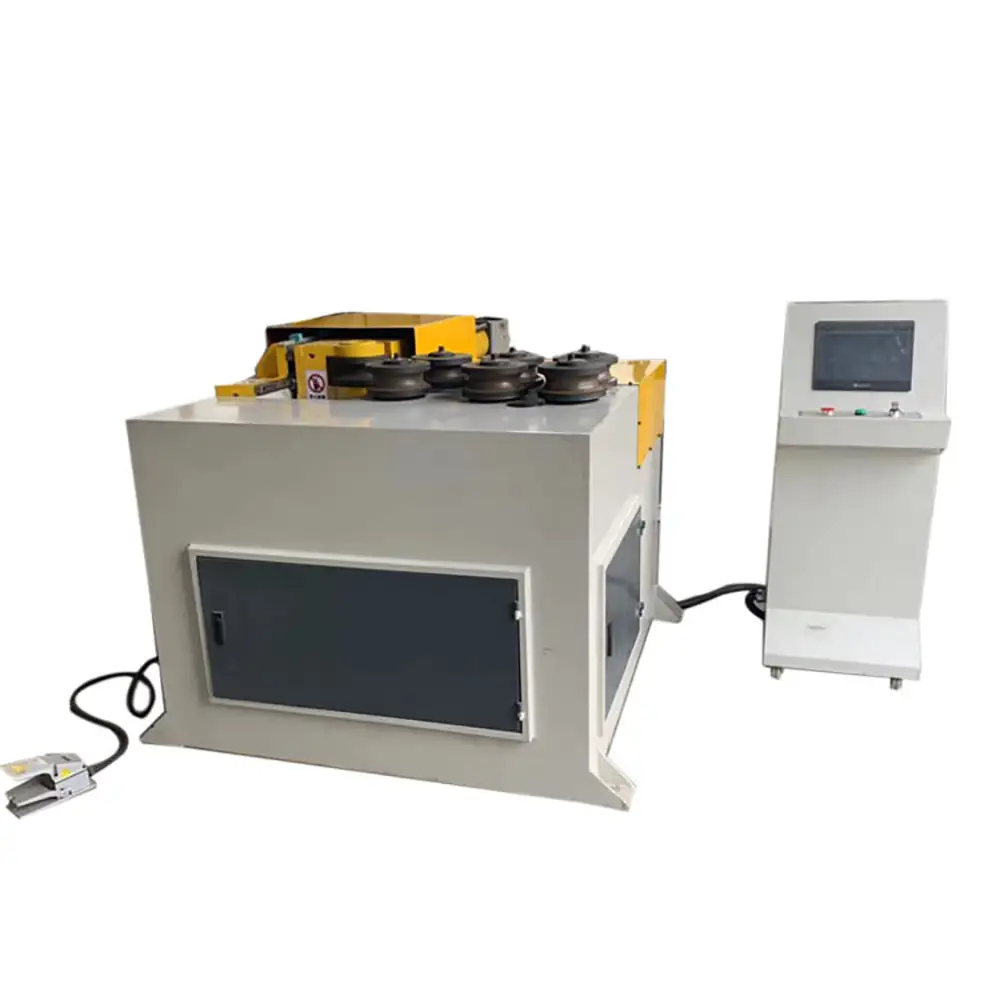
This machine is mainly used to bend large-radius angle steel, flat steel, round pipe and other special-shaped cross-section profiles.
|
Model |
76B |
Motor power |
1.5KW |
|
Voltage |
220V or 380V |
Packing method |
Wooden box pallet |
|
Size |
73x63x102CM |
Weight |
60KG |
|
Bending description |
Bending object: bending stainless steel tube and other metal thin-walled round tube square tube and rectangular tube.
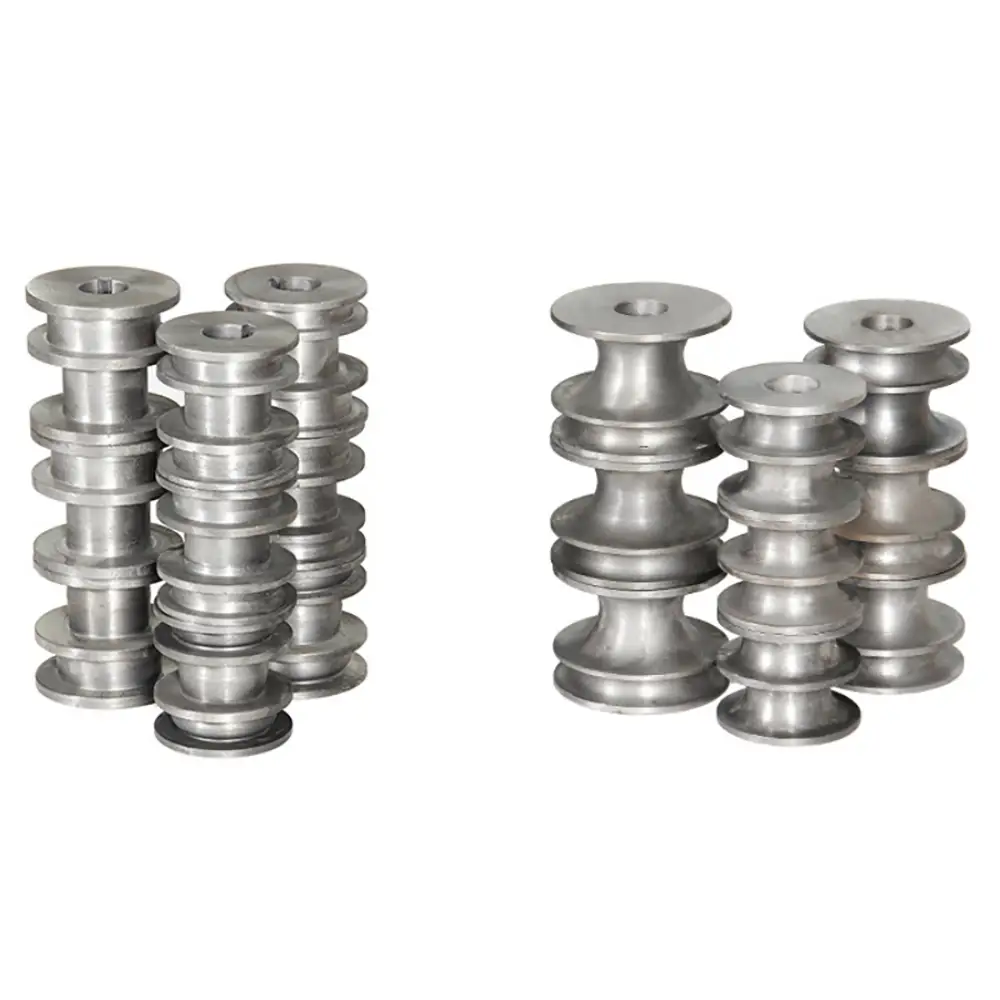
Bending range: round tube mould 16-76MM; square tube mould 16-50MM pipe wall thickness: 0.5-2.0MM
Round tube mould: 16,19,22,25,32,38,51,63,76MM
Square pipe mould: 16,19,22,25,30,38,40,50MM |
|
Product Features |
It can quickly produce large radius arcs and complete circles; it can cope with a series of operations such as electric power
construction, wharves, buildings, railways, etc. The moulds are made of special steel casting, which is durable and long-lasting. |
Semi-Automatic Electric Rolling Pipe Bender Machine for Metal Pipe Forming
The Semi-Automatic Electric Rolling Pipe Bender Machine is a practical metal forming solution designed for bending and rolling suitable pipes,tubes,and tubular profiles into controlled curved shapes. Powered by an electric drive system,the machine provides a more consistent forming process than completely manual bending methods while maintaining a straightforward operating structure.
This type of pipe bender is suitable for workshops,fabrication plants,metalworking businesses,maintenance departments,and manufacturers producing curved tubular components. It can be used for applications where pipes need to be formed into large-radius curves,arches,rings,frames,and other custom shapes.
The semi-automatic configuration provides a balance between machine-assisted forming and operator control. Depending on the specific machine design,the operator may be responsible for loading the pipe,positioning the workpiece,setting the forming parameters,and removing the finished component,while the electric system drives the rolling or bending operation.
Actual pipe diameter,wall thickness,bending radius,and production capacity depend on the machine configuration,roller dimensions,motor system,tooling,and material properties.
Electric Rolling Pipe Bending System
The electric drive system supplies mechanical power to the forming rollers. During operation,the pipe is guided through the rollers while controlled movement gradually changes its curvature.
Rolling and bending through multiple rollers is especially useful for large-radius forming because the tube is progressively deformed rather than being forced into the finished shape in a single movement.
The electric drive can provide stable roller rotation and controlled material feeding. Depending on the machine design,roller adjustment may be manual,mechanical,or assisted by another powered system.
The appropriate configuration should be selected according to the pipe material,diameter,wall thickness,and required finished radius.
Semi-Automatic Pipe Bending Operation
A semi-automatic machine typically combines powered forming with operator-controlled material handling.
A typical operating process may include:
Preparing the pipe or tube
Installing suitable roller tooling
Positioning the workpiece
Adjusting the forming rollers
Starting the electric drive
Feeding the pipe through the rollers
Performing additional forming passes when necessary
Checking the finished curvature
Removing and inspecting the workpiece
The exact sequence depends on the machine configuration.
Semi-automatic operation can be useful for small and medium production batches where full automation is not necessary but consistent machine-assisted bending is preferred.
Round Pipe and Tube Rolling
The machine is suitable for processing compatible round pipes and tubes into curved sections.
Round tube rolling is commonly used for manufacturing:
Metal frames
Circular rings
Curved supports
Handrails
Guardrails
Greenhouse structures
Canopy frames
Architectural structures
Agricultural equipment
Furniture components
The final shape depends on tube diameter,wall thickness,material strength,roller geometry,and forming parameters.
For different pipe sizes,the roller setup may need to be adjusted or changed to maintain stable workpiece contact.
Large Radius Pipe Bending
One important application of a rolling pipe bender is large-radius bending. Instead of producing a sharp bend,the machine gradually forms the tube into a smooth curve.
Large-radius tube forming can be useful for applications such as:
Greenhouse hoops
Tunnel frames
Circular structures
Curved railings
Canopy supports
Architectural frames
Machinery frames
Agricultural structures
The minimum bending radius depends on the machine and workpiece. A three-roller or multi-roller rolling process is generally better suited to gradual curves than extremely tight-radius bends.
For tight-radius applications,a dedicated rotary draw or mandrel tube bending machine may be more appropriate.
Metal Pipe and Tube Materials
Depending on the machine configuration,the electric pipe bender may process a range of suitable metal tubes.
Potential materials include:
Carbon steel
Mild steel
Stainless steel
Galvanized steel
Aluminum
Alloy steel
Other compatible metal tubing
Different materials have different yield strengths and springback characteristics.
Carbon steel and mild steel are commonly used for structural tubular products. Stainless steel may require greater forming force or different tooling depending on grade and wall thickness.
Aluminum tubing can also be formed,although attention should be given to surface protection and deformation control.
The actual material range should always be confirmed according to the machine's rated forming capacity.
Roller Tooling and Pipe Support
Roller tooling plays an important role in pipe bending quality. The roller groove should match the tube profile closely enough to provide stable support while allowing controlled movement through the forming area.
Important tooling factors include:
Roller diameter
Groove shape
Roller spacing
Roller material
Surface finish
Adjustment range
For manufacturers processing multiple pipe diameters,a machine with adjustable or interchangeable roller tooling may provide additional flexibility.
Long tubes should also be adequately supported during operation. External roller stands or material supports may be useful for reducing unwanted movement.
Springback and Forming Accuracy
Metal tubing can experience springback after the forming force is removed. The tube may partially return toward its original geometry because of its elastic properties.
Springback is influenced by material strength,wall thickness,pipe diameter,bending radius,and forming method.
Operators can compensate through appropriate roller adjustment and additional forming passes when necessary.
For repeat production,the first workpiece should be measured against the required drawing or template. Once suitable forming parameters have been established,they can be reused for subsequent workpieces.
Actual dimensional accuracy depends on machine rigidity,roller alignment,tooling,material consistency,and operator setup.
Applications in Metal Fabrication
The semi-automatic electric pipe bender can support a wide range of fabrication applications.
Typical industries include:
Metal furniture manufacturing
Greenhouse fabrication
Agricultural equipment
Construction
Architectural metalwork
Handrail manufacturing
Guardrail production
Automotive components
Bicycle and fitness equipment
Custom steel frame production
General metal fabrication
Its flexibility makes it suitable for businesses that process different tubular components rather than producing only one standardized product.
Production Efficiency
Electric powered rolling can reduce the physical effort required from operators compared with manual pipe bending.
For repetitive work,the machine can provide more consistent roller movement and reduce the amount of manual force needed to form each workpiece.
Production efficiency depends on tube dimensions,the required radius,number of forming passes,loading and unloading time,and operator workflow.
For small and medium batch production,a semi-automatic system can provide a practical balance between equipment investment,operator control,and forming consistency.
For high-volume production,the machine can be evaluated as part of a more automated tube processing line.
Quality Control
Before batch production,the first formed tube should be inspected for curvature,diameter,overall dimensions,and surface condition.
Operators should check for:
Excessive flattening
Wrinkles
Surface marks
Uneven curvature
Incorrect radius
Material deformation
Roller alignment issues
Proper roller selection and controlled forming pressure can help maintain the tube's cross-sectional shape.
When appearance is important,such as architectural railings or furniture frames,the roller surface should be kept clean and properly maintained.
Maintenance and Safety
Routine maintenance helps maintain stable operation. Operators should inspect rollers,bearings,drive components,electrical connections,fasteners,and other machine parts according to the manufacturer's recommendations.
Roller grooves should be cleaned regularly to prevent accumulated debris from affecting workpiece surfaces.
During operation,operators should keep hands away from the rollers and other pinch points. Long pipes should be properly supported to prevent unexpected movement.
Depending on the machine configuration,safety features may include emergency-stop controls,protective covers,and electrical protection. Operators should follow the manufacturer's instructions and applicable workplace safety requirements.
OEM and Custom Pipe Bender Solutions
Different customers may require different pipe sizes,bending radii,materials,and production volumes. The machine can therefore be configured according to the intended application.
For machine selection,customers should provide:
Pipe outside diameter
Wall thickness
Material type
Pipe length
Required bending radius
Finished shape
Production volume
Power supply
Desired automation level
Drawings,photos,or sample tubes can help the manufacturer evaluate the forming requirements.
OEM and ODM solutions may include custom roller tooling,material supports,drive systems,controls,and other application-specific components.
Why Choose Us
Electric Powered Forming
Electric drive provides machine-assisted rolling and bending for suitable metal pipes and tubes.
Semi-Automatic Operation
Combines powered forming with operator control for flexible workshop and batch production.
Round Pipe Processing
Suitable for forming compatible round steel pipes,tubes,and other metal tubular profiles.
Large Radius Bending
Rolling technology provides a practical method for producing smooth curved tubular sections.
Flexible Applications
Suitable for greenhouse frames,handrails,metal furniture,architectural structures,and general fabrication.
Multiple Material Options
Can be evaluated for suitable carbon steel,stainless steel,galvanized steel,aluminum,and other compatible tubing.
Custom Tooling Support
Roller grooves,tooling,and workpiece support systems can be selected according to tube dimensions.
OEM & ODM B2B Service
Suitable for manufacturers,metal fabricators,distributors,and overseas industrial machinery buyers.
FAQs
1. What is a semi-automatic electric pipe bender?
It is a powered pipe-forming machine that uses an electric drive to assist the rolling or bending process while the operator controls material handling and machine setup.
2. What types of pipes can it bend?
Depending on the configuration,it can process suitable round steel pipes,metal tubes,stainless steel tubes,galvanized tubes,and other compatible profiles.
3. Can it bend round steel pipe?
Yes. Round steel pipes and tubes can be formed when their dimensions and material properties are within the machine's rated capacity.
4. What is the difference between rolling and conventional pipe bending?
Rolling progressively forms a curve through multiple roller contact points and is commonly used for large-radius curves. Conventional tube bending may use a dedicated die to produce a more localized bend.
5. Can it make greenhouse hoops?
Yes. Suitable configurations can be used for greenhouse hoops,arches,and curved agricultural frame components.
6. Can it produce circular rings?
Depending on the roller arrangement and machine configuration,it can be evaluated for circular and ring-forming applications.
7. What determines the bending radius?
Pipe diameter,wall thickness,material strength,roller geometry,roller spacing,forming pressure,and the number of passes all affect the achievable radius.
8. Is the machine fully automatic?
No. A semi-automatic configuration normally requires operator involvement for loading,positioning,inspection,and material handling,while the electric system assists the forming operation.
9. Can stainless steel tubes be processed?
Potentially. Suitable stainless steel tubing can be processed when the machine has sufficient forming capacity and appropriate roller tooling.
10. How can pipe deformation be minimized?
Use suitable roller grooves,maintain correct roller alignment,select appropriate forming pressure,and use controlled forming passes according to the tube dimensions.
11. Can different tube sizes be processed?
Depending on the machine design,adjustable or interchangeable roller tooling may allow multiple tube sizes to be processed within the rated range.
12. What information is needed for a quotation?
Provide the pipe material,outside diameter,wall thickness,length,required bending radius,finished shape,production volume,and power supply requirements. Drawings or samples are also recommended.
Prev:
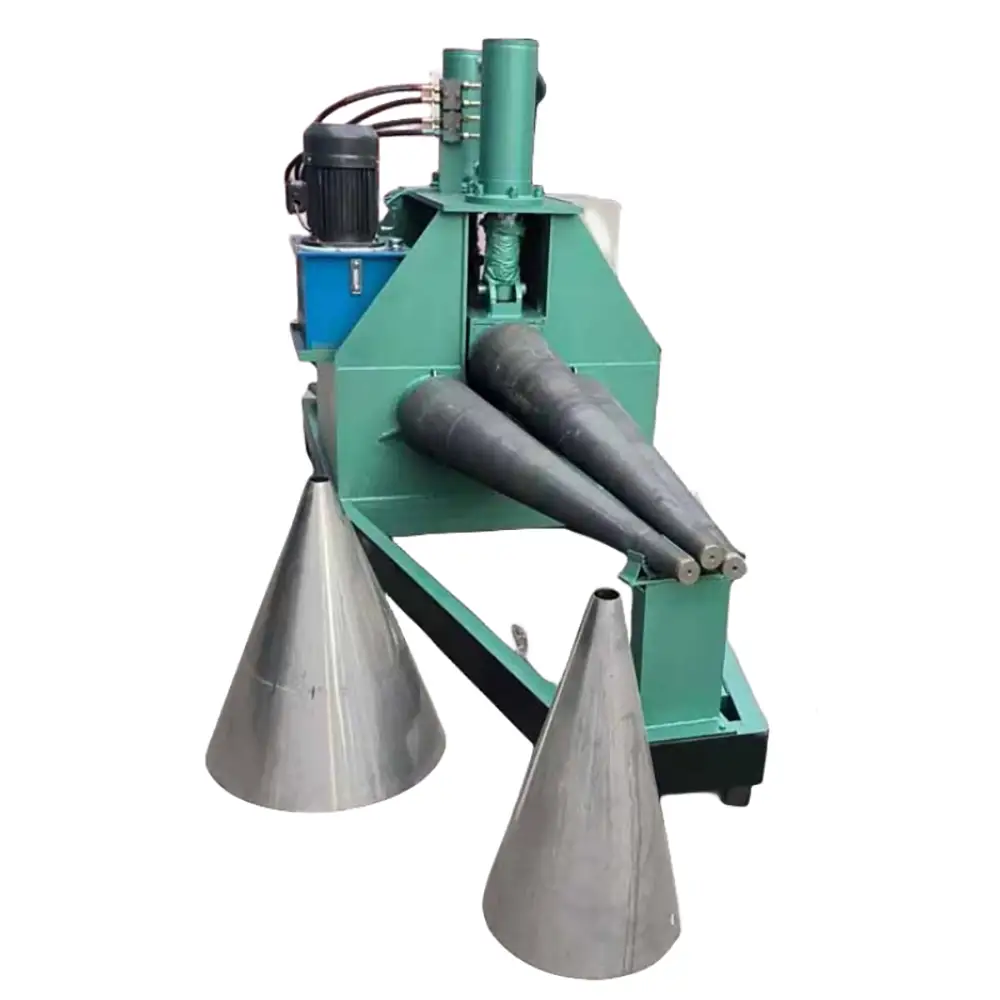
Conical Workpiece Making Tool Cnc Hydraulic Cone Rolling Machine Metal Sheet Bending Equipment
Next:
Copper Tube Multi-size and Multi-thickness, Applicable to Different Scenes
TAG:
Metal Tube Forming Machine,
Pipe Forming Machine,
Tube Forming Machine,
Electric Tube Forming Machine,
Electric Pipe Forming Machine,
Metal Tube Rolling Machine,
Aluminum Tube Bending Machine,
Steel Tube Bending Machine,
Pipe Bending Equipment,
Tube Bending Equipment,
Industrial Pipe Bending Machine,
Industrial Tube Bending Machine,
Metal Pipe Bending Machine,
Metal Tube Bending Machine,
Agricultural Pipe Bending Machine,
Agricultural Tube Bending Machine,
Automatic Pipe Bender,
Architectural Tube Bending Machine,
Automatic Tube Bender,
Metal Furniture Tube Bender,
Power Pipe Bender,
Powered Pipe Bending Machine,
Guardrail Pipe Bending Machine,
Handrail Pipe Bending Machine,
Greenhouse Pipe Bending Machine,
Greenhouse Pipe Bender,
Greenhouse Frame Bending Machine,
Greenhouse Hoop Bending Machine,
Greenhouse Arch Bending Machine,
Metal Frame Bending Machine,
Related Category:
Semi-Automatic Electric Pipe Bender,Semi-Automatic Pipe Bending Machine,Electric Pipe Bender,Electric Rolling Pipe Bende China, suppliers, manufacturers, factory, customized, wholesale, quotation, made in China