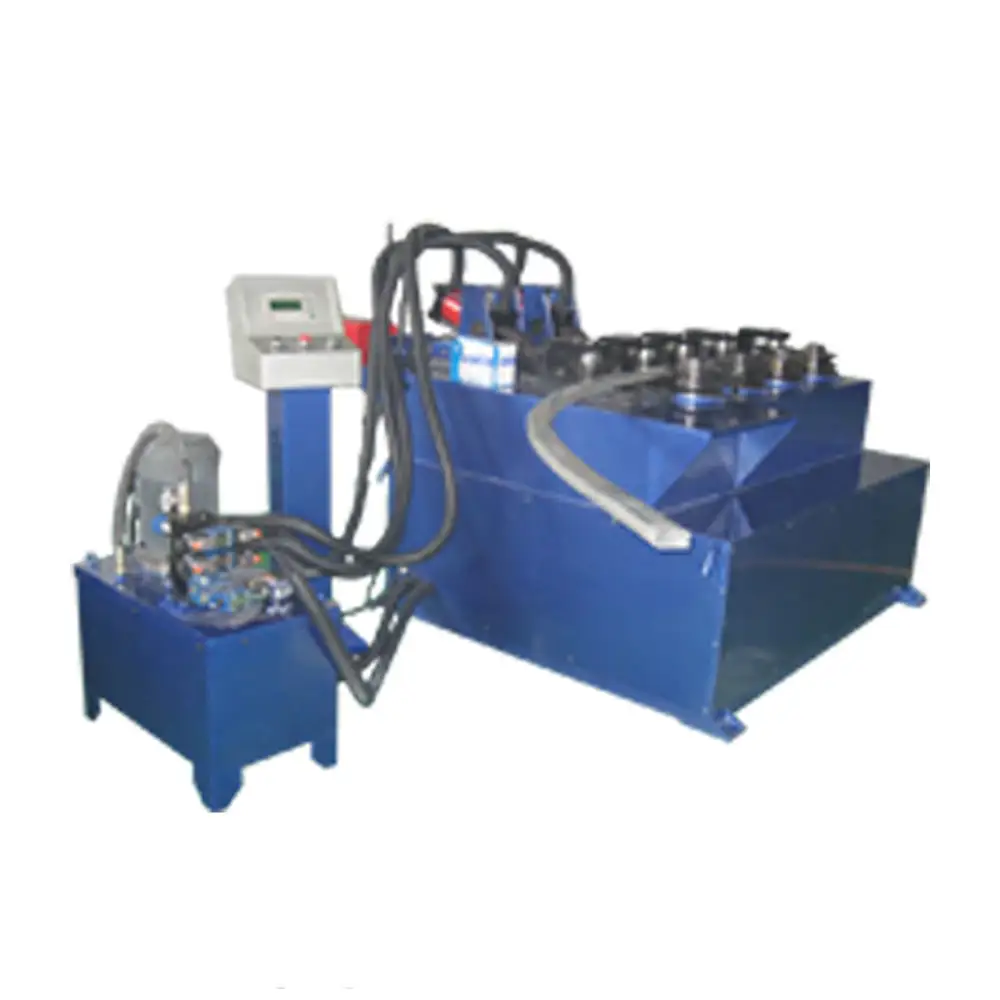
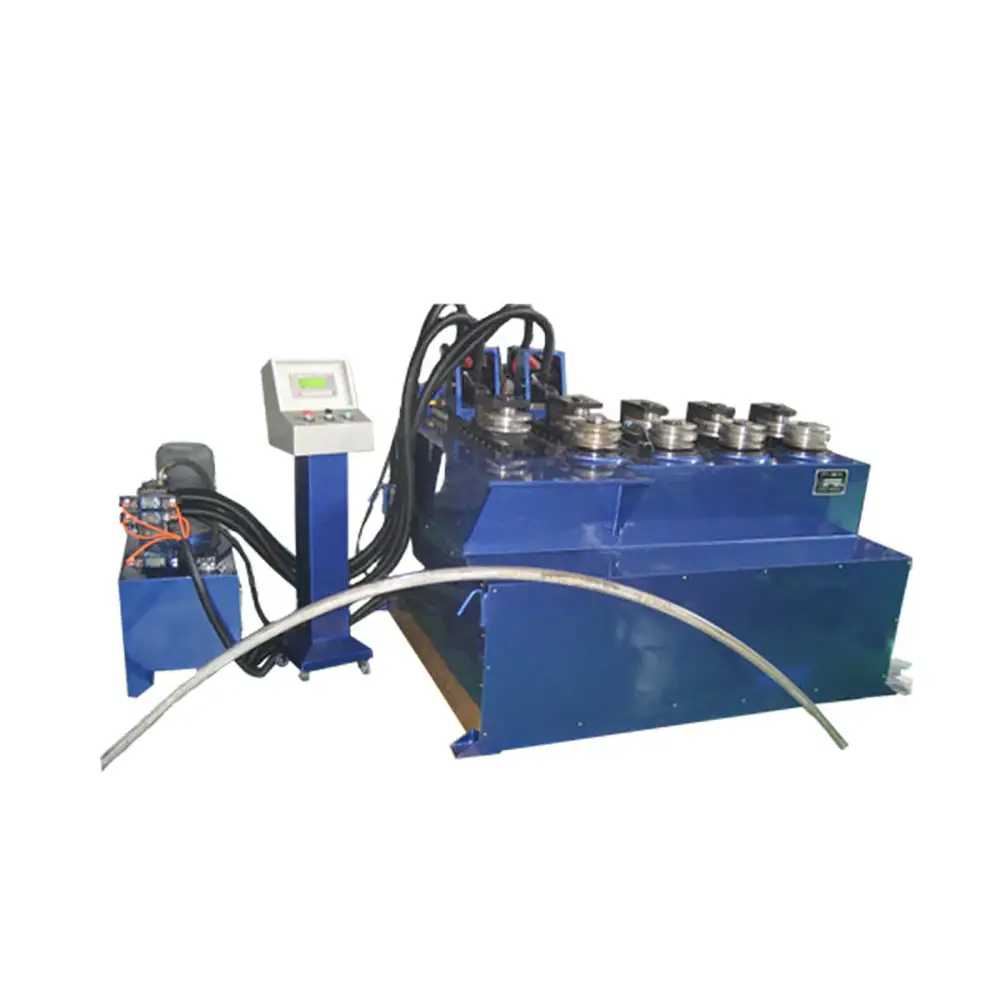
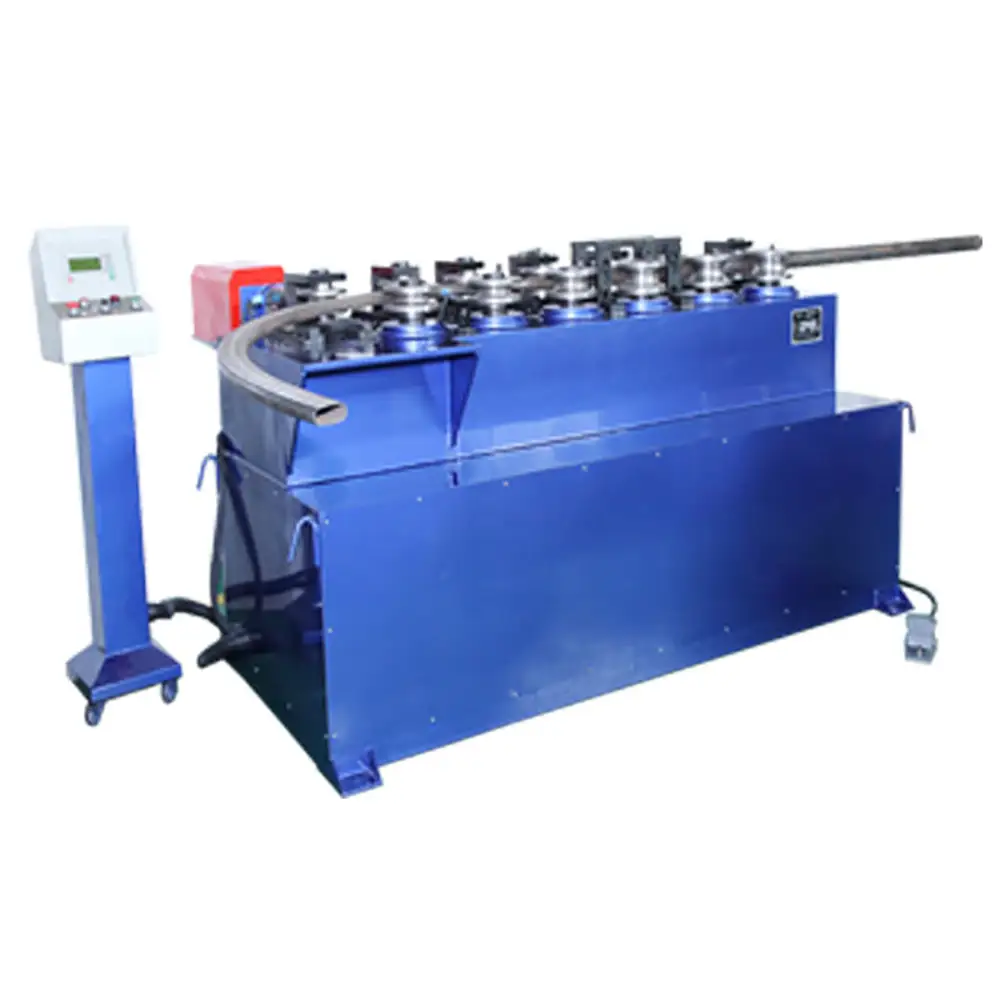
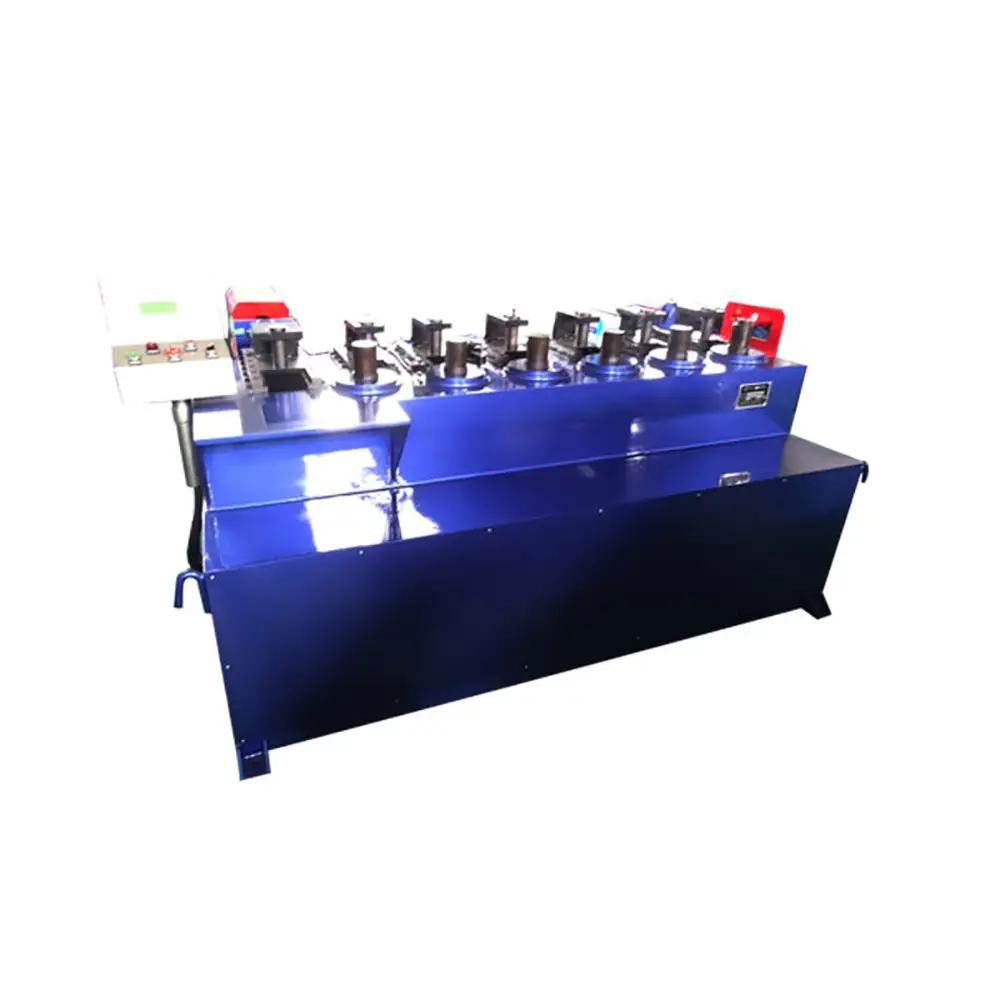
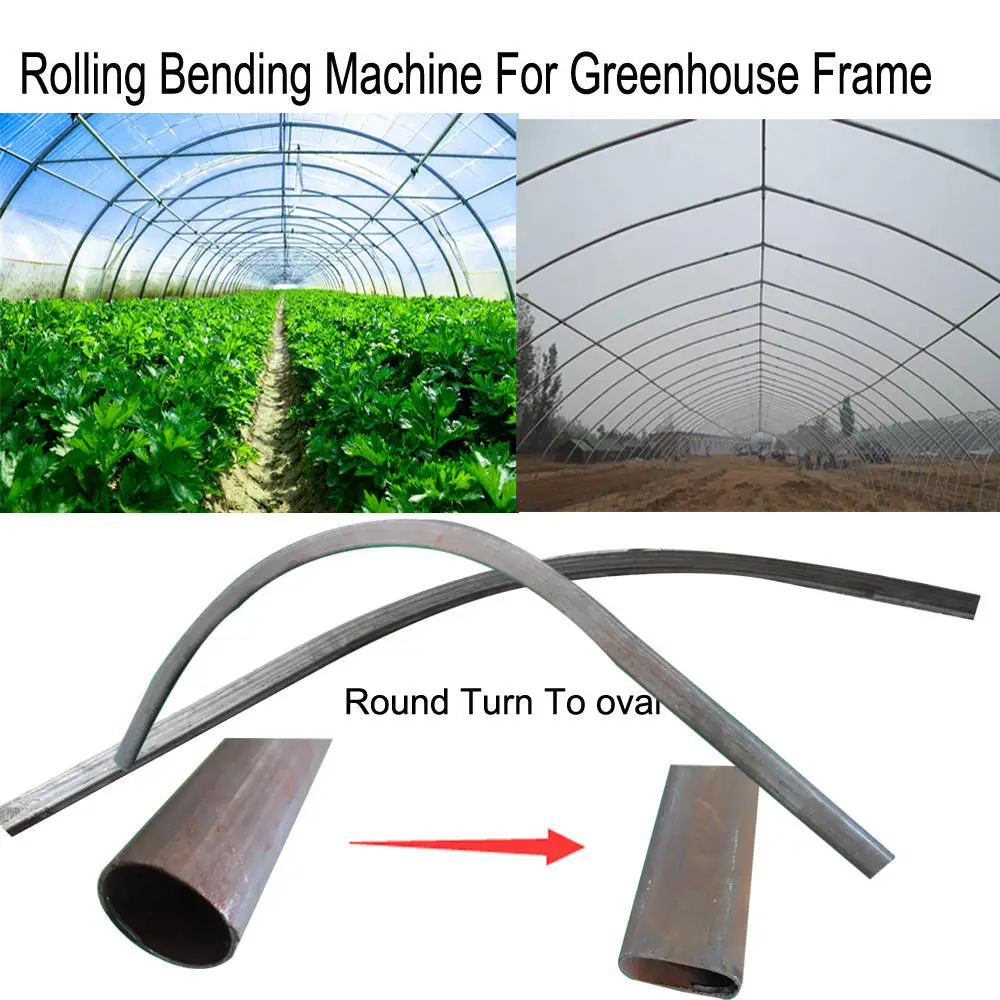
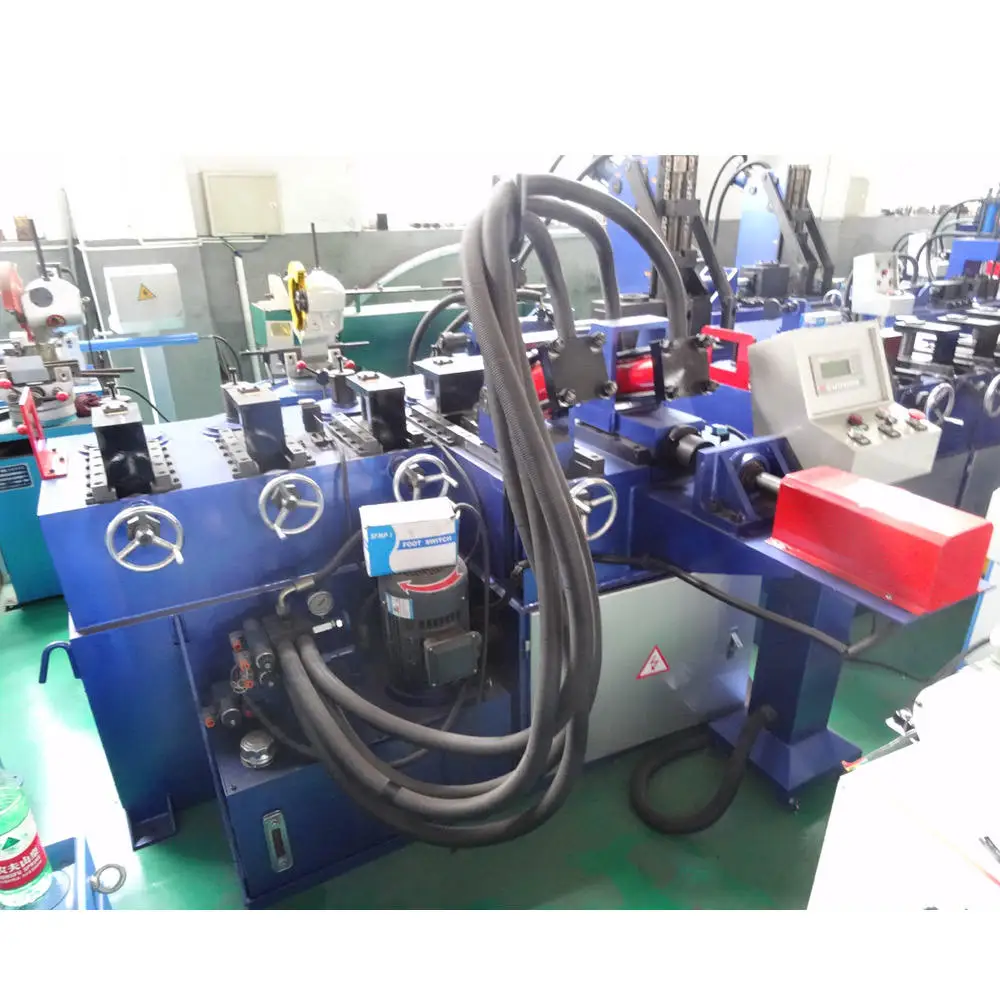
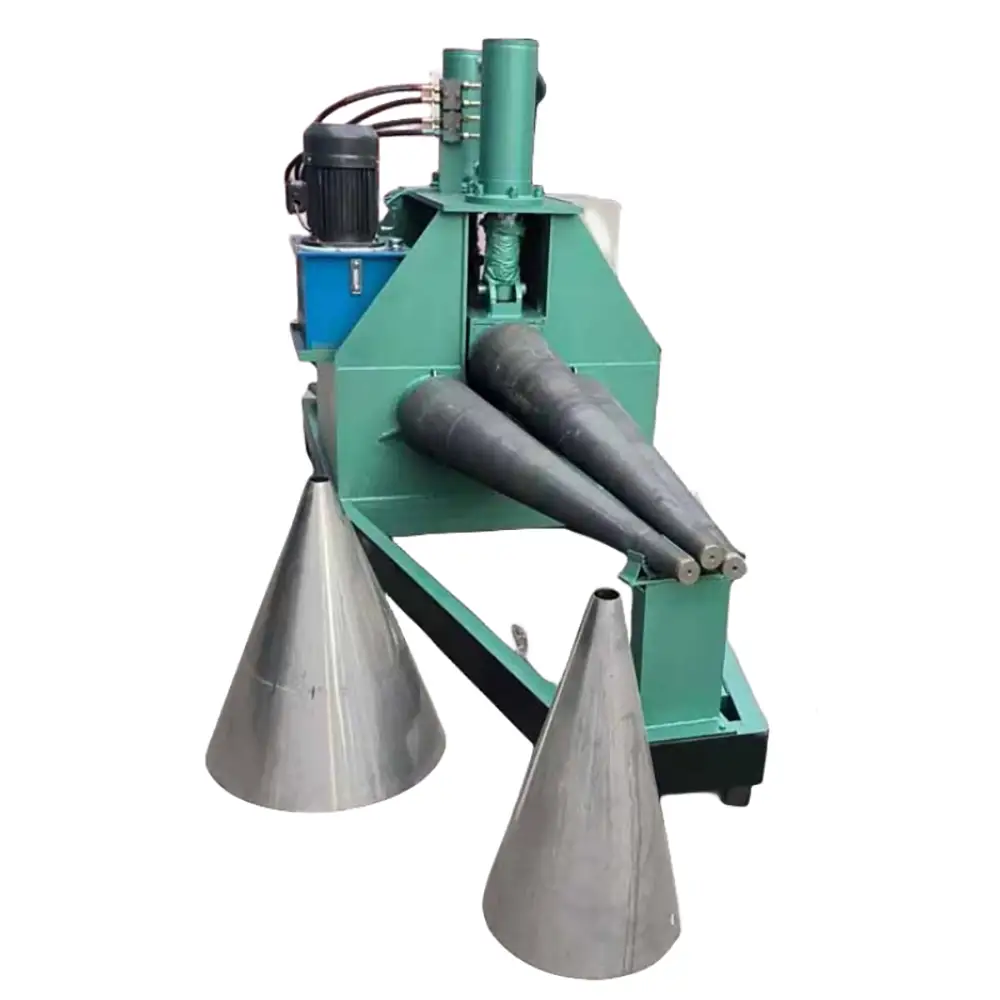
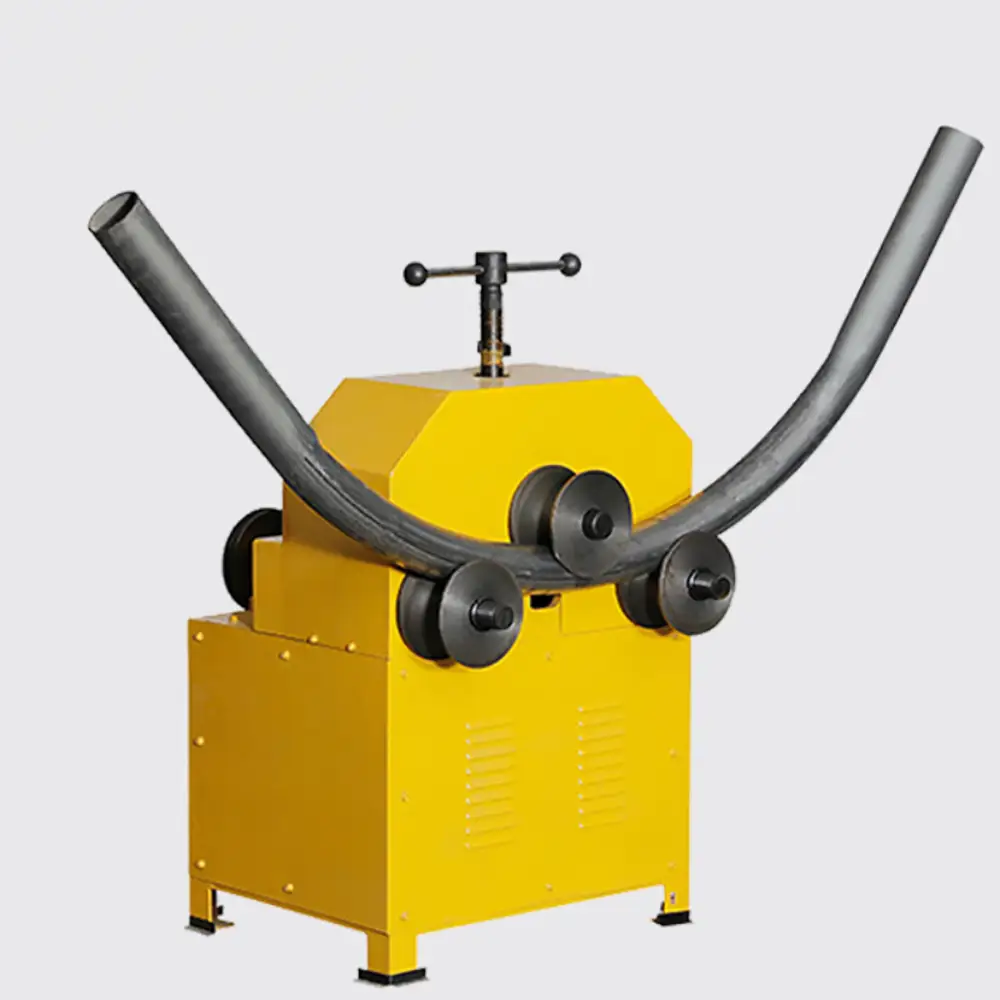
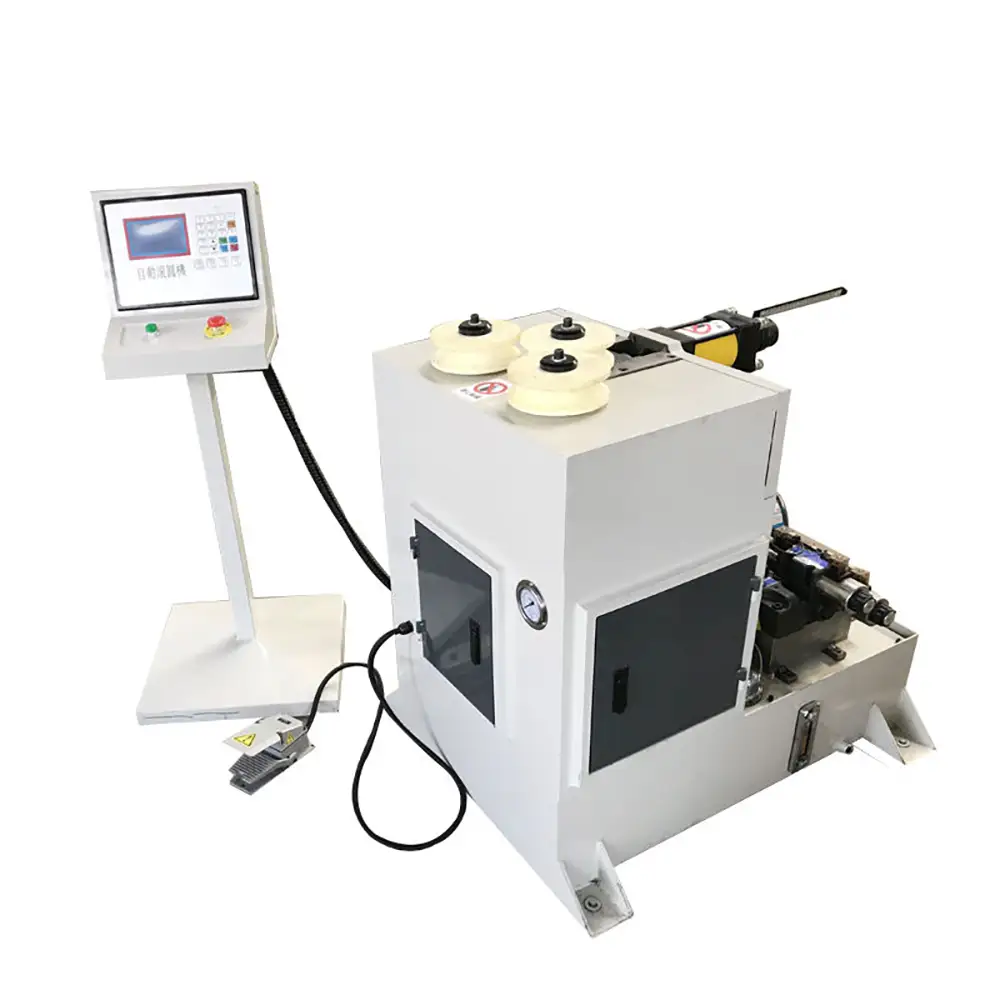
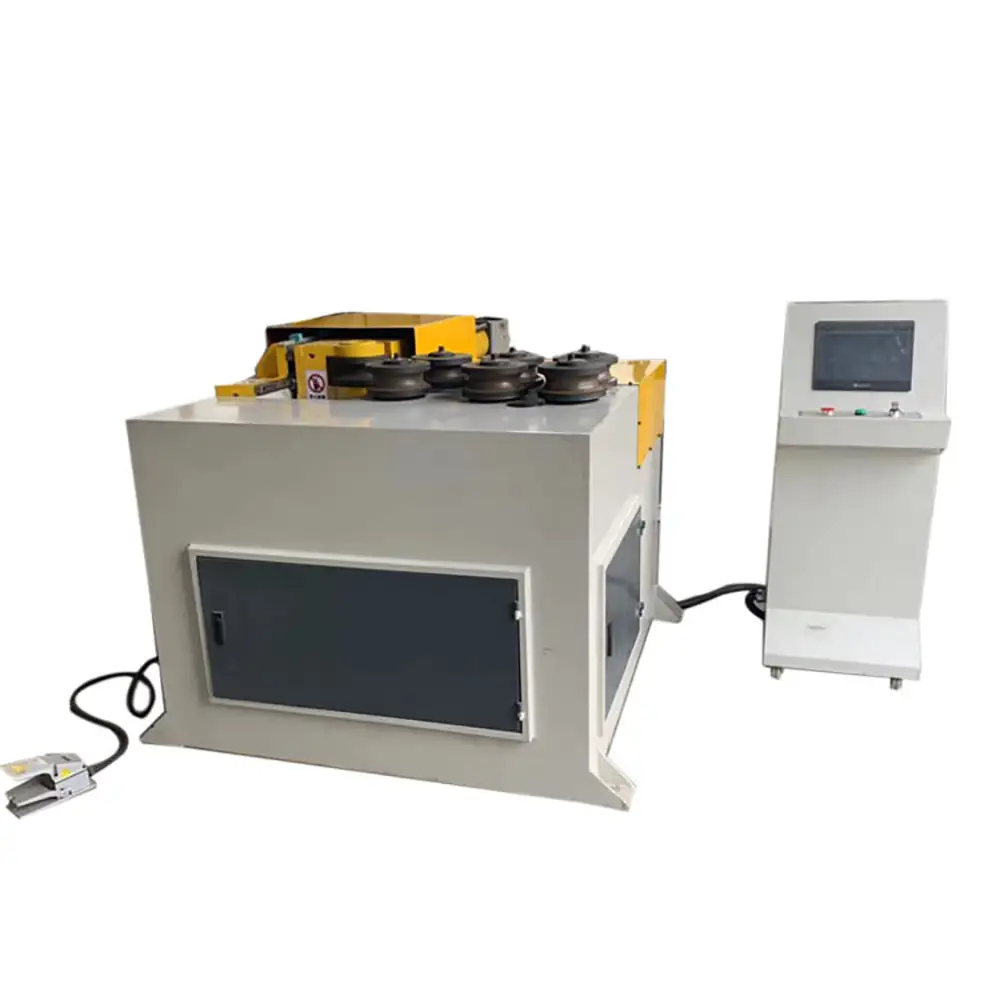
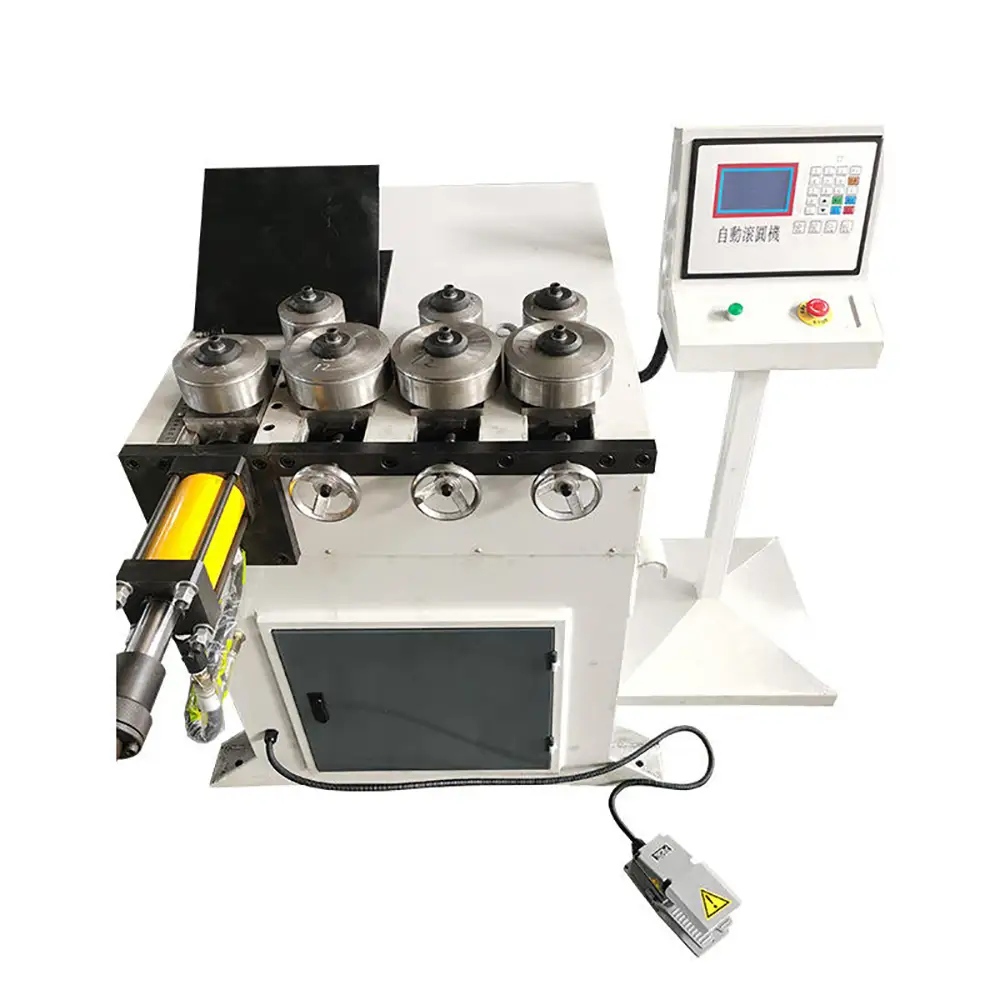
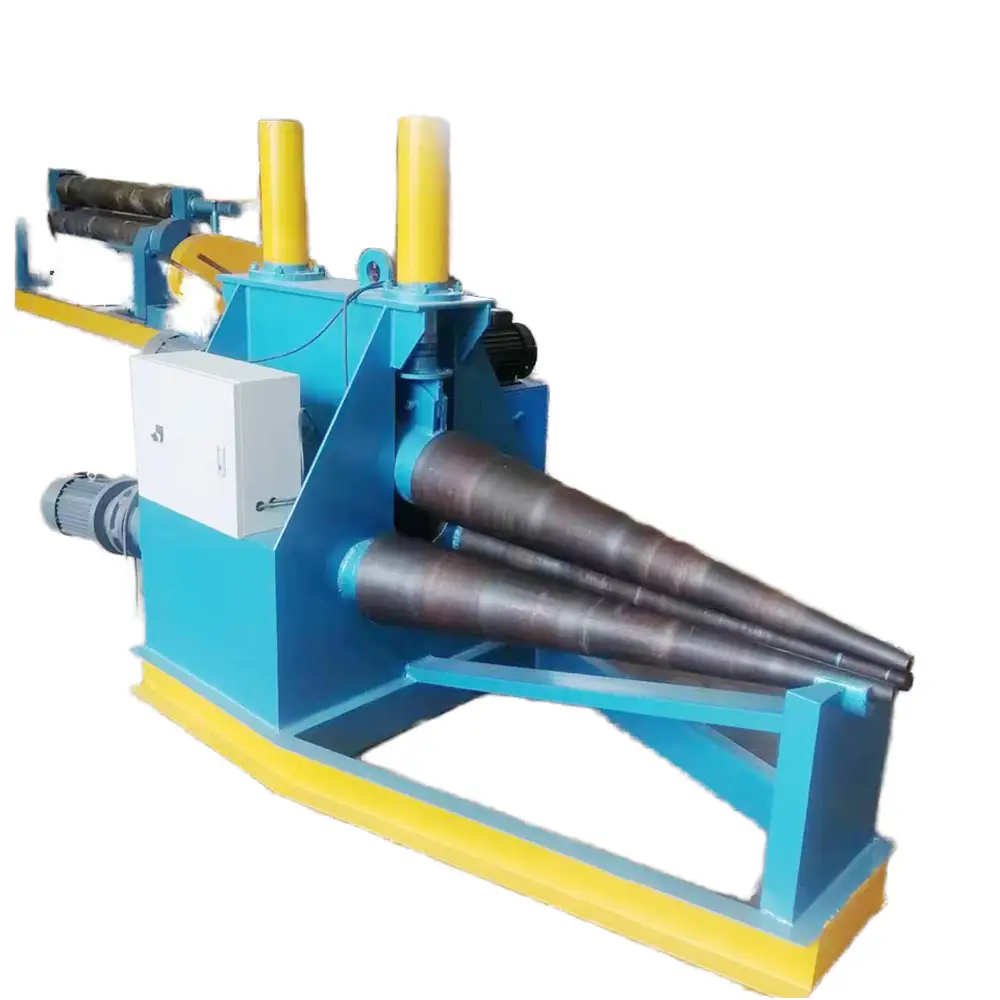
Product feature: This machine is mainly used to bend large-radius angle steel, flat steel, round pipe and other special-shaped cross-section profiles. The machine uses servo drive, PLC control system, full gear transmission mechanism, and can realize circular arcs with different radii on the same material.
(1) Complete mechanical transmission with compact structure and high reliability.
(2) Seven-roller drive, not easy to slip, thin-walled materials can also be bent.
(3) The rollers are asymmetrically distributed on both sides, reducing the straight section, which can be bent and rolled.
(4) Controller setting program, foot switch control to open and stop.
(5) Machine transmission balance, just need to adjust the compaction, you can get different curvature of the circle, arc or spiral, you can change the radius to roll, you can also change the radius and then roll, adjust according to different needs.
|
Main specifications / models |
GY100NC-7 |
|
Pipe bending capacity |
Φ100mm x6m carbon steel |
|
Minimum bend radius |
R>=10D |
|
Bending speed |
100mm/s |
|
Mold diameter |
240mm |
|
diameter of axle |
90mm |
|
speed reducer |
KF97-124.61-Y4-4P-m6-A-270 |
|
Hydraulic motor power |
11kw |
|
pump power |
pv2R2-33L |
|
size |
1800mm x1800mm x1200mm |
|
weight |
3000kg |
3 Roller Profile Bending Machine for Metal Strip,Tube,Pipe and Profile Bending
The 3 Roller Profile Bending Machine is a versatile metal forming solution designed for bending and rolling metal strips,tubes,pipes,and various structural profiles into circular,arc-shaped,and curved components. Using a three-roller forming structure,the machine progressively bends the workpiece while controlling its curvature to produce consistent profiles for fabrication and industrial applications.
Also known as a 3 roller roll bending machine,profile bending machine,section bending machine,or profile rolling machine,this equipment is commonly used when manufacturers need to transform straight metal stock into rings,arcs,curved frames,and other geometric shapes.
The machine can be applied to suitable carbon steel,stainless steel,aluminum,and other compatible metal profiles. Actual bending capability depends on the material grade,profile dimensions,wall thickness,roller configuration,machine capacity,and required bending radius.
Three-Roller Profile Rolling Structure
The three-roller design is the central forming mechanism of the machine. The rollers support and guide the workpiece while applying controlled forming pressure to progressively create the desired curvature.
Compared with one-time bending methods,the three-roller process can provide gradual deformation,which is useful when producing large-radius curves and circular components.
Depending on the machine configuration,the position of one or more rollers can be adjusted to control the forming radius. Operators can gradually increase the bending effect rather than forcing the profile into its final shape in a single operation.
This approach can be particularly useful for metal profiles that require smooth curves without excessive localized deformation.
360 Degree Rolling and Circular Forming
A major application of the machine is 360 degree rolling for producing closed circular or ring-shaped components.
Suitable workpieces can be rolled into:
Complete Metal Rings
Circular Frames
Curved Tubes
Round Profiles
Spiral Sections
Circular Structural Components
Machine Frames
Architectural Arches
Guard Rings
Custom Metal Shapes
The actual ability to complete a full 360-degree circle depends on the machine structure,roller arrangement,workpiece section,and required diameter.
Some workpieces may require pre-bending of the leading and trailing ends before the main rolling process. The exact procedure should be determined according to the profile geometry and machine design.
Metal Strip Bending
The machine can process suitable metal strips when the strip dimensions are compatible with the roller and forming system.
Metal strip bending applications may include circular bands,frames,reinforcement rings,decorative structures,and fabricated components.
For thin strips,the roller setup and forming pressure should be carefully selected to avoid excessive deformation. For thicker or stronger materials,greater forming force may be required.
Material width,thickness,yield strength,and desired radius all influence the appropriate bending parameters.
Tube and Pipe Roll Bending
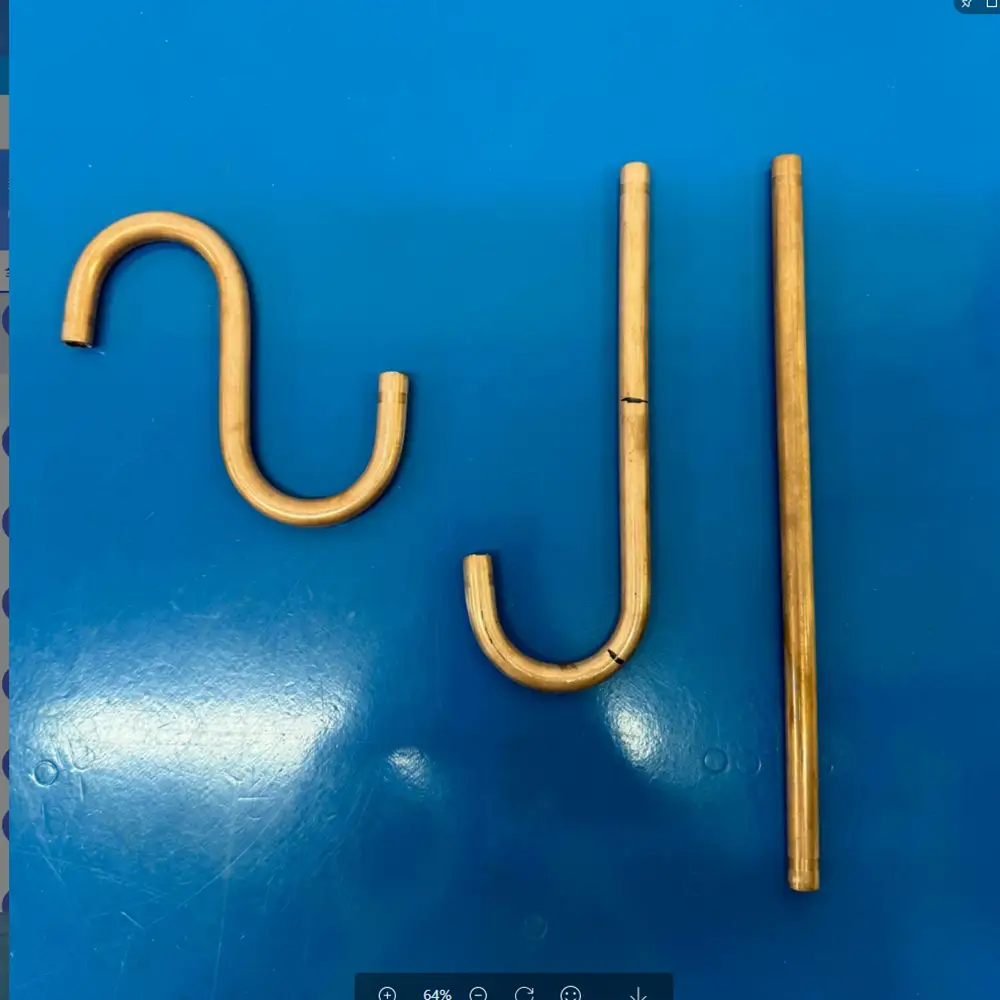
Tube and pipe bending is another important application. Suitable round tubes,pipes,and other tubular sections can be progressively rolled into large-radius curves.
Typical applications include:
Steel Pipe Arches
Tube Frames
Circular Tubes
Handrail Sections
Greenhouse Structures
Agricultural Frames
Automotive Components
Furniture Frames
Architectural Structures
Industrial Pipe Assemblies
Unlike conventional rotary draw bending,which typically forms a relatively tight bend around a die,the three-roller rolling process is particularly useful for producing large-radius curves and circular sections.
For thin-wall tubes,proper roller selection and controlled pressure are important to minimize flattening or distortion.
Profile Roll Bending
The machine is suitable for bending a variety of structural and decorative profiles depending on the roller tooling.
Potential profile types include:
Angle Steel
Flat Bar
Square Tube
Rectangular Tube
Round Tube
Channel Profiles
T Profiles
H Profiles
I Profiles
Aluminum Profiles
Stainless Steel Profiles
Different profile geometries behave differently during bending. For example, angle steel may experience twisting if the roller arrangement is not correctly configured,while rectangular tubing can be sensitive to wall deformation.
Proper tooling and roller positioning are therefore essential for maintaining the required profile orientation throughout the bending process.
Gradual Bending and Springback Control
Metal springback is an important consideration in profile rolling. After the forming pressure is removed,the material may partially return toward its original shape.
Springback depends on material strength,profile geometry,wall thickness,forming radius,and the amount of deformation applied.
The three-roller forming process allows operators to make progressive adjustments to the workpiece. Additional passes can be used when necessary to approach the desired radius.
For demanding applications,the final radius should be checked after forming rather than relying only on roller position. Trial forming can help determine suitable parameters for a particular material and profile.
Flexible Bending Radius
Different projects require different bending radii. A profile bending machine can be configured for a range of radii depending on the roller arrangement and machine specifications.
Large-radius bending is commonly required for architectural structures,greenhouses,handrails,metal frames,and industrial components.
Smaller radii may require different tooling or a machine with suitable forming capacity. Customers should provide the desired inner or outer radius when requesting a quotation.
The maximum and minimum achievable radius should always be confirmed for the specific profile and material.
Industrial and Fabrication Applications
The 3 roller profile bending machine can support many fabrication industries.
Common applications include:
Metal Fabrication
Steel Structure Manufacturing
Architectural Metalwork
Greenhouse Manufacturing
Agricultural Equipment
Automotive Parts
Trailer Manufacturing
Furniture Production
Handrail Fabrication
Gate And Fence Manufacturing
Machinery Manufacturing
Custom Metalworking
For manufacturers producing curved components regularly,the machine can reduce manual bending operations and provide a more controlled forming process.
Production Efficiency
Three-roller profile bending is suitable for individual components,custom projects,and repeated production.
The operator can progressively feed the workpiece through the rollers while adjusting the forming position according to the desired curvature.
For repeated production,the same roller settings and forming procedures can be documented and reused. However,actual production consistency depends on material variation,profile tolerances,roller condition,operator technique,and machine configuration.
For high-volume production,automatic feeding or CNC-controlled options may be considered depending on the required workflow.
Roller Tooling and Workpiece Support
Roller tooling should match the shape and dimensions of the workpiece. Incorrect tooling can lead to slipping,twisting,surface marks,or profile deformation.
Special roller sets may be required for different profile types. Customers processing multiple sizes may therefore benefit from interchangeable or customized roller tooling.
Additional workpiece supports can also be useful when handling long or heavy profiles. Proper support helps reduce unwanted movement and makes feeding through the machine more stable.
CNC and Hydraulic Options
Depending on the model,a profile bending machine may use manual,electric,hydraulic,or CNC-controlled roller adjustment.
A hydraulic configuration can provide controlled roller movement and forming force. CNC control may allow programmable roller positioning and repeatable bending procedures.
However,the actual automation level varies between machines. Buyers should confirm whether the selected model provides manual,semi-automatic,automatic,or CNC operation.
The appropriate configuration depends on production volume,profile size,required radius,and desired operator involvement.
Custom and OEM Profile Bending Solutions
Different customers may require different machine capacities and tooling arrangements. When requesting a quotation,provide the following information:
Material Type
Material Grade
Profile Shape
Profile Dimensions
Wall Thickness
Required Bending Radius
Finished Shape
Production Volume
Desired Automation Level
Drawings or sample workpieces are especially useful for determining the appropriate roller arrangement.
OEM and ODM solutions may include customized roller tooling,hydraulic systems,control systems,workpiece supports,feeding arrangements,and other application-specific configurations.
Maintenance and Safety
A three-roller bending machine contains moving rollers and significant forming forces. Operators should keep hands,clothing,and tools away from pinch points during operation.
The machine should be installed on a stable foundation when required by the design. Electrical and hydraulic components should be inspected according to the manufacturer's maintenance instructions.
Routine maintenance may include cleaning metal chips,checking roller surfaces,inspecting bearings and drive components,checking hydraulic connections,and lubricating designated moving parts.
Before changing roller tooling or performing maintenance,the machine should be stopped and isolated according to the applicable safety procedure.
Why Choose Us
Three-Roller Forming Design
Progressive roller forming provides a practical solution for bending metal strips,tubes,pipes,and structural profiles.
360 Degree Rolling Capability
Suitable configurations can produce circular rings,closed profiles,and other full-circle components.
Multi-Profile Processing
Can be configured for suitable round,square,rectangular,angle,flat,and other metal profiles.
Flexible Bending Radius
Suitable for producing large-radius curves,arcs,rings,and customized curved components.
Wide Industrial Applications
Useful for steel structures,greenhouses,handrails,furniture,automotive components,and general fabrication.
Controlled Progressive Forming
Gradual roller adjustment helps operators approach the required curvature while accounting for material springback.
Customized Roller Tooling
Roller configurations can be evaluated according to the shape,size,and material of the workpiece.
OEM And B2B Manufacturing Support
Suitable for fabricators,manufacturers,distributors,and international machinery buyers requiring customized profile bending solutions.
FAQs
1. What is a 3 roller profile bending machine?
It is a metal forming machine that uses three rollers to progressively bend strips,tubes,pipes,and structural profiles into arcs,rings,and other curved shapes.
2. What materials can it bend?
Depending on the machine configuration,it can process suitable carbon steel,stainless steel,aluminum,and other compatible metals.
3. Can it roll a profile through 360 degrees?
Suitable configurations can produce complete circular or ring-shaped components. The actual capability depends on the profile,machine design,tooling,and required diameter.
4. What profiles can be processed?
Depending on the roller tooling,the machine may process round tubes,square tubes,rectangular tubes,angle steel,flat bars,channels,T profiles,I profiles,H profiles,and other suitable sections.
5. Can it bend metal strips?
Yes. Suitable metal strips can be progressively rolled into arcs,rings,and other curved shapes within the machine's forming capacity.
6. Can it bend pipes and tubes?
Yes. Round and other suitable tubular sections can be roll-bent into large-radius curves,circular tubes,and structural frames.
7. What is the difference between profile rolling and tube bending?
Profile rolling uses rollers to progressively form a curve over a longer section,while many conventional tube bending methods use a dedicated die to create a bend at a specific location. Profile rolling is especially useful for large-radius curves.
8. What causes springback?
Springback occurs because metal tends to recover part of its original shape after forming. Material strength,thickness,profile geometry,and bending radius affect the amount of springback.
9. Can the bending radius be adjusted?
Yes. Roller positioning can be adjusted to change the forming radius,subject to the machine's design and capacity.
10. Does the machine require special rollers for different profiles?
Often yes. Different profile shapes may require different roller geometries to maintain proper contact and reduce twisting or deformation.
11. Is the machine automatic?
The operating method depends on the model. Machines may be manual,electric,hydraulic,semi-automatic,or CNC controlled. The exact configuration should be confirmed before purchase.
12. What information should I provide for a quotation?
Provide the material,profile shape,profile dimensions,wall thickness,required bending radius,finished shape,production volume,and desired automation level. Drawings or samples are recommended.
Prev:Sorry, no information
Next:
Conical Workpiece Making Tool Cnc Hydraulic Cone Rolling Machine Metal Sheet Bending Equipment
TAG:
Metal Ring Bending Machine,
Metal Strip Bending Machine,
Flat Bar Bending Machine,
Steel Strip Bending Machine,
Steel Profile Bending Machine,
Metal Profile Bending Machine,
Rectangular Tube Bending Machine,
Metal Profile Forming Machine,
Tube Rolling Machine,
Pipe Bending Equipment,
Metal Rolling Equipment,
Tube Bending Equipment,
Profile Bending Equipment,
Profile Rolling Equipment,
Section Bending Equipment,
Steel Profile Bending Equipment,
Automatic Tube Bending Machine,
Hydraulic Pipe Bending Machine,
CNC Tube Bending Machine,
Industrial Pipe Bending Machine,
Metal Bending Equipment,
Industrial Tube Bending Machine,
Hydraulic Tube Bending Machine,
Metal Arc Bending Machine,
Large Radius Pipe Bending Machine,
Large Radius Tube Bending Machine,
Large Radius Bending Machine,
Large Radius Profile Bending Machine,
Industrial Profile Bending Machine,
Hydraulic Profile Bending Machine,
Related Category:
Metal Strip Bending Machine,Tube Pipe Bending Machine,Profile Bending Machine,3 Roller Bending Machine,3 Roller Profile China, suppliers, manufacturers, factory, customized, wholesale, quotation, made in China