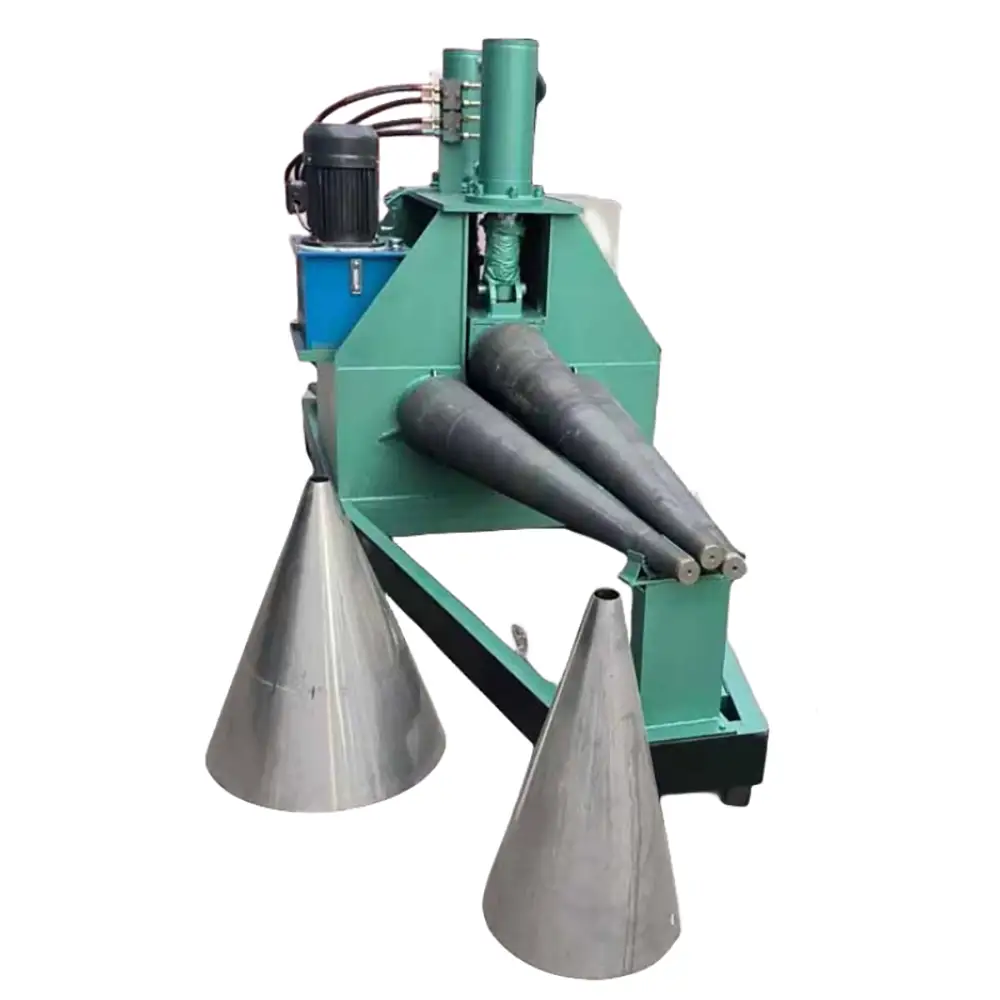
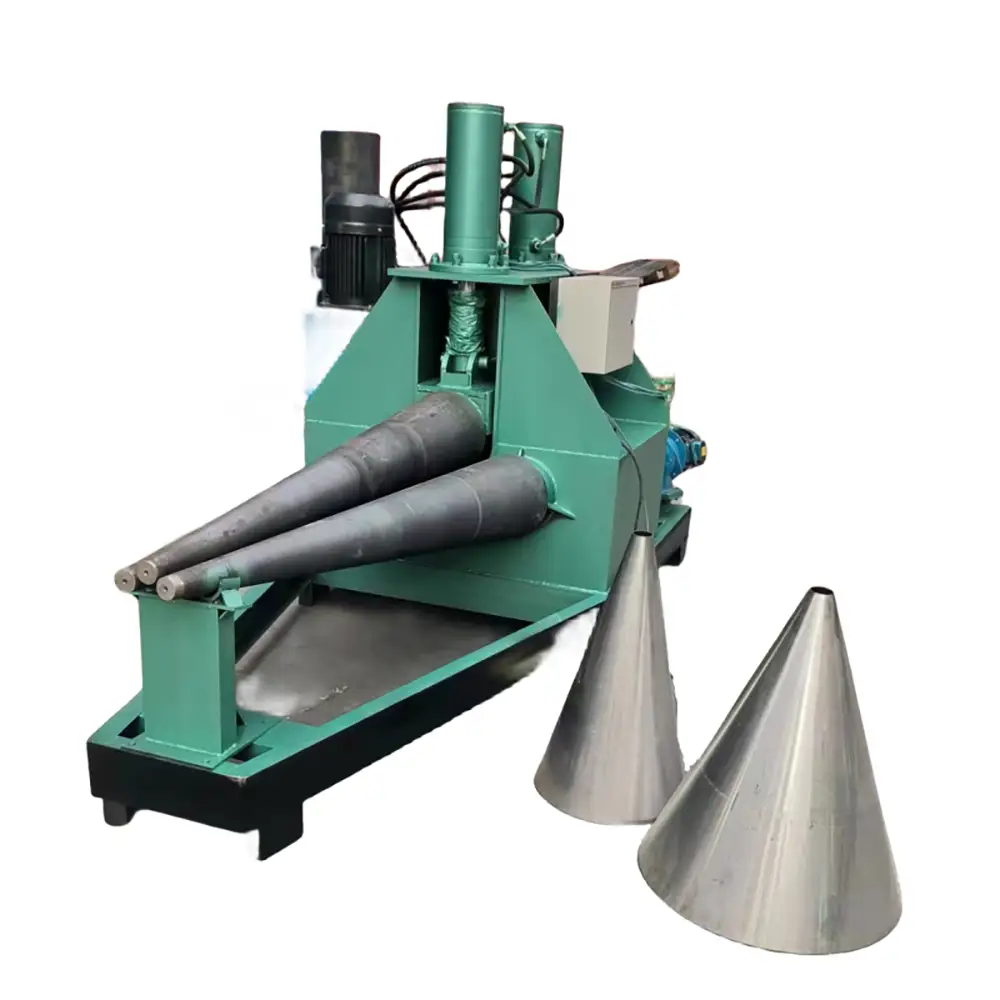
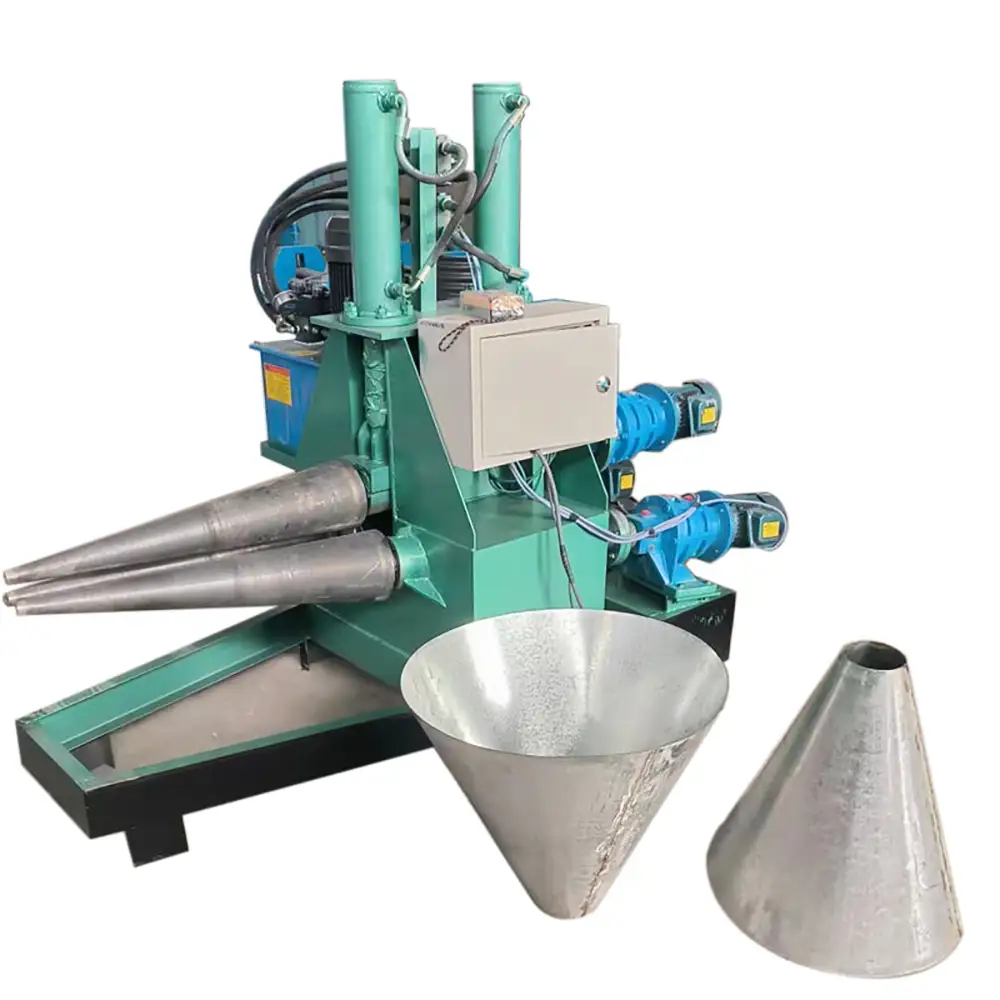
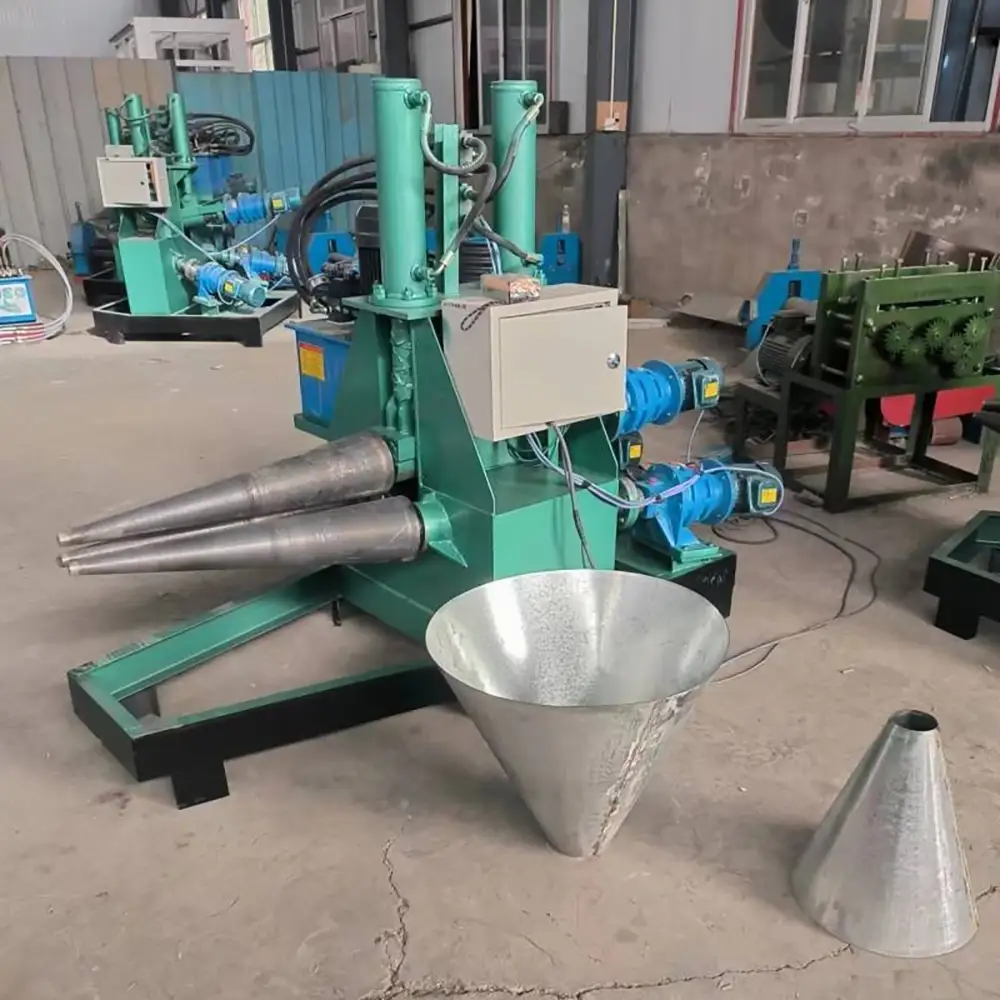
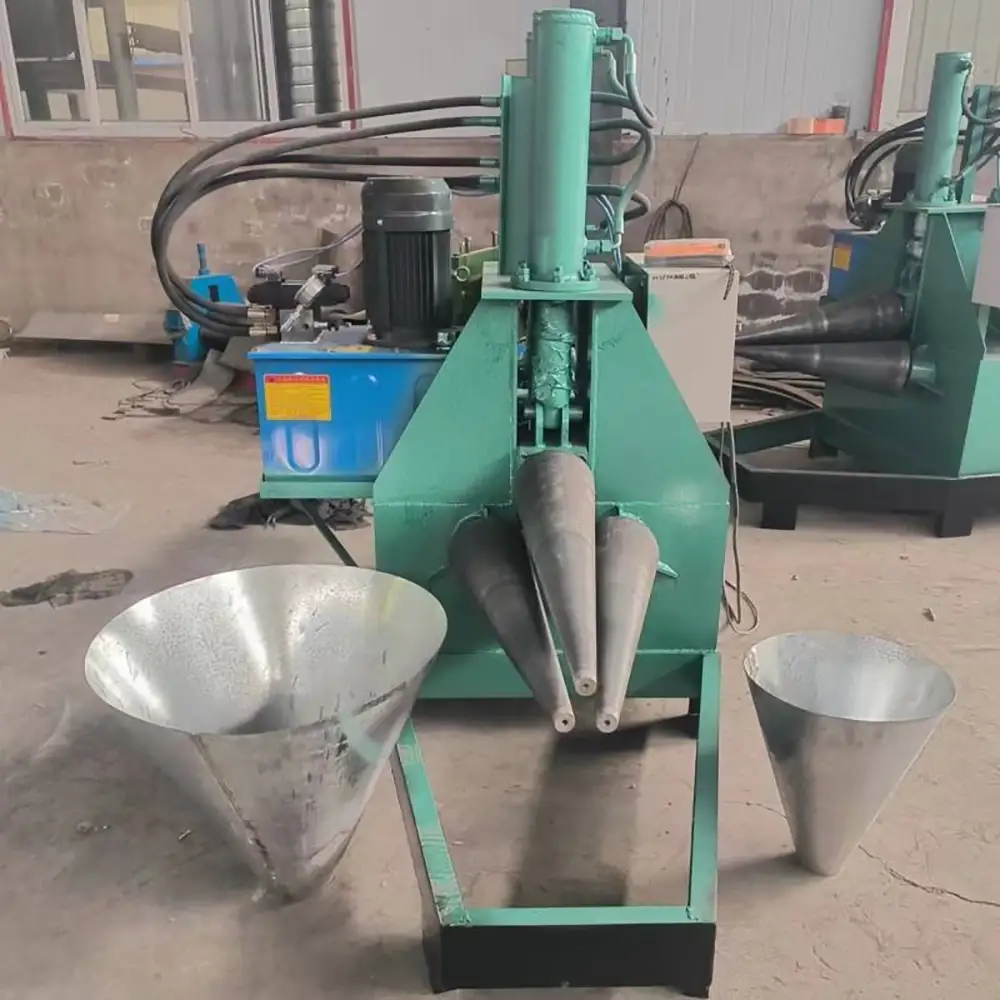
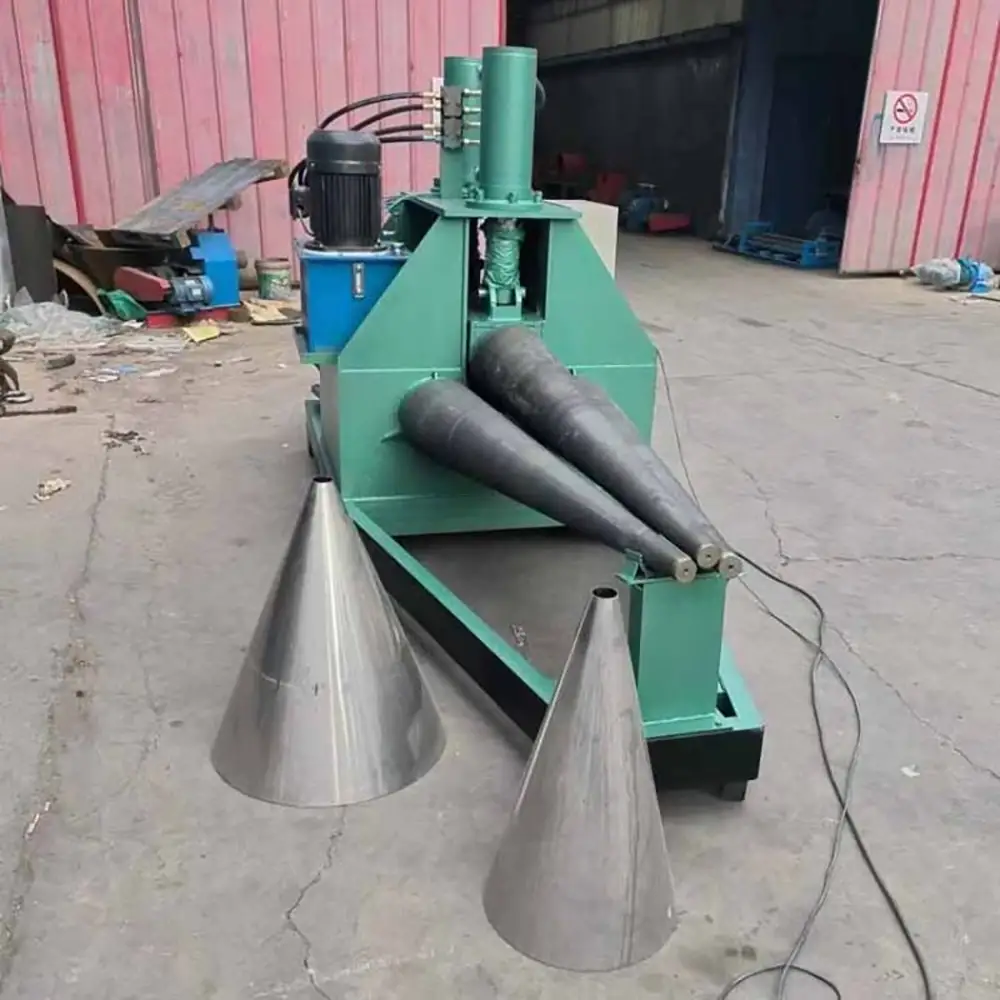
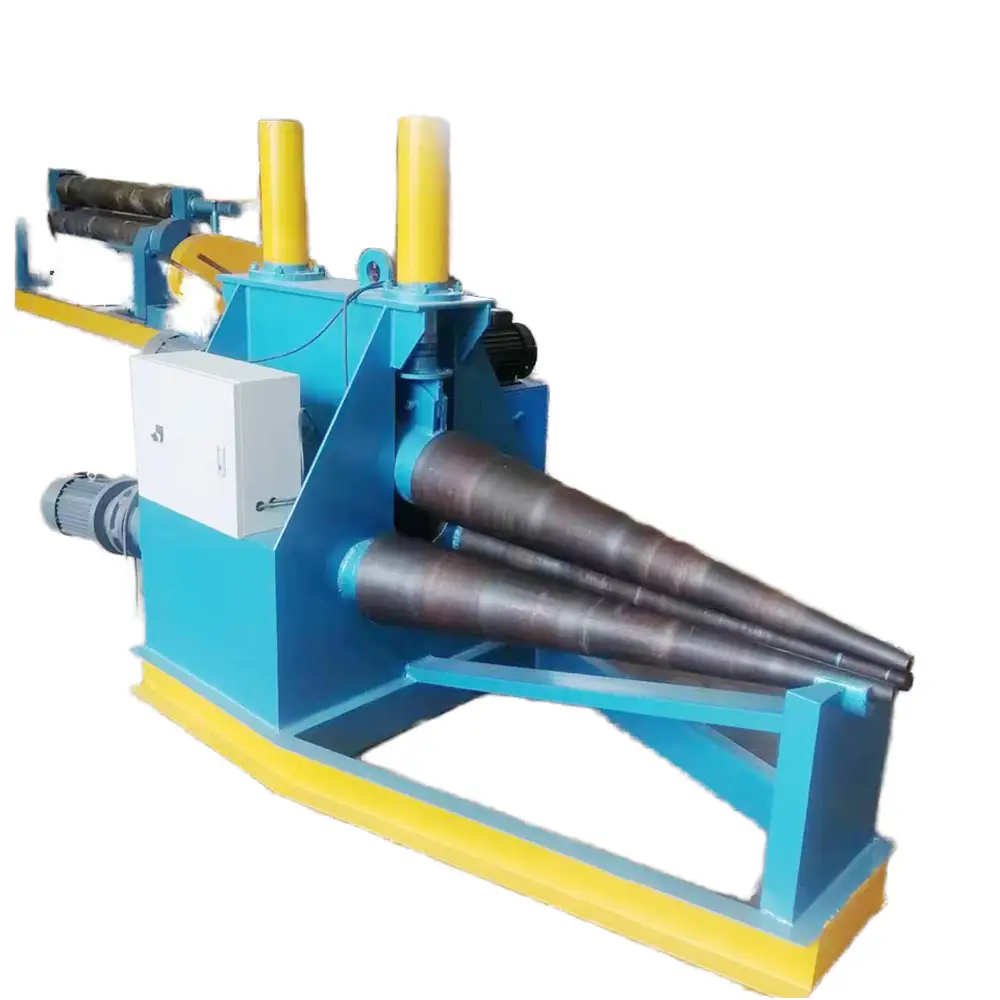
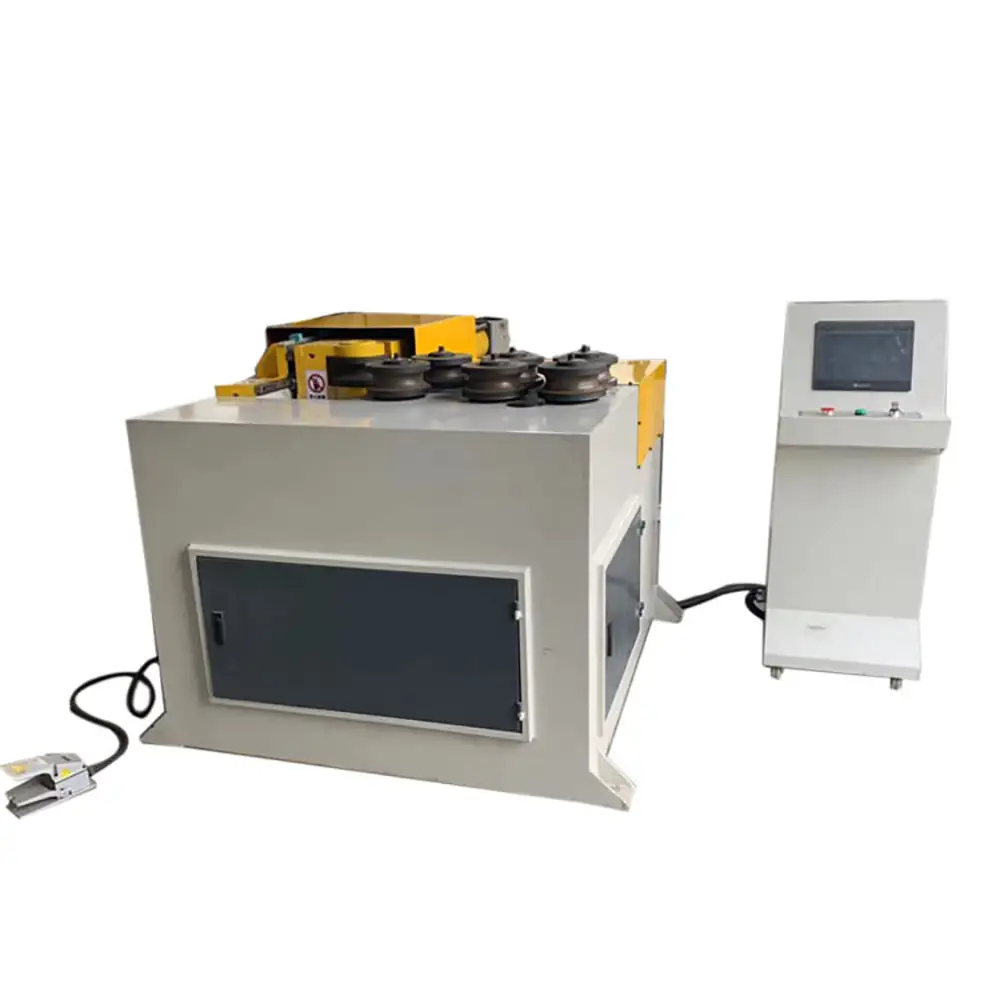
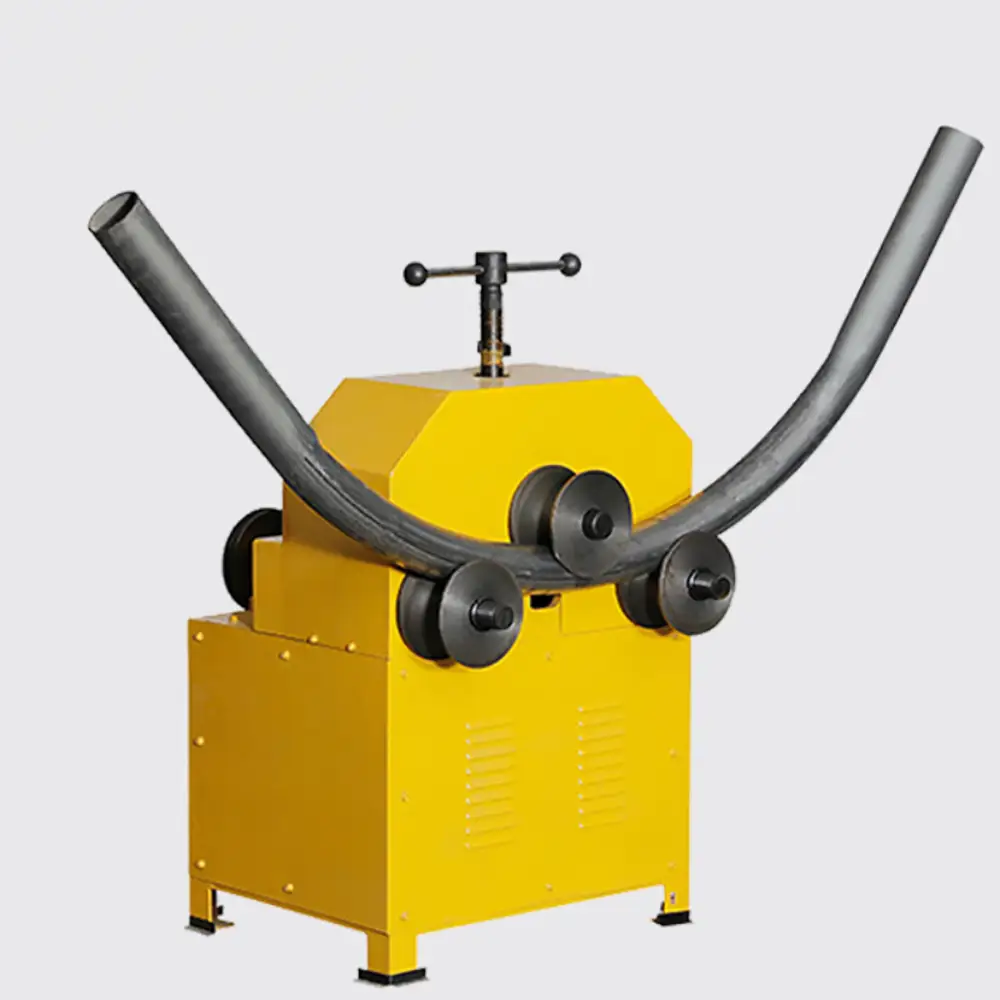
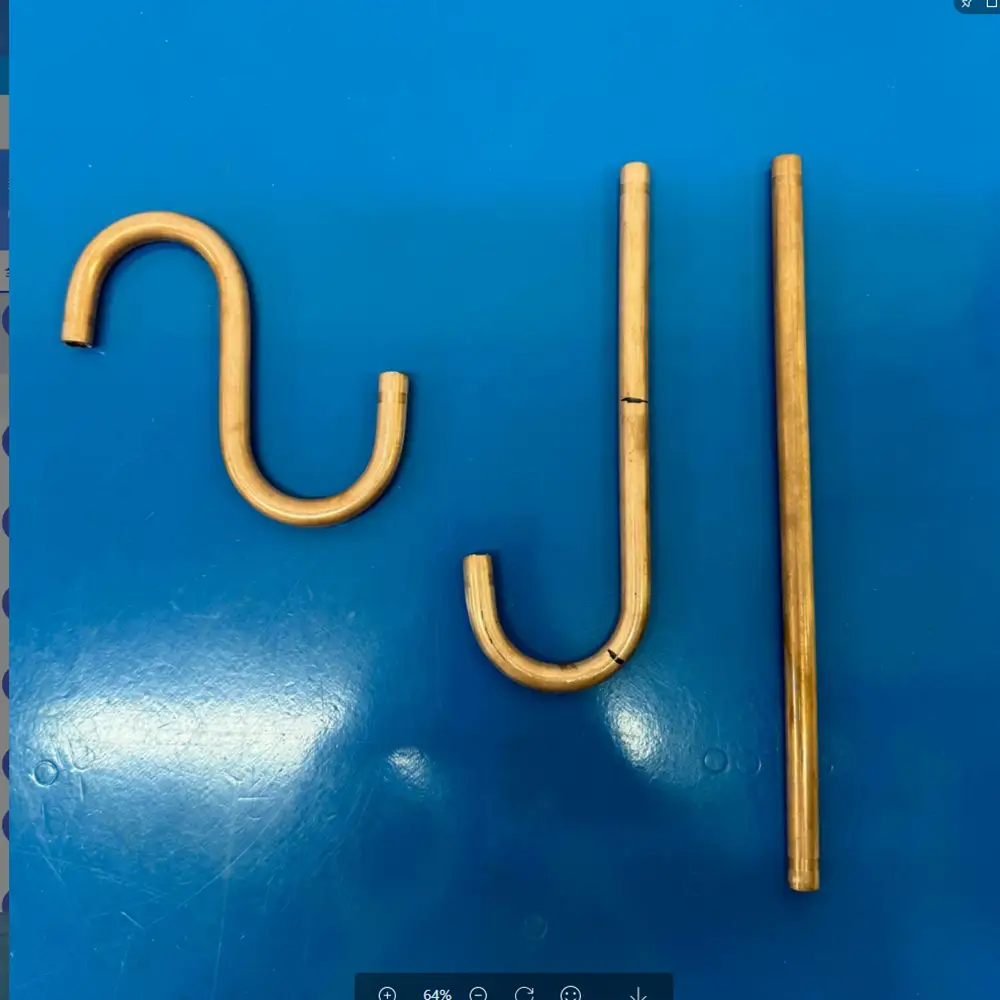
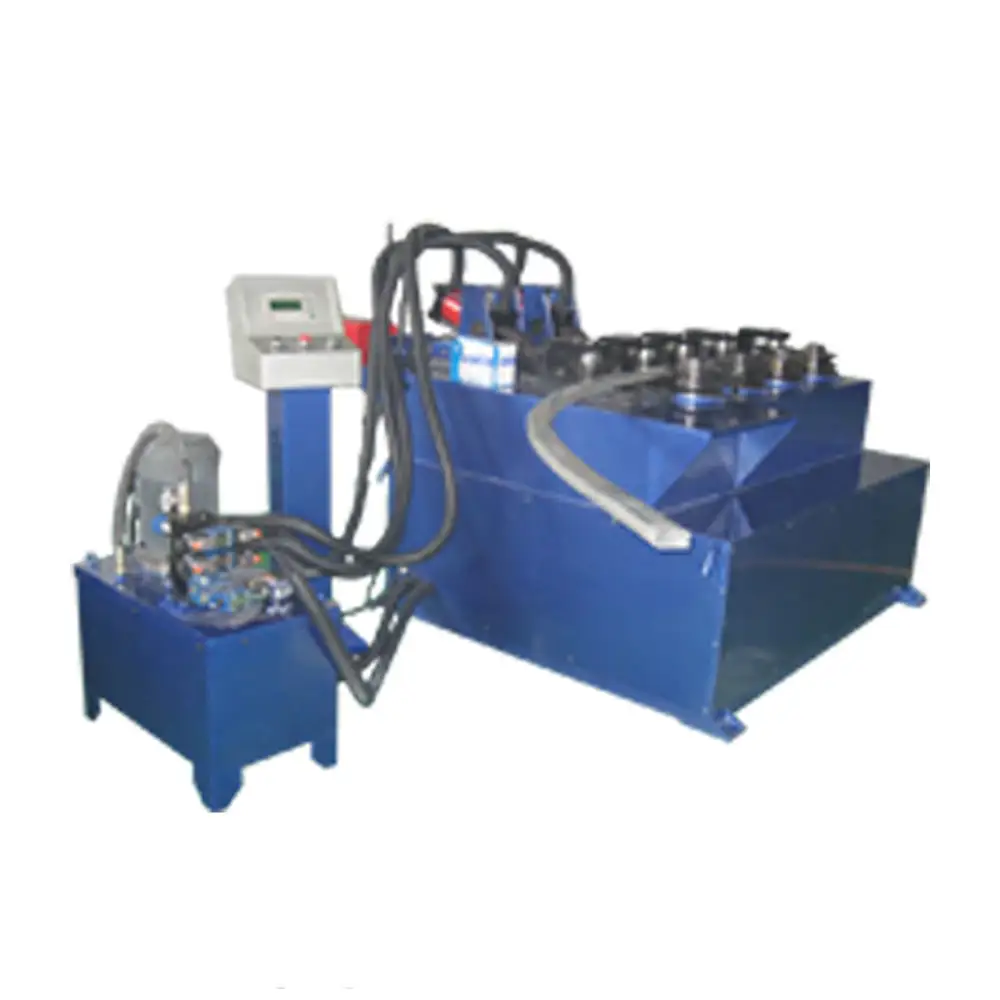
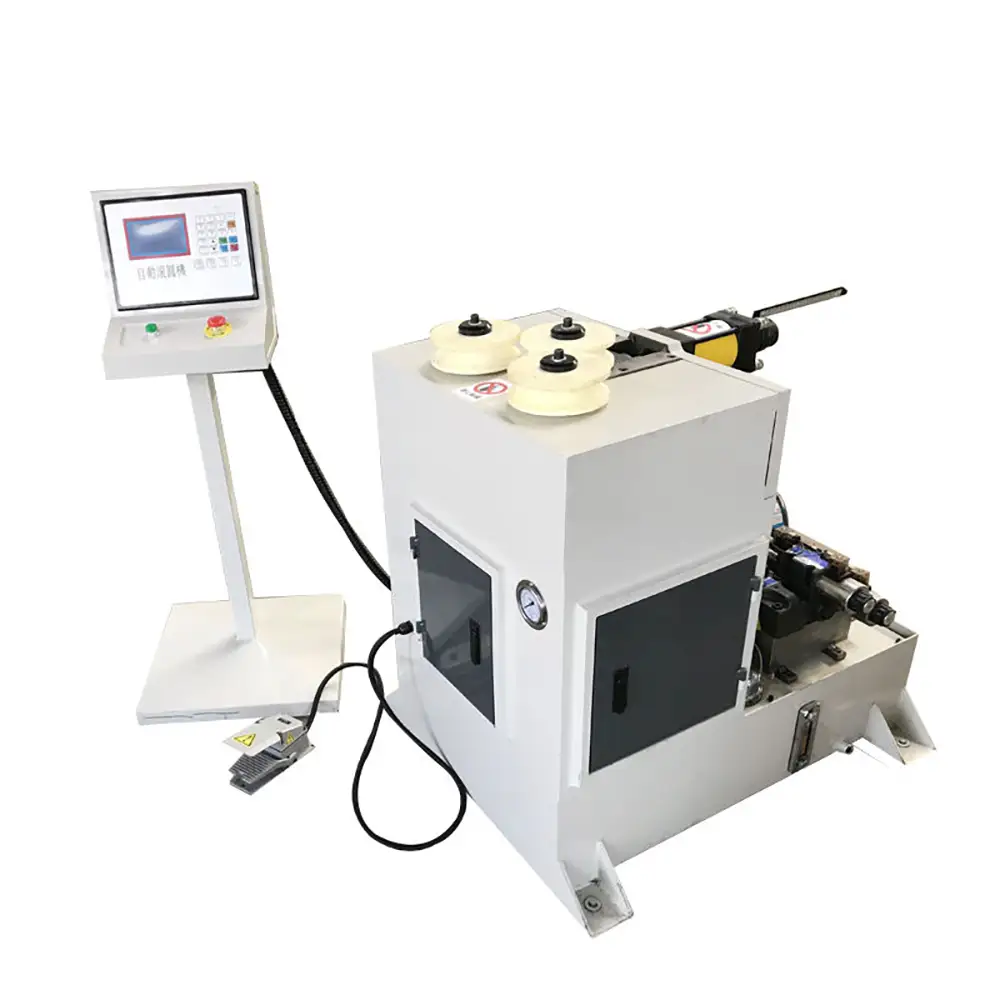
Three-Axis Tapered Roller Machine is a machine used to process and form metal materials, featuring multi-axis construction, high adjustability, automated operation and versatility. It is widely used in metalworking, sheet metal working, shipbuilding,construction and structural applications for manufacturing a wide range of metal products and components. The machine is capable of achieving high accuracy and efficiency in the machining process, providing a wide range of shapes and sizes of workpieces.
|
Adjust way |
Hydraulic |
|
Max processing capacity |
Steel 8mm, stainless steel 5mm |
|
Max motor power |
4kw*2picec,3kw*1piece |
|
Oil pump motor power |
2.2kw |
|
Total power |
13.2kw |
|
Roller quantity |
3 solid rollers |
|
Roller length |
500mm |
|
Roller data |
Small DIA 20mm,big DIA 170mm |
|
Measure |
4500x1500x1500 |
|
Weight |
4000kg |
CNC Hydraulic Cone Rolling Machine for Conical Workpiece Manufacturing
The CNC Hydraulic Cone Rolling Machine is a specialized metal forming solution designed for producing conical workpieces from steel plates,metal sheets,and other suitable materials. Combining hydraulic roller adjustment with CNC-controlled operation,the machine provides a practical method for forming tapered and conical components used across industrial fabrication.
Unlike conventional plate rolling machines that are primarily designed for cylindrical workpieces,a cone rolling machine is configured to create a controlled difference in diameter between the two ends of the rolled plate. This allows manufacturers to produce tapered sections,conical shells,transition pieces,hoppers,reducers,and other specialized components.
The machine can be used by metal fabrication companies,pressure vessel manufacturers,industrial equipment producers,duct manufacturers,steel structure fabricators,and custom manufacturing businesses. Actual forming capacity depends on the machine model,plate dimensions,material grade,thickness,roller configuration,and CNC system.
CNC-Controlled Cone Rolling Process
The CNC system provides controlled movement and adjustment during the cone forming process. Depending on the machine configuration,the control system can coordinate roller positions,feeding,and forming parameters to help operators achieve repeatable cone geometries.
CNC operation is particularly useful when a production line processes multiple conical workpieces with different dimensions. Digital settings can help reduce repetitive manual adjustment and improve consistency between production batches.
The exact CNC functions vary according to the selected control system. Some configurations may provide programmable roller adjustment,position control,forming sequences,and parameter storage.
Operators should verify the supported control functions,software,and programming method before ordering the machine.
Hydraulic Roller Adjustment
Hydraulic technology is an important feature of this cone rolling machine. Hydraulic cylinders can provide controlled roller positioning and forming force according to the machine design.
Hydraulic adjustment can help operators set the roller positions required for different plate thicknesses and cone geometries. It can also provide a practical solution for heavier metal plates that require significant forming force.
The hydraulic system should be properly maintained to ensure stable operation. Hydraulic oil level,hoses,cylinders,connections,and pressure-related components should be inspected according to the manufacturer's maintenance recommendations.
Conical Workpiece Making Tool
The machine functions as a conical workpiece making tool for manufacturers that need to convert flat metal plates into tapered or cone-shaped components.
Typical conical products may include:
Conical Hoppers
Cone Reducers
Tapered Duct Sections
Transition Pieces
Conical Covers
Industrial Funnels
Tapered Tanks
Cone Shells
Cyclone Components
Architectural Metal Cones
Exhaust And Ventilation Components
Custom Fabricated Conical Parts
The final cone geometry depends on the original plate dimensions,the required top and bottom diameters,the cone angle,plate thickness,and forming method.
For production requiring tight dimensional tolerances,customers should provide drawings or technical specifications so the machine configuration can be evaluated properly.
Metal Sheet and Plate Bending
The CNC hydraulic cone rolling machine is designed for bending and rolling suitable metal sheets and plates into tapered shapes.
Carbon steel and stainless steel are commonly processed in industrial plate rolling applications. Depending on machine configuration and tooling,other suitable metals may also be considered.
Material properties have a significant effect on forming. Tensile strength,yield strength,plate thickness,and work-hardening characteristics can influence the required forming force and the amount of springback.
For this reason,the machine should be selected according to the actual material rather than plate thickness alone.
Cone Rolling and Forming Technology
Cone rolling requires different roller positioning from conventional cylindrical plate rolling. The roller arrangement must accommodate the changing radius across the width of the plate.
During the forming process,the plate is gradually rolled while the machine creates the desired taper between the larger and smaller ends. Proper alignment and controlled forming parameters help reduce deformation and improve the consistency of the finished cone.
Depending on the machine design,the workpiece may require pre-bending,rolling,and final adjustment operations before reaching the required geometry.
The exact forming sequence depends on the machine structure,plate dimensions,and cone design.
Springback and Forming Accuracy
Metal plates naturally tend to recover part of their original shape after forming. This phenomenon is known as springback.
Springback is affected by material strength,plate thickness,cone diameter,forming radius,and forming force. CNC and hydraulic control can help operators compensate for these variables by providing controlled roller adjustment.
However, CNC control does not eliminate material springback completely. For demanding applications,trial forming and dimensional inspection may be required to determine suitable production parameters.
Customers requiring specific dimensional tolerances should provide drawings and finished-workpiece requirements before machine selection.
Applications in Industrial Fabrication
Conical workpieces are used in many industries,and the CNC hydraulic cone rolling machine can support a broad range of fabrication applications.
Typical industries include:
Pressure Vessel Manufacturing
Chemical Equipment Manufacturing
Oil And Gas Equipment
Food Processing Equipment
HVAC And Duct Fabrication
Steel Structure Manufacturing
Industrial Tank Production
Mining Equipment
Agricultural Machinery
Architectural Metalwork
Custom Metal Fabrication
The machine can be used for both individual custom components and repeat production,provided the workpiece dimensions fall within the machine's rated forming range.
Efficient Production of Tapered Components
For manufacturers producing conical parts regularly,a dedicated cone rolling machine can reduce the amount of manual forming and repositioning required.
CNC control can make it easier to reproduce similar forming conditions across multiple workpieces. Hydraulic adjustment can also simplify roller positioning for different production requirements.
Production efficiency depends on plate size,material thickness,cone dimensions,forming sequence,operator experience,and machine configuration.
For high-volume production,the cone rolling machine can be integrated into a broader workflow that includes plate cutting,edge preparation,welding,inspection,and finishing.
Plate Preparation Before Cone Rolling
Proper plate preparation is important for obtaining consistent results. The flat plate should be cut according to the developed cone geometry before rolling.
Depending on the design,the blank may resemble a sector or another calculated geometric shape. Accurate cutting helps reduce excessive material removal and simplifies subsequent forming and welding operations.
Plate edges should also be inspected for burrs,deformation,and other conditions that could affect forming.
For fabricated cones that will be welded after rolling,the prepared edges should match the required welding and assembly process.
Custom CNC Cone Rolling Solutions
Different applications require different machine configurations. Customers should provide key information when requesting a quotation,including:
Material Type
Material Grade
Plate Thickness
Maximum Plate Width
Cone Large-End Diameter
Cone Small-End Diameter
Cone Height
Cone Angle
Production Volume
Required Forming Tolerance
This information can help determine suitable roller dimensions,hydraulic capacity,CNC functions,and machine configuration.
OEM and ODM solutions may include customized control systems,roller arrangements,workpiece supports,hydraulic systems,and other application-specific features.
Maintenance and Operating Safety
A hydraulic cone rolling machine contains moving rollers,hydraulic components,and significant mechanical forming forces. Operators should receive appropriate training before using the equipment.
Hands and loose clothing should be kept away from moving rollers and pinch points. Appropriate machine guards and emergency-stop functions should be used where provided,and operators should follow applicable workplace safety requirements.
Routine maintenance may include cleaning the machine,checking roller surfaces,inspecting hydraulic components,checking electrical connections,and lubricating designated moving parts.
Regular inspection can help maintain stable machine operation and extend the service life of major components.
Why Choose Us
Specialized Cone Forming Design
Designed for producing tapered and conical workpieces from suitable metal sheets and plates.
CNC-Controlled Operation
CNC control can support repeatable roller positioning and forming parameters for consistent production.
Hydraulic Roller Adjustment
Hydraulic systems provide controlled roller movement and forming force according to the machine configuration.
Flexible Metal Plate Processing
Suitable for forming conical components from carbon steel,stainless steel,and other compatible metals.
Wide Industrial Applications
Useful for tanks,hoppers,reducers,ducts,pressure vessels,and custom fabricated conical components.
Production Flexibility
Suitable for custom fabrication,sample production,small batches,and repeat industrial manufacturing.
Customized Machine Configuration
Roller systems,CNC controls,hydraulic components,and workpiece handling can be evaluated according to application requirements.
OEM And B2B Support
Suitable for manufacturers,distributors,fabricators,and international machinery buyers requiring customized metal forming equipment.
FAQs
1. What is a CNC hydraulic cone rolling machine?
It is a metal forming machine designed to roll suitable metal plates into tapered or conical workpieces using hydraulic roller adjustment and CNC-controlled operation.
2. What can this machine produce?
It can produce suitable conical shells,hoppers,reducers,transition sections,duct components,funnels,tapered covers,and other custom cone-shaped parts.
3. What materials can be rolled?
Depending on the machine configuration,it can process suitable carbon steel,stainless steel,and other compatible metal plates.
4. Is this machine suitable for stainless steel?
Yes. Stainless steel can be processed when the machine capacity,roller configuration,and forming parameters are appropriate for the material.
5. What is the difference between cone rolling and normal plate rolling?
Normal plate rolling commonly produces cylindrical or curved sections with relatively consistent radii across the plate. Cone rolling creates different radii across the plate so that the finished workpiece is tapered.
6. Does CNC control improve cone forming?
CNC control can provide more controlled roller positioning and repeatable forming parameters. Actual accuracy still depends on machine rigidity,material properties,roller setup,and forming conditions.
7. What causes springback during cone forming?
Springback occurs because metal tends to partially return toward its original shape after forming. Material strength,thickness,diameter,and forming radius all influence springback.
8. Does the plate need to be cut before rolling?
Yes. The plate normally needs to be prepared according to the developed geometry of the required cone before the rolling process.
9. Can the machine produce different cone diameters?
Yes,within the machine's rated forming range. Different large-end and small-end diameters require corresponding roller positioning and forming parameters.
10. Is hydraulic adjustment important for thick plates?
Hydraulic adjustment can provide controlled movement and forming force,which can be useful when processing heavier plates. The actual capacity depends on the machine model and hydraulic system.
11. Can the machine be customized?
Depending on the manufacturer,customization may include CNC controls,roller configuration,hydraulic systems,workpiece supports,and other application-specific features.
12. What information is needed for a quotation?
Provide material type,material grade,plate thickness,maximum plate width,large-end diameter,small-end diameter,cone height,cone angle,production volume,and required tolerances. Drawings or samples are also recommended.
Prev:
Metal Strip Tube Pipe Profile Bending Machine 3 Roller 360 Degree Rolling Profile Roll Bending Machine
Next:
Semi-automatic Electric Rolling Pipe Bender Machine
TAG:
Sheet Metal Forming Machine,
Metal Forming Machine,
Metal Bending Equipment,
Steel Bending Machine,
Steel Plate Rolling Machine,
Plate Rolling Equipment,
Sheet Metal Rolling Equipment,
Industrial Metal Forming Equipment,
Three Roller Plate Rolling Machine,
Metal Rolling Machine,
Hydraulic Metal Rolling Machine,
Four Roller Plate Rolling Machine,
Automatic Cone Rolling Machine,
Three Roller Cone Rolling Machine,
Industrial Hopper Forming Machine,
Metal Funnel Forming Machine,
Custom Cone Rolling Machine,
Precision Cone Rolling Machine,
Conical Reducer Making Machine,
Tapered Reducer Forming Machine,
Duct Cone Forming Machine,
Transition Cone Forming Machine,
Pressure Vessel Cone Forming Machine,
Tank Cone Forming Machine,
Servo Cone Rolling Machine,
Four Roller Cone Rolling Machine,
CNC Hydraulic Plate Roller,
Industrial Cone Rolling Machine,
Industrial Cone Forming Machine,
Heavy Duty Cone Rolling Machine,
Related Category:
CNC Hydraulic Cone Rolling Machine,Cone Rolling Machine,Conical Workpiece Making Tool,Hydraulic Cone Rolling Machine China, suppliers, manufacturers, factory, customized, wholesale, quotation, made in China