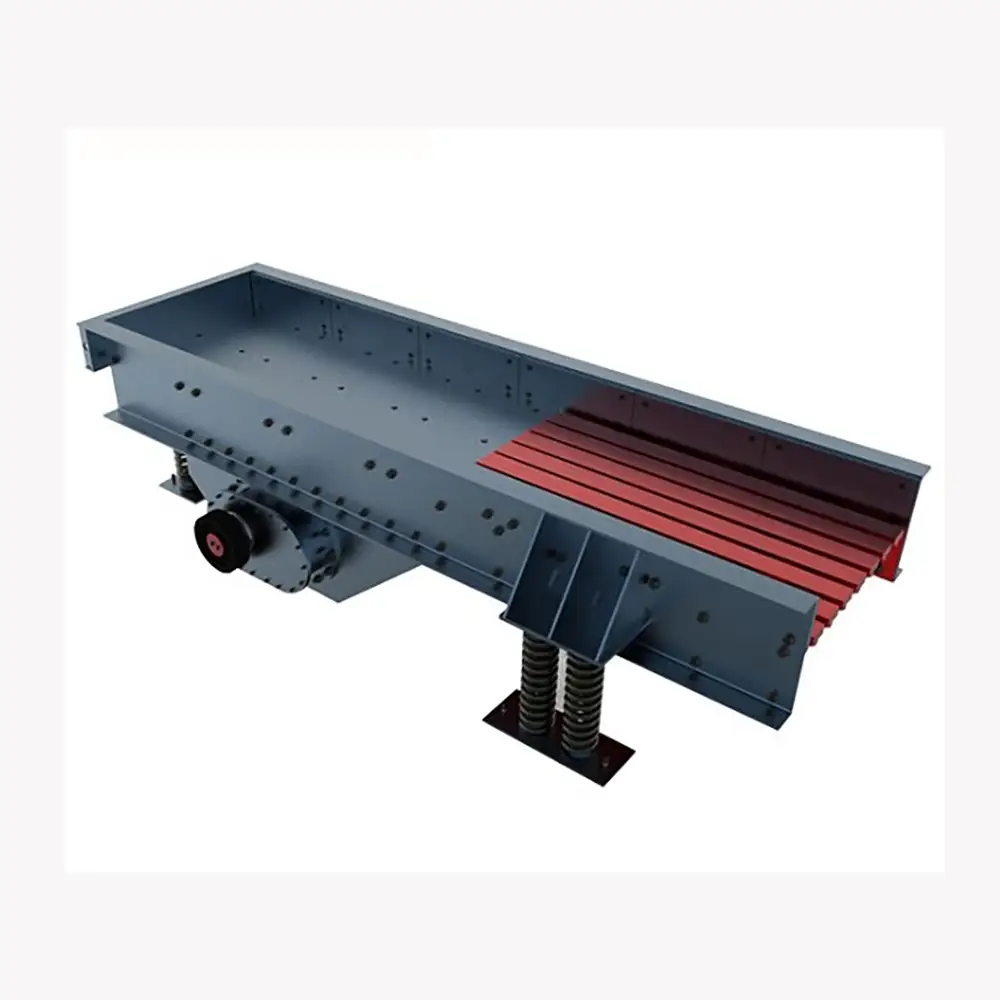
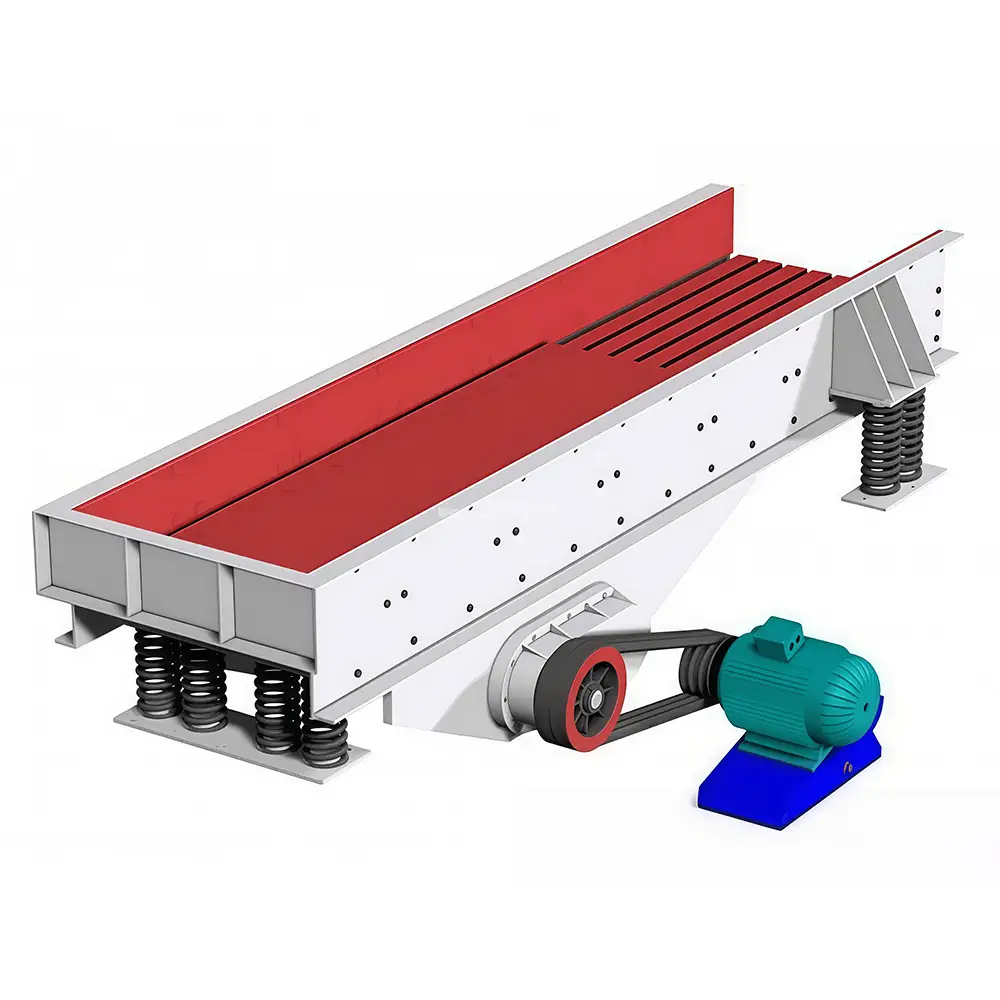
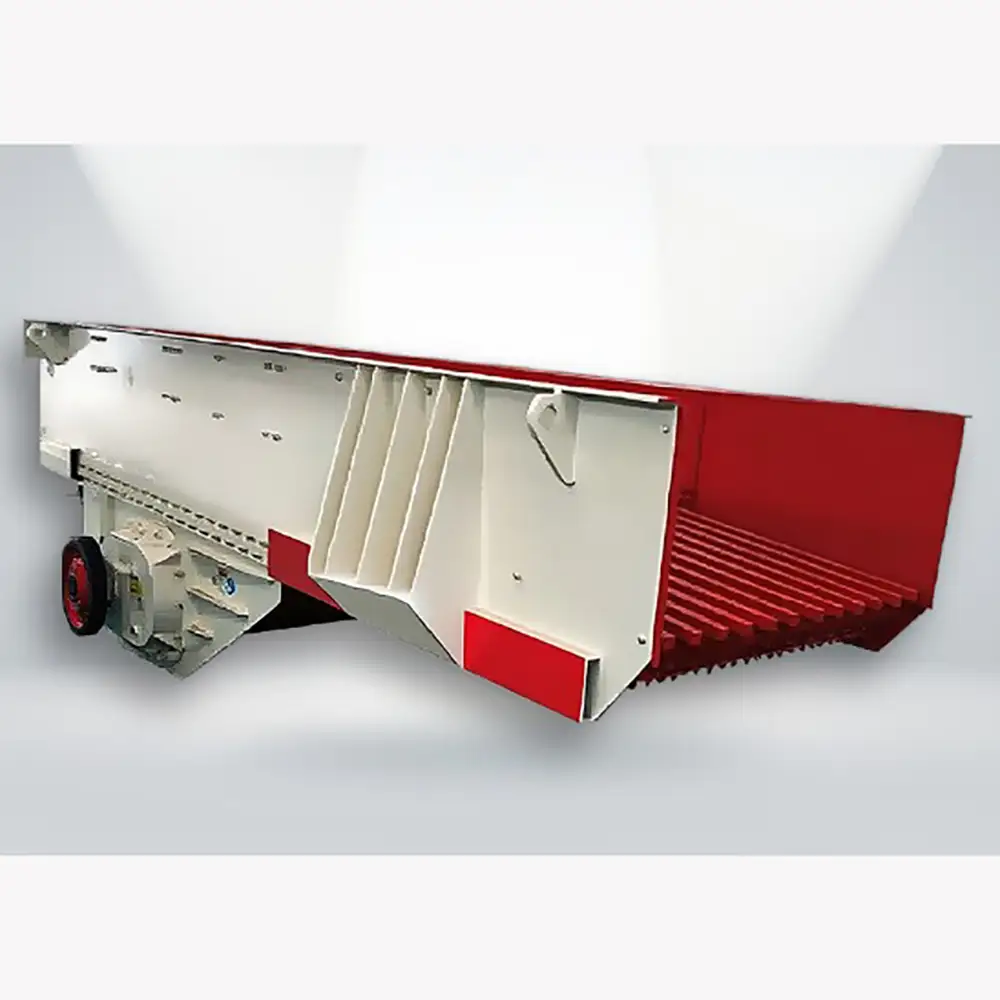
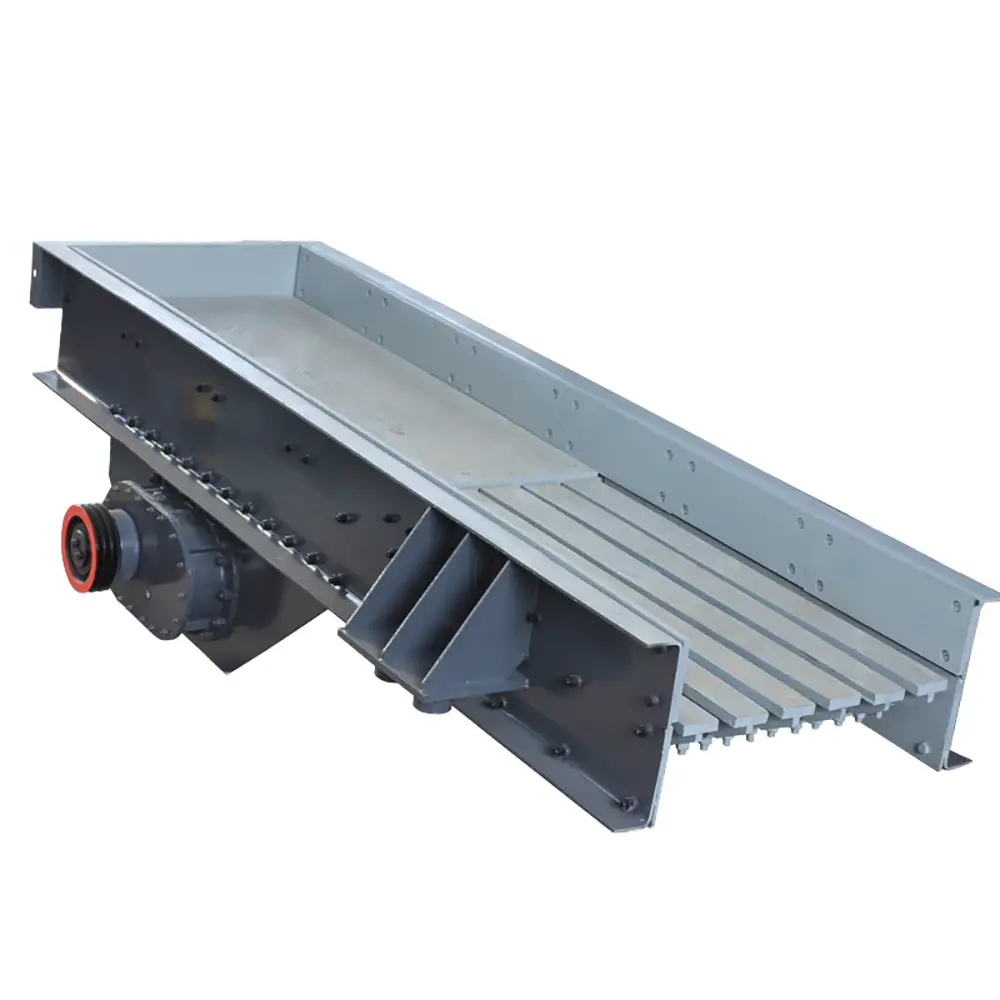
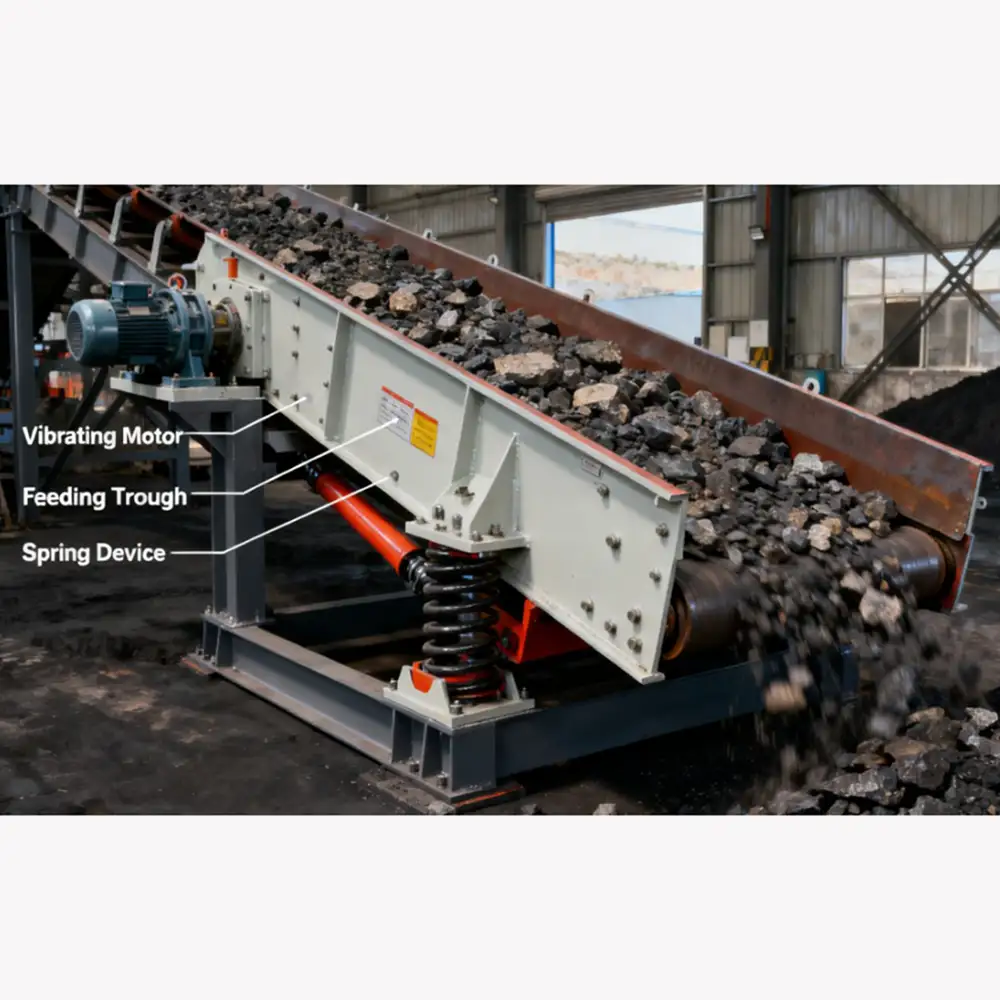
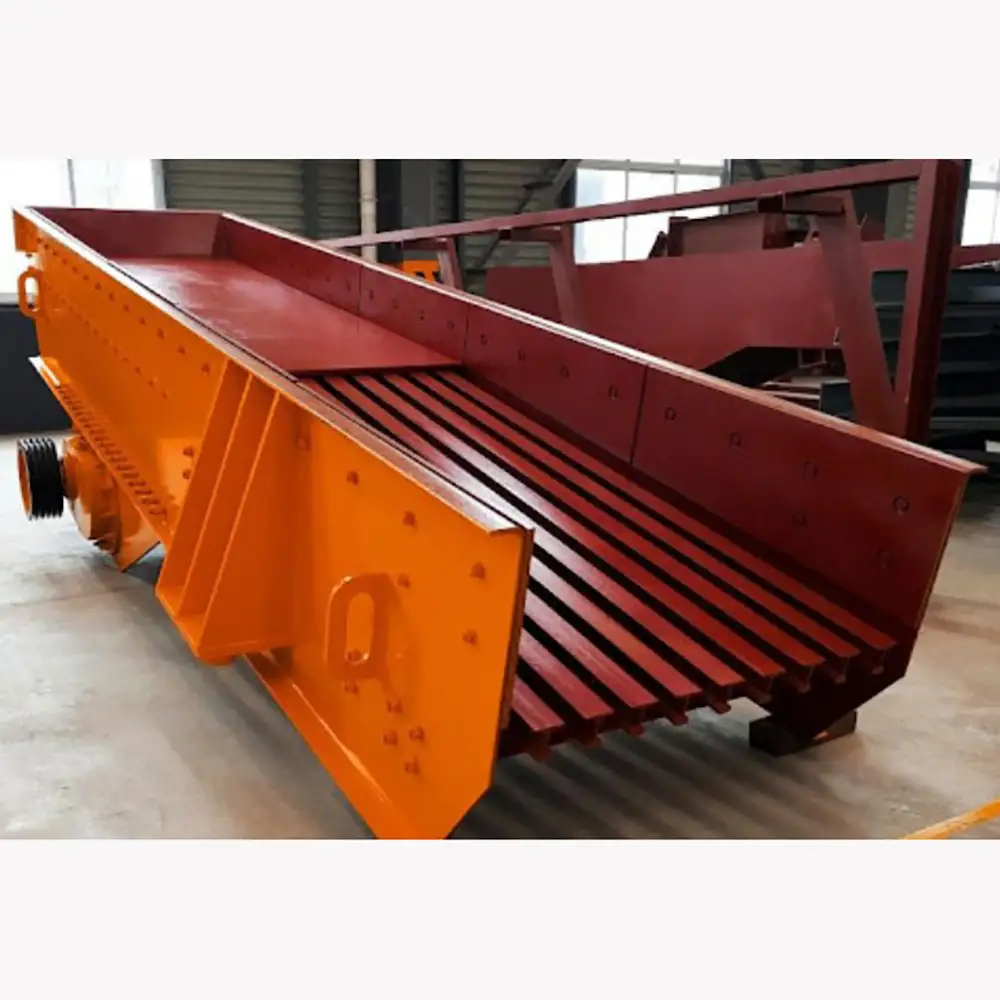
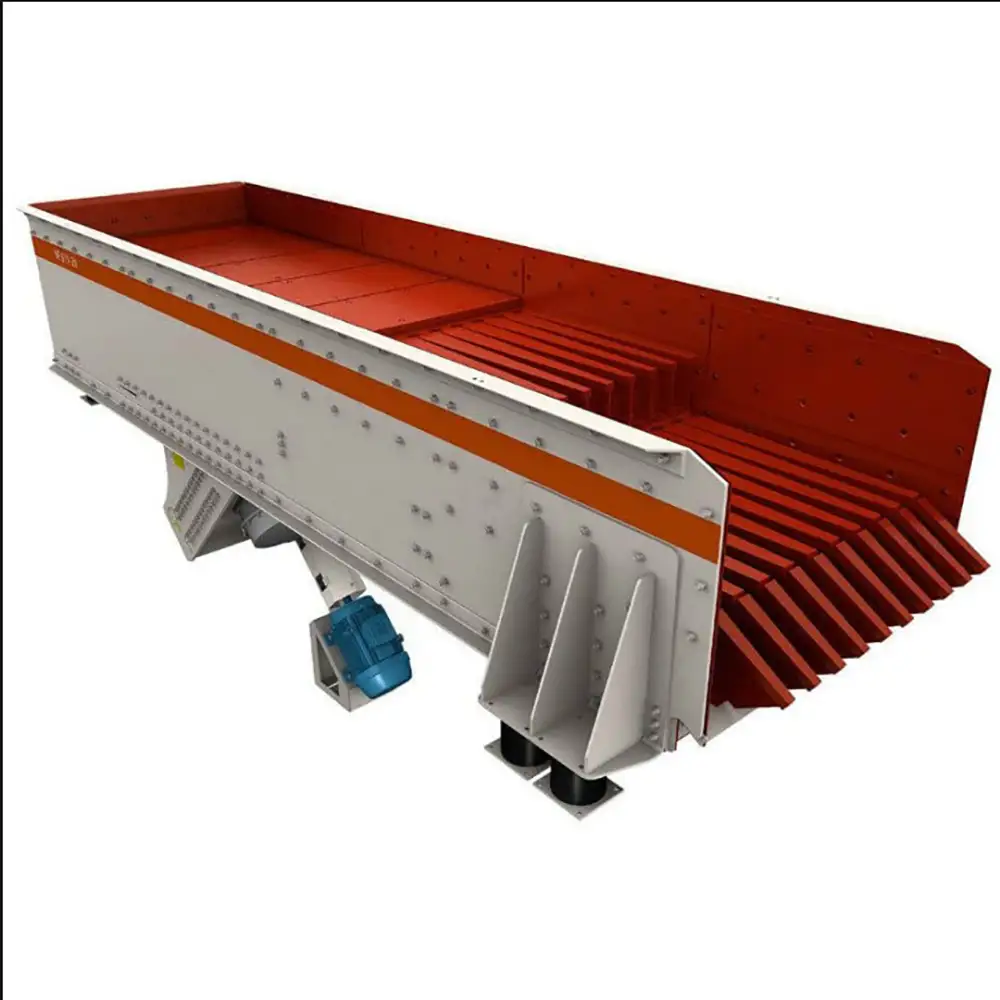
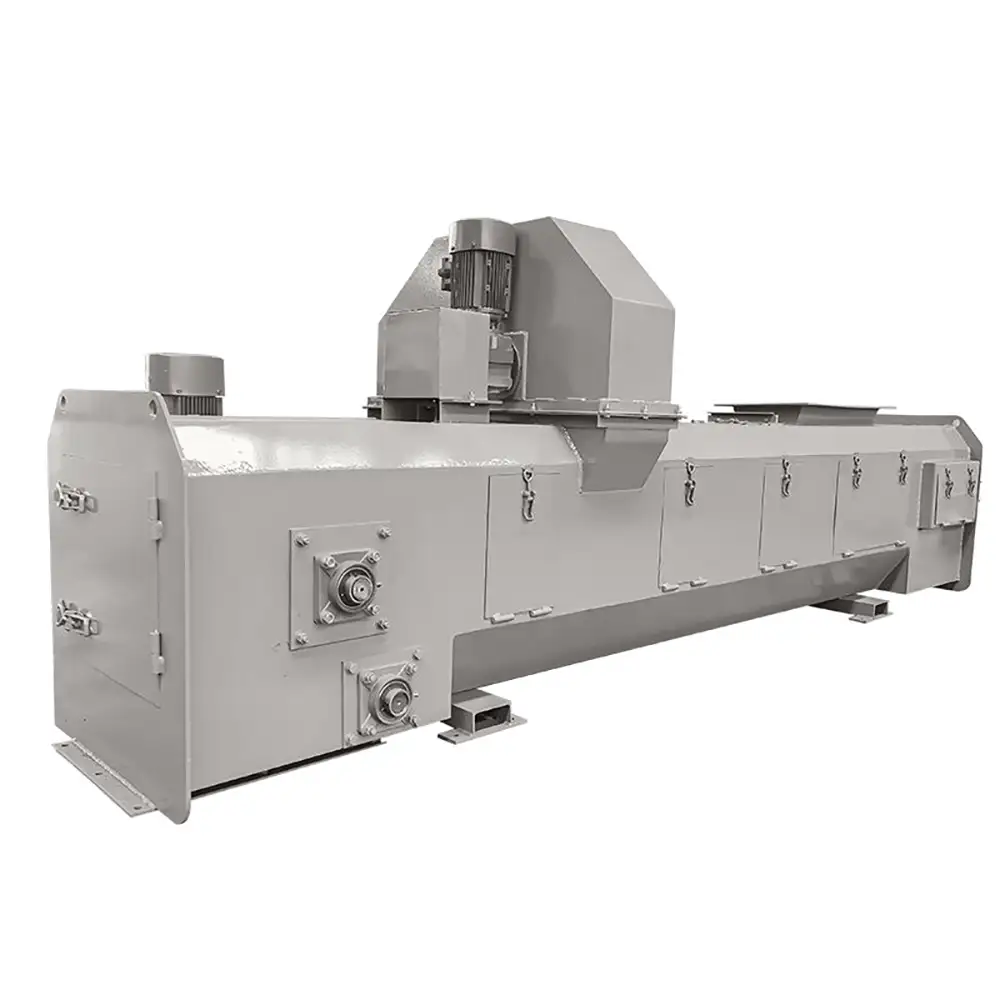
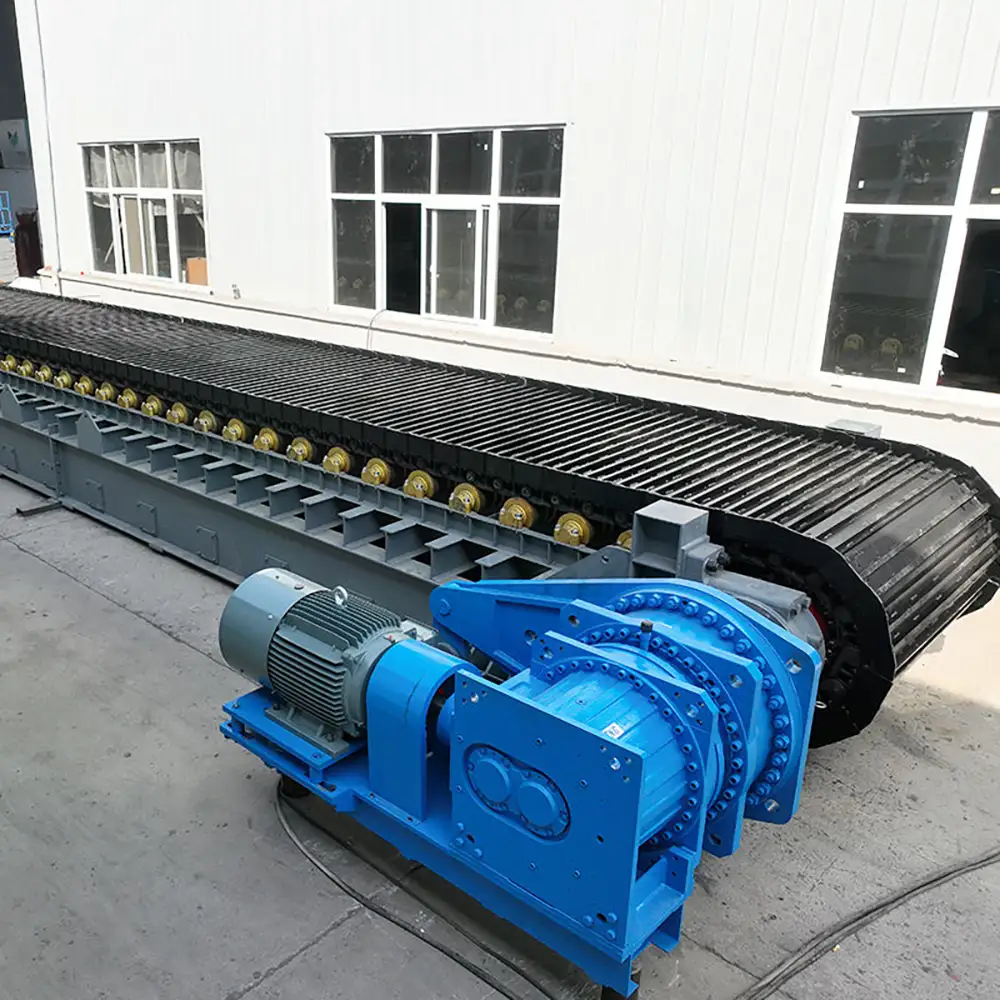
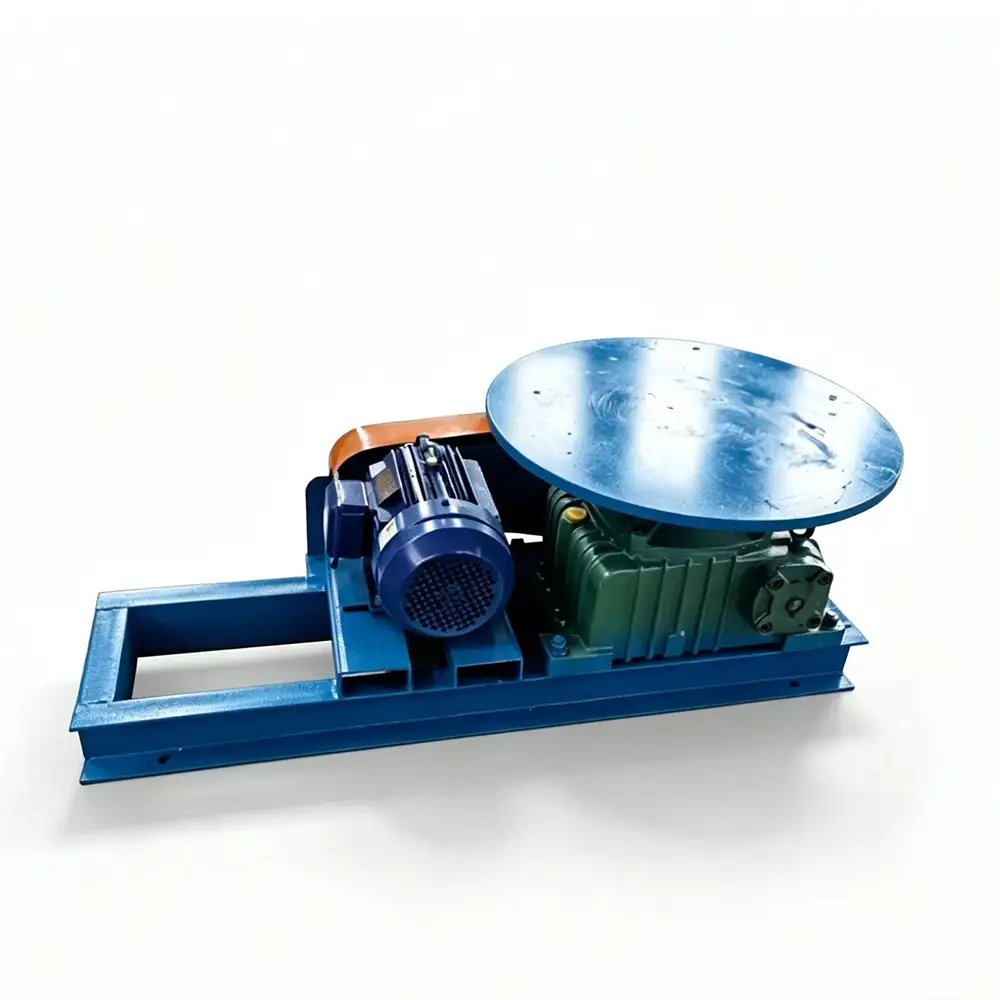
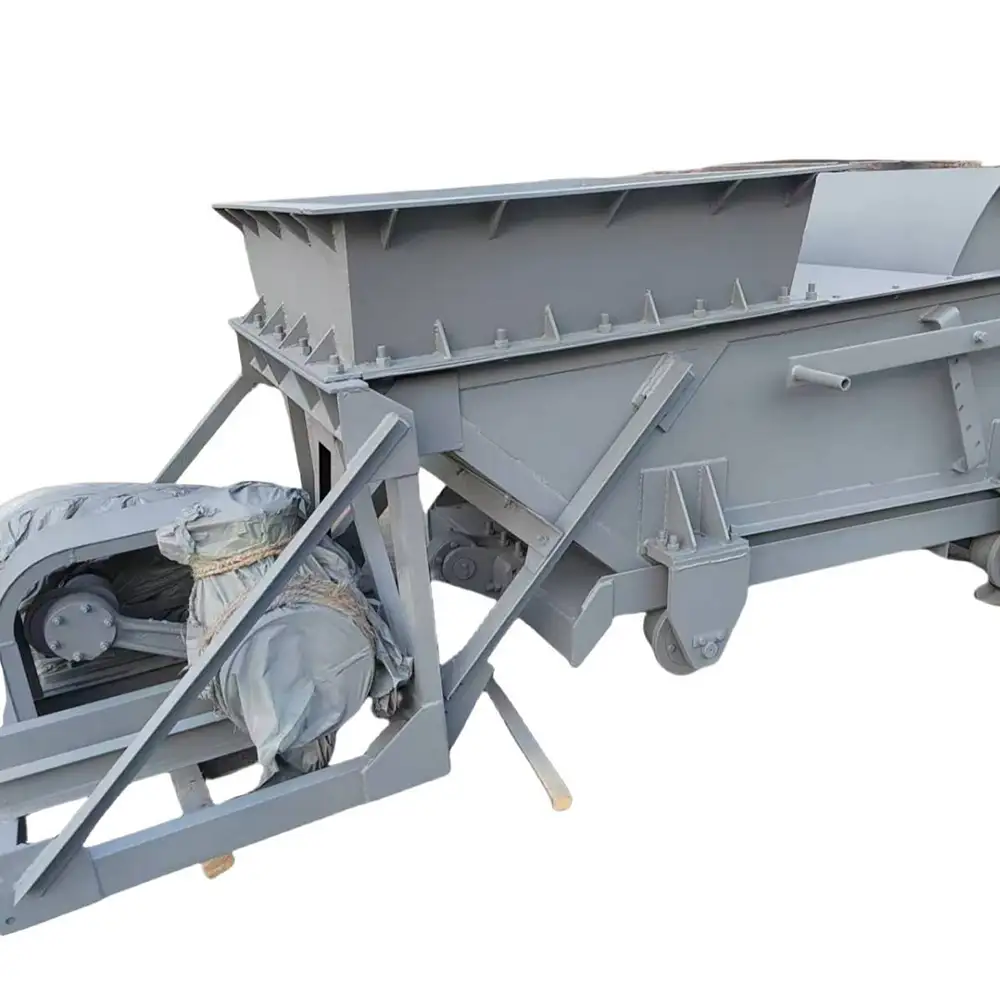
1. GZD Vibrating Feeder
is mainly used to feed materials evenly and continuously into belt conveyor, bucket elevator, screening and crushing equipment before primary crusher, also used for screening fine materials to increase the processing capacity of crusher. The feeding amount can be adjusted flexibly to achieve centralized control and automatic control in the production process.
2. Vibrating Feeder Working Principle
When installation, the two gears must be jogged according to the sign. Through drive of the motor, the two eccentric shafts start rotating to produce a linear huge power which forces the feeder to vibrate. Through the vibration, The materials will slip and sling on the funnel, moving forward, when the materials pass the screening part, smaller parts will fall down, avoiding the further crushing, so screening purpose can be reached..
3. Features
1. Stable vibration, reliable operation, low energy consumption and low noise.
2. The fence distance can be adjusted, special design of fence can prevent material blocking.
3. Adjustable speed motor applies matched motor to control feeding capacity easily and avoid frequent motor re-start.
4.Vibrating Feeder Product parameter
|
Model |
Funnel size (mm) |
Max. feed size (mm) |
Capacity(t/h) |
Power (kw) |
Weight (t) |
Overall dimension (L x W x H) ( mm) |
|
GZD-900×3800 |
900×3800 |
400 |
80-120 |
6 |
3.89 |
3900x1500x1200 |
|
GZD-950×3800 |
950×3800 |
500 |
120-210 |
6 |
3.98 |
3900×1600×1250 |
|
GZD-1100×4900 |
1100×4900 |
580 |
160-320 |
11 |
4.52 |
5000×1800×1500 |
|
GZD-1200×4900 |
1200×4900 |
650 |
200-430 |
15 |
5.2 |
5000×1900×1700 |
|
GZD-1300×6000 |
1300×6000 |
900 |
450-600 |
15 |
6.5 |
6150×1900×2100 |
The GZD Vibrating Feeder is a heavy-duty feeding machine designed to deliver rock, ore, aggregates, and other bulk materials from a hopper or storage bin to crushers, screens, and conveyor systems. It provides a continuous and relatively uniform material flow, helping maintain steady loading and improve coordination between stages of a crushing and screening plant.
Installed ahead of primary crushing equipment, the GZD feeder can handle large feed materials and, when fitted with a grizzly section, separate some undersized material before it enters the crusher. This can reduce unnecessary crushing and help the plant use its processing capacity more effectively. Typical applications include mining, quarrying, aggregate production, coal handling, and construction waste recycling. <Cite refs={["turn742300search4","turn742300search8"]}/>
What Is a GZD Vibrating Feeder?
A GZD Vibrating Feeder is a mechanical vibratory machine that moves bulk materials along a feeding trough using controlled vibration. It is commonly used as a primary feeder in crushing and screening lines, where material must be transferred from a hopper to a jaw crusher, impact crusher, or other receiving equipment.
Depending on the design, a GZD feeder may have a solid steel trough or a grizzly-style section. The solid trough conveys the material, while a grizzly section can allow smaller particles to pass through openings before the remaining material reaches the crusher.
The term Conveyor Belt Feeder is often used broadly for equipment that supplies material to a belt conveyor. A GZD vibrating feeder itself normally uses a vibrating trough rather than a conveyor belt. It can feed a separate belt conveyor as part of a complete material handling system.
Working Principle
A typical GZD mechanical vibrating feeder uses a motor-driven exciter to generate directional vibration.
Material Loading: Raw material enters the feeder from a hopper, bin, or dump point.
Vibration Generation: The motor drives the exciter, which generates a controlled vibratory force.
Trough Movement: The feeder trough moves in a repeated cycle on its spring supports.
Forward Conveying: Material slides or makes short forward jumps along the trough toward the discharge end.
Optional Pre-Screening: If a grizzly section is installed, smaller particles can fall through the openings while larger material continues toward the crusher.
Continuous Discharge: The feeder delivers material to the receiving machine or conveyor at a steady rate.
The exact vibration mechanism, drive arrangement, and adjustment method vary by model and manufacturer. <Cite refs={["turn742300search0","turn742300search4"]}/>
Main Components
A typical GZD Vibrating Feeder includes:
Feeding Trough: A heavy-duty steel structure that carries bulk material from the inlet to the discharge.
Vibration Exciter: Generates the vibration force that moves the trough.
Drive Motor: Supplies power to the exciter through the specified transmission arrangement.
Spring Supports: Support the vibrating assembly and help isolate vibration from the foundation.
Grizzly Bars or Screen Section: Optional components for preliminary separation of fines.
Support Frame: Provides structural support and maintains the feeder's installation position.
Protective Liners: Optional wear-resistant plates for applications involving abrasive rock or ore.
Drive and Safety Guards: Protect moving transmission components and support safe operation.
Applications of GZD Feeder and Crusher Feeding Equipment
Mining and Ore Processing
Feed iron ore, copper ore, gold-bearing rock, and other mined materials from storage or receiving hoppers to primary crushers and screening systems.
Quarry and Aggregate Production
Handle granite, limestone, basalt, gravel, and crushed stone in aggregate production lines. The feeder supports continuous supply to crushers and downstream screens.
Sand and Gravel Plants
Regulate the movement of raw stone and gravel from stockpiles or hoppers to crushing, screening, and washing equipment.
Coal Handling
Transfer suitable coal materials to crushers, screens, and conveyor systems in coal preparation and industrial fuel-handling operations.
Construction Waste Recycling
Feed concrete, bricks, and other suitable demolition materials into crushing and screening equipment. A grizzly section may help separate smaller material before crushing.
Cement and Building Materials
Move limestone and other raw materials through the initial stages of processing and material preparation.
Key Features and Benefits
1. Continuous and Uniform Feeding
The vibrating trough delivers material in a controlled stream, helping prevent irregular loading and interruptions caused by inconsistent material supply.
2. Heavy-Duty Material Handling
GZD feeders are designed for demanding bulk material applications. Model selection should account for maximum lump size, drop height, impact load, and required throughput.
3. Optional Grizzly Pre-Screening
A grizzly section can separate some fines before the material reaches the crusher. This may reduce unnecessary processing of already-small particles.
4. Integration With Crushing Lines
The feeder can be installed between a receiving hopper and a crusher, screen, or belt conveyor, supporting a coordinated material flow.
5. Practical Structure and Maintenance Access
The trough, exciter, springs, and drive components can be inspected as part of a planned maintenance program. Wear liners and grizzly components can be specified according to operating conditions.
6. Flexible Equipment Configuration
Trough dimensions, grizzly arrangement, liners, and drive options can be selected to suit the material, feed rate, and plant layout.
GZD Vibrating Feeder vs. Belt Feeder
A GZD Vibrating Feeder uses vibration to move material along a trough. It is commonly selected for primary feeding duties involving coarse, heavy, or irregular materials, especially ahead of crushers.
A belt feeder uses a moving belt to extract and convey material at a controlled rate. It may be preferred for certain metering tasks, longer transfer arrangements, or processes where belt-based feeding is required.
The right choice depends on the material size, impact conditions, required feed control, installation arrangement, and connection to downstream equipment. A GZD feeder can also feed a separate belt conveyor, combining vibratory extraction with belt conveying.
How to Select the Right Model
Before choosing a GZD feeder, review the following operating requirements:
Feed Capacity: Required throughput in tons per hour, including peak and normal operating rates.
Maximum Feed Size: Largest expected lump size and the size distribution of incoming material.
Material Properties: Bulk density, moisture, abrasiveness, and flow behavior.
Hopper and Drop Height: Material loading conditions and impact forces at the feeder inlet.
Trough Dimensions: Width, length, and discharge height needed for the process.
Pre-Screening Requirements: Whether a grizzly section is needed and what size separation is required.
Installation Conditions: Available space, foundation, mounting arrangement, and access for maintenance.
Downstream Equipment: Crusher opening, belt conveyor capacity, and process requirements.
Capacity and maximum feed size are model-specific. Ask the manufacturer to confirm performance against the actual material and plant layout before ordering.
Installation and Maintenance
Install the feeder on a properly designed support structure and follow the manufacturer's requirements for alignment, spring arrangement, and foundation connections. Confirm that the receiving hopper and discharge equipment do not interfere with the feeder's vibration movement.
Before operation, inspect the exciter, drive, guards, spring supports, fasteners, and electrical connections. During service, check for unusual noise, cracks, loose bolts, spring damage, worn liners, and grizzly-bar wear. Remove accumulated material that could restrict movement or alter the feeding path.
For safe maintenance, isolate and lock out power before accessing moving or vibrating components. Follow the equipment manual and the site's safety procedures.
Customization and OEM Supply
GZD Vibrating Feeder configurations can be discussed according to project requirements, including trough size, feed opening, grizzly layout, wear liners, support structure, and drive arrangement. For crushing plant projects, the feeder can be reviewed alongside the hopper, crusher, belt conveyor, and screening equipment to help coordinate material flow.
For a quotation, provide the material type, required capacity, maximum lump size, hopper details, installation drawing, and receiving equipment model. These details help the supplier evaluate the suitable feeder size and configuration.
Why Choose Us?
Application-Based Selection: We review material properties, throughput, and operating conditions to help identify a suitable feeder arrangement.
Crushing Line Compatibility: We consider the connection between the feeder, hopper, crusher, screen, and conveyor.
Wear-Resistant Options: Discuss suitable liners and grizzly configurations for abrasive or coarse materials.
Flexible OEM Support: Trough dimensions, openings, and selected components can be reviewed for project-specific needs.
Export-Oriented Communication: We support technical inquiries, equipment specifications, and coordination for industrial purchasing projects.
Frequently Asked Questions
1. What is a GZD Vibrating Feeder used for?
It feeds bulk materials such as rock, ore, and aggregates from a hopper to crushers, screens, and conveyors at a continuous rate.
2. Can a GZD feeder be used before a jaw crusher?
Yes. It is commonly installed ahead of primary crushing equipment to provide a steady supply of raw material.
3. Does the GZD feeder use a conveyor belt?
The GZD feeder normally conveys material on a vibrating trough, not a belt. It can feed a separate conveyor belt downstream.
4. Can it screen material as well as feed it?
Some configurations include grizzly bars or a screening section that can separate undersized particles before crushing.
5. What materials can it handle?
Depending on model and configuration, it can handle materials such as limestone, granite, basalt, gravel, coal, and various ores.
6. How do I select the correct feeder capacity?
Consider the required tons per hour, feed size, bulk density, material flow characteristics, and capacity of the receiving equipment.
7. Is a GZD feeder suitable for abrasive rock?
It can be used for suitable abrasive materials when the trough, liners, and structure are selected for the expected wear and impact conditions.
8. Can the feeder be connected to a belt conveyor?
Yes. A GZD feeder is often installed to discharge material onto a belt conveyor or directly into a crusher or screen.
9. What maintenance does a vibrating feeder require?
Routine checks typically include the exciter, motor, springs, fasteners, guards, trough, grizzly bars, and wear liners.
10. Can the GZD Vibrating Feeder be customized?
Depending on the manufacturer, options may include trough dimensions, grizzly arrangement, liners, and drive configuration. Confirm details for the selected model.
Prev:
K Reciprocating Coal Feeder, Mining Equipment Feeders, Automatic Feeder, Reciprocating Coal Feeder
Next:
JGC Weighing Coal Feeder, Universal Cement Coal Belt Weighing Apron Feeder
TAG:
Crusher Feeding Equipment,
Primary Feeding Equipment,
Mining Feeding Equipment,
Bulk Material Feeder,
Primary Crusher Feeder,
Iron Ore Feeder,
Industrial Feeding Equipment,
Mining Material Handling Equipment,
Conveyor Feeder,
Feeder For Crusher,
Belt Conveyor Feeder,
Uniform Feeding Machine,
Bulk Material Feeding Machine,
Heavy Duty Feeder,
Storage Bin Feeder,
Automatic Feeding Machine,
Mining Feeder Machine,
Coal Feeding Machine,
Bulk Material Handling System,
Crushing And Screening Equipment,
Aggregate Processing Equipment,
Mining Processing Equipment,
Hopper Vibrating Feeder,
Quarry Material Handling Equipment,
Crushing Plant Feeder,
Vibrating Hopper Feeder,
Silo Feeding Equipment,
Heavy Duty Vibratory Feeder,
Mechanical Vibrating Feeder,
Motor Driven Vibrating Feeder,
Related Category:
Vibrating Feeder,GZD Vibrating Feeder Machine,Conveyor Belt Feeder,Crusher Vibrating Feeder China, suppliers, manufacturers, factory, customized, wholesale, quotation, made in China