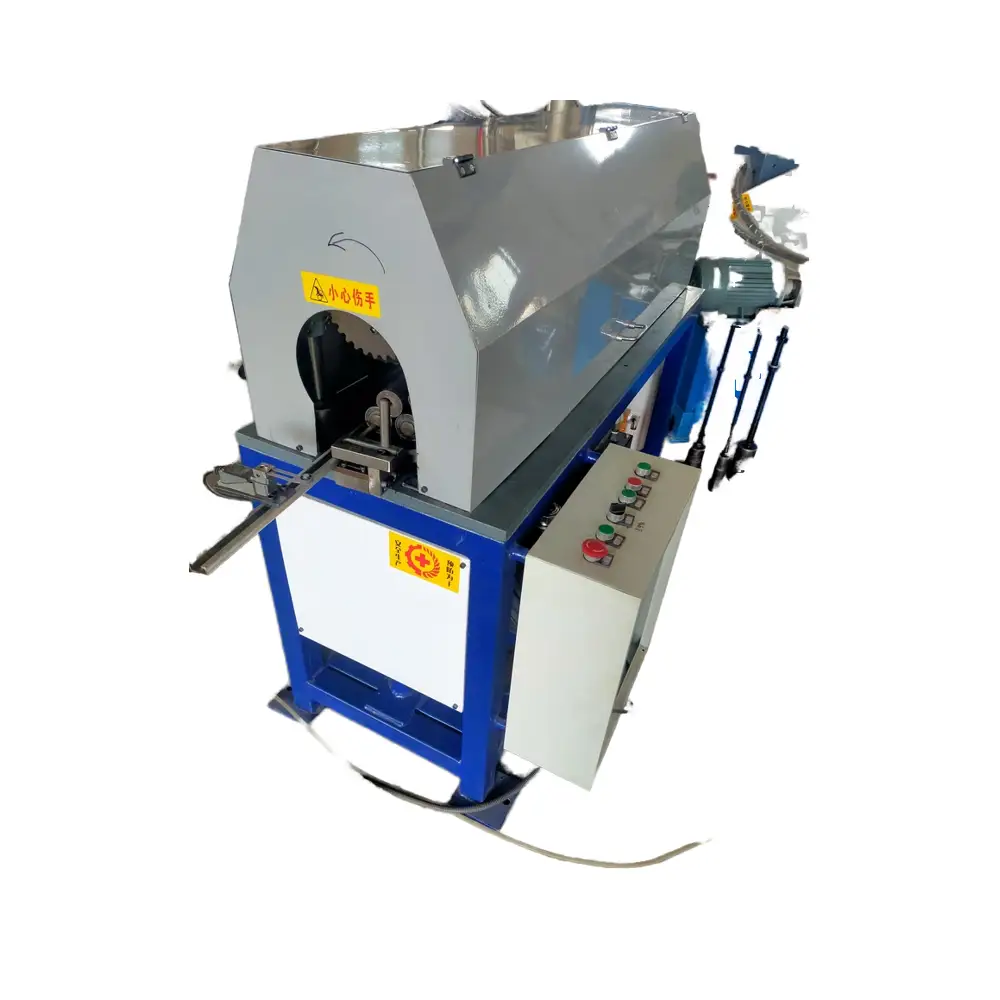
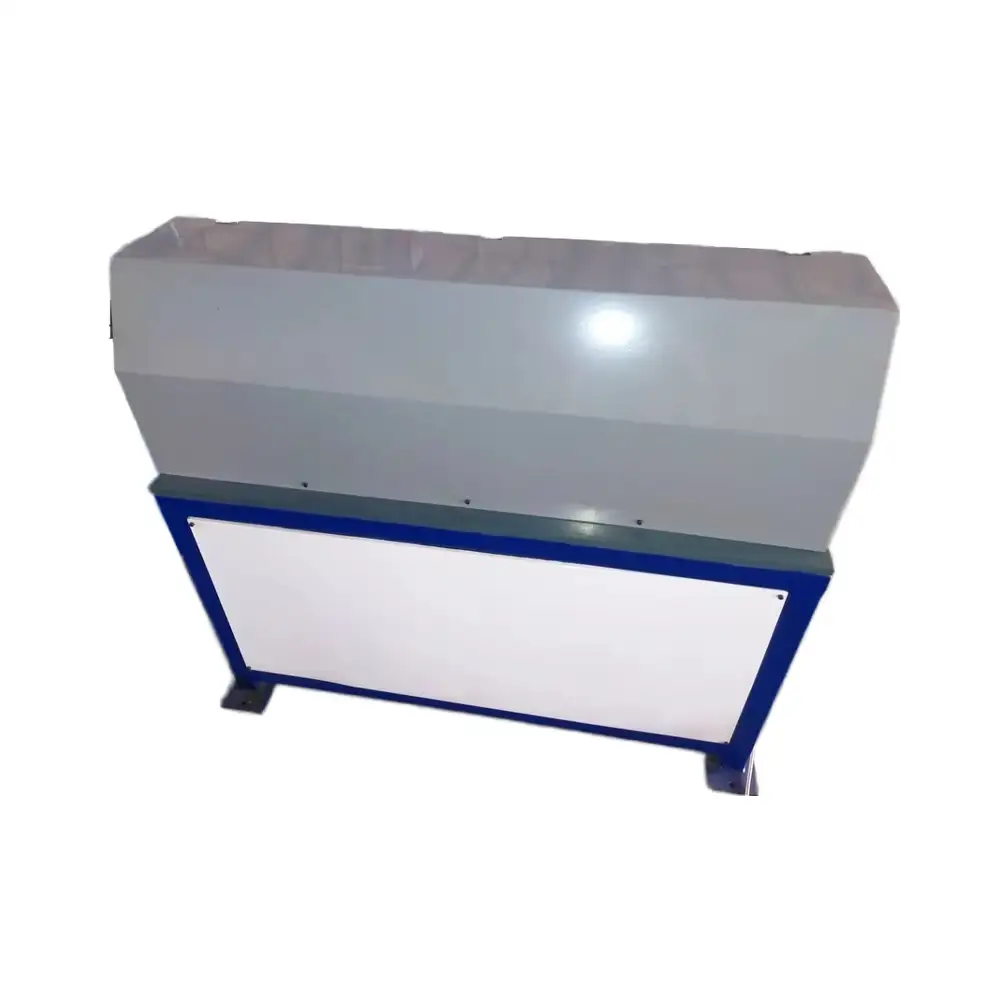
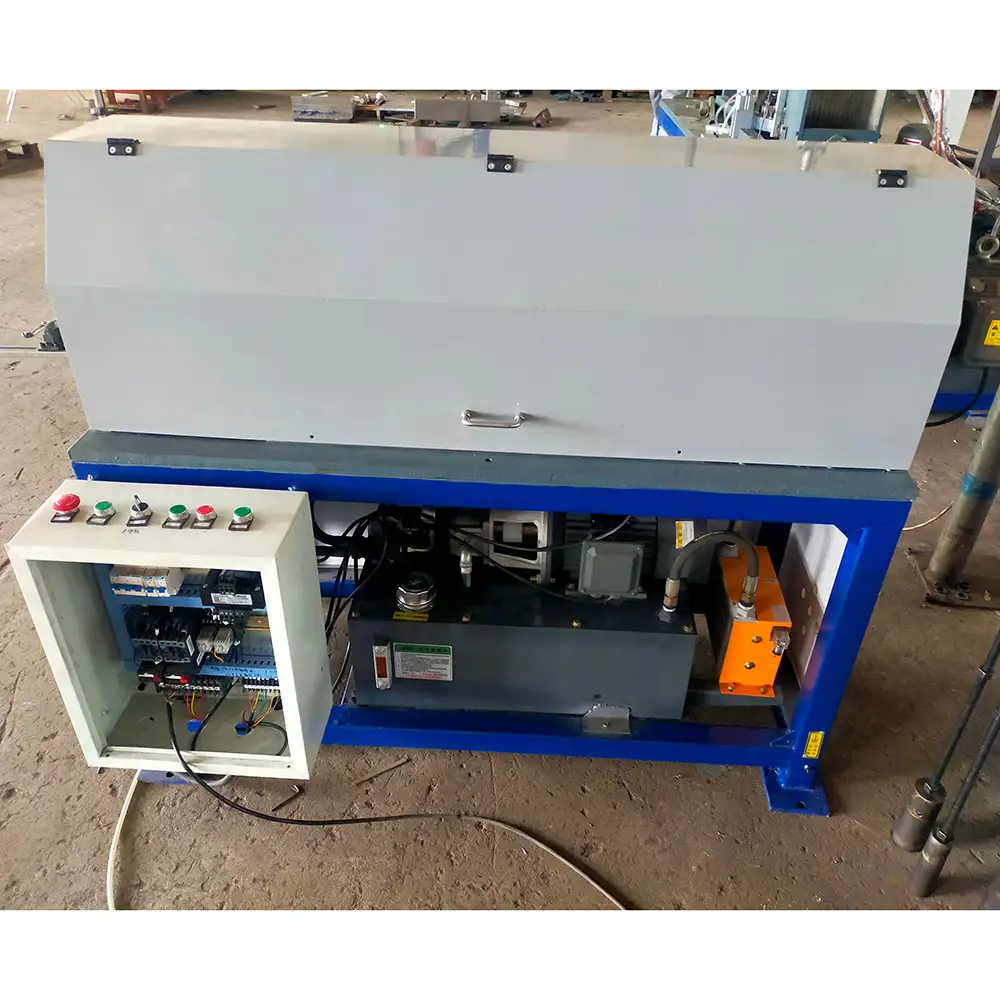
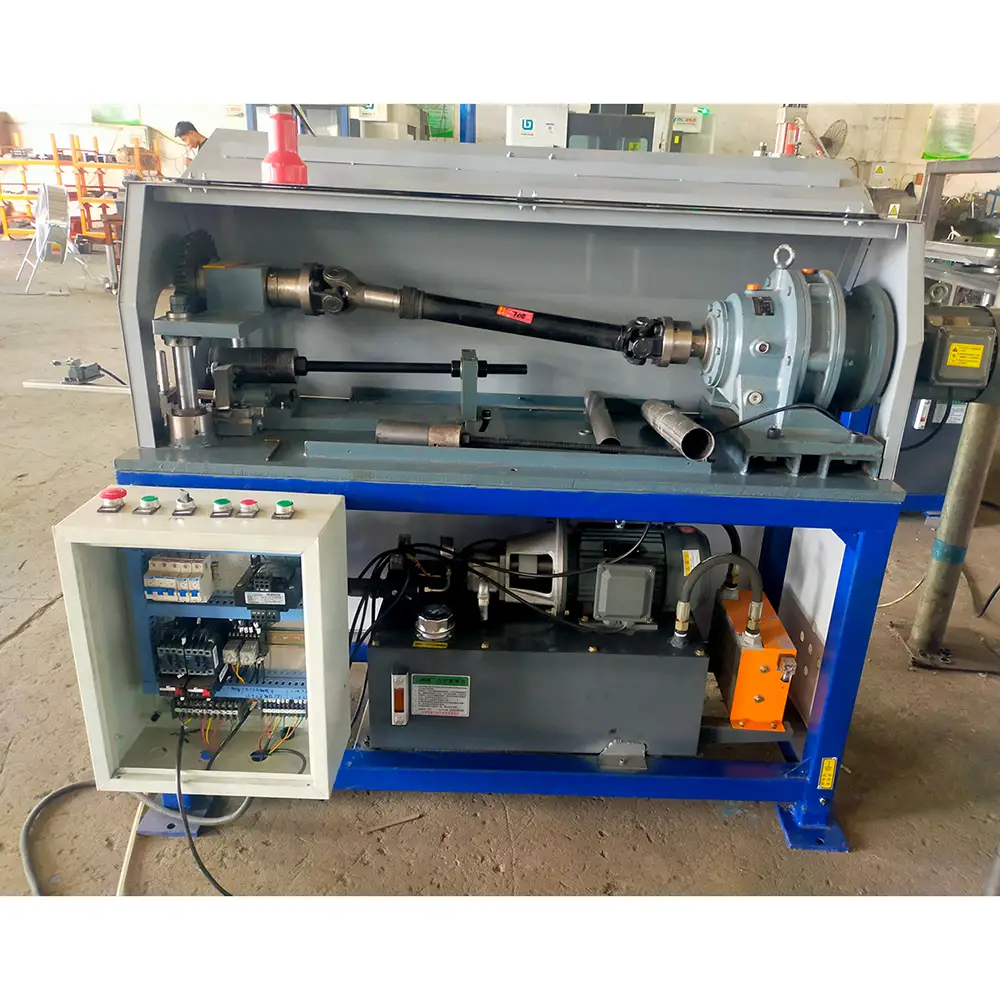
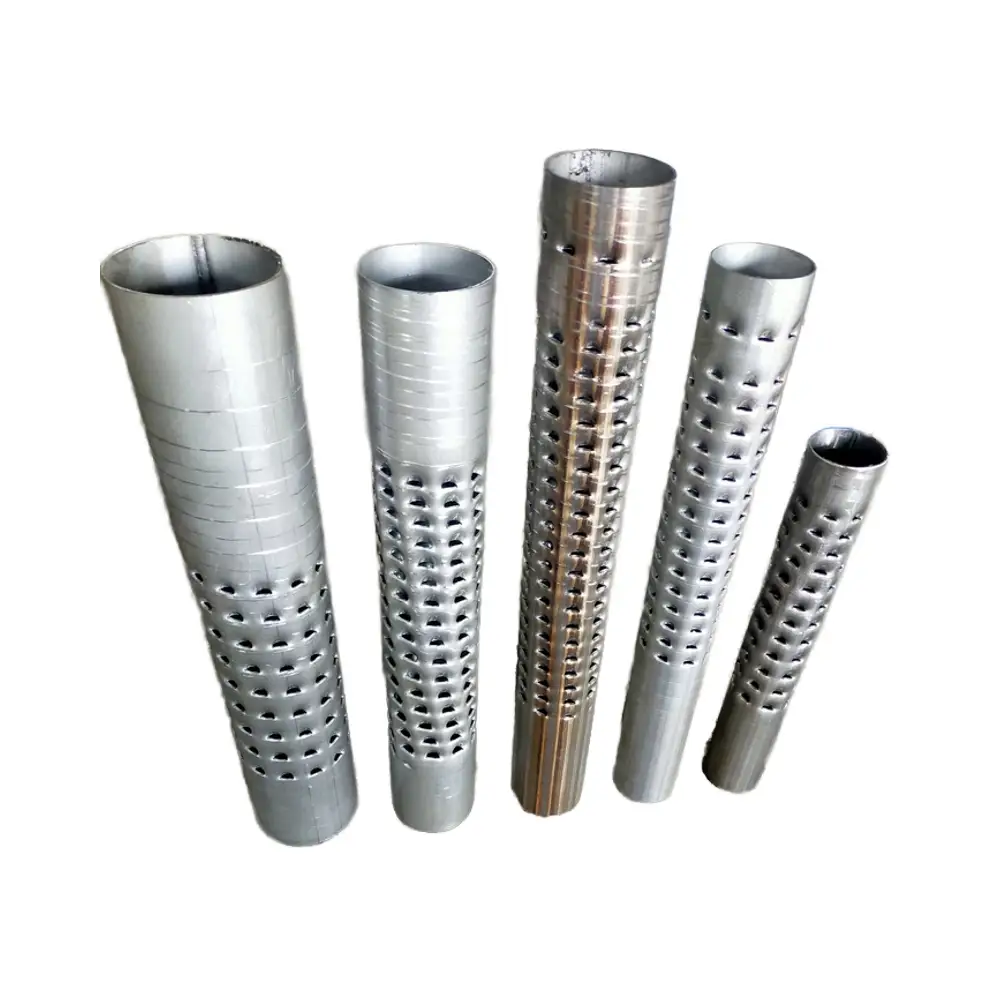
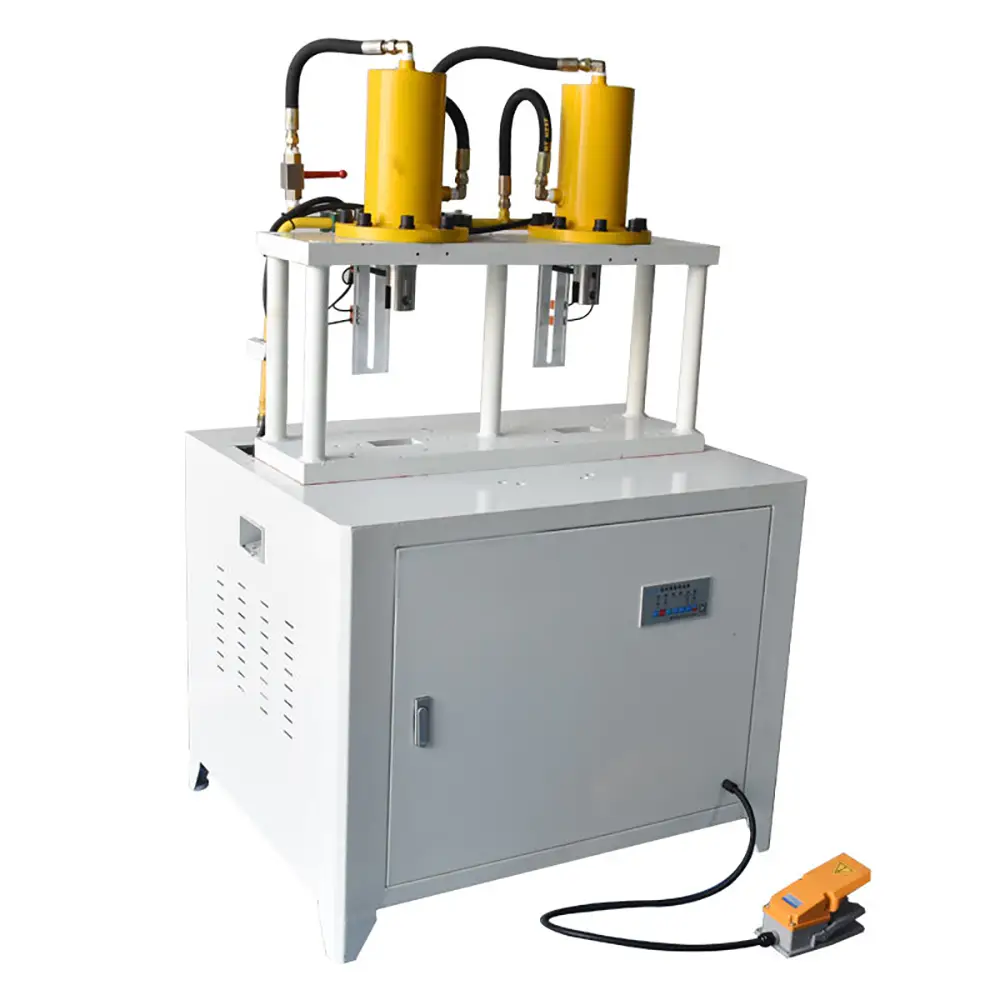
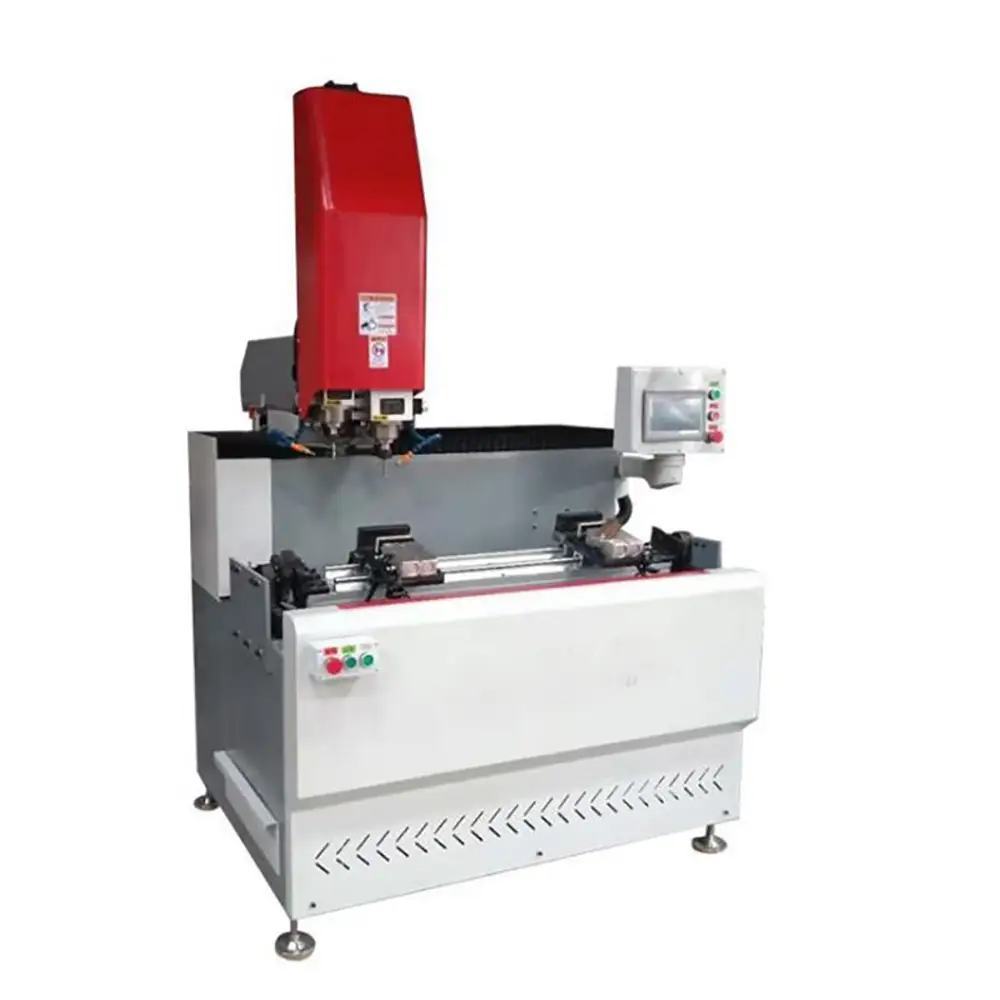
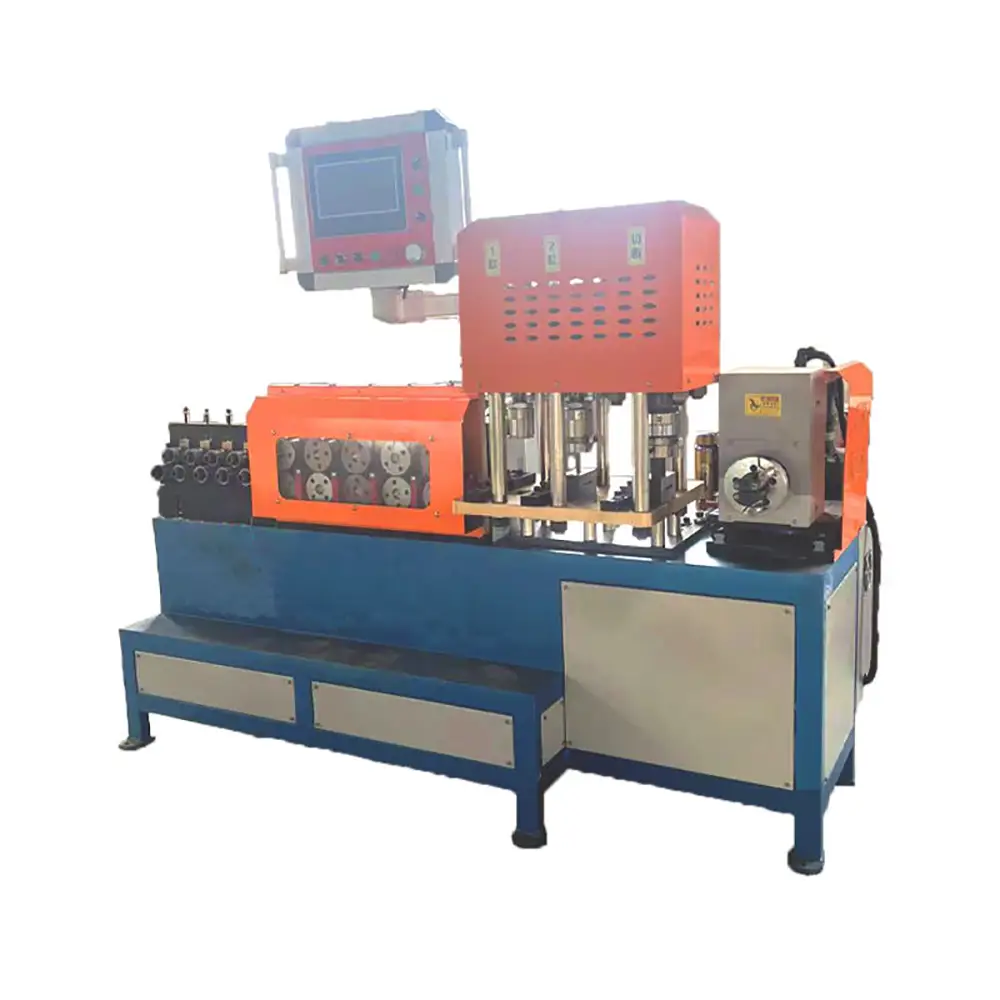
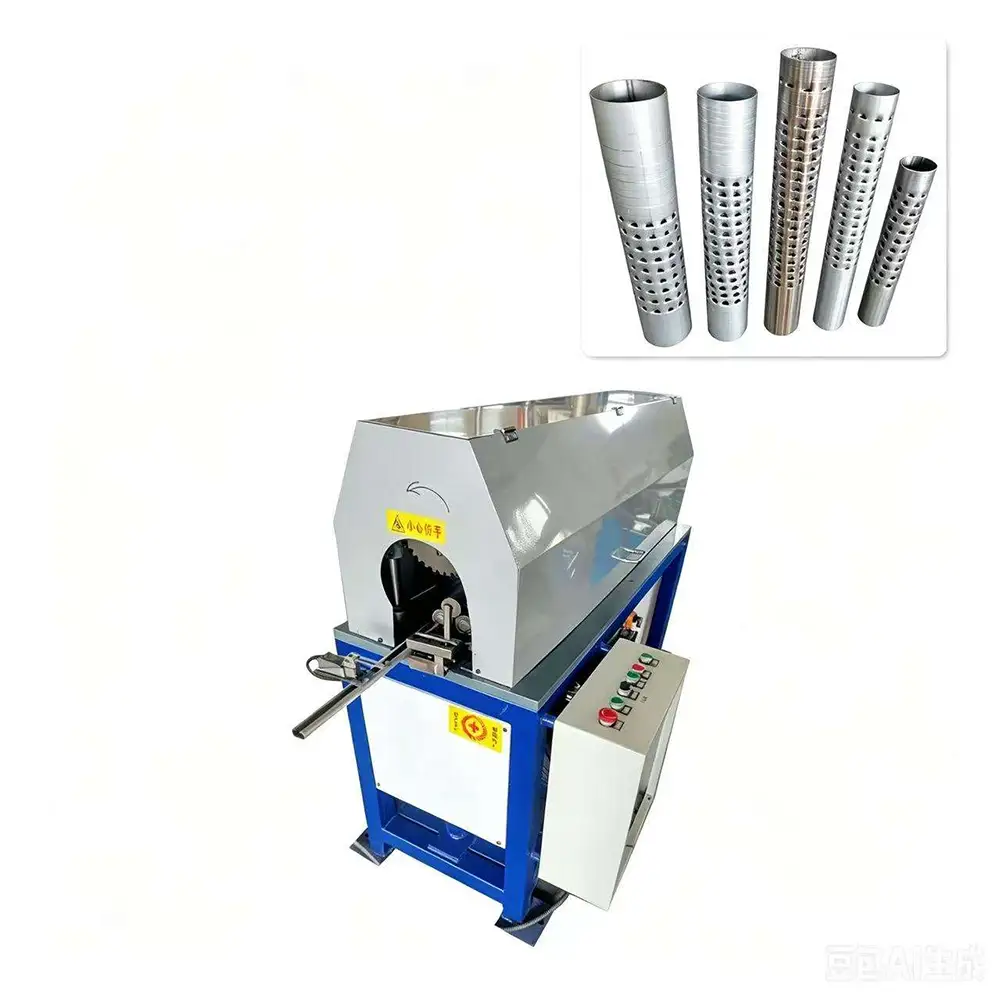
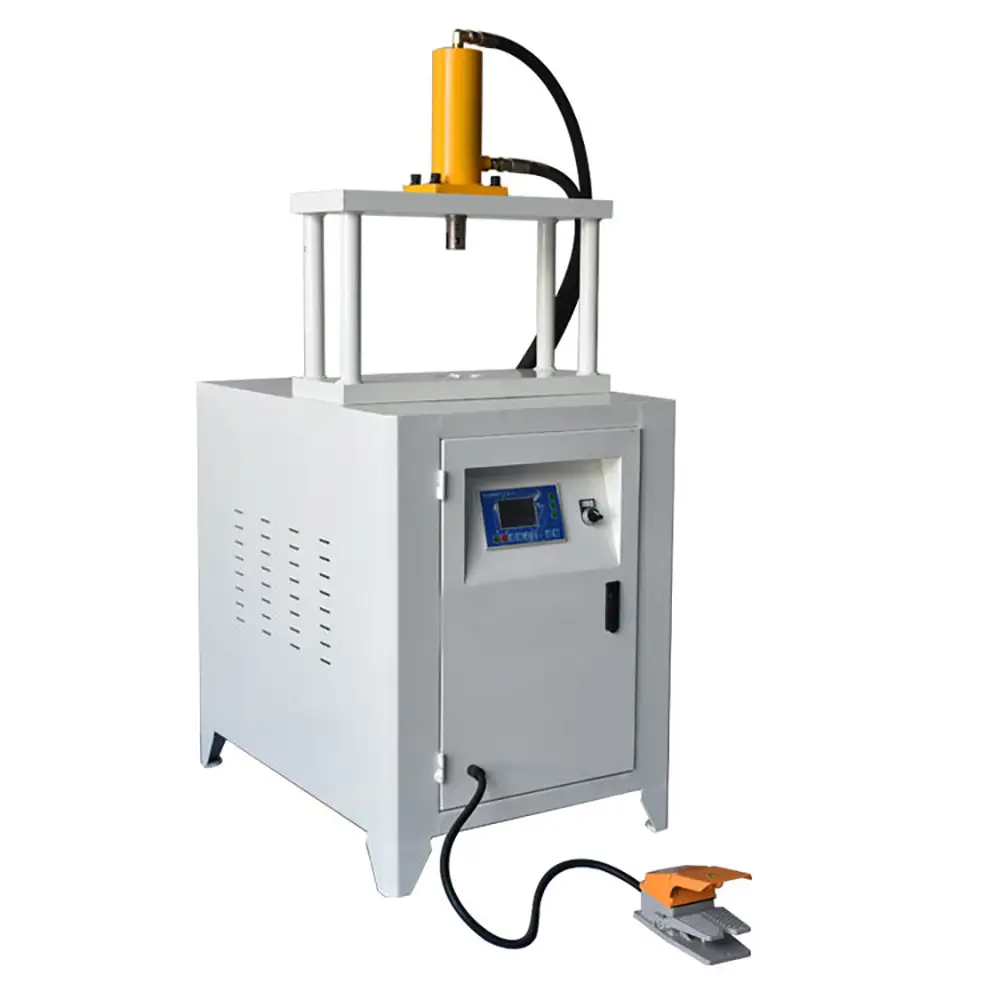
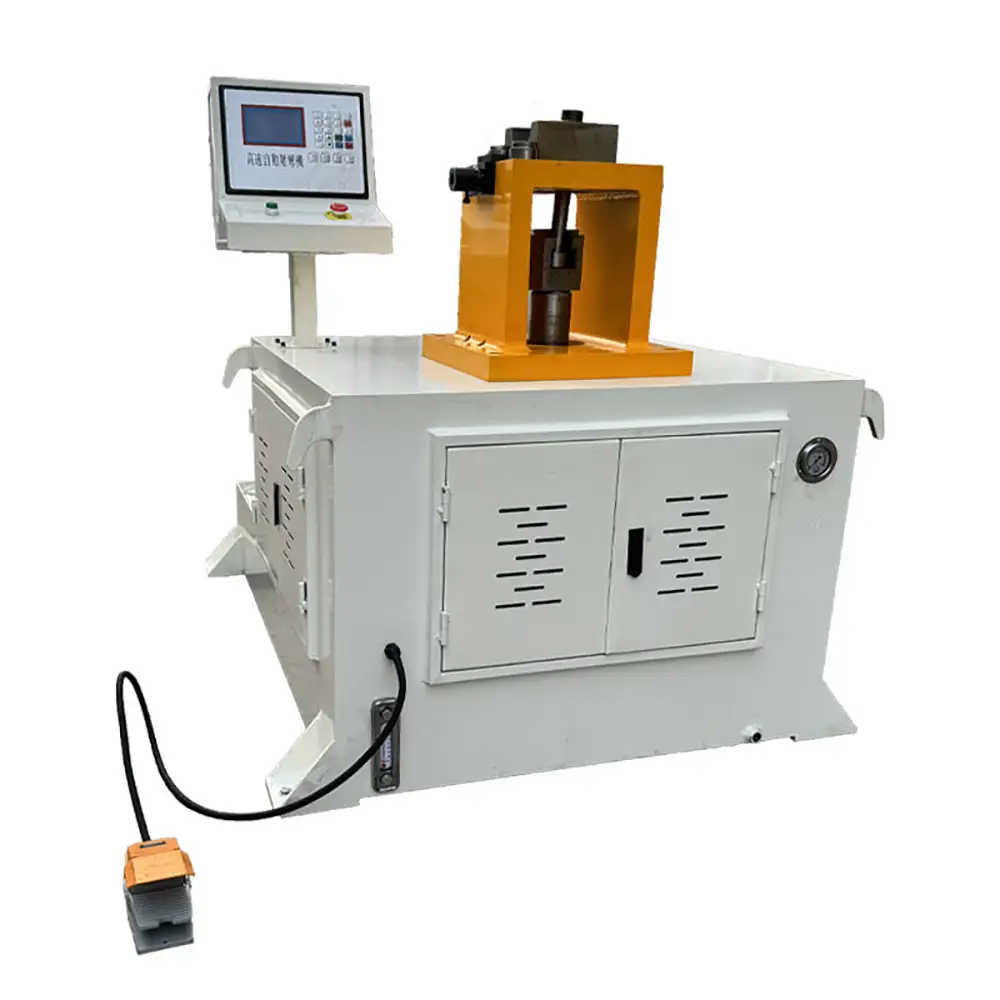
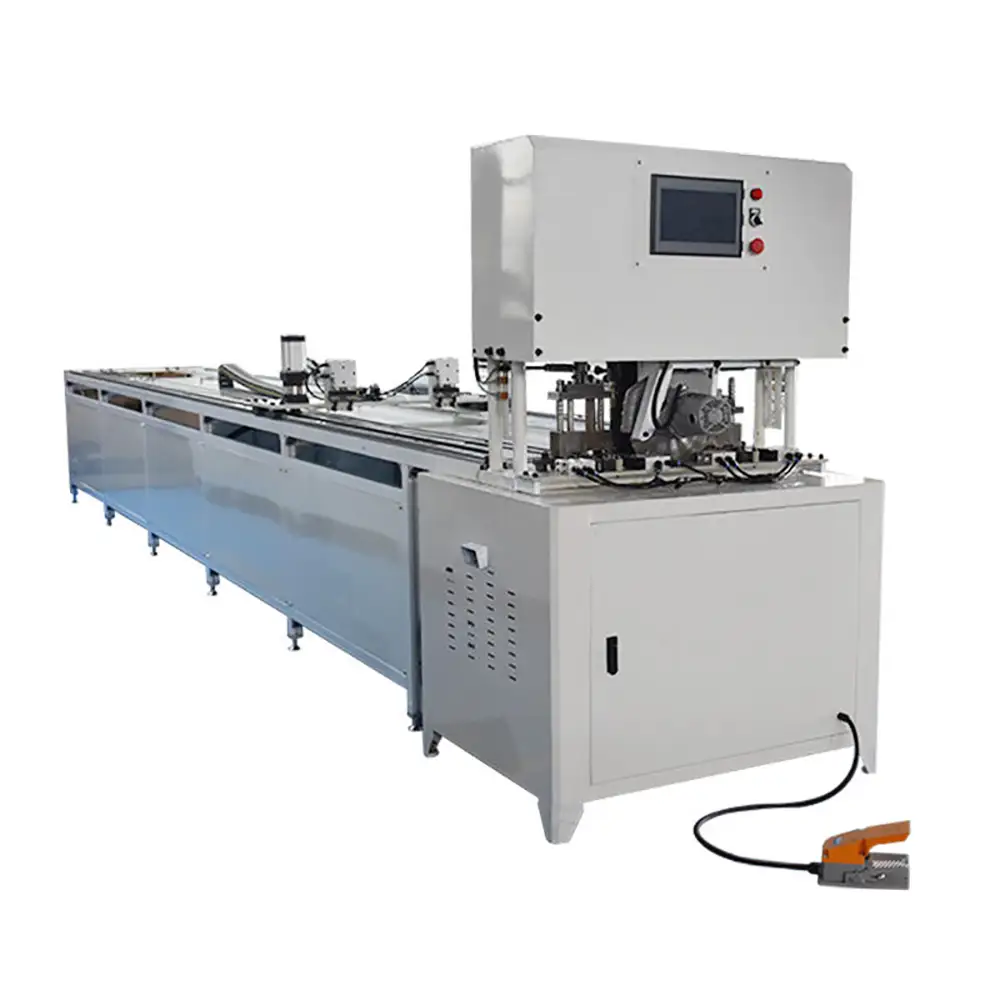
1.The machine consists of frame seat, working table, safety operation box, spindle transmission system, hydraulic pump station system, knife plate rolling mold and pipe mandrel mold, the overall design is simple and beautiful, reasonable assembly. 2.The spindle transmission system directly adopts the automobile high-strength and high-quality transmission shaft, which ensures the stability, accuracy and consistency of the distance between the pressure holes. 3.The overall structure is stable and reliable: the frame adopts all-steel welded body structure, and the purchased steel is selected in accordance with the national standard of high-quality materials, with sufficient strength and rigidity.
PRODUCT SPECIFICATIONS
|
Project |
Units |
Parameters |
|
Maximum machining diameter |
mm |
Produced according to drawings |
|
Produced according to drawings |
mm |
Plain Carbon Steel Pip |
|
Thickness of workpiece |
mm |
0.8-1.5 |
|
Maximum machining length |
mm |
300 |
|
Table size |
mm |
1200x500 |
|
Material of cutter mold |
|
CR12 quenching |
|
Spindle speed |
Rpm |
60 |
|
Adjustment height |
mm |
100 |
|
Hourly capacity |
Pieces /hour |
60 |
|
power |
kW |
3.0 |
|
Weight |
T |
0.5 |
|
Size |
mm |
1400X500X1200 |
Hydraulic Core Tube Roll Punching Machine for Exhaust Pipe Piercing
The Hydraulic Core Tube Roll Punching Machine is a specialized metal tube processing solution designed for punching, piercing, and hole-making operations on compatible tubes and exhaust pipe components. Combining hydraulic punching force with dedicated tube fixtures and tooling, the machine is suitable for manufacturers that need repeatable processing of tubular metal parts.
The machine can be configured around different tube shapes, dimensions, materials, hole sizes, and production requirements. For exhaust manufacturing, hydraulic piercing can be used to create openings in tube sections according to a specified production drawing or perforation pattern.
The term core tube roll punching machine may refer to a specialized tube processing configuration in which the workpiece, tooling, or positioning system incorporates a rolling or core-supported process. Because tube-processing requirements vary considerably, the exact machine structure and working method should be selected according to the customer's tube specifications and required operation.
Actual punching and piercing capacity depends on tube material, outside diameter, wall thickness, hole diameter, hydraulic pressure, punch and die design, fixture arrangement, and machine configuration.
Hydraulic Tube Punching and Piercing
Hydraulic punching uses controlled hydraulic force to drive a punch through a metal tube or pipe. Compared with manual drilling, dedicated punching equipment can provide a more repeatable production process for applications involving large quantities of similar tube components.
For tube piercing, the punch and die must be properly matched to the material and wall thickness. The workpiece should also be securely supported to minimize movement and deformation during the operation.
The machine can be configured for different hole diameters and tube dimensions through application-specific tooling. Custom punch and die sets can be developed when standard tooling does not meet the required hole shape or position.
Exhaust Pipe Piercing Machine
Exhaust pipe piercing is an important application for hydraulic tube punching equipment. Exhaust tubes and muffler components may require openings for gas flow, component connections, brackets, internal structures, or other assembly requirements.
The machine can be configured to process compatible exhaust tubes according to specified hole positions and dimensions. Depending on the application, the tube may require one or multiple piercing operations.
For automotive and motorcycle exhaust components, the final hole pattern should be determined by the product engineering requirements. Sample testing is recommended to verify hole diameter, location, edge condition, tube deformation, and overall processing quality before mass production.
Core Tube Processing
Core-supported tube processing can be useful when the tube geometry requires additional internal support during punching or forming. An appropriate internal support or core can help maintain tube shape during certain processing operations.
The actual core structure depends on the tube dimensions and the required process. Round tubes, thin-wall tubes, and specially shaped components may require different support methods.
When developing a customized machine, tube material, outside diameter, inside diameter, wall thickness, processing position, and required hole geometry should all be considered.
Tube Roll Punching Configuration
The roll punching concept can be adapted for tube processing where workpiece positioning, rotation, or indexing is part of the production process. This can be useful when holes need to be distributed along a tube or positioned at different angular locations.
Depending on the machine design, the tube may be positioned manually, indexed mechanically, or supported by a customized fixture and rolling mechanism.
The appropriate arrangement depends on the production requirement. For example, a simple application with one fixed hole may require a different configuration from a tube requiring repeated holes at defined intervals.
Stainless Steel and Metal Tube Processing
The hydraulic machine can be configured for a range of compatible metal tube materials. Potential materials include stainless steel, carbon steel, mild steel, galvanized steel, and aluminum, depending on machine capacity and tooling.
Stainless steel exhaust tubes are commonly used in automotive and motorcycle exhaust applications. Because stainless steel can have different hardness and forming characteristics compared with mild steel, appropriate punch geometry, die clearance, and processing parameters should be selected.
For each new material or tube specification, sample testing can help confirm the appropriate tooling and production process.
Exhaust Tube Hole Making
Exhaust tube hole making requires consistent positioning because the hole pattern can affect subsequent assembly and product performance.
Dedicated fixtures can help locate the tube relative to the punch. Positioning stops, scales, clamps, indexing systems, or other mechanisms can be used depending on the machine configuration.
For repetitive production, a fixed reference position can reduce manual measuring and marking. This can help operators reproduce the same hole locations across multiple workpieces.
Actual positioning accuracy depends on the machine structure, fixture design, tube straightness, tooling condition, and operator procedure.
Custom Punches, Dies, and Fixtures
Custom tooling is often required for specialized tube punching and exhaust pipe piercing applications.
Tooling may include punches, dies, tube supports, internal cores, clamps, positioning stops, guides, and other application-specific components. The tooling can be developed according to the required tube dimensions and finished hole geometry.
Customers can provide technical drawings, tube samples, material specifications, hole dimensions, hole positions, and production volume. These details help determine the appropriate tooling and machine configuration.
For OEM production, sample testing before final tooling production is recommended.
Applications
The Hydraulic Core Tube Roll Punching Machine can be used for a wide range of tube processing applications, including:
Automotive exhaust pipe manufacturing
Motorcycle exhaust components
Muffler tube processing
Stainless steel exhaust tube piercing
Industrial exhaust systems
Metal tube hole punching
Agricultural machinery components
Equipment frame manufacturing
Tubular structural components
Custom OEM tube parts
Metal fabrication
Industrial pipe processing
The actual application range depends on the machine configuration, tooling, and workpiece specifications.
Production Efficiency
A dedicated hydraulic tube punching machine can reduce repetitive manual drilling and marking operations. Once the appropriate fixture and tooling have been established, operators can follow a defined loading, positioning, clamping, and punching procedure.
For production runs involving similar tubes, dedicated fixtures can help reduce setup variation and improve repeatability.
If the machine incorporates a rolling, indexing, or positioning mechanism, it may also support repeated hole locations along the tube according to the machine's specific design.
Actual production speed depends on tube length, hole quantity, hole size, material, tooling arrangement, loading method, and operator workflow.
Hole Quality and Process Control
Hole quality is affected by several factors, including punch sharpness, die clearance, material properties, wall thickness, hydraulic force, and workpiece support.
During production, manufacturers should check hole diameter, hole location, edge condition, burr formation, tube deformation, and overall dimensional consistency.
Worn punches and dies should be replaced or serviced according to the manufacturer's recommendations. Maintaining properly aligned tooling can help achieve more consistent results.
For specialized exhaust pipe piercing, sample inspection is particularly useful before moving into high-volume production.
Maintenance and Safety
Regular maintenance helps maintain stable machine operation. Operators should inspect hydraulic hoses, fittings, cylinders, punches, dies, fixtures, clamps, electrical components, and other wear parts according to the machine manufacturer's instructions.
The working area should be kept clean, and tooling should be checked regularly for damage or excessive wear.
Operators should receive appropriate training before operating the equipment. Emergency-stop functions, guards, electrical protection, and other safety provisions should be confirmed according to the actual machine configuration and applicable local requirements.
Custom & OEM Hydraulic Tube Processing
For customers with specialized production requirements, Custom & OEM services can include customized punching dies, internal tube cores, fixtures, positioning systems, rolling or indexing mechanisms, and machine configurations.
OEM buyers can provide tube drawings, samples, material specifications, hole patterns, production quantities, and other technical requirements.
This allows the machine to be developed around the actual tube processing process rather than relying only on a standard configuration.
The equipment is suitable for manufacturers, wholesalers, distributors, purchasing agents, and international B2B buyers seeking hydraulic tube punching and exhaust pipe piercing solutions.
Why Choose Us
Hydraulic Tube Punching — Controlled hydraulic force provides a practical solution for repetitive tube piercing and hole-making operations.
Exhaust Pipe Applications — Designed for compatible exhaust tubes, muffler components, and other tubular metal parts.
Custom Core Support — Internal core or tube support solutions can be developed for applications requiring additional workpiece support.
Flexible Tooling — Punches, dies, fixtures, clamps, guides, and positioning systems can be customized.
Tube Roll And Positioning Options — Suitable configurations can incorporate rolling, indexing, or positioning functions when required by the production process.
OEM & ODM Support — Machine and tooling solutions can be developed from drawings, tube samples, and production specifications.
Wide Material Compatibility — Suitable configurations can be developed for stainless steel, carbon steel, mild steel, aluminum, and other compatible metals.
B2B Manufacturing Solution — Suitable for factories, distributors, wholesalers, purchasing agents, and industrial equipment buyers.
FAQs
1. What is a Hydraulic Core Tube Roll Punching Machine?
It is a hydraulic tube-processing machine designed for punching or piercing compatible metal tubes using dedicated tooling, fixtures, and, where required, core or rolling support.
2. What is exhaust pipe piercing?
Exhaust pipe piercing is the process of creating controlled holes or openings in an exhaust tube or pipe using punching or piercing tooling.
3. Can this machine process stainless steel exhaust pipes?
Yes. Stainless steel exhaust pipes can be processed when the hydraulic capacity and tooling are properly matched to the tube material and dimensions.
4. Can it punch round tubes?
Yes. Round tube punching is a common application when the machine is equipped with an appropriate tube fixture and punch/die system.
5. Can it process muffler tubes?
Yes. The machine can be configured for compatible muffler tube punching and piercing applications.
6. What is the purpose of a tube core?
A tube core or internal support can help support the inside of a tube during certain punching or forming operations and may help control deformation.
7. Can the hole position be customized?
Yes. Hole positions can be established through customized fixtures, stops, guides, indexing systems, or other positioning arrangements.
8. Can it make multiple holes in one tube?
Yes. Multiple-hole processing can be configured when the machine includes suitable positioning, indexing, or tooling arrangements.
9. What materials can be processed?
Depending on the configuration, the machine may process stainless steel, carbon steel, mild steel, galvanized steel, aluminum, and other compatible tube materials.
10. Can custom punches and dies be supplied?
Yes. Custom punches, dies, tube supports, cores, and fixtures can be developed according to the required tube and hole specifications.
11. What information is needed for a customized machine?
Useful information includes tube material, outside diameter, inside diameter, wall thickness, tube length, hole diameter, hole location, hole quantity, and production volume.
12. Can you provide OEM exhaust pipe punching solutions?
Yes. OEM solutions can include customized tooling, tube fixtures, core supports, positioning systems, and machine configurations based on drawings or physical samples.
Prev:
Semi-Automatic Hydraulic CNC Punching & Flanging Machine 15kW Motor High Productivity
Next:
Semi Automatic Exhaust Pipe Perforating Machine for Muffler | Hole Punching Stainless Steel Tube
TAG:
Metal Tube Processing Machine,
Pipe Processing Machine,
Tube Processing Machine,
Round Tube Punching Machine,
Round Pipe Punching Machine,
Metal Tube Punching Machine,
Pipe Hole Punching Machine,
Tube Hole Punching Machine,
Stainless Steel Tube Punching Machine,
Stainless Steel Pipe Punching Machine,
Hydraulic Pipe Punching Machine,
Hydraulic Tube Punching Machine,
Stainless Steel Exhaust Pipe Machine,
Exhaust Pipe Processing Equipment,
Exhaust Tube Processing Machine,
Muffler Tube Processing Machine,
Metal Pipe Punching Machine,
Exhaust Tube Punching Machine,
Exhaust Pipe Punching Machine,
Exhaust Pipe Hole Punching Machine,
Muffler Tube Punching Machine,
Hydraulic Pipe Hole Punching Machine,
Exhaust Tube Hole Punching Machine,
Hydraulic Tube Hole Punching Machine,
Core Tube Punching Machine,
Core Tube Piercing Machine,
Hydraulic Round Tube Punching Machine,
Tube Roll Punching Machine,
Pipe Roll Punching Machine,
Tube Rolling And Punching Machine,
Related Category:
Hydraulic Core Tube Roll Punching Machine,Core Tube Roll Punching Machine,Hydraulic Tube Punching Machine,Exhaust Pipe P China, suppliers, manufacturers, factory, customized, wholesale, quotation, made in China