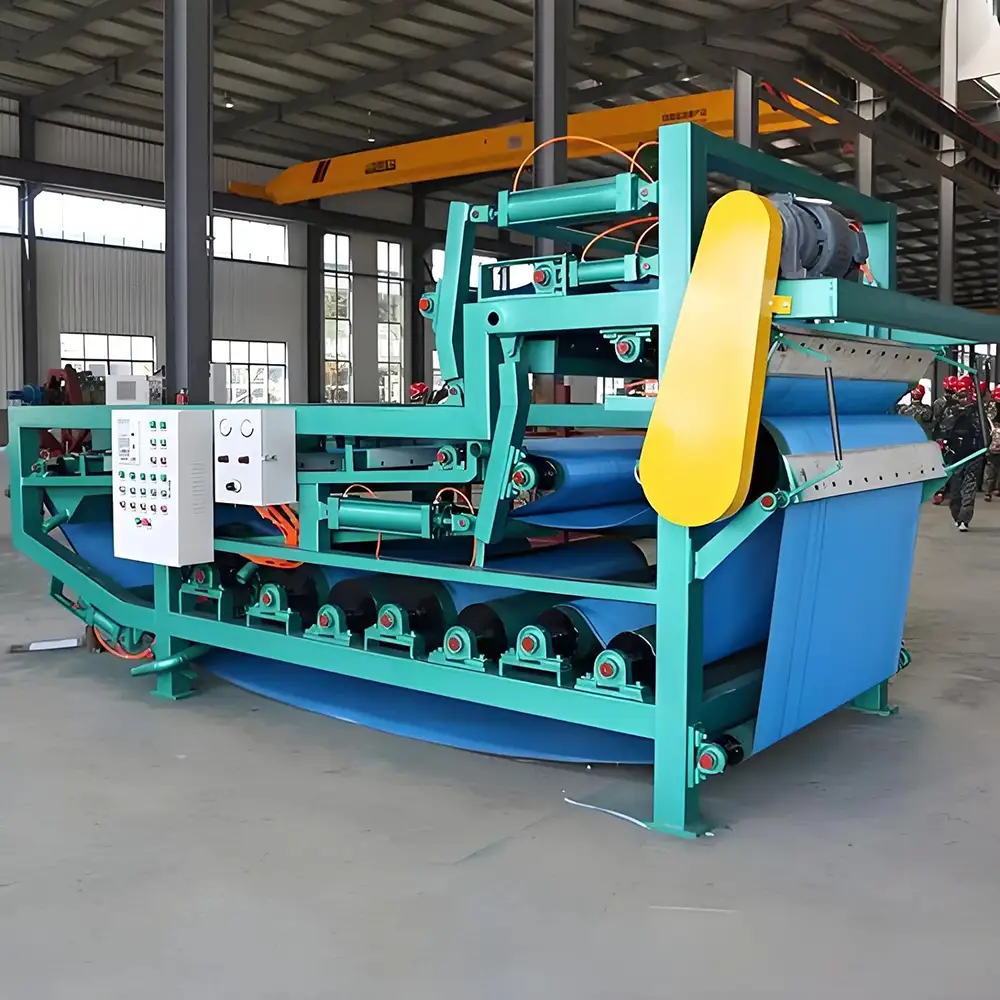
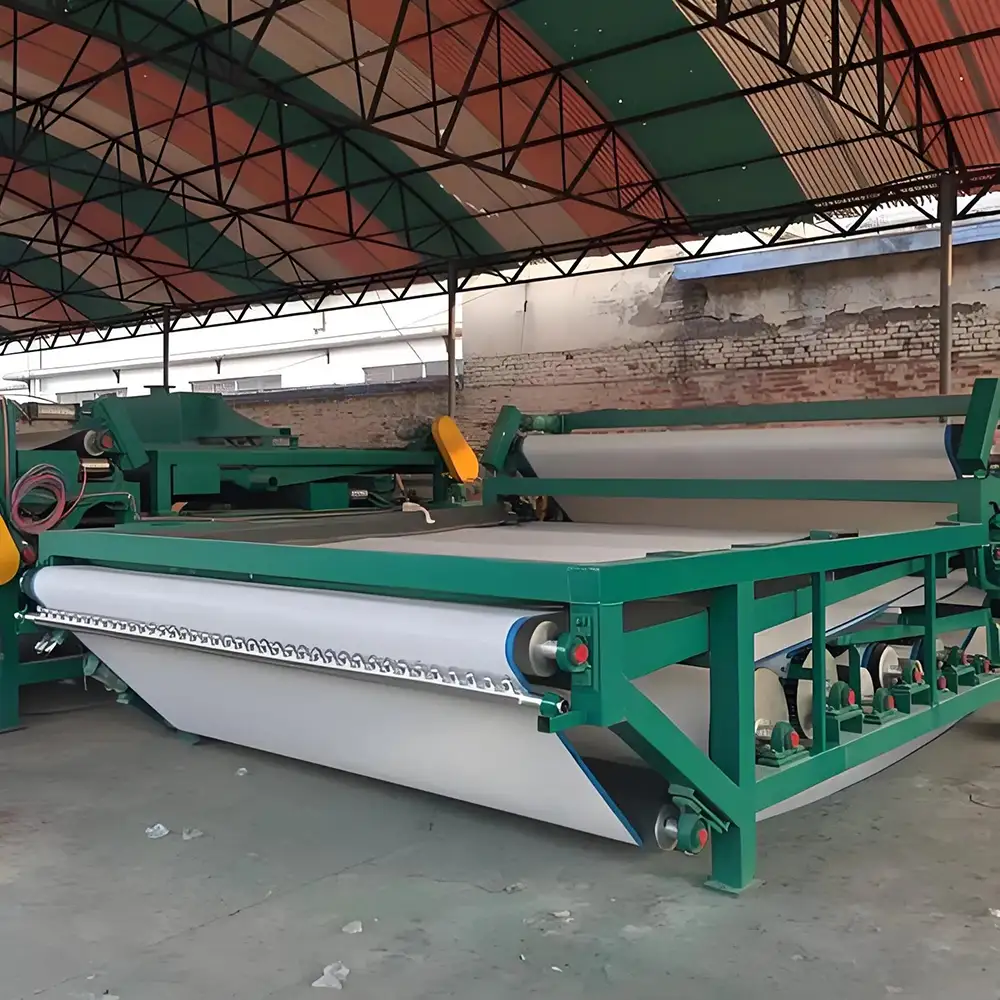
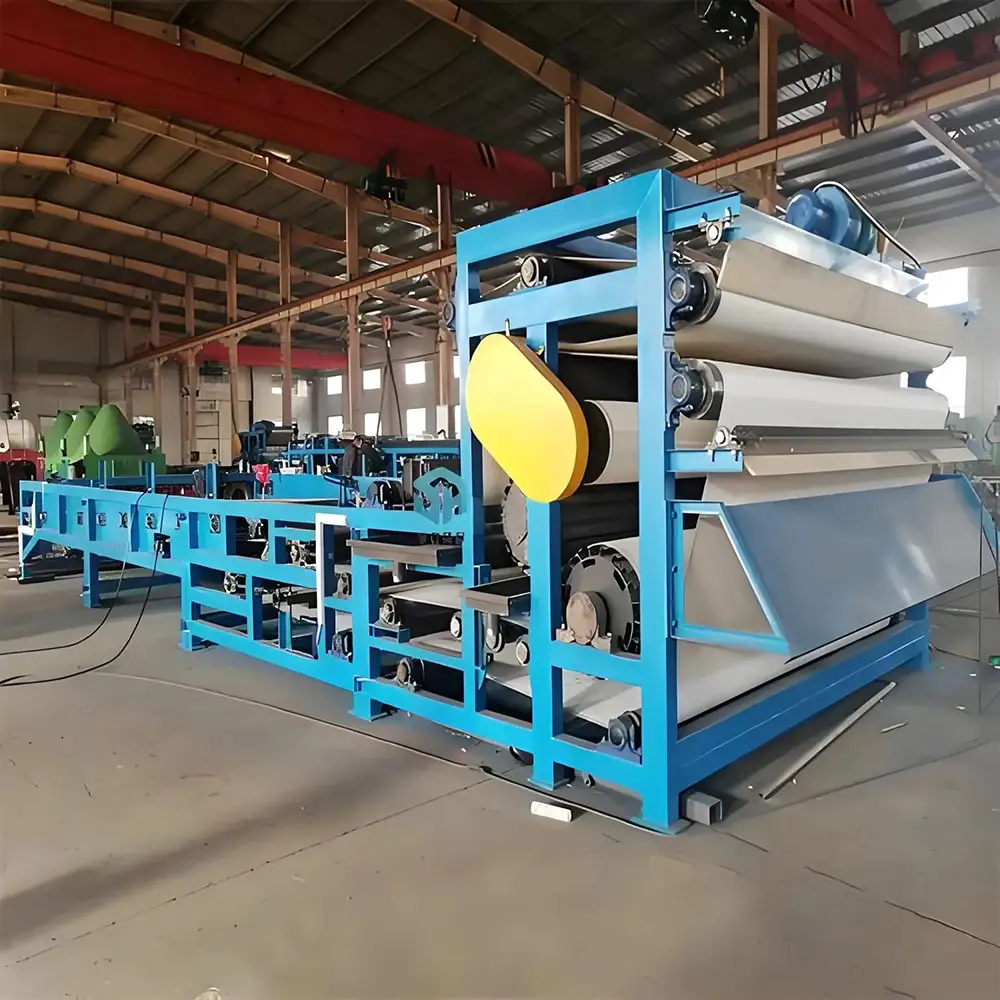
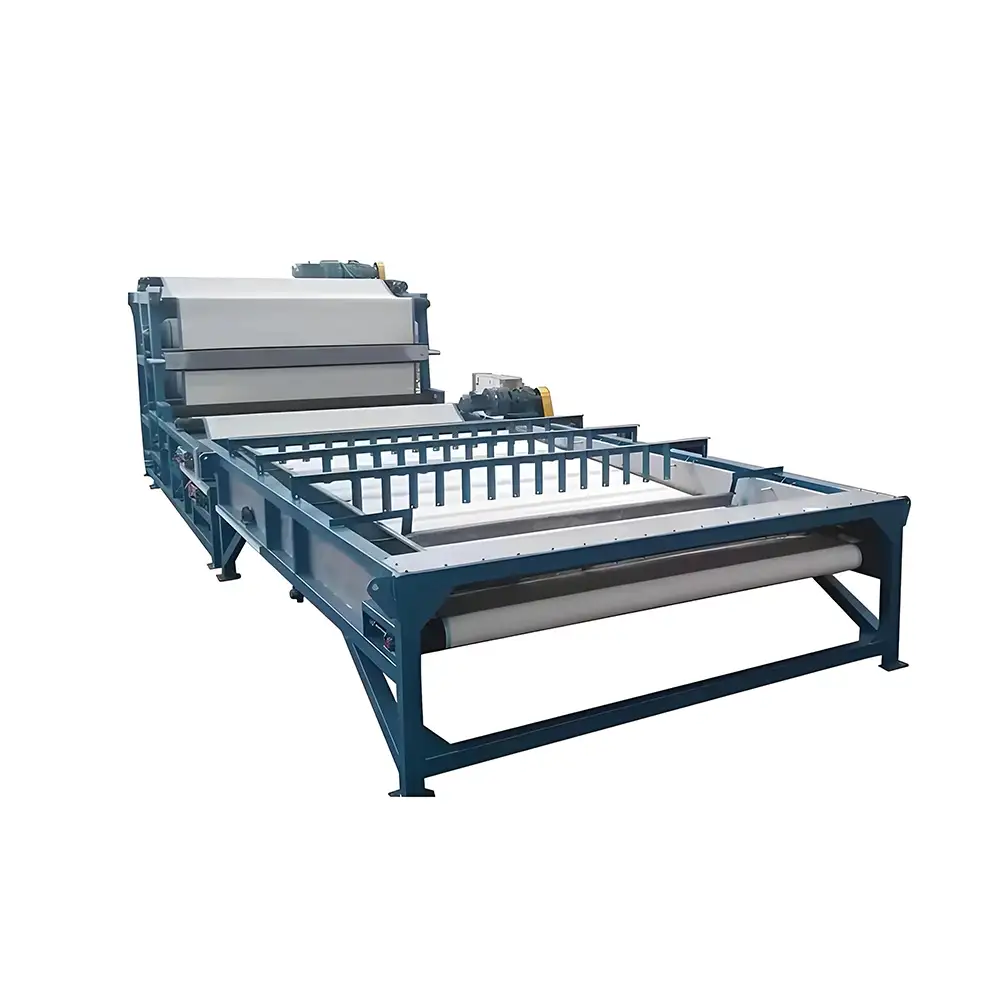
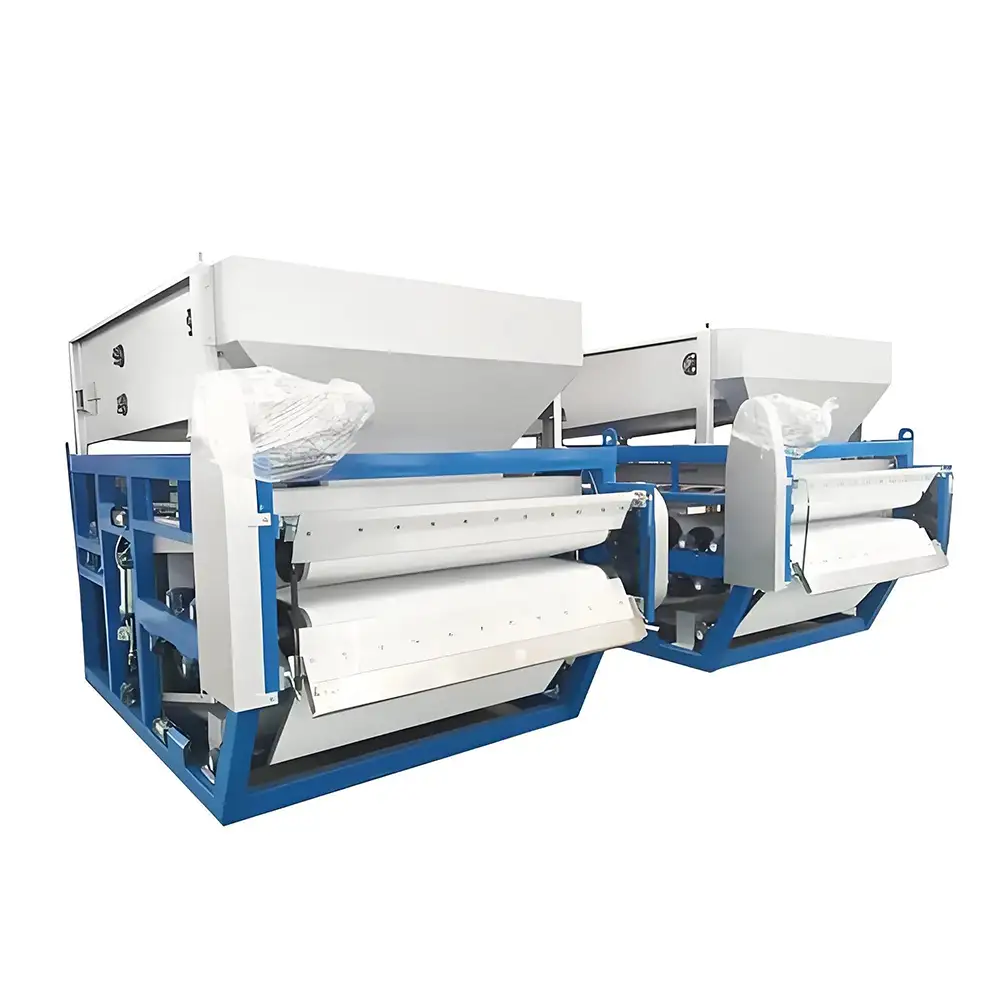
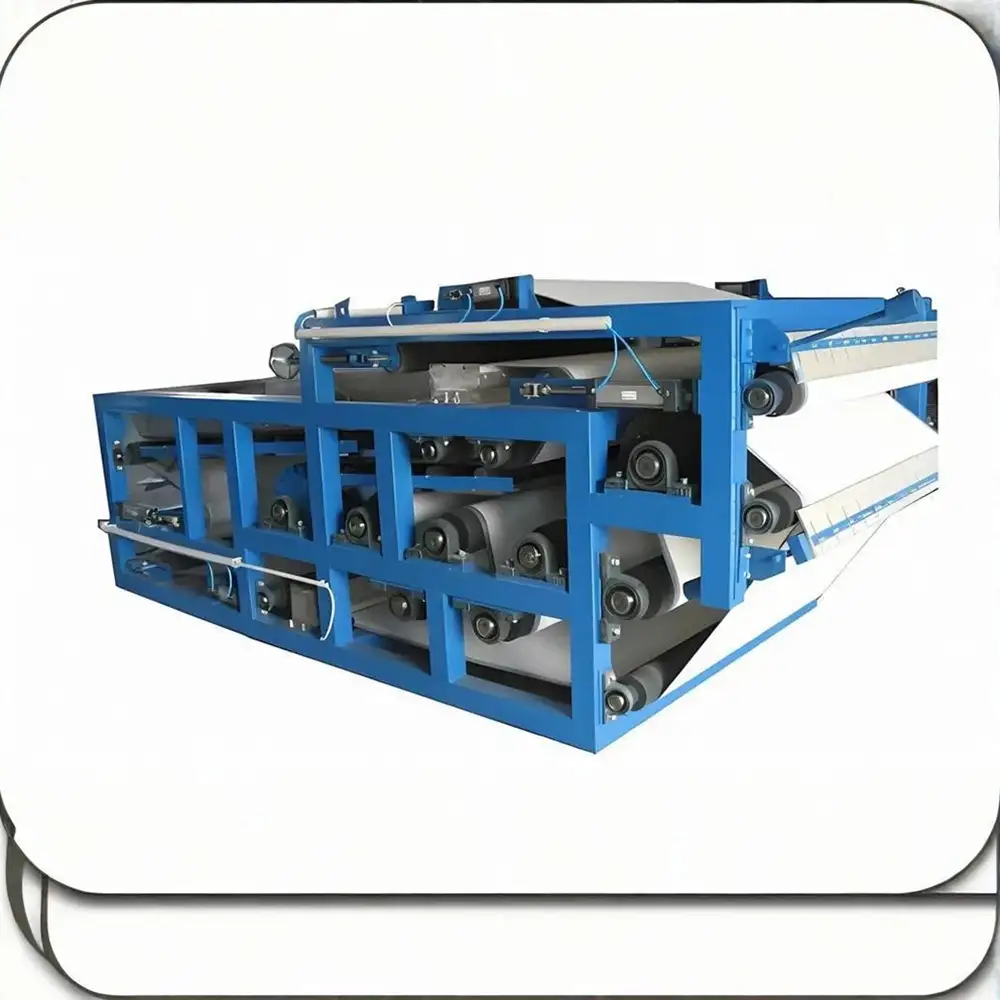
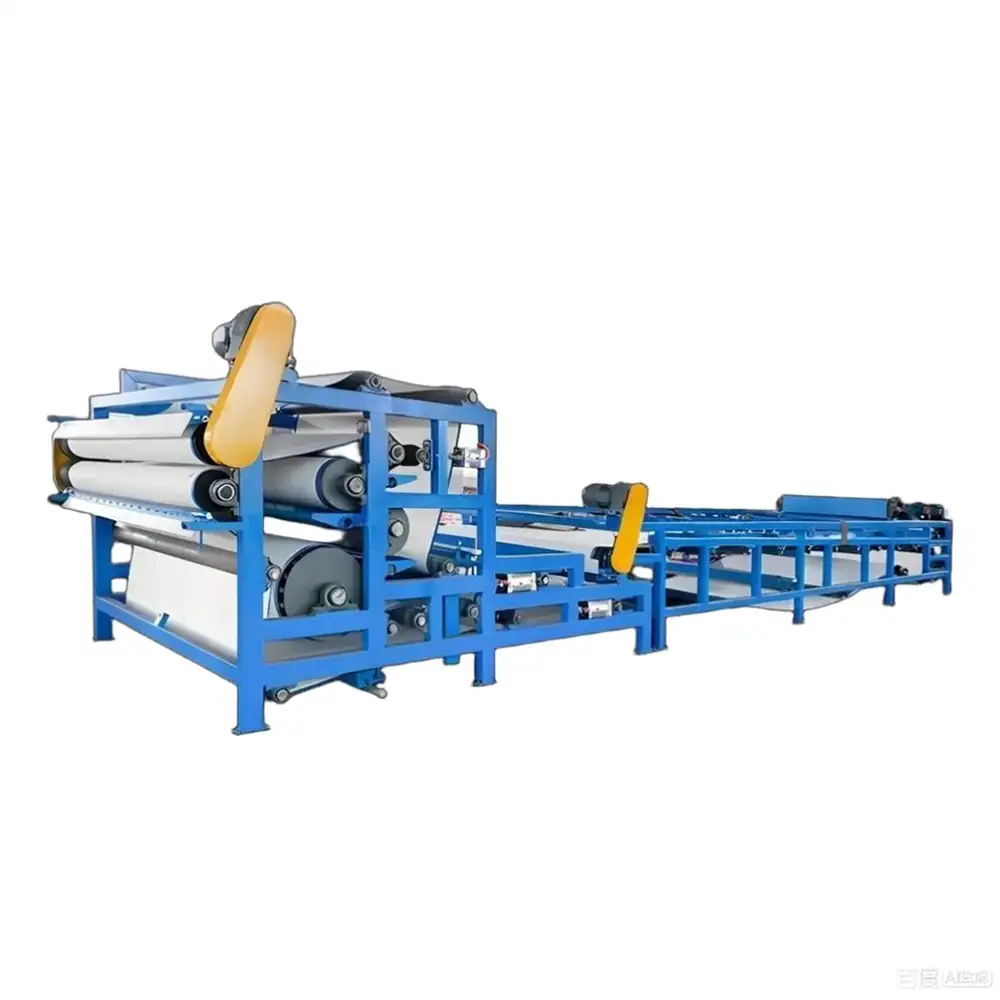
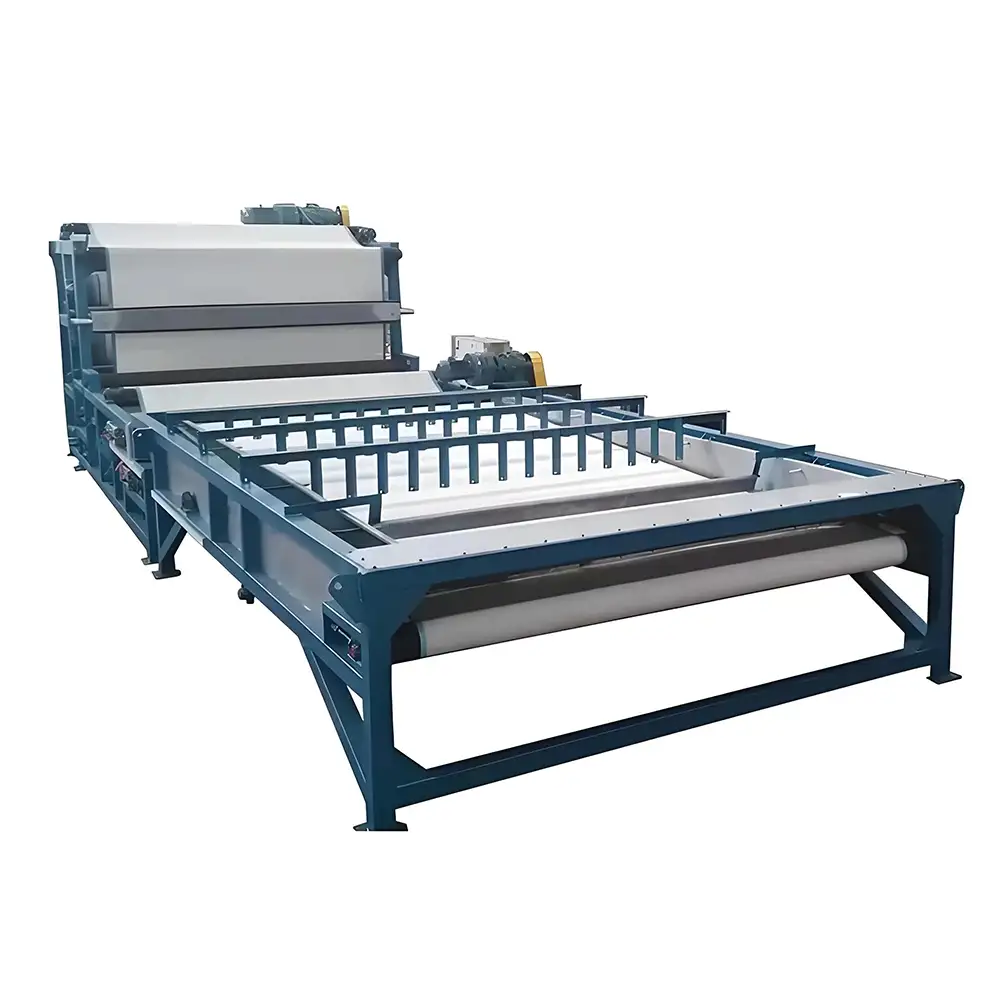
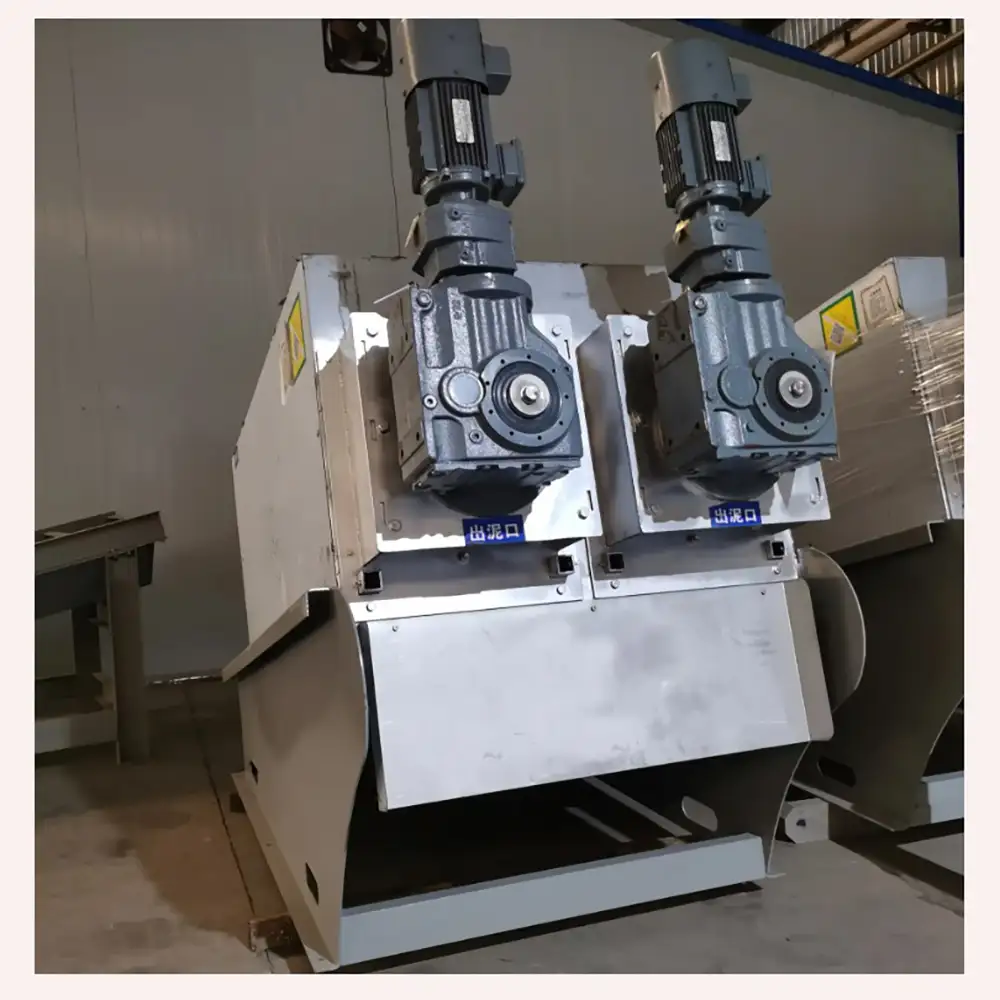
belt filter press is a continuous solid-liquid separation device. Its core working principle involves a three-stage process of gravity dewatering, wedge-zone pre-dewatering, and high-pressure dewatering using press rollers to squeeze and separate water from materials such as sludge and slurries, achieving volume reduction and harmless treatment of solid materials. It features high processing capacity, high degree of automation, and low operating costs, making it a mainstream dewatering equipment in environmental water treatment, mining, chemical, and other fields..
The Energy-Saving Belt Filter Press for Sludge Dewatering is a continuous mechanical dewatering machine designed to separate water from sludge and produce a more concentrated solid material for subsequent handling, transportation, treatment, or disposal. It is suitable for municipal wastewater treatment plants, industrial wastewater facilities, food processing plants, chemical industries, paper mills, agricultural processing operations, and other applications that generate compatible sludge.
The belt filter press works through a combination of gravity drainage, mechanical squeezing, filtration, and progressive compression. Sludge is introduced into the dewatering system and distributed onto a moving filter belt. Free water drains through the belt during the gravity dewatering stage, after which the partially dewatered sludge passes through a series of rollers that apply controlled mechanical pressure.
This continuous process provides an efficient alternative to batch-type sludge dewatering methods and can be integrated into automated wastewater treatment systems.
|
Module |
core components |
Specifications/Material/Function |
Common configuration |
|
Basic support |
frame |
Carbon steel with powder coating/stainless steel; load-bearing and fixing all components. |
1 set (including main beam, end beam, and support frame) |
|
Feeding system |
Feed hopper + mixer |
Stainless steel/PP; uniform fabric + flocculation mixing |
1 set (including static mixer + mud spreader) |
|
Dehydration system |
Upper/lower filter belt |
Polyester (PET)/Polypropylene (PP); abrasion resistant, corrosion resistant, breathable |
2 strips (width 1m/1.5m/2m/3m) |
|
|
Gravity dehydration section |
Bracket + feed trough; pre-dehydration, reducing moisture content to 80%-90%. |
Group 1 |
|
|
wedge-shaped preloading section |
Filter belt with angled structure; slight compression reduces moisture content to 70%-80%. |
Group 1 |
|
|
S-shaped pressing section |
Multiple sets of pressure-reducing press rolls with varying diameters; high-pressure shearing reduces moisture content to 60%-70%. |
1 set (including large/small diameter rollers) |
|
Drive control |
Transmission device |
Variable frequency motor + reducer; drives the filter belt at a speed of 0.8-8m/min |
1 set (power 3-11kW) |
|
|
tensioning device |
Cylinder/airbag + tension roller; tension 50-88 N/cm, stabilizing the filter belt. |
2 sets (independent control of upper and lower filter belts) |
|
|
Pivot adjustment device |
Adjusting roller + cylinder + sensor; to prevent filter belt from running off-center. |
4-6 groups (bilateral arrangement) |
|
Accessibility |
Cleaning System |
High-pressure nozzle + liquid receiving box; flushes away filter belt residue and prevents clogging. |
1 set (with cleaning pump) |
|
|
unloading device |
Scraper + discharge roller; peeling off mud cake |
1 set |
|
|
Pneumatic/Electrical Control System |
PLC + cylinder + solenoid valve; automatic tensioning, alignment, and speed control. |
1 set (including control cabinet + pneumatic components) |
Energy-Saving Belt Filter Press Design
The energy-saving concept of the machine is based on continuous mechanical dewatering and an efficient transmission and compression structure. Compared with separation technologies that rely heavily on high-speed rotating equipment, a belt filter press uses relatively low-speed belt movement and mechanical roller compression.
The actual energy consumption depends on machine size, sludge characteristics, feed concentration, polymer dosing, operating hours, motor configuration, and system design.
For wastewater treatment plants operating continuously, selecting an appropriately sized belt press and optimizing sludge conditioning can help establish an efficient overall dewatering process.
Continuous Sludge Dewatering
A major advantage of the belt filter press is its continuous operating principle. Sludge can be continuously fed into the machine while dewatered solids are continuously discharged.
This makes the equipment suitable for treatment plants with regular sludge production.
The continuous process can reduce the need for repeated batch loading and unloading and can be integrated with sludge pumps, thickening tanks, polymer dosing systems, conveyors, and sludge collection equipment.
Gravity Drainage Zone
Before mechanical compression begins, sludge is distributed across the moving filter belt and enters a gravity drainage zone.
During this stage, a portion of the free water naturally drains through the porous belt. Removing free water before the compression stage can improve the subsequent mechanical dewatering process.
The performance of the gravity drainage stage depends on sludge concentration, floc structure, viscosity, belt characteristics, feed distribution, and polymer conditioning.
Proper sludge distribution across the belt is important for achieving stable and uniform dewatering.
Mechanical Compression And Filtration
After gravity drainage, the sludge enters the mechanical pressing section. The filter belt carries the sludge through a series of rollers that gradually apply pressure.
As the space between the belts and rollers changes, water is squeezed from the sludge and passes through the filter media.
The concentrated sludge continues through the pressing section before being discharged from the machine.
This progressive compression principle allows the belt press to perform continuous filtration and mechanical dewatering without requiring high-speed centrifugal separation.
Sludge Thickening And Conditioning
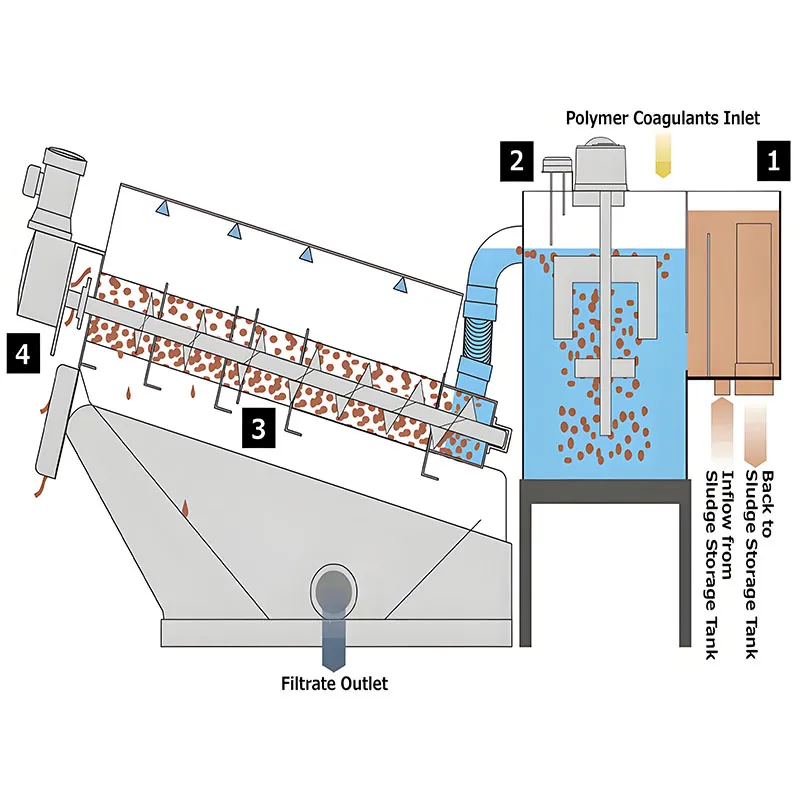
Sludge conditioning is often an important part of belt press operation. Depending on sludge characteristics, polymer may be added upstream to improve floc formation.
Effective flocculation can help bind fine suspended particles together and improve the release of water during gravity drainage and mechanical pressing.
The appropriate polymer type and dosage depend on the characteristics of the sludge and should be determined through testing.
The belt press can be integrated with automatic polymer preparation and dosing equipment for continuous wastewater treatment applications.
Filter Belt System
The filter belt is one of the most important components of a belt press. It provides the filtration surface through which separated water passes while retaining the concentrated sludge solids.
Different sludge types may require different belt materials, mesh characteristics, permeability, and cleaning arrangements.
The correct belt selection can help balance filtration performance, solids retention, cleaning requirements, and operating life.
Regular belt inspection and cleaning are important for maintaining stable filtration performance.
Automatic Belt Washing
Continuous belt washing can help remove accumulated sludge particles from the filter media.
A washing system typically uses pressurized water to clean the belt after the dewatering cycle. The exact washing pressure, water consumption, nozzle configuration, and cleaning frequency depend on the machine design and sludge characteristics.
Maintaining a clean belt is important because blocked filtration pores can reduce drainage performance and affect dewatering efficiency.
Efficient Solid-Liquid Separation
The belt filter press separates liquid from sludge through gravity drainage and mechanical pressure.
Separated liquid, commonly referred to as filtrate, is collected separately and can be returned to an appropriate wastewater treatment stage according to the overall plant process.
The solid fraction exits the press as dewatered sludge. Its final properties depend on the original sludge concentration, sludge type, conditioning method, belt configuration, and machine operating parameters.
Suitable For Municipal Wastewater Sludge
Municipal wastewater treatment plants generate biological and primary sludge that often requires dewatering before transportation or further processing.
A belt filter press can provide continuous mechanical dewatering for compatible municipal sludge.
It can be integrated with sludge thickening, polymer dosing, filtrate collection, sludge conveyors, storage systems, and downstream treatment processes.
The appropriate machine capacity should be selected according to sludge production, operating hours, and required treatment capacity.
Industrial Wastewater Applications
The belt press can also be used for suitable industrial wastewater sludge from food processing, beverage production, paper manufacturing, chemical processing, mining-related wastewater, textile operations, and other industries.
Industrial sludge characteristics can vary significantly. Some sludges contain fine particles, oils, fibers, chemicals, or inorganic solids that influence filtration behavior.
Therefore, application testing and sludge analysis are recommended before final machine selection.
Food And Organic Sludge Dewatering
Food processing plants can generate organic wastewater sludge containing suspended solids, biological material, food particles, and other residues.
A belt filter press can be used to dewater suitable food industry sludge continuously.
Potential applications include meat processing, vegetable processing, fruit processing, beverage production, dairy-related wastewater, starch processing, and other food industry wastewater systems.
Material compatibility and hygiene requirements should be considered when selecting machine construction materials and cleaning systems.
Reduced Sludge Handling Requirements
Mechanical dewatering removes a portion of the water contained in sludge, which can reduce the volume and weight of the material requiring transportation or subsequent treatment.
This can make sludge storage, conveying, loading, and transportation more manageable.
The actual reduction in sludge volume depends on the feed solids concentration, sludge characteristics, conditioning process, machine settings, and final dewatering performance.
Low-Speed Mechanical Operation
The belt filter press relies on relatively slow belt movement and roller compression rather than high-speed centrifugal forces.
This operating principle can provide continuous dewatering with controlled mechanical movement.
The combination of gravity drainage and progressive compression can help reduce the mechanical work required compared with processes that depend primarily on high-speed separation.
Actual energy performance should be evaluated according to the complete system configuration and operating conditions.
Easy Integration With Wastewater Treatment Plants
The belt filter press can be incorporated into complete sludge treatment systems.
Typical upstream equipment may include sludge collection tanks, sludge thickening equipment, pumps, mixers, and polymer preparation systems.
Downstream equipment may include sludge conveyors, storage containers, drying systems, composting systems, thermal treatment equipment, or other appropriate processes.
This flexibility allows the belt press to be adapted to both new wastewater treatment projects and existing plant upgrades.
Compact And Practical Layout
The belt filter press combines sludge feeding, gravity drainage, mechanical pressing, belt washing, and sludge discharge into an integrated machine.
Its continuous design can provide a practical solution for treatment facilities that need regular sludge dewatering without relying on large batch filtration systems.
The actual footprint depends on the selected model, belt width, ancillary equipment, and installation configuration.
Easy Operation And Maintenance
The machine can be configured with automatic controls for belt movement, sludge feeding, polymer dosing, belt washing, and other operating functions.
Operators can monitor the sludge feed, belt condition, filtrate discharge, and dewatered sludge output during operation.
Routine maintenance includes inspection and cleaning of the filter belt, rollers, bearings, scrapers, water nozzles, pumps, seals, and drive components.
Regular maintenance can help maintain stable operation and extend the service life of wear components.
Customized Belt Filter Press Solutions
Different wastewater plants require different dewatering configurations.
Important factors for equipment selection include:
Sludge Type
Sludge Flow Rate
Feed Solids Concentration
Operating Hours
Sludge Temperature
Particle Characteristics
Polymer Conditioning Requirements
Required Dewatering Performance
Available Installation Space
Downstream Sludge Handling Method
Based on these parameters, the appropriate belt width, filtration configuration, washing system, drive system, and control arrangement can be evaluated.
B2B Sludge Dewatering Equipment
The Energy-Saving Belt Filter Press for Sludge Dewatering is suitable for wastewater treatment contractors, municipal treatment plants, industrial manufacturers, environmental engineering companies, food processing facilities, and international equipment distributors.
It provides continuous mechanical sludge dewatering with flexible system integration and application-based configuration.
For B2B projects, customers can provide sludge analysis, flow rate, solids concentration, operating schedule, required capacity, and installation information. These details help determine a suitable machine configuration.
Key Features
Energy-Efficient Mechanical Dewatering Design
Continuous Belt Filter Press Operation
Gravity Sludge Drainage
Progressive Roller Compression
Efficient Solid-Liquid Separation
Automatic Belt Washing System
Optional Polymer Dosing Integration
Continuous Dewatered Sludge Discharge
Suitable For Municipal And Industrial Sludge
Low-Speed Mechanical Operation
Easy Wastewater System Integration
Customized Belt Press Configuration
Main Applications
Municipal Wastewater Sludge
Industrial Wastewater Sludge
Food Processing Sludge
Beverage Industry Sludge
Paper Mill Sludge
Chemical Industry Sludge
Textile Wastewater Sludge
Agricultural Processing Sludge
Organic Sludge Dewatering
Biological Sludge Dewatering
Wastewater Treatment Plants
Industrial Sludge Treatment
FAQs
1. What Is An Energy-Saving Belt Filter Press?
It is a continuous mechanical sludge dewatering machine that uses gravity drainage, filtration belts, and roller compression to separate water from sludge.
2. How Does A Belt Filter Press Dewater Sludge?
Sludge first undergoes gravity drainage on the filter belt and then passes through mechanical rollers that progressively compress the sludge and release additional water.
3. Is The Belt Filter Press Energy Efficient?
The belt press uses relatively low-speed belt movement and mechanical roller compression. Actual energy consumption depends on machine size, sludge properties, polymer requirements, operating hours, and overall system design.
4. Does The Machine Require Polymer?
Many sludge types benefit from polymer conditioning, but requirements vary. Polymer selection and dosage should be determined through sludge testing.
5. Can It Process Municipal Sludge?
Yes. Belt filter presses are suitable for many municipal primary and biological sludge dewatering applications when properly configured.
6. Can It Be Used For Industrial Wastewater?
Yes. It can be configured for many compatible industrial sludges, including food processing, paper, textile, chemical, and other wastewater treatment residues.
7. What Is The Purpose Of Belt Washing?
The belt washing system removes accumulated sludge particles from the filter media. Keeping the belt clean helps maintain filtration and drainage performance.
8. Can The Belt Press Operate Continuously?
Yes. It is designed for continuous sludge feeding, dewatering, belt washing, and dewatered sludge discharge.
9. How Do I Select The Right Belt Filter Press?
Important information includes sludge type, feed flow, solids concentration, operating hours, polymer requirements, required processing capacity, and available installation space.
10. Can The Belt Filter Press Be Customized?
Yes. Belt width, filtration belt, roller configuration, washing system, feeding system, controls, materials, and auxiliary equipment can be configured according to the project requirements.
Why Choose Us
Professional Sludge Dewatering Solutions
We provide belt filter press equipment for municipal, industrial, food processing, and other compatible wastewater sludge applications.
Energy-Efficient Mechanical Design
The combination of gravity drainage and progressive roller compression provides a practical continuous dewatering process without relying primarily on high-speed centrifugal separation.
Application-Based Configuration
We evaluate sludge characteristics, feed flow, solids concentration, operating hours, polymer requirements, and downstream treatment needs before recommending equipment.
Complete System Integration
The belt press can be integrated with sludge pumps, thickening tanks, polymer preparation systems, conveyors, filtrate collection, and downstream sludge treatment equipment.
Factory-Direct Support
We support international customers with technical consultation, application evaluation, equipment configuration, production coordination, export packaging, installation guidance, and after-sales service.
Customized Equipment Solutions
Different sludge types require different belt materials, roller configurations, washing systems, and operating parameters. We provide application-based configurations for individual projects.
Prev:
Low Noise Oil Sludge Yeast Slurry Screw Press Dewatering Machine
Next:
Industrial Continuous Operation Belt Filter Press for Wastewater Treatment
TAG:
Industrial Wastewater Sludge Treatment,
Sludge Solid Liquid Separation,
Belt Press Dewatering Machine,
Continuous Sludge Dewatering,
Sludge Dewatering Belt Press,
Industrial Belt Filter Press,
Sludge Filtration Equipment,
Mechanical Sludge Dewatering,
Municipal Sludge Dewatering,
Industrial Sludge Filter Press,
Belt Press Filter Machine,
Belt Filter Press Sludge Dewatering,
Sludge Dewatering System,
Food Processing Sludge Dewatering,
Sludge Dewatering Equipment,
Wastewater Sludge Dewatering,
Automatic Sludge Dewatering Machine,
Energy-Saving Belt Filter Press,
Energy Saving Sludge Dewatering Machine,
Belt Press Sludge Dewatering,
Related Category:
Energy-Saving Belt Filter Press for Sludge Dewatering, Energy Saving Belt Filter Press, Belt Filter Press Sludge Dewater China, suppliers, manufacturers, factory, customized, wholesale, quotation, made in China