Introduction
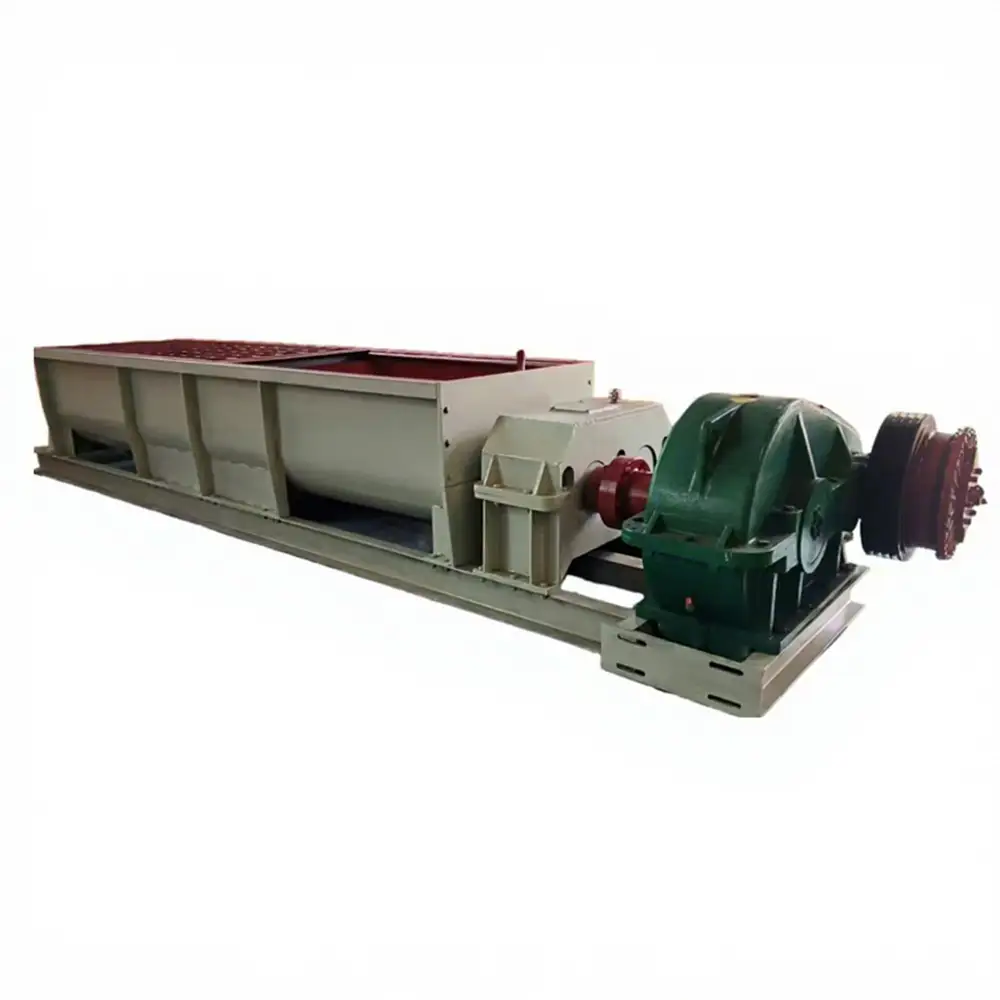
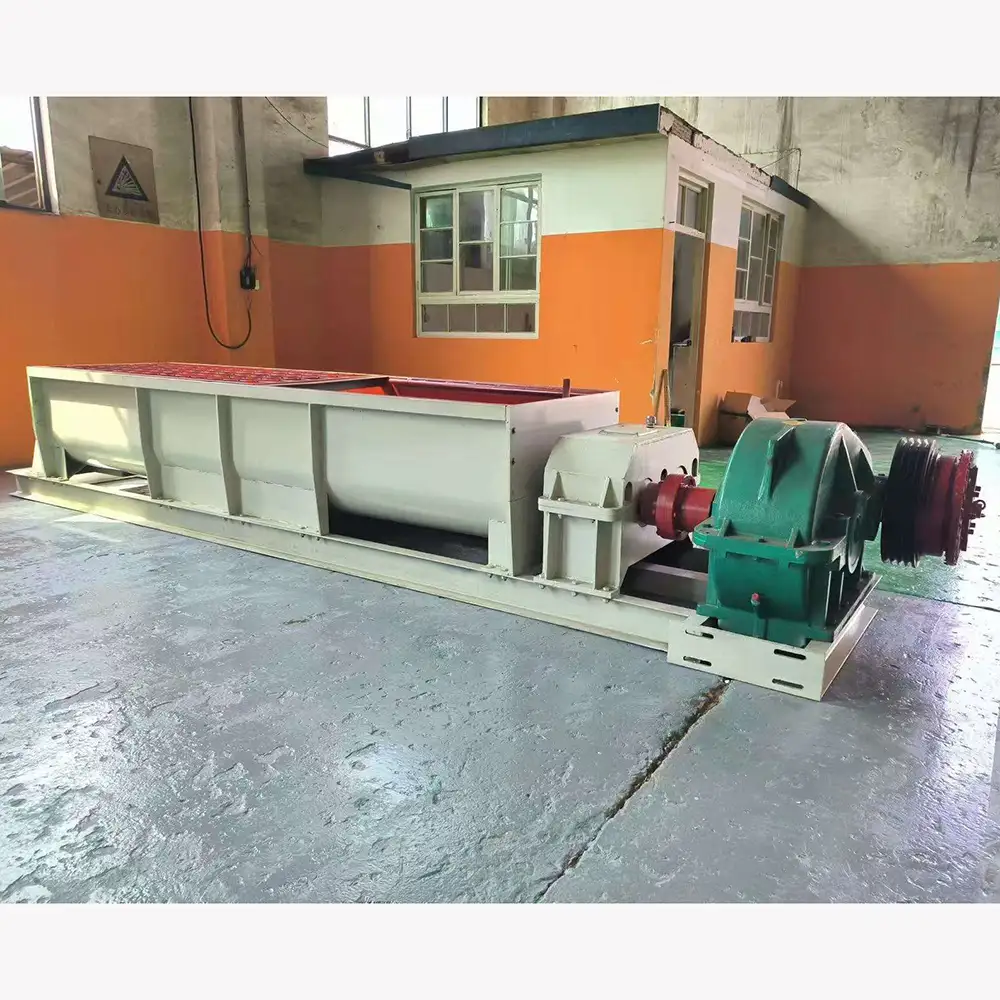
This double shaft mixer is mainly used for various powdery materials, such as clay, shale, cola gangue and fly ash, etc, which can well stir materials. It is the important equipment in brick making production
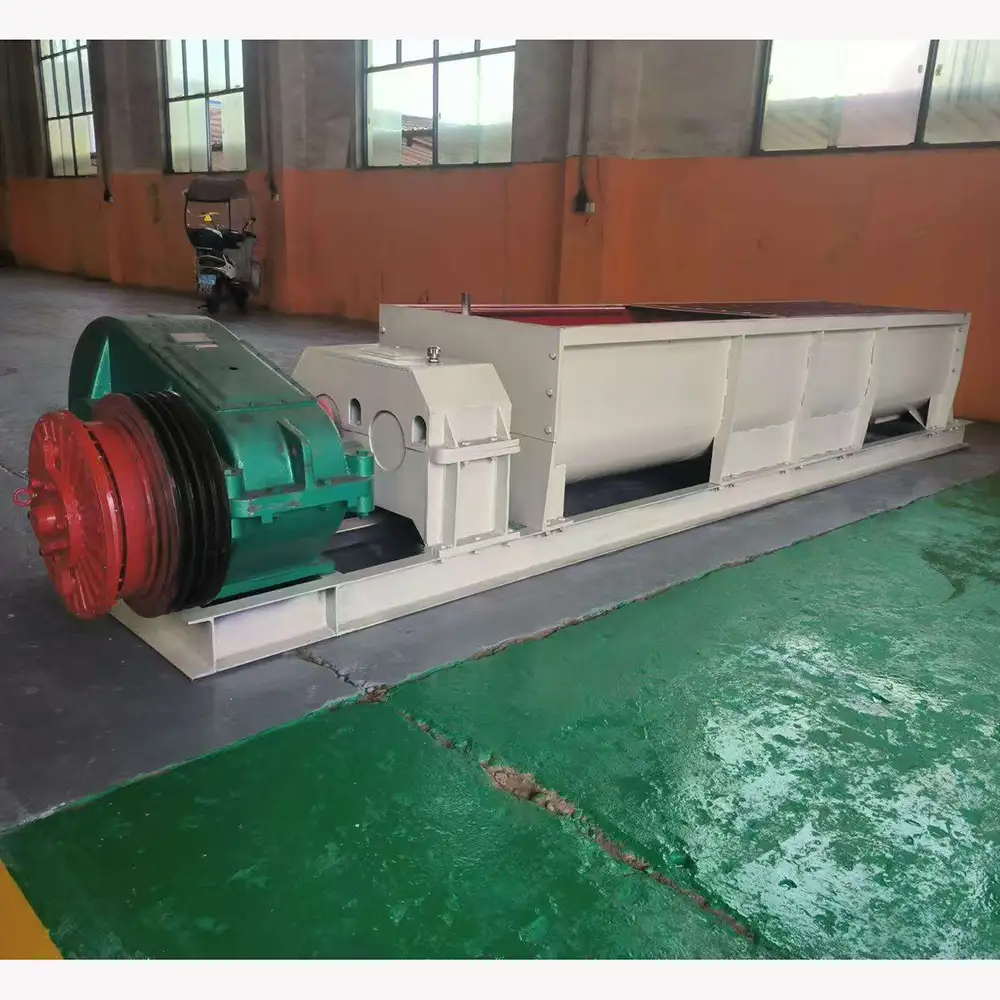
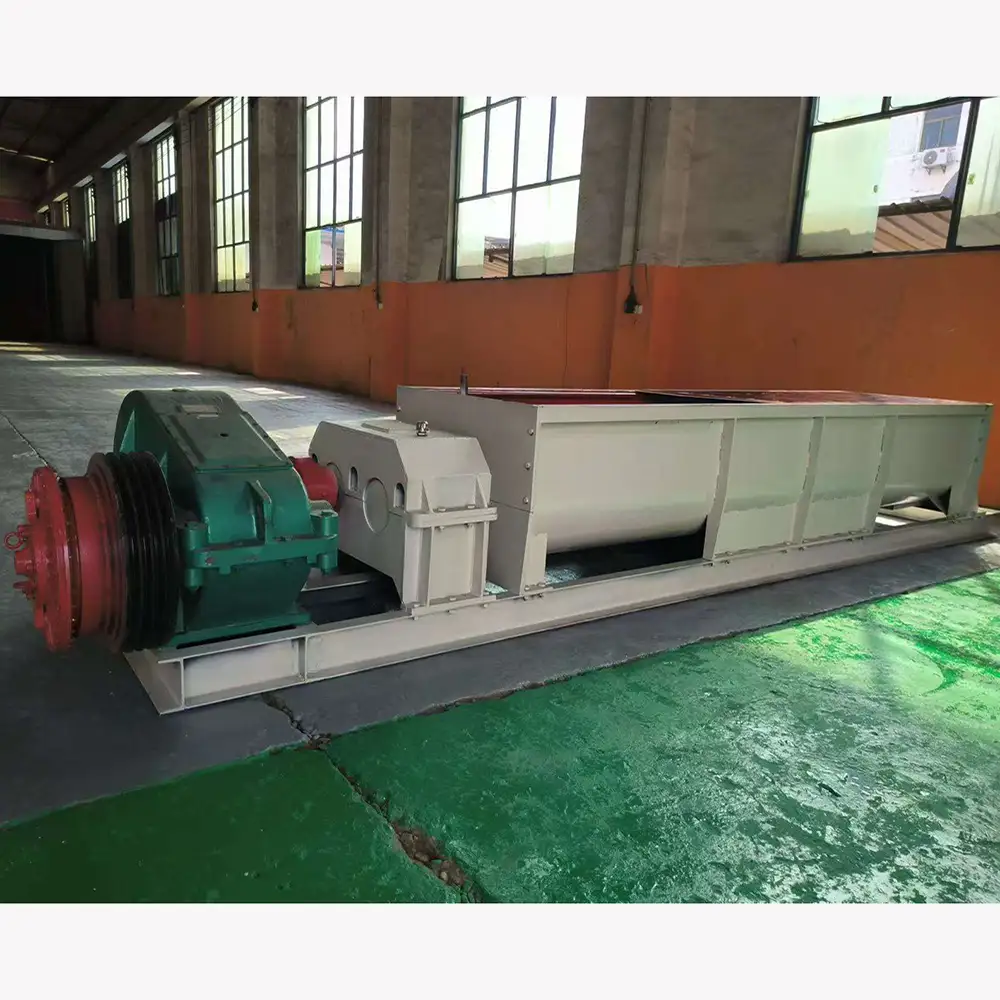
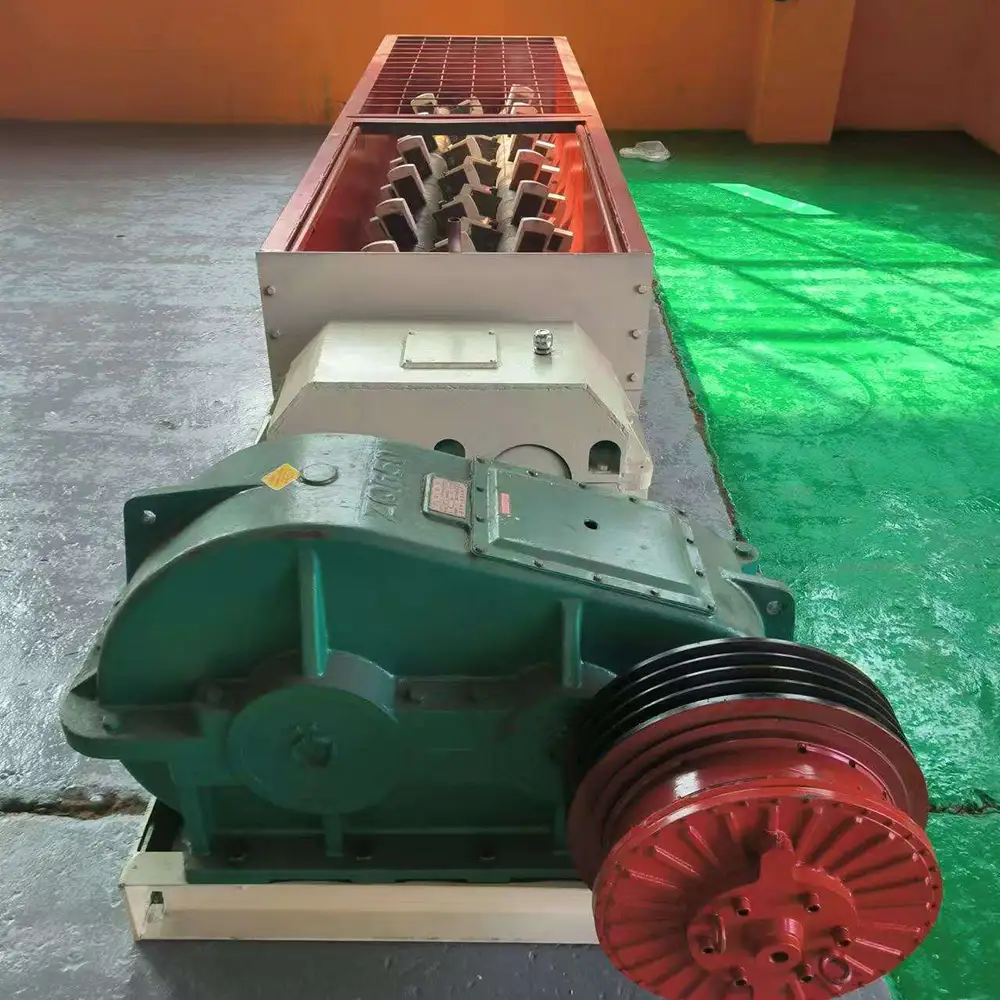
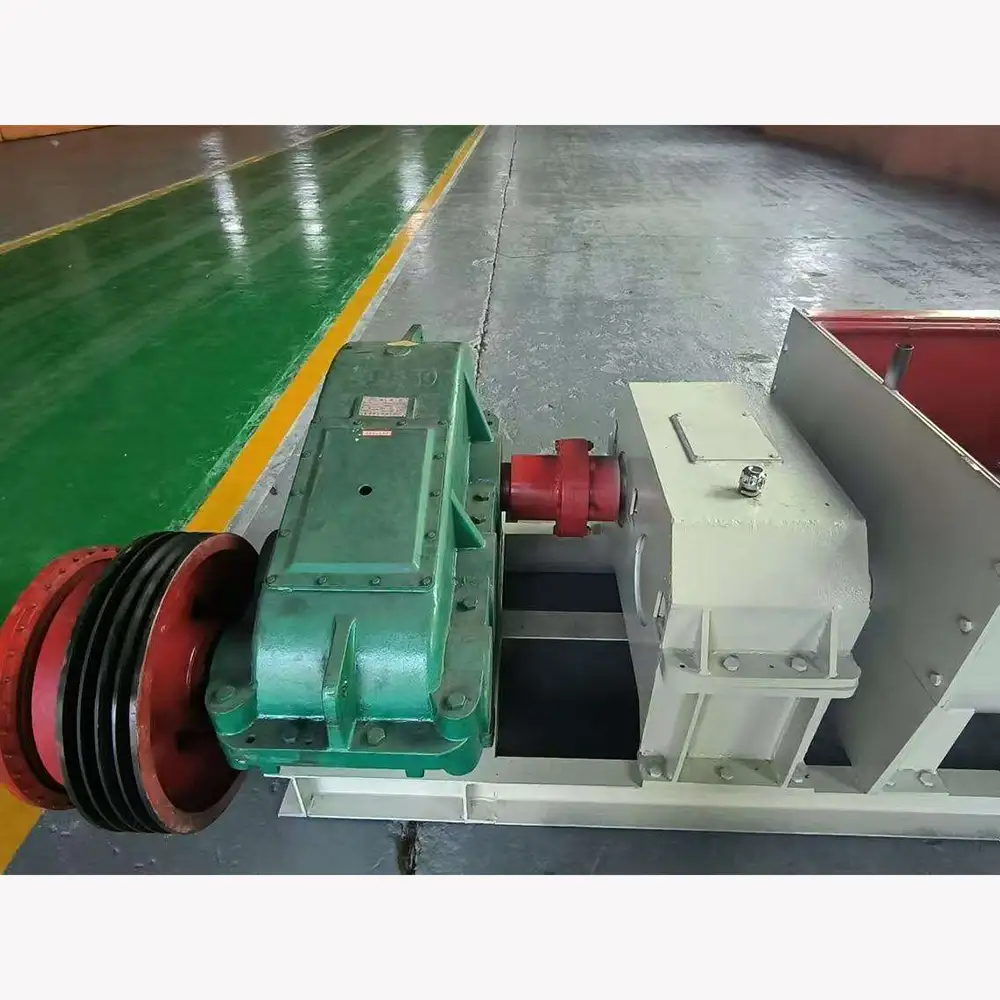
This double shaft mixer is composed of shell, screw shaft assembly, drive unit, piping assembly, cover and chain guard, etc. Specific features as follows:
1. As the main support of dual-stage mixer, the shell body is welded with sheet materials and profile steel and assembled with other parts. This shell completely seal up without ash leakage.
2. Screw shaft assembly is key component of this mixer, which is made up of left-and-right rotating screw shaft, bearing block, bearing holder, bearing cap, gear, chain wheel, oil cup and other parts.
3. Piping assembly for adding water is formed by take-over, tie-in and muzzle. With simple structure, the stainless steel muzzle is easy to change and antiseptic. Through handle the manual control valve on the pipe can adjust moisture content of wet ash.
4. The cover mainly includes left cover, mid-cover, right cover, hole cover and manhole cover. With six manhole covers on two sides of the double shaft mixer, it’s easy for operators to repair and maintain.
Main technical parameters:
|
Model |
Capacity (t/h) |
Blade rotation speed (r/min) |
Blade diameter (mm) |
Motor type |
Motor power(kw) |
|
SJ10 |
10 |
37.5 |
400 |
Y132S-4 |
5.5 |
|
SJ20 |
20 |
47.6 |
400 |
U123M-4 |
7.5 |
|
SJ40 |
40 |
47.6 |
500 |
Y160M-4 |
11 |
|
SJ60 |
60 |
47.6 |
600 |
Y160L-4 |
15 |
|
SJ80 |
80 |
53 |
600 |
Y180M-4 |
18.5 |
|
SJ100 |
100 |
47.6 |
700 |
Y250M-4 |
37 |
|
SJ200 |
200 |
47.6 |
860 |
Y225M-4 |
45 |
SJ Double-Axle Mixer With Wall Scraper Agitator
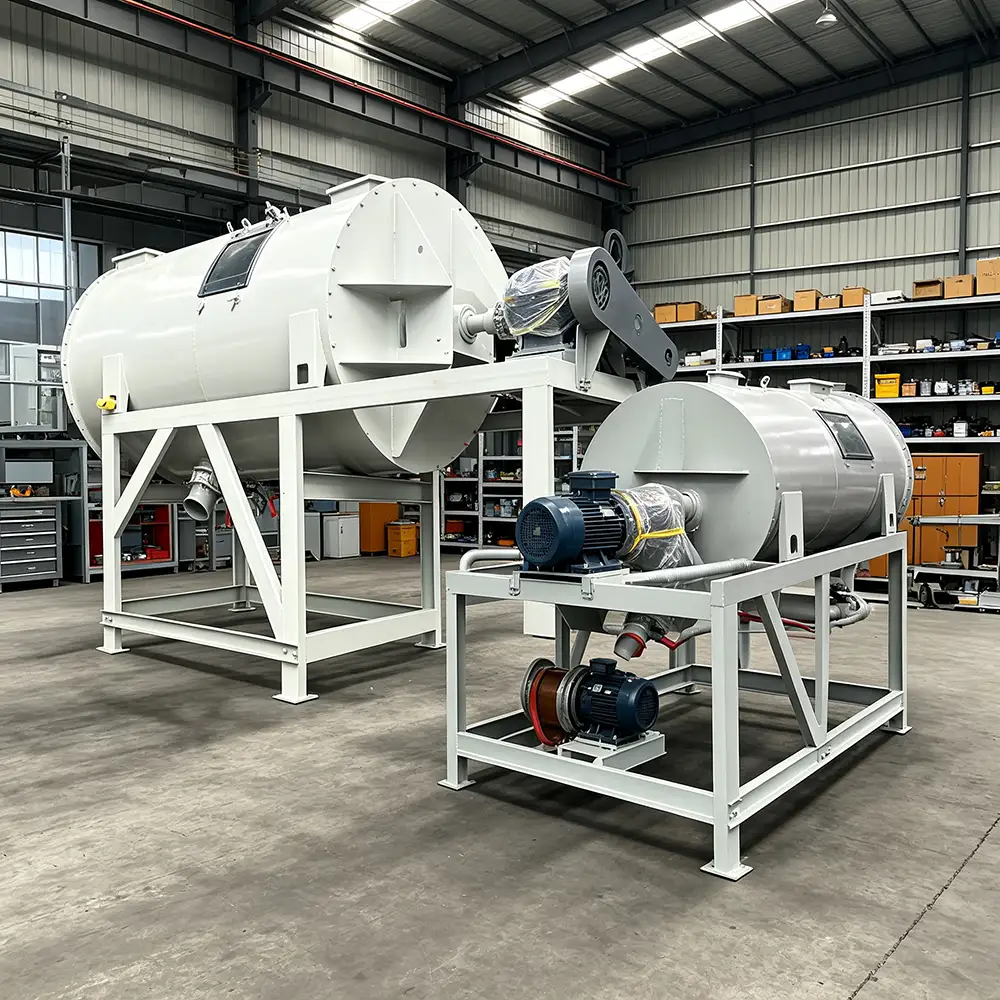
The SJ Double-Axle Mixer is an industrial mixing machine designed for efficient and uniform blending of powders, granules, bulk solids, and other process materials. Also known as a Double-Axle Mixer, Double-Shaft Mixer, or Twin Shaft Mixer, the equipment uses two rotating mixing shafts to create intensive material movement inside the mixing chamber.
A key feature of this design is the agitator with wall scrapers, which helps move material away from the inner walls of the mixing chamber and return it to the active mixing zone. This design can reduce material accumulation on the chamber walls and improve overall material circulation.
The SJ Double-Axle Mixer can be used in chemical processing, cement and construction materials, mineral processing, fertilizer production, food ingredients, feed manufacturing, ceramics, plastics, and other industrial applications where consistent material blending is required.
What Is a Double-Axle Platform Mixer?
A double-axle platform mixer is a mechanical mixing system equipped with two parallel rotating shafts fitted with mixing elements. The shafts operate together to create multiple material movement patterns within the mixing chamber.
Compared with a single-shaft mixer, the twin-shaft configuration can create more intensive interaction between materials. The agitators continuously lift, fold, push, and redistribute the material, helping different ingredients achieve a more uniform mixture.
The platform structure can also provide convenient access to the mixer for inspection, feeding, cleaning, and maintenance.
The exact mixing action depends on the shape and arrangement of the agitators, shaft rotation speed, material properties, filling ratio, and mixing time.
Agitator With Wall Scrapers
One of the important features of the SJ Double-Axle Mixer is the wall-scraping agitator system.
During mixing, some materials can adhere to the internal wall of the mixing chamber. This can be more noticeable with cohesive, moist, sticky, or fine materials.
Wall scraper elements move close to the chamber walls as the shafts rotate. They continuously remove or redistribute material that accumulates near the wall, returning it toward the central mixing area.
This can provide several practical benefits:
Reduced material buildup
Improved chamber utilization
More consistent material circulation
Better contact between ingredients
Reduced dead zones
Easier material discharge
Improved mixing efficiency
The scraper design should be selected according to the material characteristics and required clearance.
How Does the SJ Double-Axle Mixer Work?
The working principle combines twin-shaft agitation with controlled material circulation.
First, the required raw materials are loaded into the mixing chamber. The two parallel shafts begin rotating, causing the attached agitators to move through the material.
As the agitators rotate:
Material is lifted and pushed through the chamber.
The two shafts create overlapping mixing zones.
Different ingredients are continuously redistributed.
Wall scraper components remove material from the chamber walls.
Material returns to the active mixing area.
Repeated circulation gradually produces a more uniform mixture.
The finished material is discharged through the outlet.
Mixing time depends on the material, formulation, batch size, particle characteristics, and desired uniformity.
Main Components of the Double-Axle Mixer
Mixing Chamber
The mixing chamber contains the material during processing. Its dimensions and internal geometry are designed according to the required working capacity.
Double Mixing Shafts
Two parallel shafts provide the mechanical movement required for intensive material circulation.
Agitator Blades
Agitator elements are mounted on the shafts and can be configured according to the desired mixing action.
Wall Scrapers
Scraper elements move close to the internal chamber walls to reduce material accumulation and improve material circulation.
Drive Motor
The motor supplies the power required to rotate the twin shafts.
Gearbox and Transmission
A suitable transmission system transfers motor power to the mixing shafts while providing the required torque and speed.
Feeding System
A top-mounted or side feeding arrangement can be provided according to the production line.
Discharge Outlet
The discharge system allows finished material to be removed from the mixing chamber.
Platform and Support Frame
The platform and structural frame support the mixer and provide access for operation, inspection, and maintenance.
Applications of SJ Double-Axle Mixer
The SJ Double-Axle Mixer can be configured for many industrial bulk material processing applications.
Cement and Construction Materials
The mixer can be used for cementitious powders, dry mortar ingredients, mineral additives, gypsum-based materials, and other construction products.
Chemical Industry
Chemical manufacturers can use double-shaft mixers for powders, granules, additives, pigments, catalysts, and other process materials.
Mineral Processing
The machine can blend mineral powders, concentrates, additives, refractory materials, and other inorganic bulk products.
Fertilizer Production
Twin-shaft mixing equipment can combine fertilizer ingredients, mineral additives, and other granular or powdered components.
Food Processing
Suitable configurations can be used for dry food ingredients, flour-based products, spices, nutritional powders, and other bulk food materials.
Food applications may require stainless steel construction and additional hygienic design features.
Animal Feed
Feed manufacturers can use industrial mixers to blend grains, protein ingredients, minerals, vitamins, and additives.
Plastic and Polymer Processing
Powders, fillers, pigments, additives, and other materials can be mixed before extrusion, molding, or compounding processes.
Ceramic and Refractory Materials
The mixer can be configured for ceramic powders, refractory ingredients, mineral materials, and other abrasive products.
Key Advantages of SJ Double-Axle Mixer
Intensive Mixing Action
Two rotating shafts create multiple material movement patterns and can provide efficient blending.
Wall Scraping Function
The agitator with wall scrapers helps reduce material accumulation along the inner chamber walls.
Improved Material Circulation
Twin shafts continuously redistribute material throughout the mixing chamber.
Suitable for Difficult Materials
The double-shaft configuration can be adapted for powders, granules, cohesive materials, and selected moist or sticky products.
Flexible Agitator Configuration
Different blade and paddle arrangements can be selected according to material properties and mixing objectives.
High Production Efficiency
The mixer can support continuous or batch industrial production depending on the specific configuration.
Easy Process Integration
The mixer can be connected with weighing systems, feeders, conveyors, storage hoppers, dust collectors, packaging systems, and other equipment.
Customizable Design
Capacity, shaft configuration, scraper arrangement, material of construction, motor power, discharge system, and other specifications can be customized.
Double-Axle Mixer vs. Single-Shaft Mixer
A single-shaft mixer uses one rotating shaft, while a double-axle mixer uses two parallel shafts.
The twin-shaft configuration creates overlapping mixing zones and can produce stronger material circulation. It may therefore be suitable for applications requiring intensive blending or efficient processing of larger quantities of bulk materials.
A single-shaft mixer may be sufficient for simpler blending applications or materials with relatively easy flow characteristics.
The correct selection depends on material properties, production capacity, required mixing uniformity, batch size, moisture, and mixing time.
How to Choose the Right Double-Axle Mixer
Before selecting an SJ Double-Axle Mixer, several factors should be evaluated.
Material Type: Determine whether the feed consists of powder, granules, fibers, pellets, minerals, chemicals, food ingredients, or construction materials.
Bulk Density: Different material densities affect mixer loading and motor requirements.
Moisture: Cohesive or moist materials may require stronger mixing and specialized scraper configurations.
Particle Size: Particle-size distribution affects mixing behavior and equipment selection.
Required Capacity: Select the mixer according to required working volume and production rate.
Mixing Uniformity: Define the required degree of homogeneity and acceptable variation.
Mixing Time: Short-cycle production may require more intensive agitator designs.
Discharge Requirements: Consider whether fast, gravity, controlled, or automated discharge is required.
Material Compatibility: The chamber and agitator materials should be compatible with the processed product.
Installation and Maintenance
The mixer should be installed on a stable foundation capable of supporting the equipment and its operating load.
Before startup, inspect the shafts, agitators, scrapers, gearbox, motor, fasteners, and discharge system.
Routine maintenance should include:
Checking motor operation
Inspecting gearbox and transmission
Checking shaft alignment
Inspecting agitator blades
Checking wall scraper clearance
Tightening fasteners
Inspecting seals
Cleaning the mixing chamber
Checking the discharge valve
Inspecting wear components
For abrasive materials, agitators and scrapers should be inspected regularly because wear can change the designed clearance and affect mixing performance.
OEM and Custom Double-Shaft Mixer Solutions
As an industrial mixer manufacturer and supplier, we can provide customized double-axle mixing equipment for different production applications.
Customization options may include:
Mixing capacity
Working volume
Shaft length
Agitator design
Scraper configuration
Motor power
Mixing speed
Gearbox specification
Carbon steel construction
Stainless steel construction
Wear-resistant lining
Heating or cooling jacket
Liquid spray system
Dust-tight cover
Discharge valve
Automatic control system
OEM solutions are available for chemical plants, cement manufacturers, fertilizer producers, mineral processors, food manufacturers, feed mills, construction-material companies, distributors, and engineering contractors.
Why Choose Us?
We provide industrial mixing solutions based on the characteristics of the material and the requirements of the production process. Our SJ Double-Axle Mixer combines twin-shaft mixing with wall-scraping agitators to support efficient material circulation and reduce material accumulation inside the mixing chamber.
Our engineering team can assist with equipment selection, mixer configuration, agitator design, capacity calculation, material-of-construction selection, and production-line integration.
Whether you need a Twin Shaft Mixer for powder blending, a Double Shaft Mixer for cement materials, a Wall Scraping Mixer for cohesive products, or a Custom Industrial Mixer for bulk material processing, we can provide a solution designed around your application.
FAQs
1. What is an SJ Double-Axle Mixer?
An SJ Double-Axle Mixer is an industrial mixer equipped with two parallel rotating shafts and agitators for blending powders, granules, and other bulk materials.
2. What is the advantage of two mixing shafts?
Two shafts create overlapping mixing zones and can improve material circulation and mixing intensity compared with a basic single-shaft configuration.
3. What is the purpose of the wall scraper?
The wall scraper helps remove or redistribute material that accumulates near the internal walls of the mixing chamber.
4. Can the mixer process powder materials?
Yes. The machine can be configured for many types of powder and granular materials.
5. Can it handle sticky materials?
It can be configured for certain cohesive or sticky materials. Material properties should be evaluated before selecting the agitator and scraper configuration.
6. Can the agitator design be customized?
Yes. Agitator blade shape, arrangement, scraper design, shaft configuration, and other internal components can be customized.
7. Is stainless steel construction available?
Yes. Stainless steel can be used when corrosion resistance, cleanability, or hygienic processing is required.
8. Can liquid be added during mixing?
Yes. A controlled liquid addition or spray system can be incorporated for suitable mixing, coating, or conditioning applications.
9. Can the double-axle mixer be integrated into an automatic production line?
Yes. It can be connected with feeders, weighing systems, conveyors, hoppers, dust collectors, packaging systems, and automatic controls.
10. How do I choose the correct SJ Double-Axle Mixer?
The main factors include material type, bulk density, particle size, moisture, capacity, mixing uniformity, mixing time, discharge requirements, and material compatibility. Providing these parameters allows the appropriate configuration to be selected.
Prev:
JS Concrete Mixer Machine, CDS /JS Twin Spiral Concrete Mixer Machine
Next:
Mixing Machine, Powder Mixing Machine, Mixing and Blending Equipment
TAG:
Industrial Twin Shaft Mixer,
Heavy Duty Twin Shaft Mixer,
Cement Mixing Machine,
Twin Shaft Mixer,
Industrial Batch Mixer,
Automatic Powder Mixer,
Heavy Duty Industrial Mixer,
Heavy Duty Powder Mixer,
Industrial Powder Blender,
Continuous Mixing Machine,
Continuous Mixer,
Automatic Mixing Machine,
High Capacity Mixer,
High Efficiency Mixer,
Powder Homogenizer,
High Intensity Mixer,
Intensive Mixer,
Homogeneous Mixing Machine,
Industrial Homogenizing Mixer,
Material Homogenizer,
Dry Powder Mixer,
Dry Material Mixer,
Batch Mixing Machine,
Batch Mixer,
Plastic Powder Mixer,
Ceramic Powder Mixer,
Feed Mixing Machine,
Polymer Mixing Machine,
Refractory Material Mixer,
Granule Mixer,
Related Category:
Double-Axle Mixer,Agitator With Scrape The Walls China, suppliers, manufacturers, factory, customized, wholesale, quotation, made in China