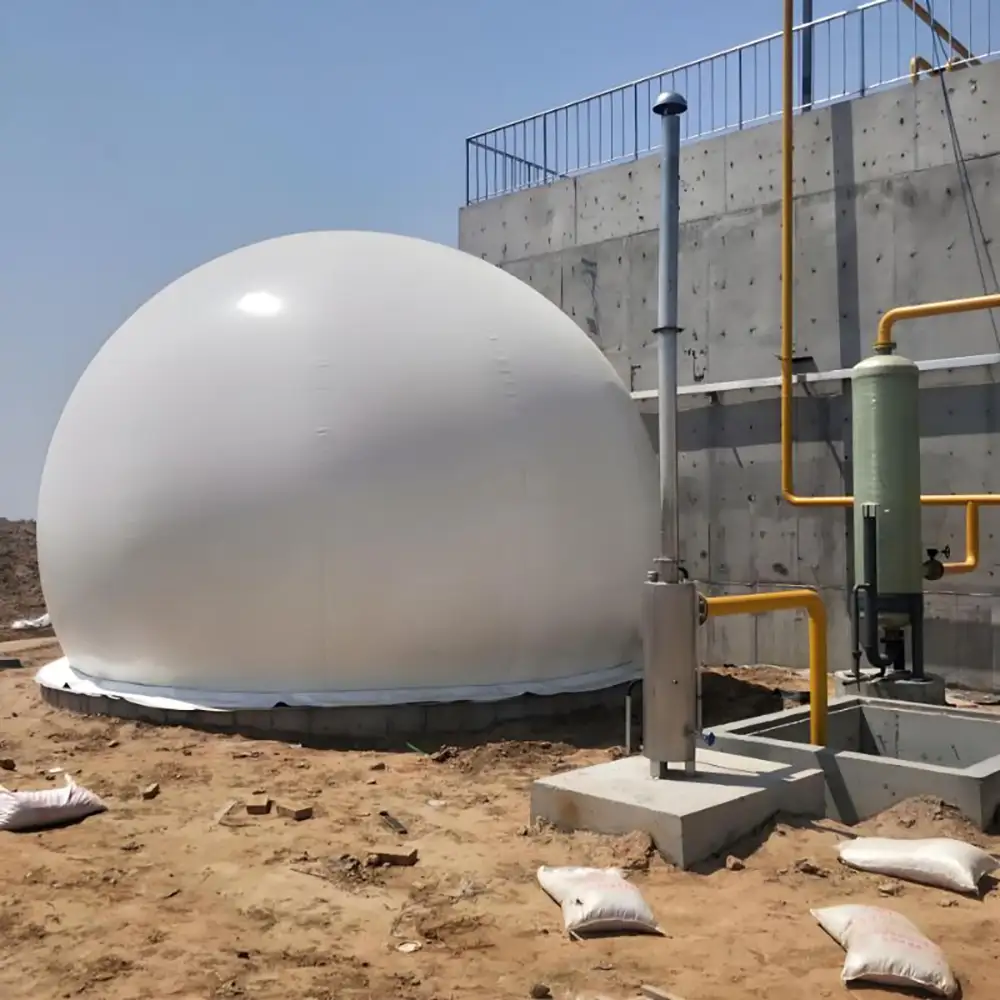
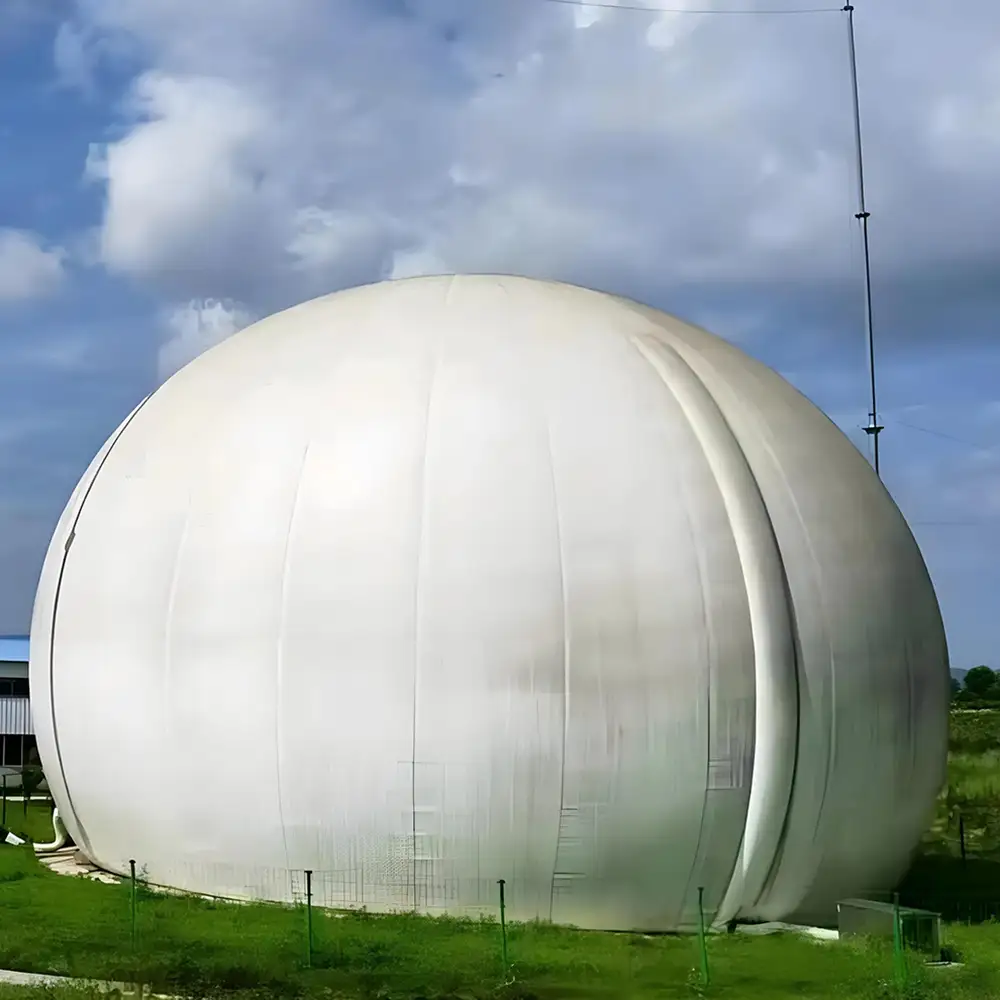
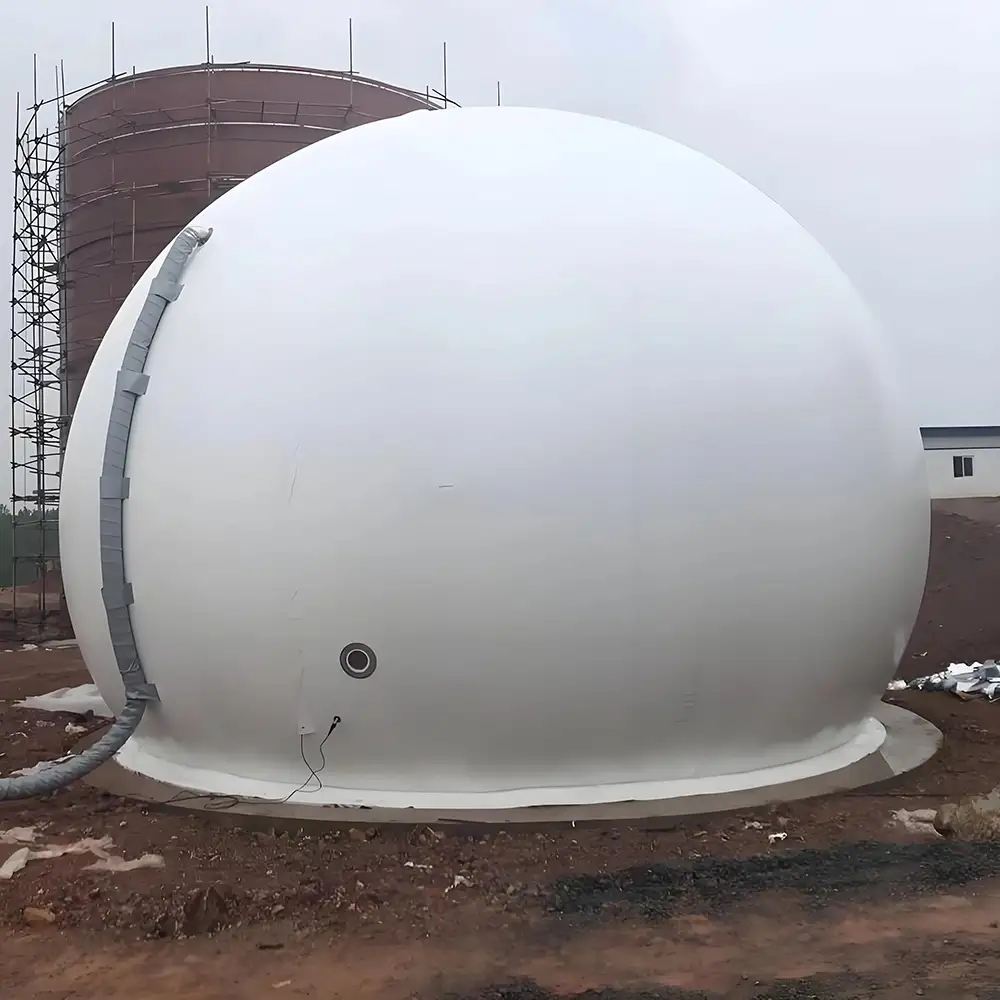
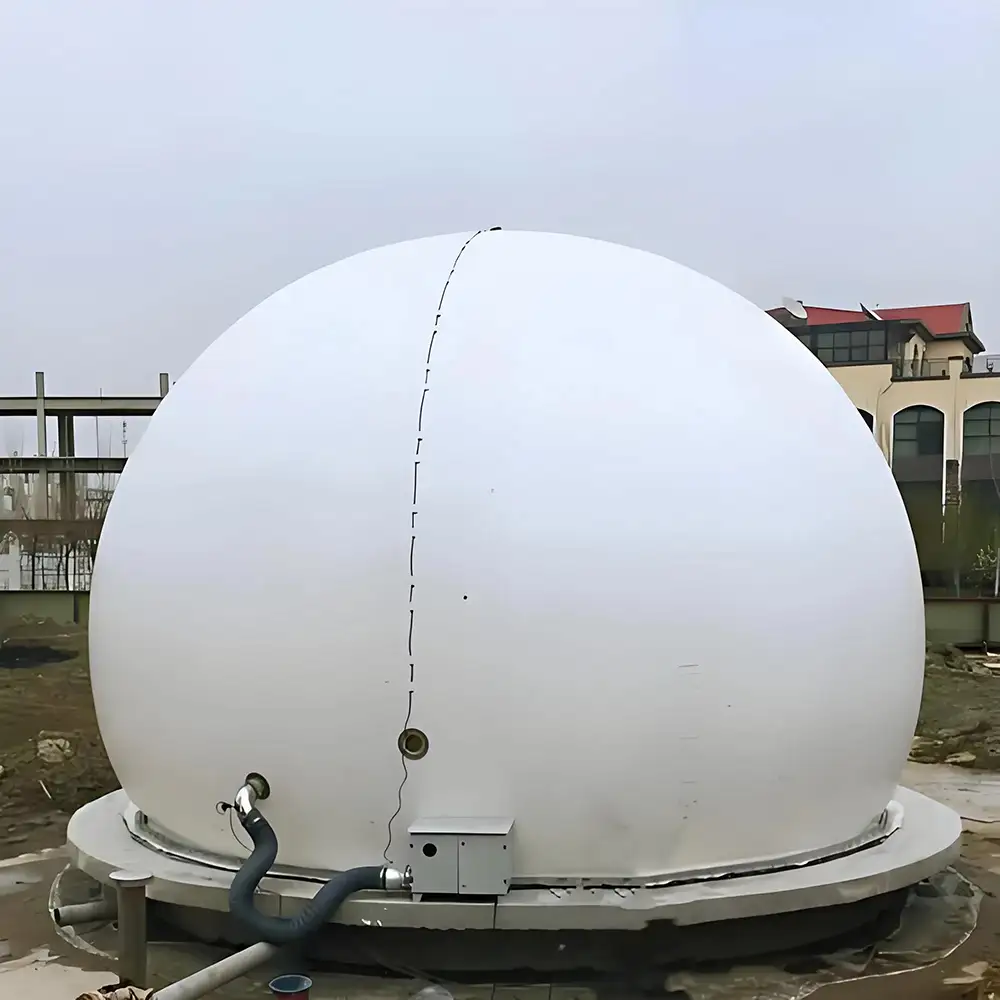
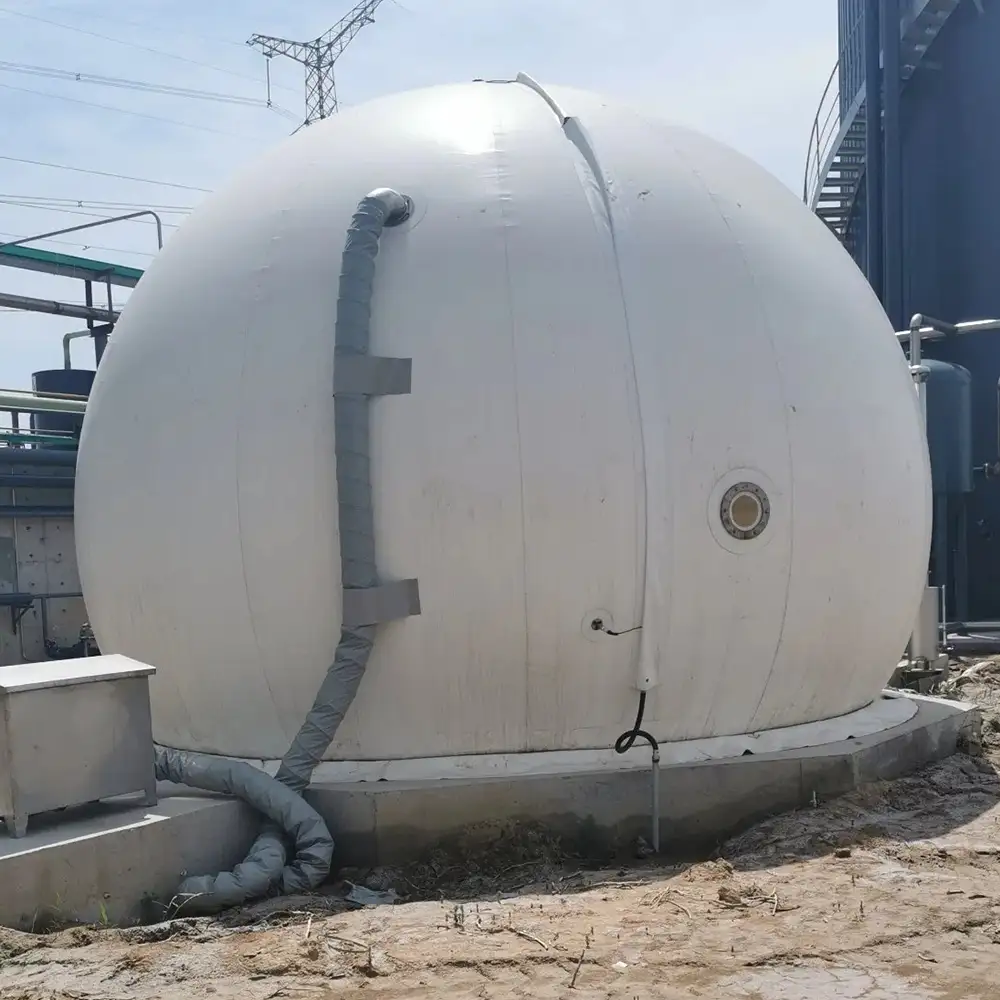
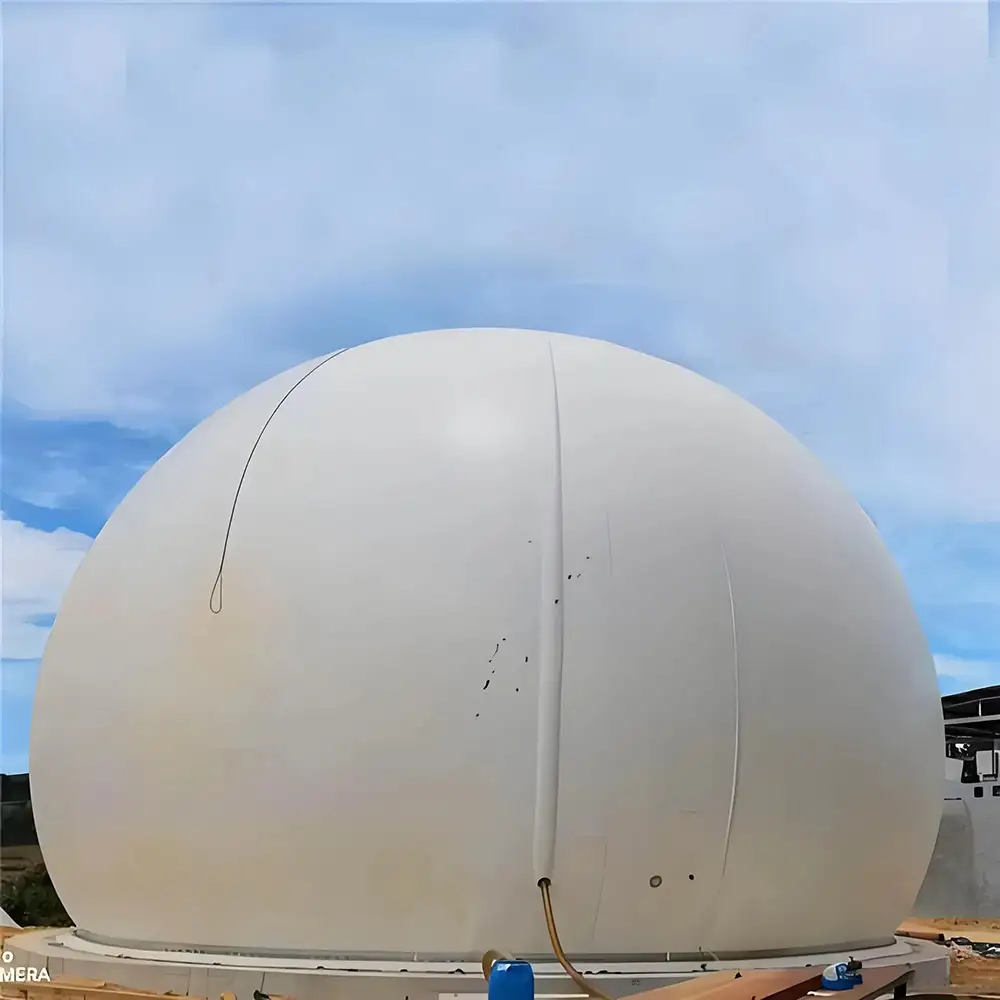
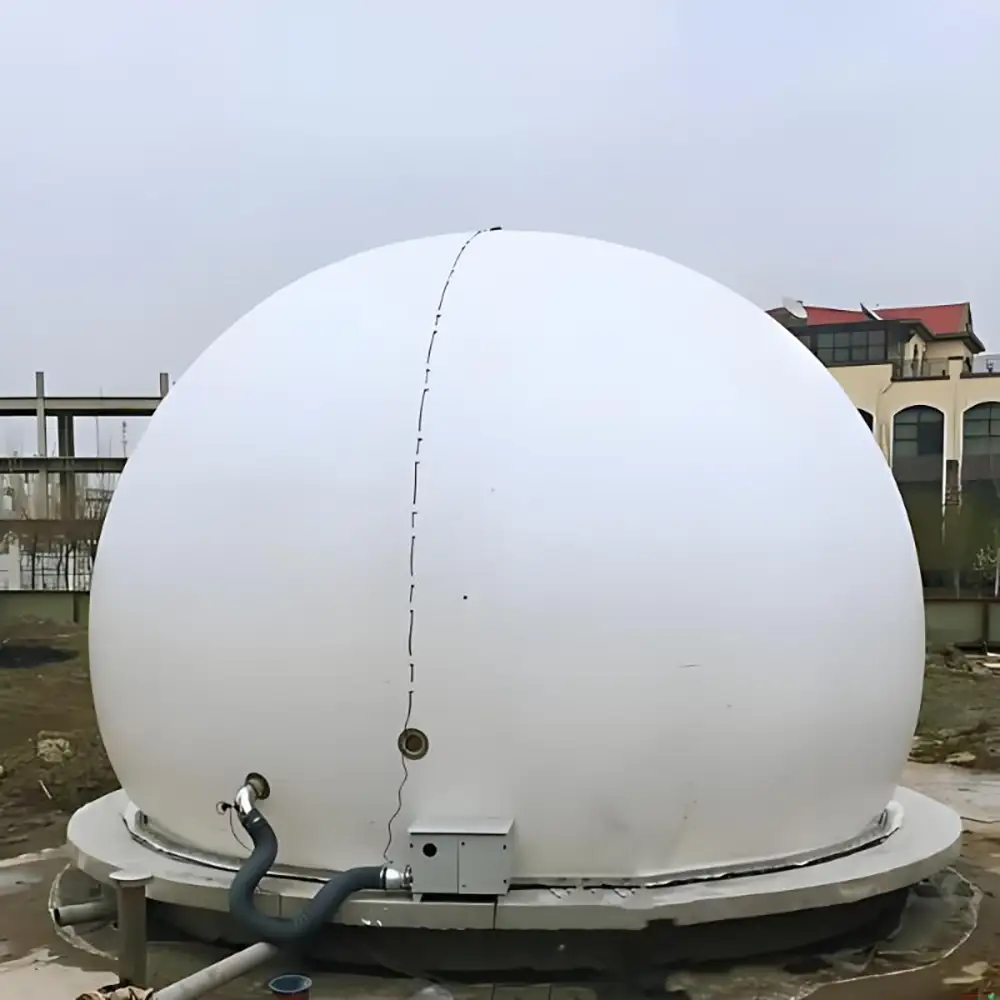
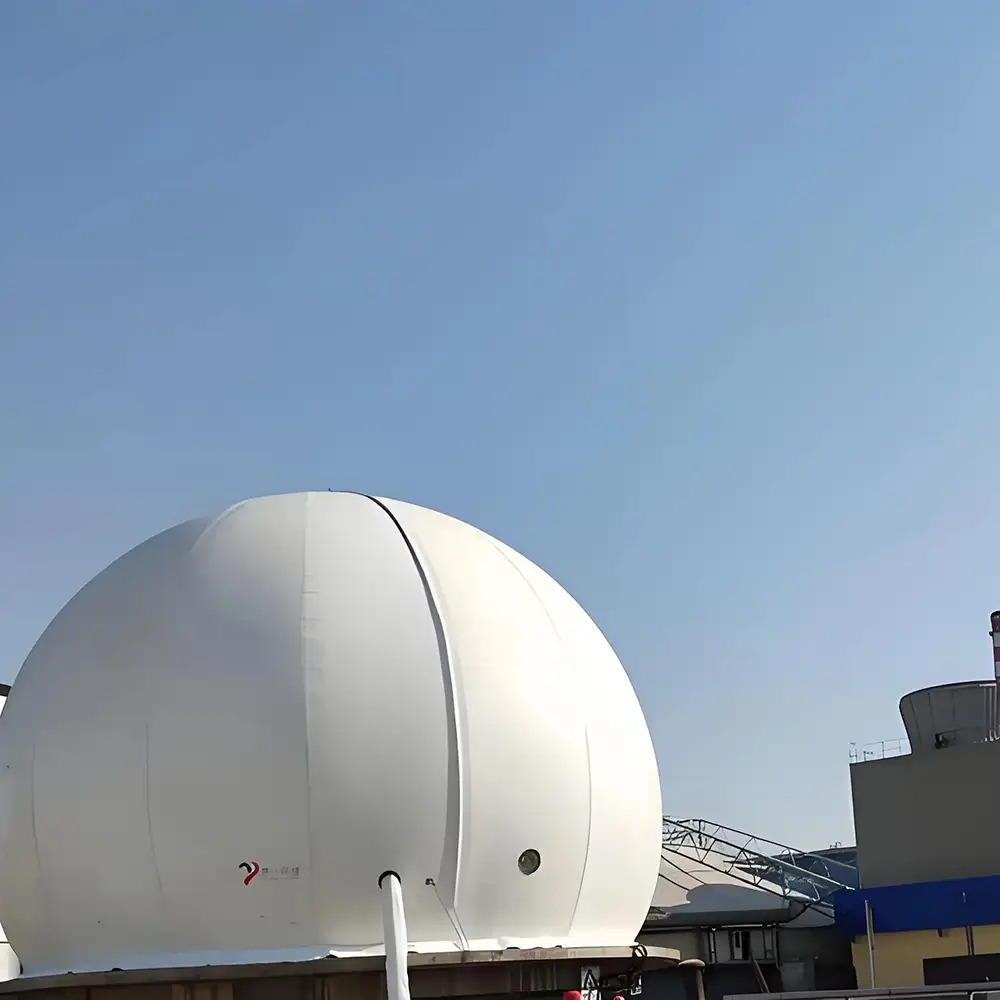
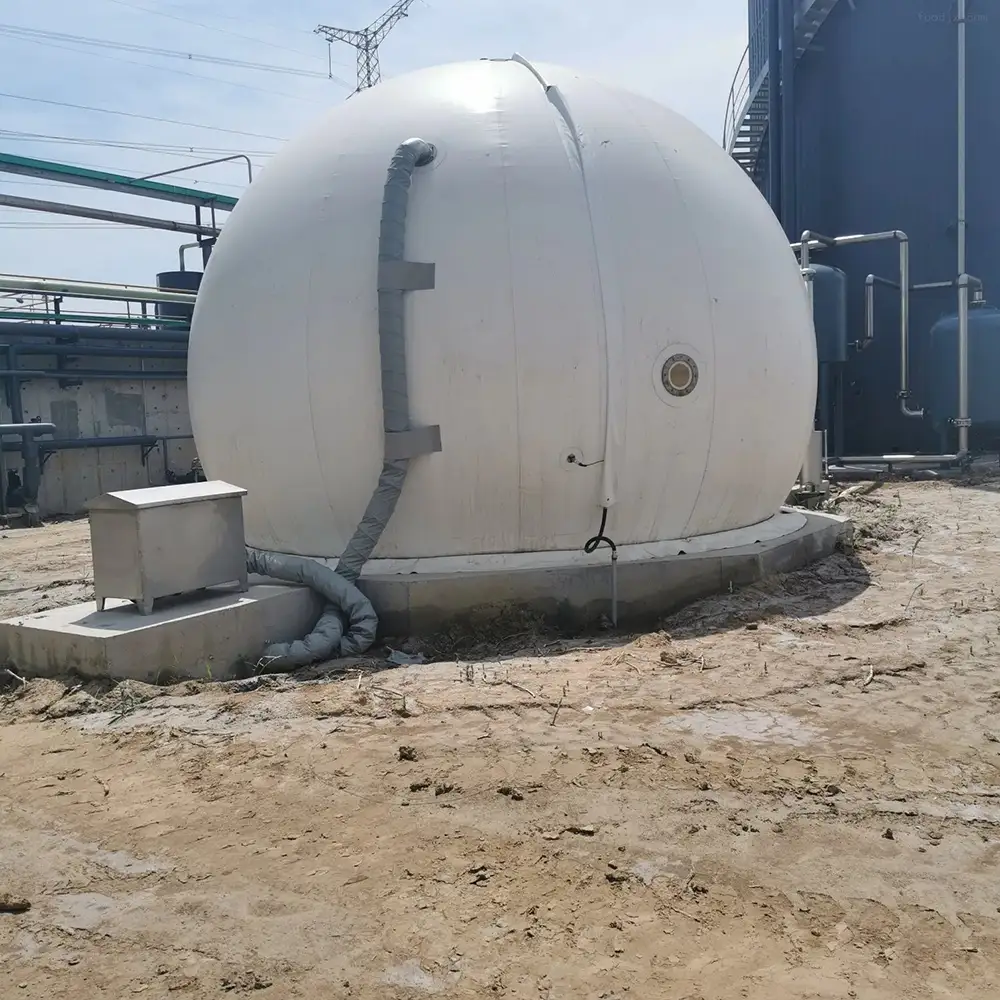
The double membrane gas cabinet is mainly composed of three parts: outer membrane, inner membrane and bottom membrane. The inflatable outer membrane forms a protective shell. Even in strong winds, rain and snow, the outer membrane can continue to bear pressure and maintain rigidity; the inner membrane is used to store biogas, and automatically shrinks and expands according to the amount of gas stored; the bottom membrane is laid flat in civil construction Basically, the biogas is completely sealed between the inner membrane and the bottom membrane
Biogas Storage Cabinet Double Membrane Gas Cabinet Biogas Utilization
The gas cabinet comes with a set of overpressure protection devices to prevent overpressure in the gas cabinet in an emergency. Antifreeze can be added to the water seal to meet the needs of severe cold conditions. Stainless steel guide rails and H-ilti expansion bolts are used for on-site positioning and installation without pre-embedding, which is conducive to civil construction and installation is quick and fast.
The Biogas Double Membrane Gas Storage Cabinet is a flexible gas storage solution designed for biogas plants, anaerobic digestion systems, wastewater treatment facilities, agricultural projects, organic waste treatment, and biogas utilization applications. It provides temporary storage for biogas generated during anaerobic digestion and helps balance fluctuations between gas production and downstream consumption.
Biogas generation is not always constant. Feedstock characteristics, digestion conditions, organic loading, temperature, retention time, and biological activity can influence the amount of gas produced. At the same time, gas consumption from generators, boilers, heating systems, or upgrading equipment can vary according to operating schedules.
A double membrane gas storage cabinet provides a buffer between gas production and utilization. The inner membrane stores the biogas, while the outer membrane provides structural support and protection. The flexible structure allows the stored gas volume to change according to actual production and consumption.
Double Membrane Biogas Storage Design
The double membrane structure is designed around two primary membrane layers. The inner membrane functions as the gas storage chamber, while the outer membrane maintains the overall shape of the cabinet and helps protect the internal membrane from environmental exposure.
This configuration provides a flexible alternative to rigid gas storage equipment. As biogas enters the storage cabinet, the inner membrane expands. When gas is supplied to downstream equipment, the stored volume decreases.
The system can be designed with suitable pressure management, gas pipelines, monitoring equipment, safety devices, and other auxiliary components according to project requirements.
Biogas Storage For Anaerobic Digestion
Anaerobic digestion converts biodegradable organic material into biogas under oxygen-limited conditions. Common feedstocks include livestock manure, agricultural residues, food waste, organic wastewater, and other suitable biodegradable materials.
The resulting biogas typically contains methane and carbon dioxide, along with moisture, hydrogen sulfide, and other trace components.
The double membrane gas cabinet can be installed downstream of an anaerobic digester to temporarily store the generated gas before it is purified, upgraded, or utilized.
Gas storage can help provide a more stable supply to downstream equipment when production and consumption fluctuate.
Biogas Utilization System
Biogas storage is an important part of many biogas utilization systems. Stored biogas can be supplied to suitable downstream equipment according to the quality and composition of the gas.
Potential applications include:
Biogas Power Generation
Boiler Fuel
Industrial Heating
Combined Heat And Power
Gas Upgrading
Biomethane Production
Agricultural Energy Systems
Before utilization, biogas may require desulfurization, dehydration, filtration, cooling, or other conditioning. The appropriate treatment depends on gas composition and the requirements of the downstream equipment.
Agricultural And Livestock Applications
Livestock farms and agricultural facilities can generate biogas from manure and other organic residues through anaerobic digestion.
The double membrane gas storage cabinet can be integrated with farm digesters, manure treatment systems, biogas purification equipment, and gas utilization equipment.
For agricultural projects, the storage system can provide a buffer between continuous or semi-continuous biogas production and gas consumption from generators, boilers, or heating systems.
Storage volume should be selected according to actual gas production, consumption patterns, and project requirements.
Wastewater Treatment Applications
Anaerobic wastewater treatment can generate biogas when wastewater contains suitable biodegradable organic matter.
The storage cabinet can temporarily store the resulting biogas before it is sent to a gas purification system or utilization equipment.
Potential applications include wastewater treatment plants, food processing facilities, agricultural wastewater systems, and industrial wastewater projects.
Wastewater characteristics such as organic concentration, pH, temperature, suspended solids, salinity, and potentially inhibitory compounds should be evaluated when designing the complete anaerobic treatment and gas storage system.
Flexible Gas Storage Capacity
Gas storage capacity is an important consideration when designing a biogas utilization system. The required capacity depends on gas production, gas consumption, peak demand, operating schedule, and desired buffering time.
A properly sized storage cabinet can help absorb short-term differences between gas production and utilization.
For example, if a digester produces more biogas than the generator consumes at a particular time, the excess gas can temporarily enter the storage cabinet. When demand increases, stored gas can be supplied to the utilization system.
This operating flexibility can help improve coordination between the digestion and energy utilization processes.
Gas Pressure Management
Appropriate pressure management is essential for flexible gas storage. The actual operating pressure depends on membrane design, gas utilization equipment, pipeline configuration, and pressure control components.
The cabinet can be integrated with appropriate pressure monitoring and control devices to help maintain stable gas delivery.
Pressure protection, emergency systems, gas monitoring, and other safety equipment should be selected according to the complete project design and applicable regulations.
Outdoor Installation
Double membrane biogas storage cabinets can be designed for outdoor installation. The membrane materials and supporting components should be selected according to the local environment.
Important considerations may include ultraviolet exposure, temperature changes, wind, rainfall, humidity, and installation conditions.
Proper foundation preparation, anchoring, drainage, ventilation, and routine inspection are important for long-term system reliability.
Biogas Purification Integration
The gas storage cabinet can be connected with upstream and downstream gas treatment equipment.
Depending on the gas quality and final utilization method, biogas may require:
Desulfurization
Dehydration
Filtration
Cooling
Pressure Regulation
Gas Upgrading
Hydrogen sulfide can affect certain gas utilization equipment, while moisture can create problems in pipelines and equipment. Appropriate gas conditioning should therefore be considered as part of the overall biogas system.
The gas storage cabinet is designed for storage and should not be considered a replacement for gas purification equipment when treatment is required.
Biogas Power Generation
Biogas generators are a common utilization method for methane-rich biogas. A storage cabinet can provide a buffer between the anaerobic digester and the gas engine generator.
When gas production changes during normal plant operation, stored biogas can help maintain a more flexible gas supply to the generator.
The generator manufacturer's requirements should be considered when determining the necessary gas cleaning and conditioning system.
A complete system may include anaerobic digestion, gas storage, desulfurization, dehydration, filtration, gas engine generation, electrical control, and heat recovery equipment.
Industrial And Commercial Biogas Projects
The double membrane gas cabinet can be used in industrial and commercial projects where anaerobic digestion produces biogas for energy recovery or other utilization.
Potential applications include food processing plants, agricultural facilities, organic waste treatment plants, wastewater treatment facilities, and industrial production sites.
The system can be configured as part of a larger biogas project according to gas production, storage requirements, site conditions, and final utilization.
B2B Project Configuration
Every biogas project has different feedstock, gas production, storage, and utilization requirements. Therefore, gas storage equipment should be selected based on actual project data rather than using a standard configuration for every application.
Important information can include expected biogas production, digester capacity, gas composition, required storage volume, gas consumption, installation location, climate conditions, and downstream utilization equipment.
Customers can provide project drawings, process information, site conditions, or existing system specifications for technical evaluation.
Safety And Maintenance
Biogas is combustible and may contain hydrogen sulfide and other components that require appropriate safety management.
Depending on the project, suitable safety equipment may include gas detection, pressure monitoring, pressure protection, ventilation, flame protection, emergency shutdown, and other appropriate devices.
Routine inspection should cover membrane condition, structural components, anchoring, gas pipelines, valves, pressure devices, and safety equipment.
Following appropriate operating and maintenance procedures helps support reliable long-term performance.
Key Features
Double Membrane Biogas Storage Design
Flexible Gas Storage Capacity
Suitable For Biogas Utilization
Compatible With Anaerobic Digestion Systems
Suitable For Biogas Plants
Inner Gas Storage Membrane
Outer Protective Membrane
Suitable For Agricultural Biogas Projects
Suitable For Wastewater Treatment Applications
Compatible With Biogas Purification Systems
Suitable For Biogas Power Generation
Project-Based Configuration
Main Applications
Biogas Plants
Anaerobic Digestion Systems
Biogas Utilization Projects
Agricultural Biogas Systems
Livestock Manure Treatment
Wastewater Treatment
Organic Waste Treatment
Food Waste Anaerobic Digestion
Industrial Biogas Projects
Biogas Power Generation
Biogas Heating Systems
Biogas Upgrading Projects
FAQs
1. What Is A Biogas Double Membrane Gas Storage Cabinet?
It is a flexible gas storage system designed to temporarily store biogas generated by anaerobic digestion. It uses an inner gas storage membrane and an outer protective membrane.
2. What Does The Inner Membrane Do?
The inner membrane provides the storage space for the biogas. Its volume changes as gas enters or leaves the storage system.
3. What Is The Purpose Of The Outer Membrane?
The outer membrane supports the overall structure and provides additional protection for the inner gas storage membrane against environmental exposure.
4. Can It Be Used With An Anaerobic Digester?
Yes. The storage cabinet can be connected to suitable anaerobic digesters and used as a buffer between biogas production and downstream utilization.
5. Can It Be Used For Biogas Power Generation?
Yes. It can provide temporary gas storage before a suitable biogas generator. Gas purification and conditioning should be provided according to the generator requirements.
6. Can It Be Used On Livestock Farms?
Yes. It can be integrated into agricultural biogas systems that process livestock manure and other suitable organic materials.
7. Can It Store Wastewater Biogas?
Yes. It can be used with suitable anaerobic wastewater treatment systems. The gas composition and treatment requirements should be evaluated for each project.
8. Does Biogas Need To Be Purified?
The required treatment depends on the gas composition and downstream application. Desulfurization, dehydration, filtration, or other conditioning may be required.
9. How Is The Storage Capacity Selected?
Capacity depends on expected biogas production, gas consumption, peak demand, desired storage duration, and the operating characteristics of the complete biogas plant.
10. What Information Is Needed For A Project Quotation?
Please provide expected biogas production, digester capacity, required storage volume, gas composition if available, utilization method, installation location, climate conditions, and project drawings or technical specifications.
Why Choose Us
Professional Biogas Storage Solutions
We provide double membrane gas storage solutions for anaerobic digestion, agricultural biogas, wastewater treatment, organic waste, and industrial biogas utilization projects.
Flexible Double Membrane Technology
The inner and outer membrane structure provides flexible gas storage with structural support and environmental protection for suitable biogas applications.
Complete Biogas Utilization Integration
The storage cabinet can be connected with gas purification, dehydration, desulfurization, generators, boilers, gas upgrading systems, and other downstream equipment.
Project-Based Configuration
We evaluate gas production, storage requirements, utilization patterns, installation conditions, and site requirements to help determine an appropriate storage configuration.
Technical Support
We support international customers with technical communication, project configuration, drawings, equipment coordination, documentation, export packaging, and shipping arrangements.
Practical Biogas Project Solutions
Our gas storage systems are suitable for agricultural, wastewater, organic waste, industrial, and renewable energy projects where flexible biogas storage and utilization are required.
Prev:
Flexible Double Membrane Biogas Storage Tank Biogas Project Double Membrane Gas Tank Biogas Plant
Next:
Biogas Pool/Biogas Generator/Biogas Storage/Fully Sealed Welded Tank/PVDF/Anti-Oxidation
TAG:
Agricultural Biogas Storage,
Industrial Biogas Storage,
Biogas Utilization System,
Biogas Utilization Equipment,
Biogas Gas Holder,
Biogas Storage System,
Biogas Gas Storage Tank,
Organic Waste Biogas Storage,
Biogas Project Gas Storage,
Biogas Power Generation Storage,
Biogas Generator Gas Storage,
Double Membrane Gas Holder,
Biogas Storage Equipment,
Livestock Biogas Storage,
Wastewater Biogas Storage,
Flexible Biogas Gas Holder,
Double Membrane Biogas Tank,
Anaerobic Digestion Gas Storage,
Biogas Plant Gas Storage,
Anaerobic Digester Gas Holder,
Biogas Plant Storage Cabinet,
Biogas Plant Gas Cabinet,
Flexible Biogas Storage,
Double Membrane Gas Storage System,
Biogas Gas Storage Equipment,
Biogas Gas Storage Cabinet,
Double Membrane Biogas Storage,
Biogas Storage Cabinet,
Biogas Double Membrane Gas Storage Cabinet,
Double Membrane Gas Cabinet,
Related Category:
Biogas Double Membrane Gas Storage Cabinet, Biogas Storage Cabinet, Double Membrane Gas Cabinet, Double Membrane Biogas China, suppliers, manufacturers, factory, customized, wholesale, quotation, made in China