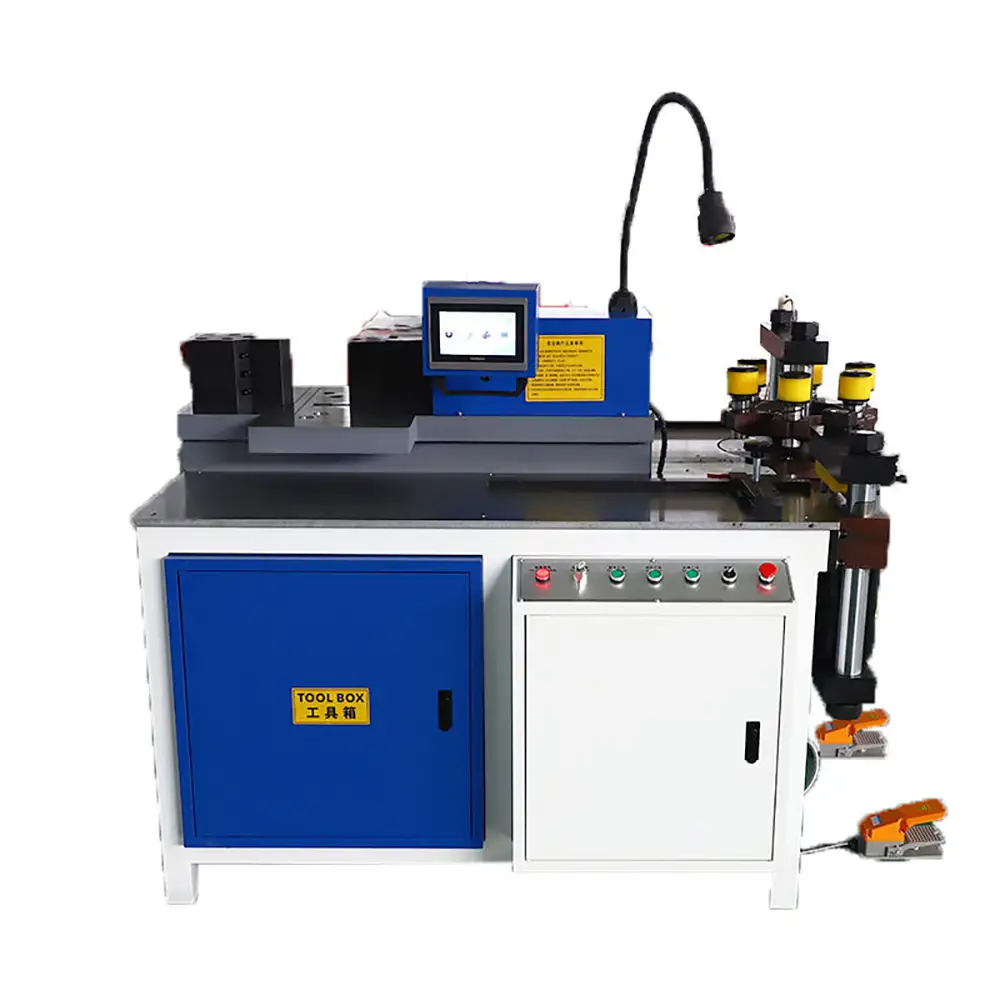
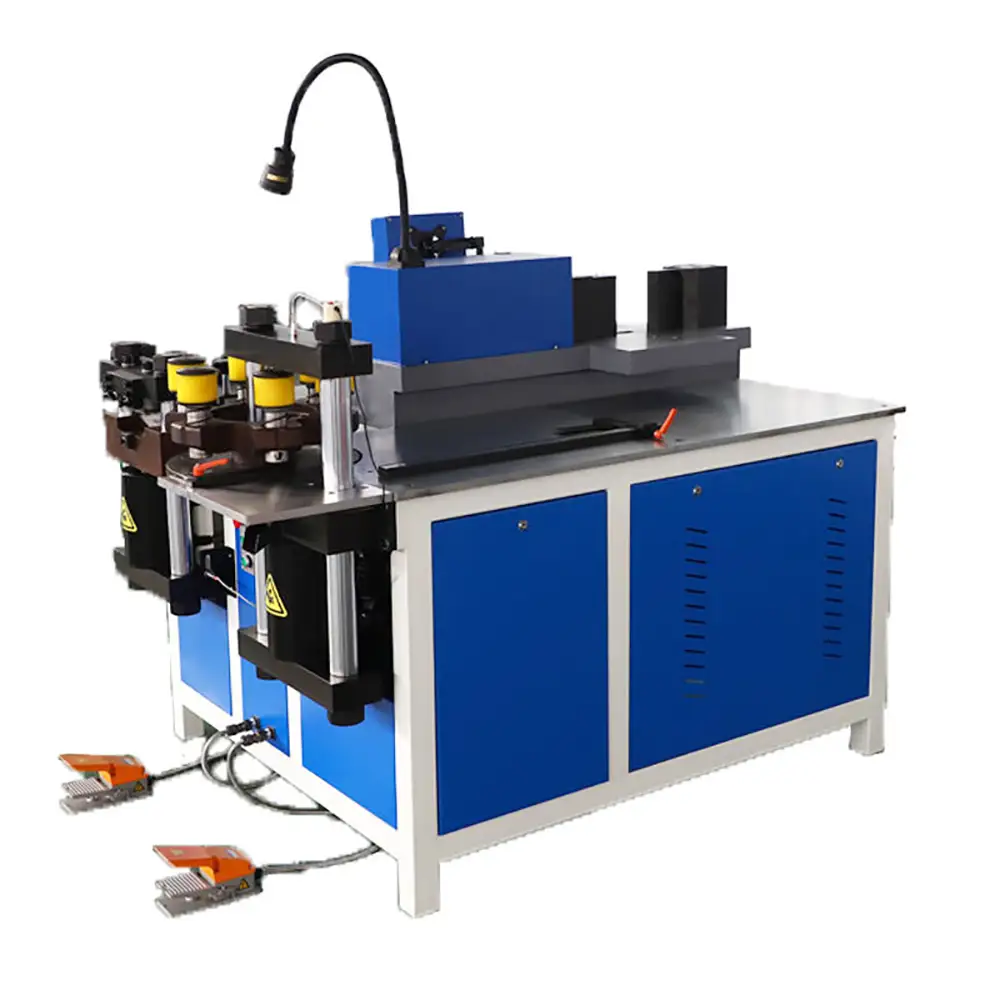
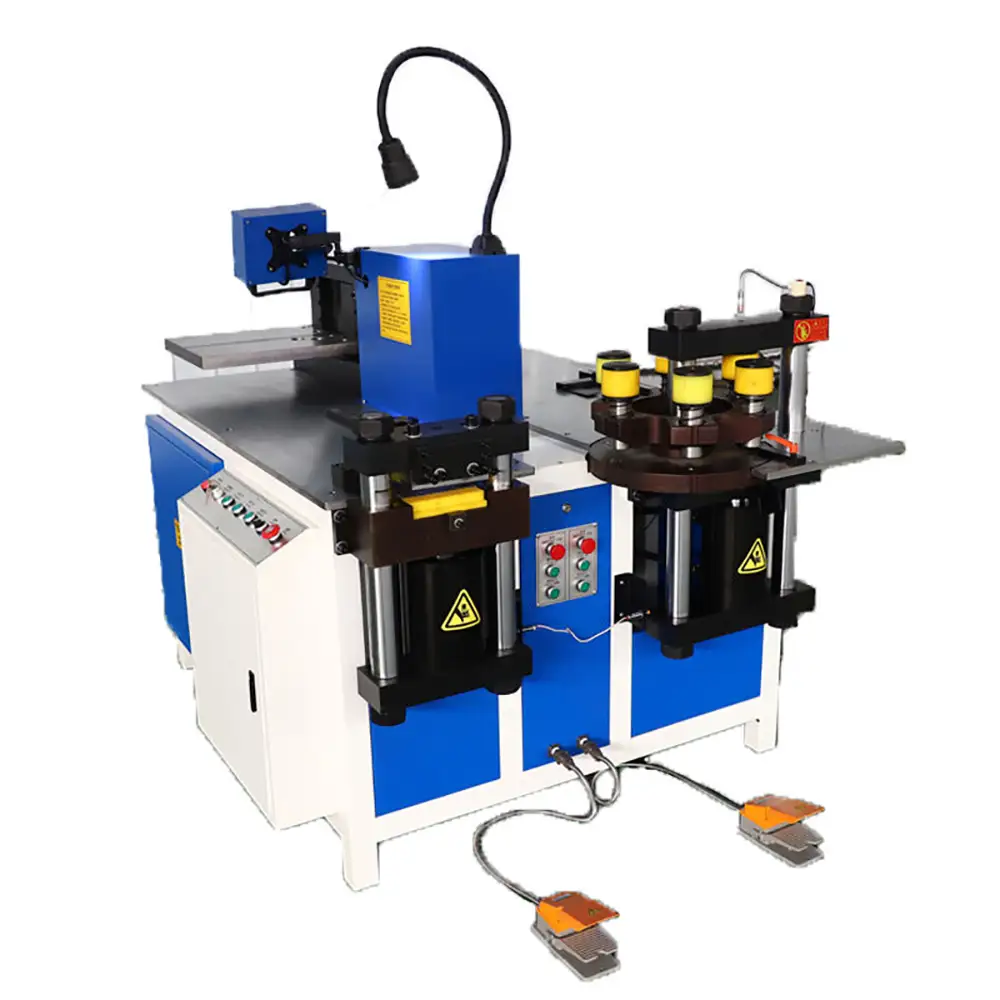
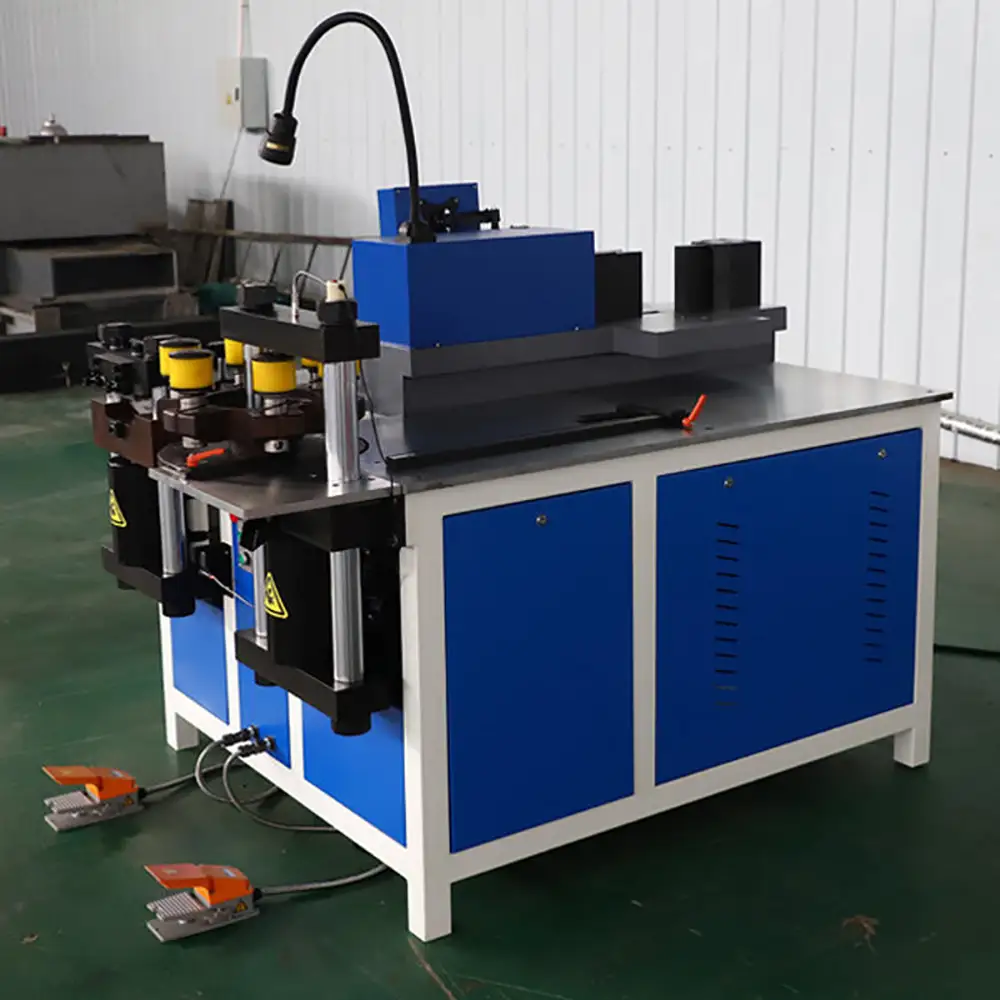
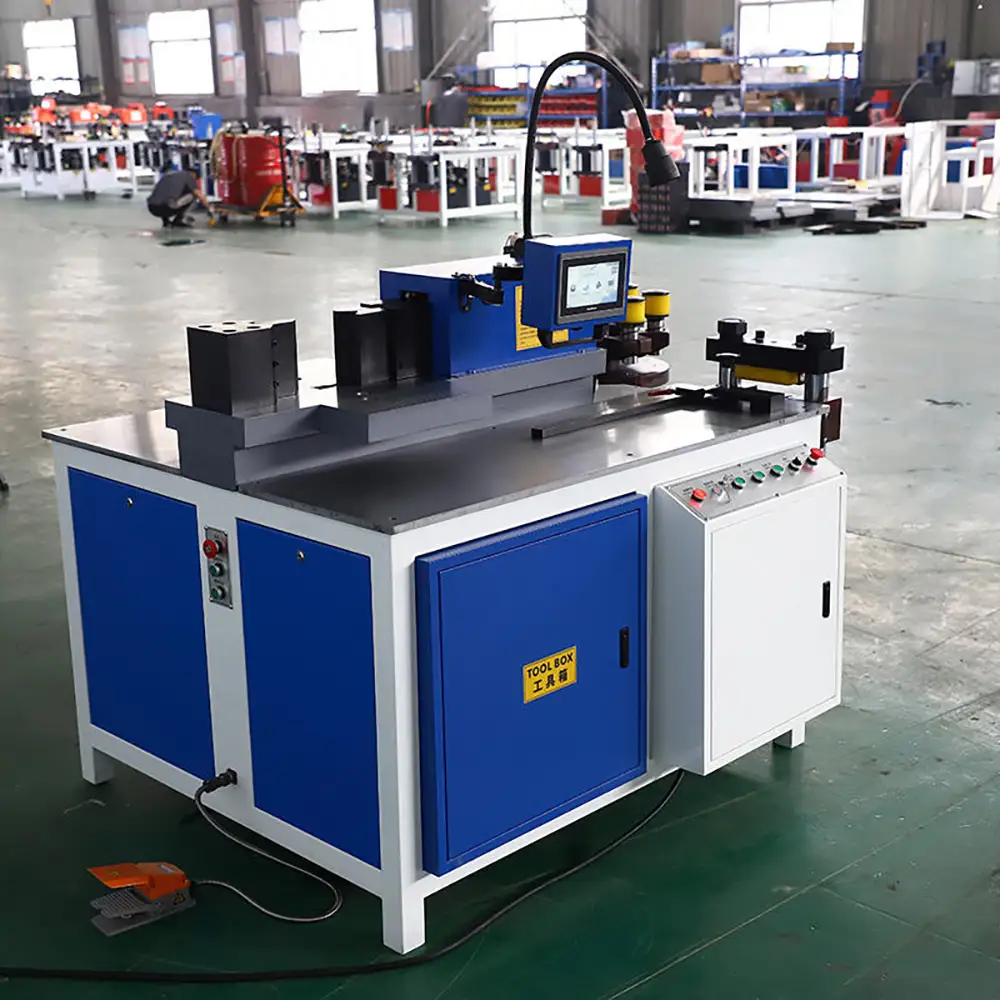
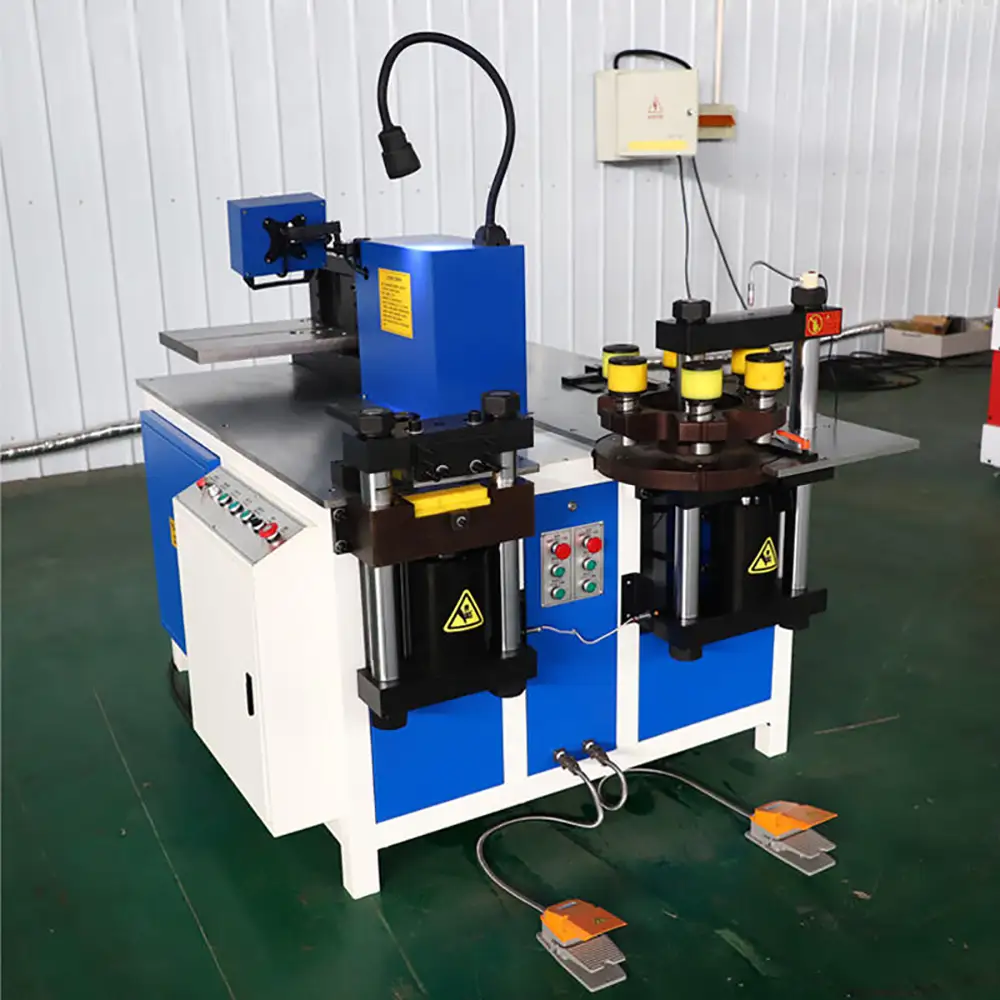
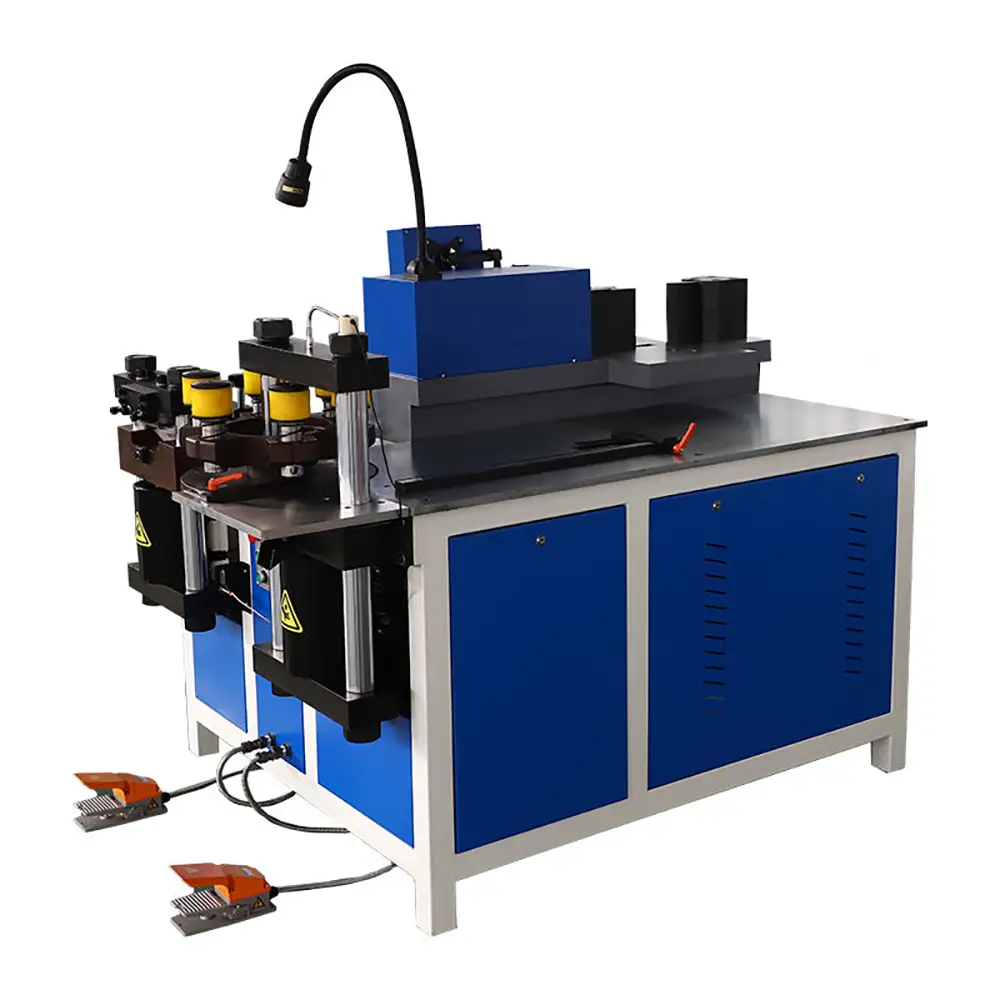
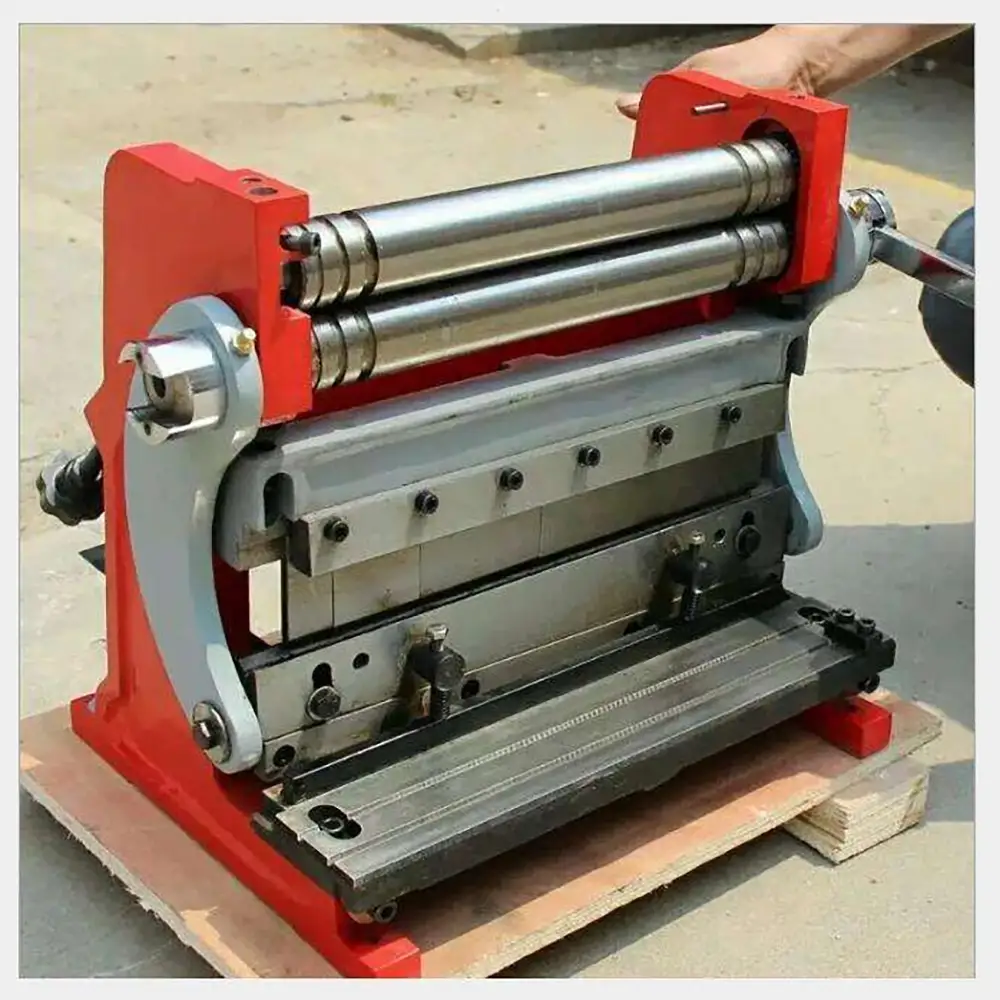
CNC Busbar Shearing Bending Punching Machine Copper Aluminum Busbar Processing Machine
Multifunctional busbar machine, CNC copper bar processing machine, busbar machine, three in one open punching and bending closed copper plate machine.Customized consultation with sellers.The busbar processing machine is used for punching, shearing, and bending copper bars
|
Maximum punching force (kn) |
400 |
|
Punching processing range(mm) |
OD 4.3-36 |
|
Max. Thickness (mm) |
16mm |
|
Max. Width (mm) |
160mm |
|
Maximum shear force (KN) |
500 |
|
Maximum shear width(mm) |
160 |
|
Max. Shearing Thickness (mm) |
16 |
|
Maximum bending force(KN) |
400 |
|
Maximum bending width(mm) |
160 |
|
Maximum bending thickness(mm) |
16 |
|
Bend width(mm) |
30-100 |
|
Bend U shape minimum width (mm) |
50 |
|
Dimension(mm) |
1780*1400*1200 |
|
Work table dimension(mm) |
1400*1250*1200 |
|
Main motor power(kw) |
3*4kw |
|
Machine weight(T) |
1.5 |
The 3-in-1 Copper Busbar Cutting Punching Bending Busbar Processing Machine is an integrated solution designed for efficient fabrication of copper busbars used in electrical distribution systems, switchgear, control cabinets, transformers, power equipment, and industrial electrical assemblies. By combining busbar cutting, punching, and bending operations into one machine, it helps manufacturers reduce material handling, simplify production workflows, and improve consistency across repeated busbar fabrication jobs.
Copper busbars are widely used as electrical conductors because of their excellent electrical conductivity, thermal performance, and mechanical properties. However, producing finished busbars often requires several separate operations, including cutting the raw bar to length, creating mounting holes or slots, and forming the bar into precise angles or shapes. A 3-in-1 busbar processing machine integrates these core processes into one production platform, making it suitable for electrical panel manufacturers, switchgear factories, power distribution equipment suppliers, and custom electrical fabrication businesses.
Integrated Cutting, Punching and Bending
The main advantage of this machine is its multifunctional design. Instead of transferring each copper busbar between separate machines, operators can perform three common fabrication processes using one integrated system.
1. Copper Busbar Cutting
The cutting function is designed to cut copper busbars to the required production length. Clean and controlled cutting is important because accurate dimensions help ensure proper assembly inside electrical cabinets and switchgear.
Depending on the machine configuration, different cutting tools and working ranges can be provided for various busbar sizes and thicknesses. The actual cutting capacity depends on the machine model, copper material, busbar dimensions, tooling, and operating conditions.
2. Copper Busbar Punching
The punching section creates holes, slots, and other required openings in copper busbars. These holes are commonly used for bolts, terminals, connectors, mounting points, and electrical assembly connections.
Accurate punching helps reduce secondary drilling work and improves production efficiency. Tooling can be selected according to the required hole diameter, busbar dimensions, and application.
3. Copper Busbar Bending
The bending function forms copper busbars into straight, angled, offset, or customized configurations required by electrical equipment designs. Controlled bending is particularly important when busbars must fit into compact switchgear, distribution cabinets, or control panels.
Proper tooling and bending parameters help achieve repeatable forming results while minimizing unnecessary deformation of the copper bar.
Designed for Copper Busbar Fabrication
Copper is commonly selected for busbar applications because of its high electrical conductivity and good heat dissipation characteristics. However, copper busbars can be relatively thick and rigid, making dedicated processing equipment valuable for efficient fabrication.
A 3-in-1 busbar machine can process different copper busbar specifications depending on its rated capacity and tooling configuration. Manufacturers can select suitable machine specifications according to busbar width, thickness, required hole patterns, bending radius, production volume, and finished-product dimensions.
For projects requiring aluminum busbar processing, a suitable machine configuration and tooling should be confirmed separately because aluminum and copper have different mechanical characteristics.
Efficient Electrical Manufacturing Workflow
Traditional busbar fabrication may require a cutting machine, punching machine, and bending machine. Moving workpieces between multiple machines increases handling time and may introduce dimensional inconsistencies.
An integrated busbar processing machine simplifies the workflow:
Measure → Cut → Punch → Bend → Inspect → Assemble
This process can reduce unnecessary material handling and make it easier to organize production orders. For repetitive electrical cabinet and switchgear components, standardized tooling and production parameters can also improve repeatability.
Applications
The 3-in-1 copper busbar processing machine is suitable for many electrical manufacturing applications, including:
Electrical Distribution Cabinets
Switchgear Manufacturing
Control Panel Production
Power Distribution Equipment
Transformer Components
Industrial Control Cabinets
Low-Voltage Electrical Equipment
High-Voltage Electrical Assemblies
Busbar Trunking Systems
Power Supply Equipment
Electrical Connection Components
Custom Copper Busbar Fabrication
It can be used by electrical equipment manufacturers as well as specialized busbar processing service providers.
Production Accuracy and Repeatability
Busbar fabrication requires dimensional consistency because finished components often need to fit within predefined electrical cabinet layouts. Cutting length, hole position, bending angle, and overall shape can all affect final assembly.
A properly configured machine helps operators establish repeatable processing procedures. Depending on the control system and configuration, numerical settings can be used to manage processing parameters and simplify repeated production.
However, actual dimensional accuracy depends on machine construction, tooling condition, material characteristics, operator setup, and production requirements. For high-precision projects, customers should provide detailed busbar drawings or samples so the machine configuration can be evaluated before production.
Tooling and Customization
Different busbar products require different cutting blades, punching dies, bending tools, hole patterns, and forming configurations. Therefore, tooling selection is an important part of the machine specification.
Manufacturers can configure the machine according to:
Copper Busbar Width
Copper Busbar Thickness
Required Cutting Length
Hole Diameter
Hole Spacing
Punching Patterns
Bending Angles
Bending Radius
Production Volume
Automation Requirements
Control System
Custom Busbar Shapes
For OEM and custom projects, customers can provide technical drawings, product dimensions, sample workpieces, or production requirements for machine configuration.
Improving Busbar Production Efficiency
The integrated design is especially useful for workshops producing many different busbar configurations. Instead of investing in three separate processing machines, a multifunctional system provides the basic operations needed for common busbar fabrication work within one equipment platform.
This can help reduce floor-space requirements and simplify operator workflows. It can also make production scheduling easier because cutting, punching, and bending operations can be coordinated around the same workpiece.
For high-volume production, additional automation, positioning systems, feeding solutions, and customized tooling may be considered depending on the project requirements.
Quality Control
Reliable busbar fabrication requires both machine quality and process control. Before shipment, equipment can be checked for mechanical operation, tooling installation, electrical control functions, positioning, and processing performance according to the agreed specifications.
For customer projects, sample processing or testing can be arranged when appropriate. This allows the required cutting, punching, and bending operations to be evaluated before final production.
Customers should also establish incoming material inspection and finished-part inspection procedures to ensure copper busbars meet their electrical and dimensional requirements.
Operation and Maintenance
Routine maintenance helps maintain stable processing performance. Operators should regularly inspect cutting tools, punching dies, bending tools, fasteners, moving components, electrical connections, and lubrication points according to the machine manufacturer's instructions.
Copper chips and processing debris should be removed from the working area. Punching and cutting tools should be inspected for wear, while bending tooling should be checked for damage or deformation.
Operators should also follow appropriate electrical and machine safety procedures. Guards, emergency stops, grounding, two-hand controls, or other safety features may vary by machine configuration and local requirements.
OEM and B2B Supply
For electrical equipment manufacturers, purchasing a busbar processing machine is often part of a larger production project. Machine specifications should therefore be selected according to the actual busbar products, production capacity, workshop layout, and future expansion plans.
A professional supplier can provide machine configuration, tooling selection, technical documentation, sample testing, installation guidance, operator training, spare parts, and after-sales support according to the project.
The 3-in-1 Copper Busbar Cutting Punching Bending Busbar Processing Machine provides a practical solution for manufacturers looking to integrate essential busbar fabrication operations into one machine. Its combination of cutting, punching, and bending makes it suitable for electrical panel production, switchgear fabrication, power distribution equipment, and custom copper busbar manufacturing.
FAQs
1. What is a 3-in-1 copper busbar processing machine?
It is a multifunctional machine that combines copper busbar cutting, punching, and bending operations in one integrated system.
2. What materials can this machine process?
The machine is primarily designed for copper busbars. Aluminum processing may also be possible with a suitable configuration and tooling, which should be confirmed according to the specific machine model.
3. What are the main functions of the machine?
The three main functions are busbar cutting, busbar punching, and busbar bending.
4. What industries use copper busbar processing machines?
They are commonly used in switchgear, electrical cabinets, control panels, power distribution equipment, transformers, and industrial electrical manufacturing.
5. Can the machine make different hole patterns?
Yes. Suitable punching dies and positioning configurations can be selected for different hole diameters, spacing, and production requirements.
6. Can it bend copper busbars into different angles?
Yes. The bending function can be configured for different bending requirements. Actual bending capability depends on machine capacity, tooling, busbar dimensions, and material characteristics.
7. Can custom busbar shapes be produced?
Custom shapes can be produced when the machine configuration and tooling are suitable. Customers can provide drawings or samples for technical evaluation.
8. Does one machine replace three separate machines?
The 3-in-1 design combines the three core functions into one equipment platform, reducing the need to transfer workpieces between separate cutting, punching, and bending machines.
9. Is the machine suitable for high-volume production?
It can be used for repetitive and production-oriented busbar fabrication. For high-volume applications, automation and customized tooling can be considered according to production requirements.
10. Can the machine be customized?
Yes. Machine capacity, tooling, control system, working range, positioning, and other configurations can be customized depending on the project.
11. How do I choose the correct machine model?
Provide the copper busbar width, thickness, material, required hole sizes, bending requirements, production volume, and drawings if available. These details help determine a suitable configuration.
12. What information should I provide for a quotation?
Customers should provide busbar dimensions, material, cutting requirements, punching hole specifications, bending shapes or angles, desired production volume, and electrical requirements.
Why Choose Us
3-in-1 Integrated Processing – Combines cutting, punching, and bending operations in one machine to simplify busbar fabrication.
Copper Busbar Expertise – Designed around the common processing requirements of copper busbar manufacturers and electrical equipment factories.
Flexible Tooling Options – Punching dies, cutting tools, and bending tooling can be selected according to different production requirements.
B2B Customization – Machine specifications can be configured according to busbar dimensions, production volume, and application.
Efficient Production Workflow – Reduces repeated material handling between separate processing machines and helps streamline production.
Suitable for Electrical Manufacturing – Ideal for switchgear, control cabinets, distribution equipment, and industrial electrical applications.
OEM & ODM Support – Technical configurations can be developed for customized production requirements and special busbar applications.
Complete Project Support – Technical consultation, tooling recommendations, sample testing, documentation, spare parts, and after-sales support can be provided according to the project.
Prev:
Three Function Bending Cutting Rolling Multifunction Bender Metal Sheet Rolling Machine
Next:
Automatic Busbar Copper Aluminium Cutting Punching Bending Busbar Processing Machine
TAG:
Copper Bar Punching Machine,
Copper Bar Cutting Machine,
Copper Busbar Fabrication Equipment,
Busbar Processing Equipment,
Busbar Fabrication Equipment,
Busbar Punching And Bending Machine,
CNC Busbar Processing Machine,
Electrical Busbar Processing Machine,
Copper Busbar Machine,
Electrical Panel Busbar Machine,
Busbar Bending Equipment,
Automatic Copper Busbar Machine,
Industrial Busbar Processing Machine,
Switchgear Busbar Processing Machine,
Electrical Busbar Fabrication Machine,
Copper Busbar Manufacturing Machine,
Copper Busbar Bending Machine,
Copper Busbar Punching Machine,
Copper Busbar Processing Machine,
Copper Busbar Fabrication Machine,
Busbar Bending Machine,
Busbar Punching Machine,
Busbar Fabrication Machine,
Automatic Busbar Processing Machine,
Copper Busbar Cutting Machine,
Busbar Cutting Machine,
Busbar Cutting Punching Bending Machine,
3-in-1 Busbar Processing Machine,
Related Category:
Copper Busbar Processing Machine,Busbar Cutting Punching Bending Machine,Copper Busbar Cutting Machine,Copper Busbar Pun China, suppliers, manufacturers, factory, customized, wholesale, quotation, made in China