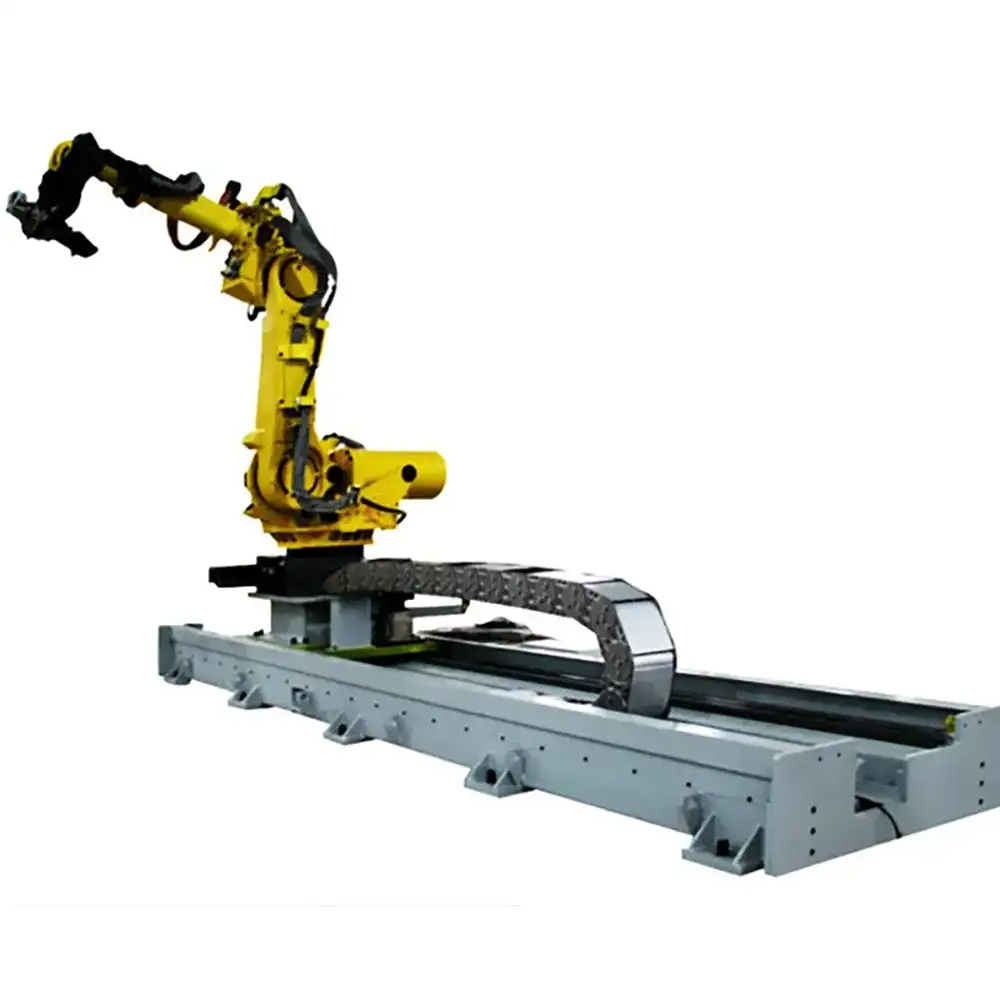
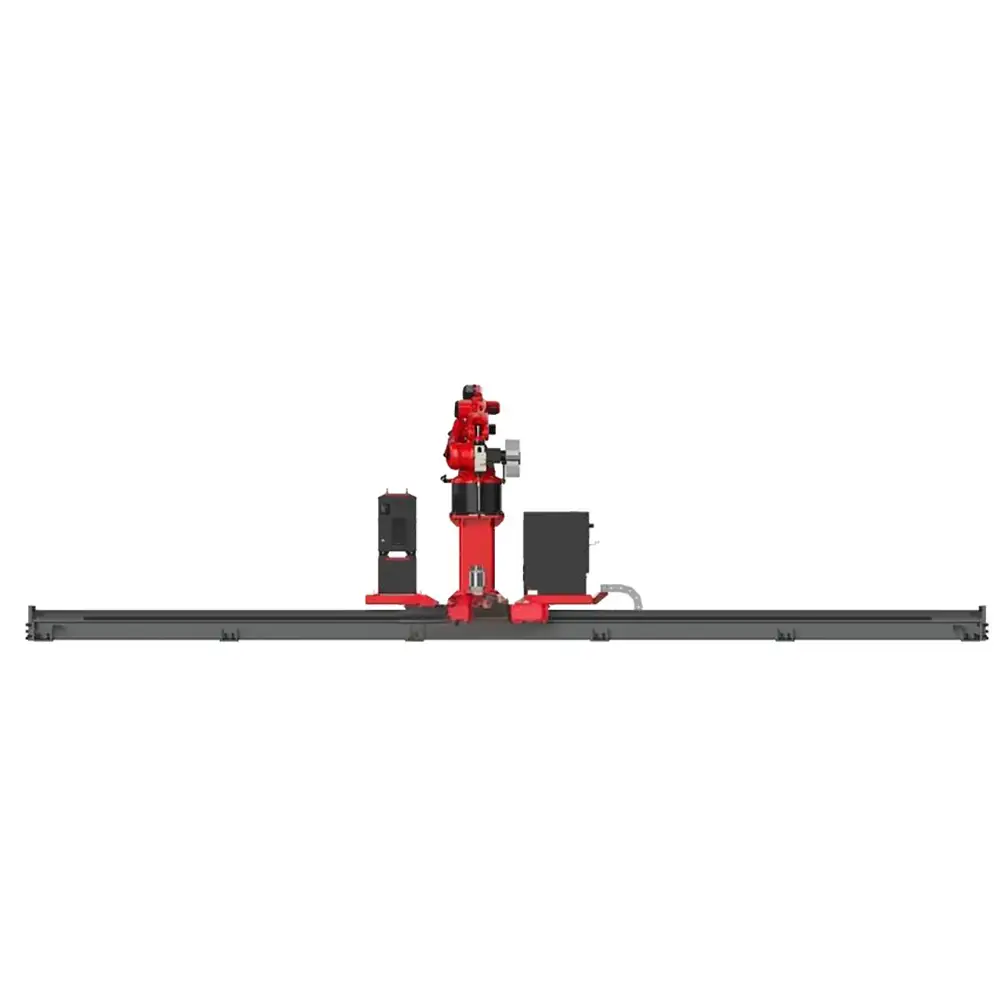
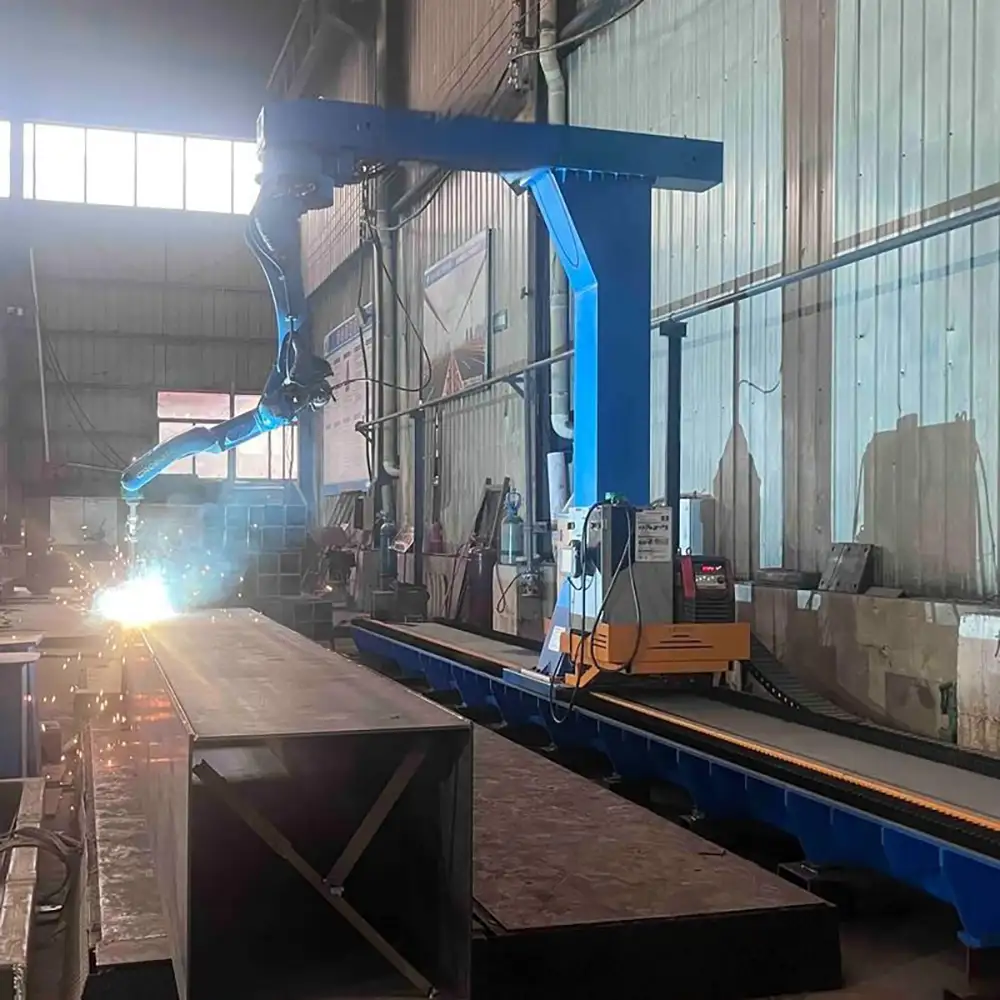
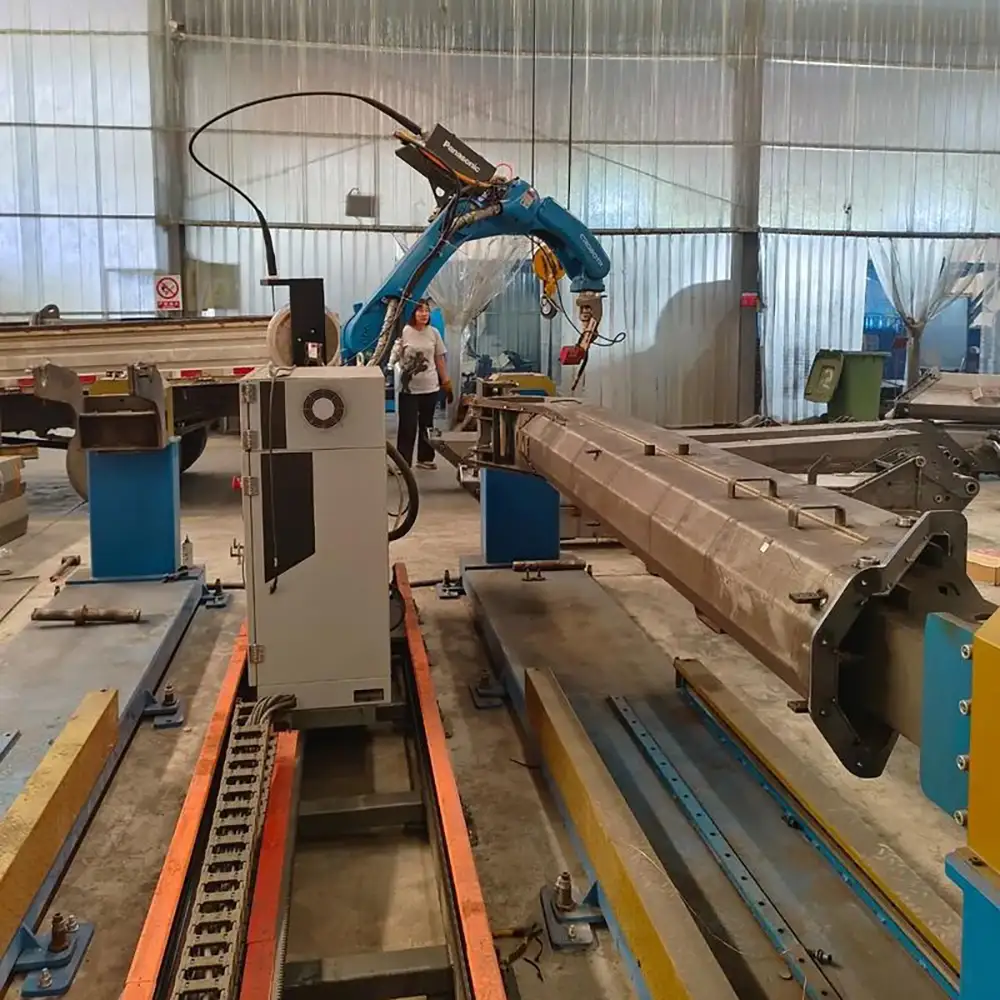
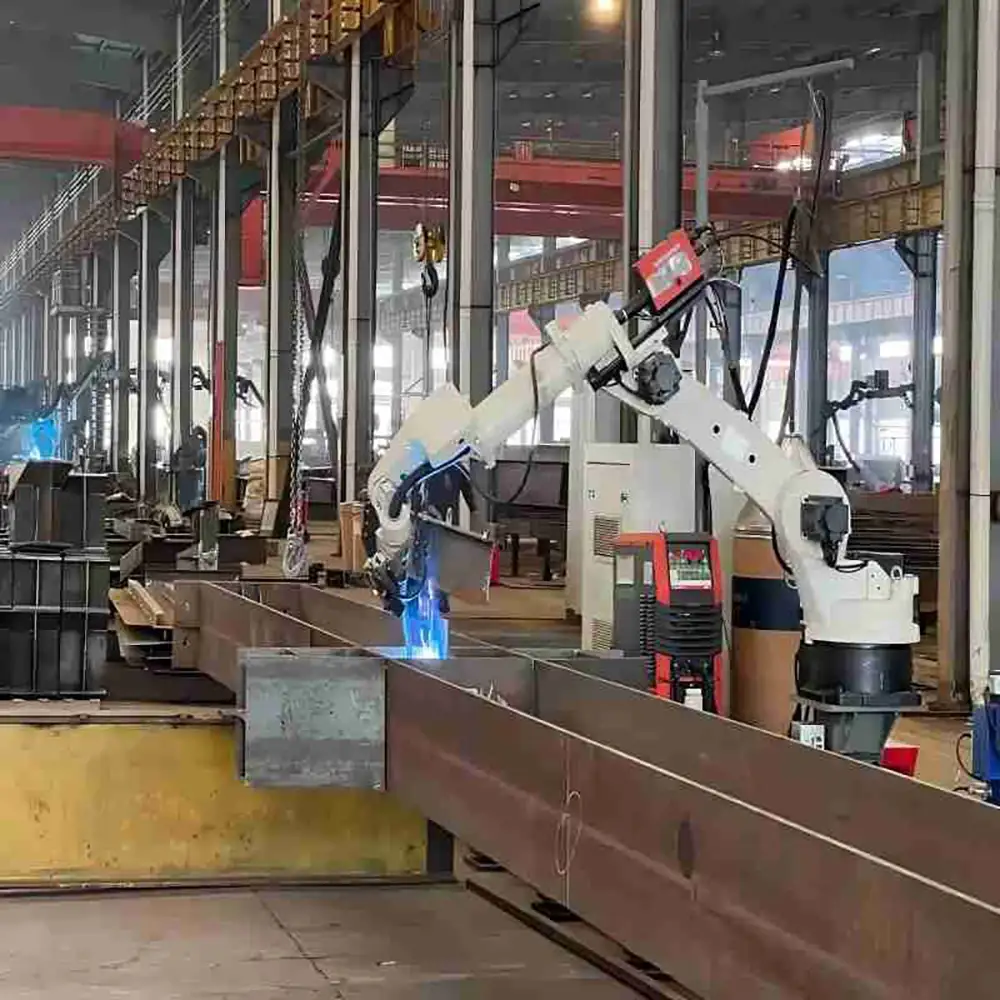
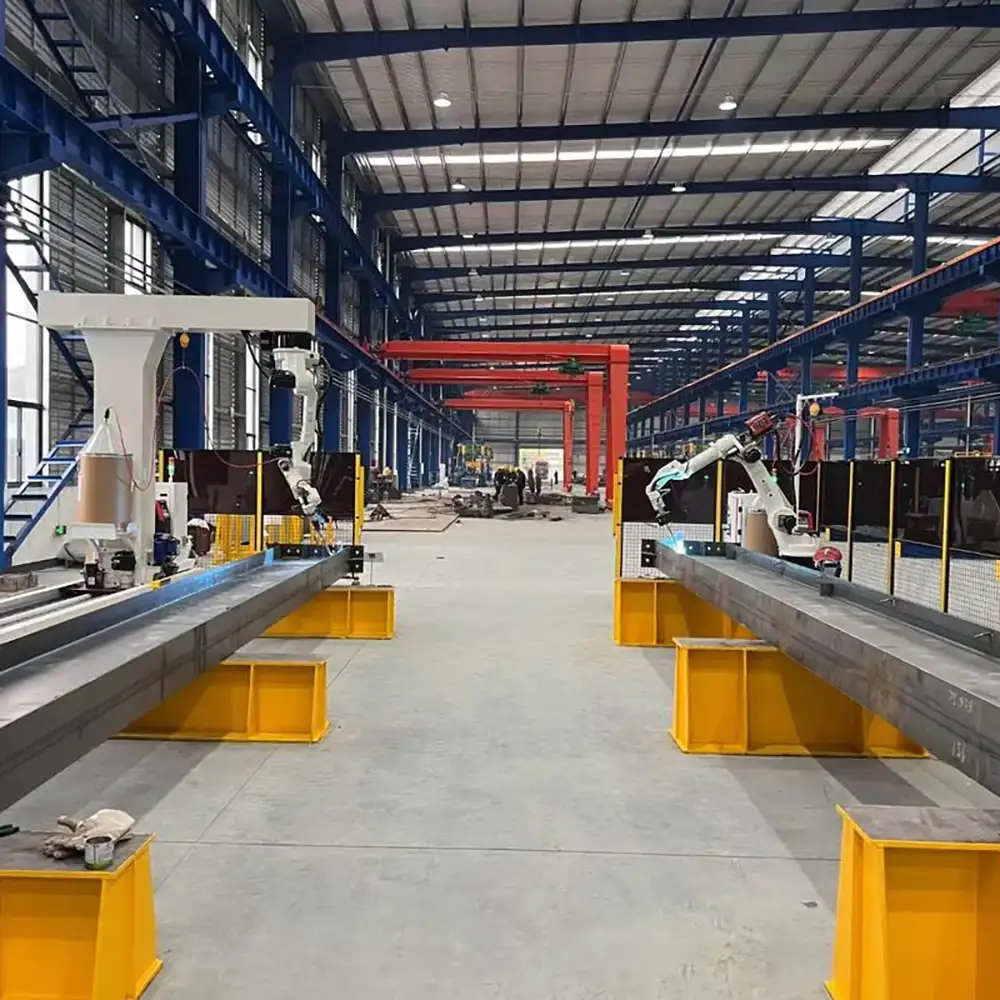
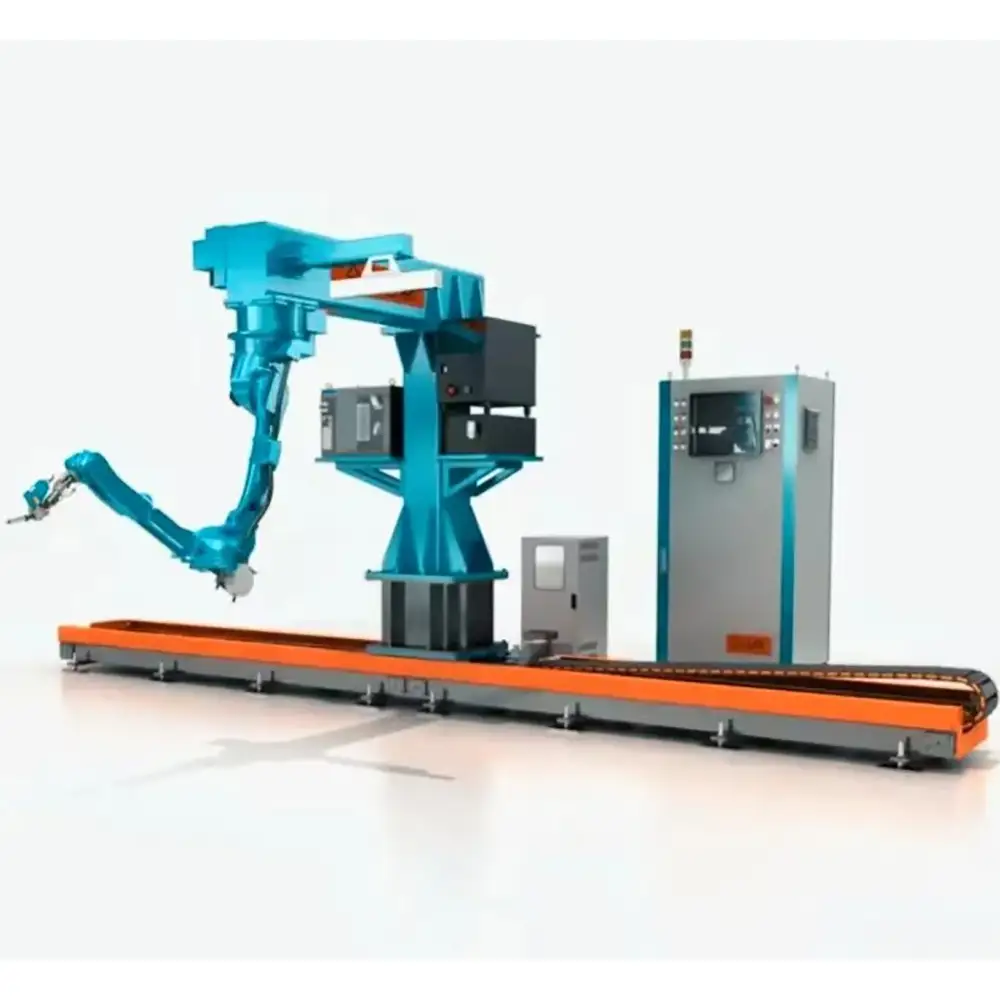
1.Ground rail vertical arm type
Application field /Industry Field
Steel structure, engineering machinery, bridge and ship small welding components, etc.
Slender workpiece scene
Ground Rail Visual Welding Robot
The Ground Rail Visual Welding Robot is an intelligent automated welding solution designed for industrial fabrication applications that require accurate welding, flexible robot movement, and stable production quality. Combining a robotic welding arm, ground rail travel system, visual sensing technology, welding power source, and intelligent control, the system can improve the efficiency and consistency of repetitive welding operations.
Traditional manual welding often depends heavily on operator experience and requires continuous control of welding speed, torch position, angle, and welding parameters. For large steel structures and complex workpieces, maintaining the same welding trajectory can be difficult.
A ground rail visual welding robot provides an automated alternative. The robot can move along an extended linear rail while a vision system helps identify welding seams, workpiece positions, or joint characteristics. This combination is particularly suitable for long and large industrial components.
Visual guidance, intelligent recognition trajectory planning, multi-mode fusion, adaptive
Process parameters, autonomous correction, lightweight design, small footprint,
Flexible welding posture. 2.Ground rail crane welding robot
Application field /Industry Field
Steel structure, construction machinery, civil air defense engineering, special vehicles for heavy trucks,
Bridge and ship welding components and other slender workpiece scenes.
Product Features /Product Feature
Visual guidance, intelligent recognition trajectory planning, multi-mode fusion, adaptive process parameters, autonomous deviation correction, seven-axis linkage, autonomous obstacle avoidance, both operating range and flexibility, suitable for large component operations, strong scalability, and highly flexible settings.
Ground Rail Robotic Movement
The ground rail provides an extended working range for the welding robot. Unlike a fixed-position robot, the robot can travel along the rail to reach multiple welding areas on large workpieces.
This configuration is suitable for long steel beams, structural frames, crane components, machinery assemblies, metal fabrication, and other large workpieces.
The linear movement system can be programmed to coordinate with the robot arm and welding process. This allows the robot to move between welding locations while maintaining the required working distance and torch orientation.
For large-scale fabrication, the ground rail can significantly expand the robot's effective workspace without requiring a separate robot for every welding station.
Intelligent Visual Welding Technology
The visual welding system provides an additional layer of intelligence compared with conventional programmed robotic welding.
A vision sensor or welding seam tracking system can detect the position of a joint and provide information to the robot control system. This can help compensate for certain variations in workpiece positioning, joint location, or welding path.
Visual guidance is especially useful when workpieces cannot always be positioned with perfect repeatability. Instead of relying entirely on a fixed coordinate path, the robot can use detected information to improve its welding trajectory.
Depending on the system configuration, visual technology may support seam recognition, joint location, seam tracking, workpiece identification, and other automated welding functions.
Automatic Welding Seam Tracking
Welding seam tracking can help the robot maintain a suitable torch position along the joint during welding.
In conventional robotic welding, accurate fixtures and repeatable workpiece positioning are normally required. Visual sensing can provide additional process information when small variations occur.
The system can help maintain appropriate torch alignment and welding path consistency, reducing the risk of deviation from the intended joint.
This is particularly useful for long weld seams, large structural components, and fabrication environments where workpiece tolerances may vary.
High-Precision Welding Performance
Welding quality depends on several factors, including welding current, voltage, wire feeding speed, travel speed, torch angle, arc length, shielding gas, joint preparation, and material condition.
The robotic welding system can control many of these parameters according to the programmed welding procedure. Combined with visual guidance, the system supports stable and repeatable welding operations.
For production environments, consistent welding can help reduce defects caused by variations in manual operation and improve the repeatability of finished components.
Proper welding procedures, inspection, and process qualification should still be followed according to the applicable standards for the specific application.
Large Workpiece Welding
The ground rail configuration makes the robot particularly suitable for large workpieces.
Typical applications include:
Steel Beams
Crane Structures
Gantry Components
Heavy Machinery Frames
Structural Steel
Industrial Equipment
Metal Fabrication
Large Welded Assemblies
Storage Equipment
Material Handling Structures
The robot can travel along the rail to reach multiple weld joints, while the visual system helps locate the required welding position.
This can reduce manual movement of large workpieces and improve production workflow.
Flexible Robotic Welding Configuration
A complete ground rail visual welding workstation may include several integrated components:
Industrial Welding Robot
Ground Linear Rail
Welding Power Source
Vision Sensor
Seam Tracking System
Wire Feeder
Welding Torch
Welding Positioner
Workpiece Fixture
Control Cabinet
Safety Fence
Fume Extraction System
The exact configuration depends on the workpiece size, material, welding process, joint design, production volume, and required automation level.
The system can be configured for MIG, MAG, or other suitable robotic arc welding processes.
Improved Production Efficiency
Automation is especially valuable when a factory performs repetitive welding operations on similar components.
The robot can execute programmed welding procedures with consistent movement and controlled welding parameters. The ground rail allows one robot to serve multiple welding positions across a large working area.
Visual sensing can further reduce setup sensitivity when workpiece position varies within an acceptable range.
Together, these technologies can help reduce repetitive manual welding, improve production cycle consistency, and increase overall manufacturing efficiency.
Improved Welding Safety
Robotic welding can reduce the amount of time operators need to spend directly beside the welding arc.
The operator can focus on workpiece preparation, fixture setup, system monitoring, quality inspection, and production management while the robot performs programmed welding operations.
A complete robotic welding cell should include appropriate guarding, emergency-stop devices, safety interlocks, ventilation, and welding fume extraction according to the installation environment and applicable safety requirements.
Applications Across Industrial Fabrication
Although the Ground Rail Visual Welding Robot is suitable for large steel structures, its applications can extend across many industrial sectors.
It can be used for crane manufacturing, construction machinery, agricultural machinery, heavy equipment, steel fabrication, transportation equipment, industrial frames, and other welded metal products.
The visual welding system is particularly valuable when the production process involves long weld seams, large components, multiple welding positions, or moderate variations in workpiece placement.
Why Choose Us
Selecting a visual welding robot requires careful consideration of robot reach, rail length, workpiece dimensions, welding process, visual sensing requirements, production volume, and factory layout.
Our robotic welding solutions focus on:
Intelligent Visual Guidance: Vision technology helps identify welding joints and improve welding path accuracy.
Extended Working Range: Ground rail movement allows one robot to cover a large fabrication area.
Automatic Seam Tracking: Helps maintain torch alignment along suitable welding joints.
Consistent Welding: Programmed movement and controlled parameters improve repeatability.
Large Workpiece Capability: Suitable for beams, crane structures, machinery frames, and other large assemblies.
Flexible Configuration: Positioners, fixtures, sensors, power sources, and safety equipment can be integrated.
Higher Productivity: Automation reduces repetitive manual welding operations.
Improved Working Environment: Operators can monitor the welding process from a safer position.
Scalable Automation: The system can be configured according to production requirements and factory layout.
Frequently Asked Questions
1. What is a ground rail visual welding robot?
It is an industrial welding robot mounted on a ground linear rail and equipped with visual sensing technology to support automated welding and welding seam recognition.
2. Why does the robot use a ground rail?
The ground rail extends the robot's working range, allowing it to weld long or large workpieces that cannot be efficiently handled by a fixed-position robot.
3. What does the vision system do?
The vision system can detect workpiece features, welding seams, joint positions, or other relevant information and provide data to the robot control system.
4. Can it perform automatic seam tracking?
Yes. When equipped with an appropriate visual seam tracking system, the robot can follow suitable welding joints and compensate for certain positioning variations.
5. What materials can the robot weld?
The system can be configured for suitable steel, stainless steel, aluminum, and other weldable metals depending on the welding process and equipment configuration.
6. What welding processes can be integrated?
MIG and MAG robotic welding are common options. Other suitable arc welding processes can be considered according to the application.
7. Can it weld large steel structures?
Yes. The ground rail makes the system suitable for large structures such as steel beams, crane components, machinery frames, and industrial assemblies.
8. Does visual welding eliminate the need for fixtures?
No. Proper fixtures and positioning remain important. Visual sensing provides additional flexibility but does not replace good workpiece preparation and positioning.
9. Can one robot weld multiple positions?
Yes. With an appropriately sized ground rail and programmed movement, one robot can access multiple welding locations within its effective working area.
10. What information is required before selecting the system?
Important information includes workpiece dimensions, weight, material, weld seam length, joint type, welding process, production volume, required cycle time, rail length, and available factory space.
Prev:Sorry, no information
Next:
Intelligent Automatic Welding Robot for Ground Rail Crane
TAG:
Automated Metal Welding,
Gantry Crane Welding Robot,
Steel Fabrication Welding System,
Industrial Frame Welding Robot,
Metal Fabrication Welding Robot,
Crane Welding Robot,
Crane Welding System,
Heavy Steel Welding Robot,
Heavy Steel Structure Welding,
Structural Steel Welding Robot,
Heavy Duty Welding Robot,
Structural Steel Welding Equipment,
Large Structure Welding Robot,
Large Workpiece Welding Robot,
Heavy Duty Welding System,
Steel Structure Welding Robot,
Steel Structure Welding Machine,
Steel Structure Welding System,
Automatic Steel Welding Machine,
Automated Steel Welding System,
Smart Robotic Welding,
Smart Welding Robot,
MAG Welding Robot,
Robotic MAG Welding System,
Automatic MAG Welding Equipment,
MIG Welding Robot,
MIG Robotic Welding,
Seam Tracking Welding Robot,
Automatic Seam Tracking,
Robotic Seam Tracking,
Related Category:
Ground Rail Visual Welding Robot, Visual Welding Robot, Ground Rail Welding Robot, Intelligent Welding Robot, Robotic We China, suppliers, manufacturers, factory, customized, wholesale, quotation, made in China