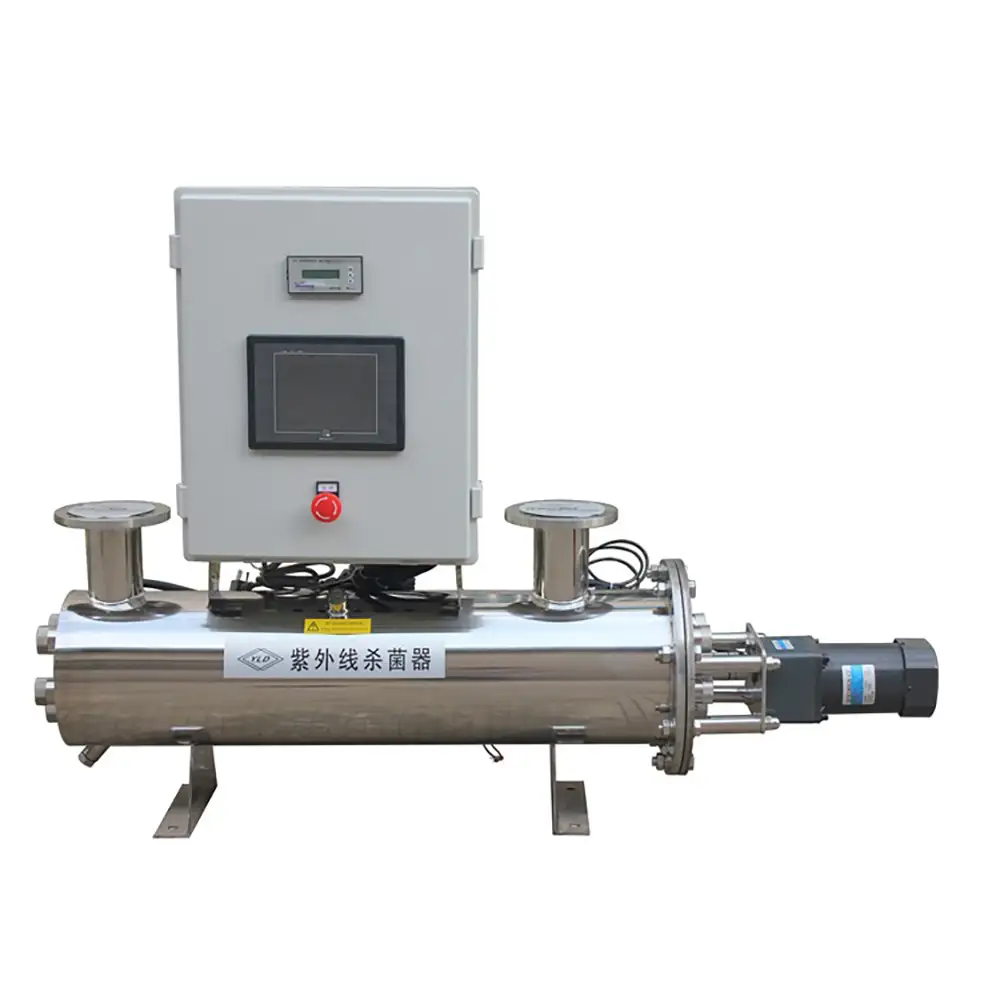
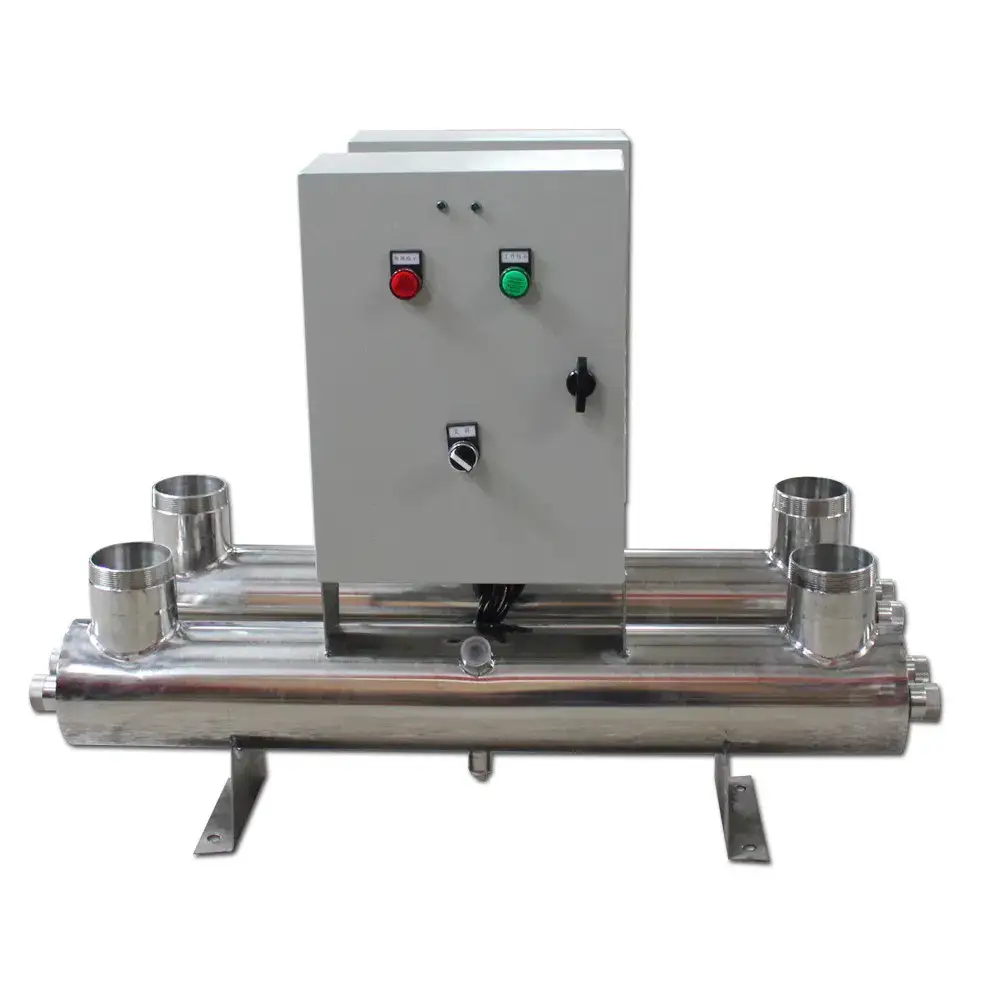
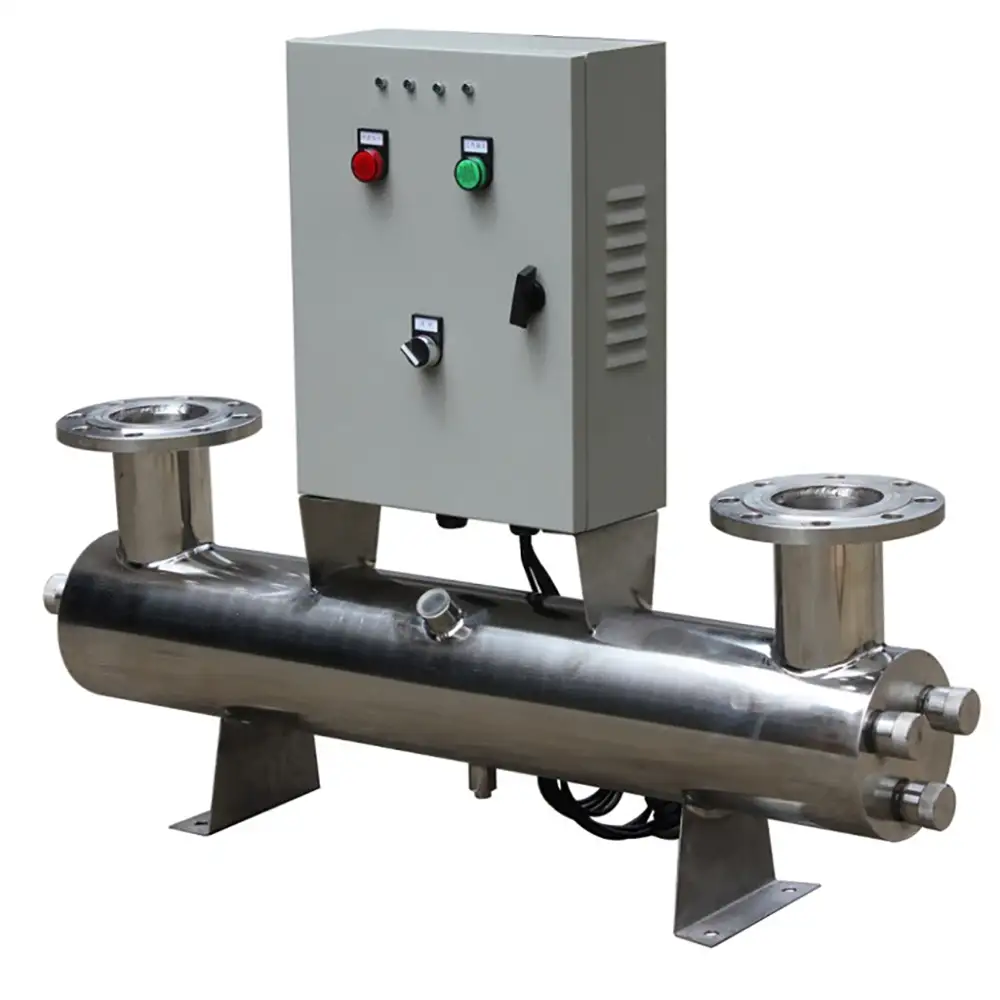
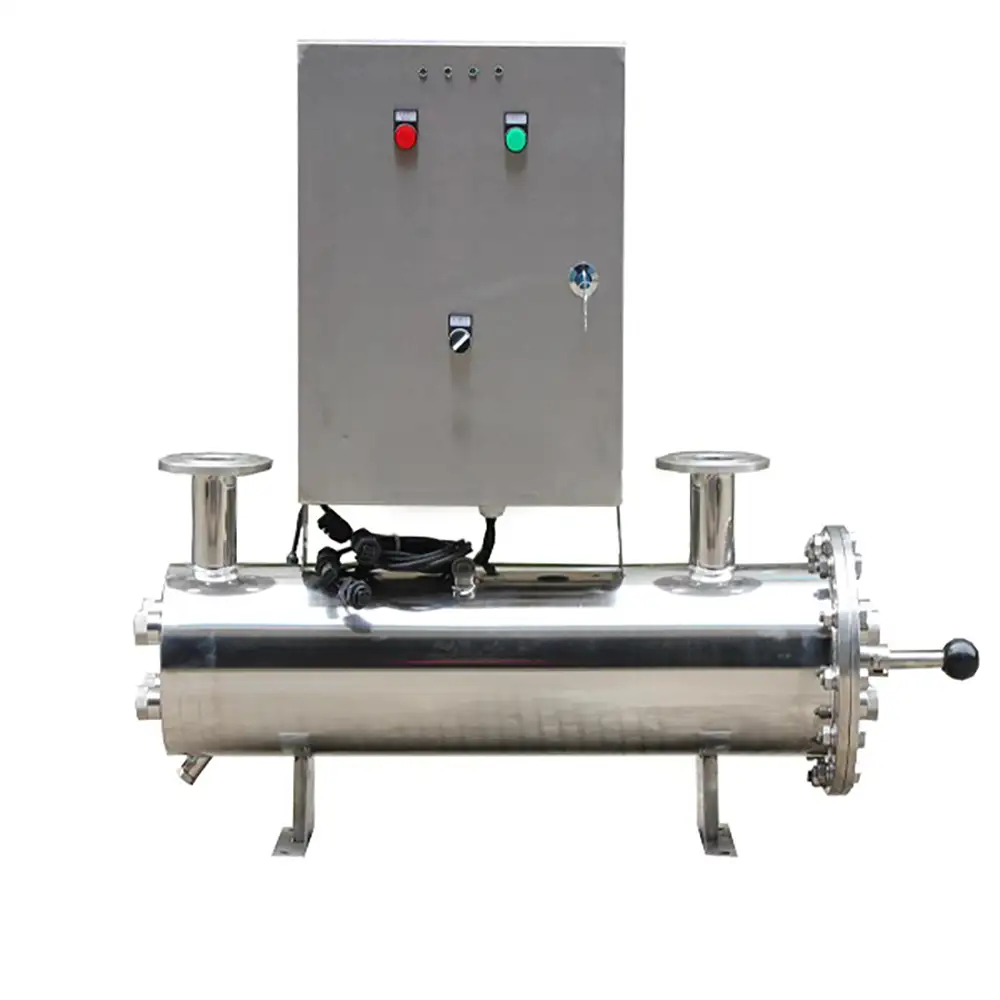
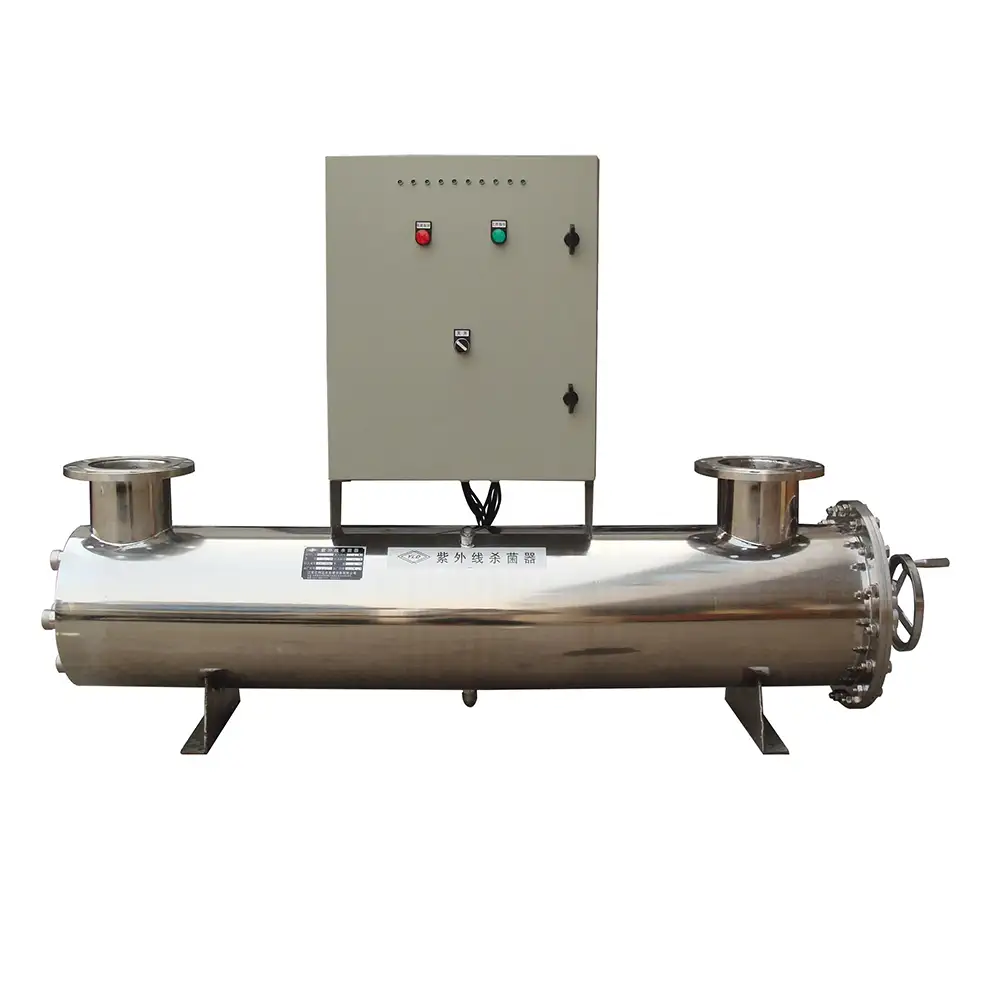
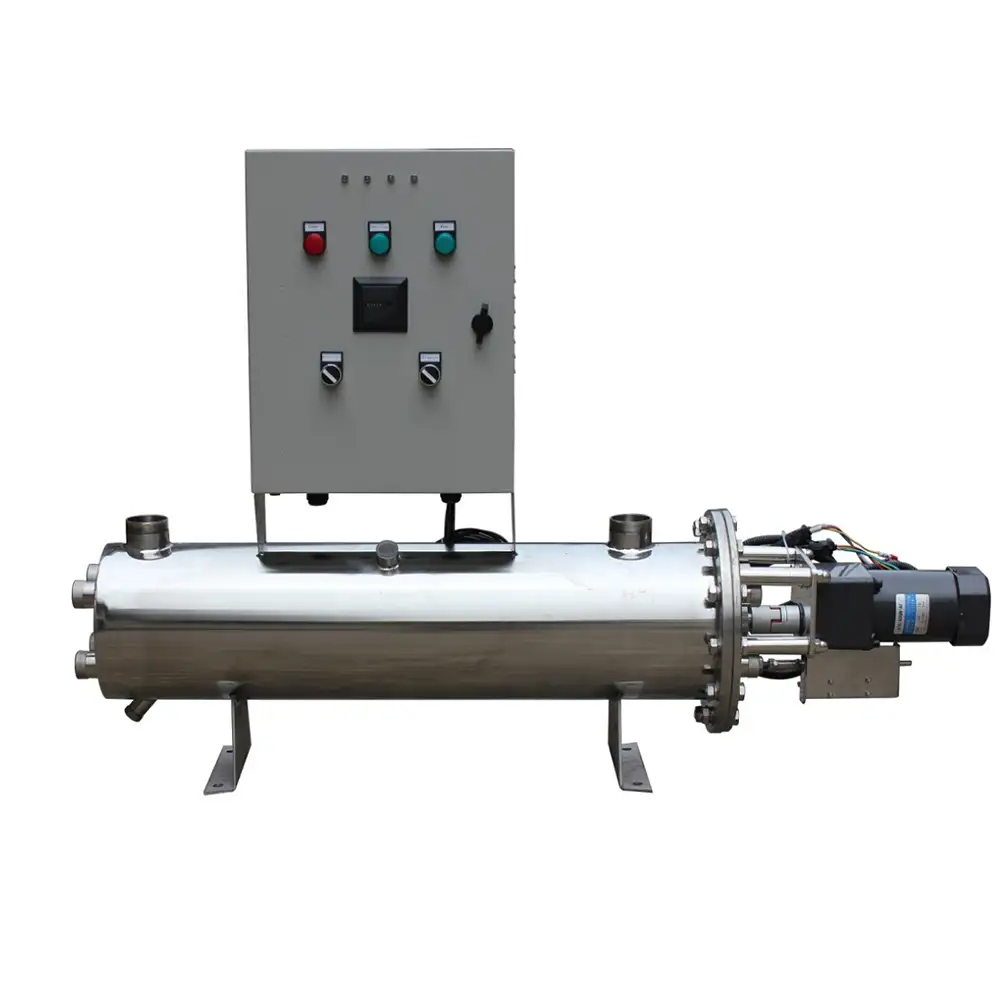
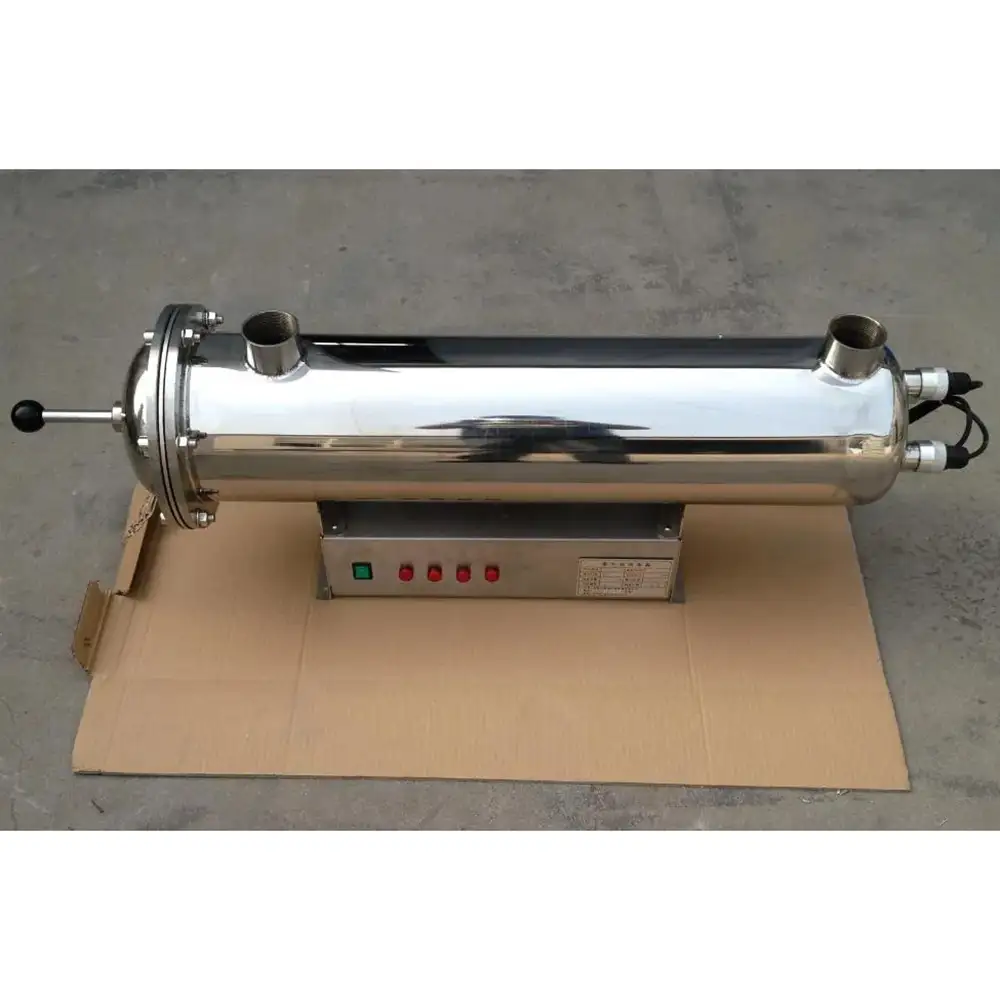
254nm UV light water disinfecion sterilizers for fish ponds use the ultraviolet technology to remove the bacterials and organisms which are harmful to fishes in water.UV light disinfection is an effective method in destroying micro-organisms in a water stream and an endorsed technology currently being used by a wide range of manufacturers and industries. UV radiation has three wavelength zones: UV-A,UV-B, and UV-C, and it is this last region, the short wave UV-C, that has germicidal properties for disinfection. Ultraviolet systems use low-pressure mercury lamps that emit UV light in the range of 254nm that attacks the microorganism and stops the microorganism's ability to function and reproduce.
The UV Disinfection Equipment for Drinking Water Purifying is a water treatment solution designed to provide ultraviolet disinfection for drinking water and other suitable water applications. Using UV-C light, the system helps control microorganisms by exposing water to ultraviolet radiation as it passes through the treatment chamber.
Unlike chemical disinfection methods, UV treatment does not require the direct addition of disinfectant chemicals into the treated water. This makes ultraviolet disinfection an attractive option for drinking water treatment, municipal water systems, commercial water purification, industrial process water, and other applications where microbial control is required.
The equipment can be installed as a standalone disinfection unit or integrated into a complete water purification system. Depending on the application, it can be combined with pretreatment, filtration, activated carbon, membrane filtration, reverse osmosis, or other water treatment technologies.
40m3/Hr UV Disinfection Equipment for Drinking Water Purifying
A UV sterilizer is used to control infections by stopping the spread of microorganisms from one fish/coral/invertebrate to another through the water. It is also used in pond applications to control free-floating algae. When operated correctly, free-floating microorganisms will be killed by the UV light. Note that the organisms must be in the water that flows to the UV sterilizer. The UV light has no residual effect and will not kill organisms attached to fish or rocks .
Water Quality (Feed in)
Water quality plays a major role in the transmission of germicidal UV rays. It is recommended that the water does not exceed following maximum concentration levels
Maximum Concentration Levels (Very Important)
|
Iron |
≤0.3ppm(0.3mg/L) |
|
Hardness |
≤7gpg(120mg/L) |
|
Turbidity |
≤1NTU |
|
Manganese |
≤0.05ppm(0.05mg/L) |
|
Tannins |
≤0.1ppm(0.3mg/L) |
|
UV Transmittance |
≥750‰ |
Effectively treating water with higher concentration levels than listed above can be accomplished, but may require added measures to improve water quality to treatable levels. If, for any reason, it is believed the UV transmission is not satisfactory, contact the factory.
UV wavelength (nm)
DOSAGE is the product of intensity & time
dosage=intensity*time=micro watt/cm2*time=microwatt-seconds per square centimeter
(μW-s/cm2)
Note:1000μW-s/cm2=1mj/cm2(milli-joule/cm2) |
As a general guideline, the following are some typical UV transmission rates (UVT)
|
City water supplies |
850-980‰ |
|
De-ionized or Reverse Osmosis water |
950-980‰ |
|
Surface waters(lakes, rivers, etc) |
700-900‰ |
|
Ground water(wells) |
900-950‰ |
|
Other liquids |
10-990‰ |
UV-C Ultraviolet Disinfection
UV disinfection works by exposing microorganisms to UV-C radiation at an appropriate wavelength and dose. The UV energy can interfere with the genetic material of microorganisms, reducing their ability to reproduce.
The treatment is a physical disinfection process rather than a chemical oxidation process. It does not depend on adding chlorine or other conventional chemical disinfectants to the water.
Actual disinfection performance depends on UV intensity, exposure dose, water flow, water quality, UV transmittance, microorganism characteristics, and equipment configuration. Proper sizing is therefore important when selecting a UV water disinfection system.
Drinking Water Disinfection
Drinking water systems require reliable microbial control as part of an overall water treatment process. UV equipment can be installed at an appropriate point in the treatment line to provide additional disinfection.
UV treatment can be considered for municipal drinking water, well water, community water systems, commercial facilities, and other suitable drinking water applications.
Pretreatment is important when the source water contains high turbidity, suspended solids, iron, manganese, or other substances that can interfere with UV transmission. The complete water treatment process should therefore be designed according to the source water characteristics.
Chemical-Free UV Treatment
One major advantage of ultraviolet disinfection is that the UV process itself does not require direct chemical dosing into the treated water.
This can help avoid certain issues associated with chemical disinfectant storage and handling. UV treatment also does not intentionally introduce a residual disinfectant into the water.
However, the absence of a disinfectant residual can be an important consideration for distribution systems. For some applications, UV may be combined with another disinfection method depending on the required treatment strategy.
Stainless Steel UV Chamber
A UV disinfection system typically uses a treatment chamber designed to expose flowing water to UV radiation. Stainless steel is commonly selected for suitable water treatment applications because of its durability and compatibility with many water environments.
The chamber design can include UV lamps or UV-C LED technology depending on the selected equipment configuration.
The actual chamber material, surface finish, lamp configuration, seals, connections, and electrical components can be selected according to the intended application and water quality.
UV Lamp System
Conventional UV water disinfection systems commonly use UV lamps positioned inside or adjacent to the treatment chamber. The lamp arrangement is designed to provide appropriate UV exposure as water flows through the system.
The service life and operating characteristics of the lamp depend on the lamp type, operating conditions, water quality, electrical system, and maintenance practices.
Some systems can include lamp-status indicators, operating-hour monitoring, alarm functions, and other controls to help operators maintain the equipment.
UV Intensity Monitoring
For professional water treatment applications, monitoring UV performance can be important. UV intensity sensors can be incorporated into suitable systems to monitor the radiation level available for disinfection.
If UV intensity falls below the required operating range, the control system can provide an alarm or other indication depending on the equipment configuration.
Monitoring requirements depend on the application, treatment standards, system design, and customer specifications.
Flow Control And UV Dose
UV disinfection performance is closely related to the UV dose received by the water. The dose depends on UV intensity and exposure conditions as water passes through the treatment chamber.
If the flow rate is too high for the selected system, the available exposure time may be insufficient. Therefore, UV equipment should be selected according to actual peak flow rather than only average water consumption.
Water quality also affects UV transmission. Clearer water generally allows UV radiation to pass more effectively through the treatment chamber.
Municipal Drinking Water Applications
Municipal water treatment facilities can use UV disinfection as part of a multi-stage drinking water treatment process.
A typical system may include raw water intake, coagulation, sedimentation, filtration, activated carbon treatment, UV disinfection, and other processes depending on source water quality and regulatory requirements.
UV can serve as a final or intermediate microbial control step when appropriate.
The equipment capacity and UV dose should be determined according to plant flow, water quality, required microbial reduction, and applicable drinking water standards.
Well Water And Groundwater Treatment
Private, commercial, and community well-water systems may use UV disinfection where microbial contamination is a concern.
UV can provide a chemical-free microbial treatment stage after appropriate filtration and pretreatment.
Groundwater may contain iron, manganese, hardness, turbidity, or other constituents that require treatment before UV. For this reason, UV equipment should not automatically be considered a complete purification system for untreated well water.
Water analysis is recommended before selecting the final treatment configuration.
Industrial Process Water
Industrial facilities may require microbiological control for process water, utility water, rinse water, or other suitable water streams.
UV disinfection can be integrated into industrial water treatment systems where the water has suitable UV transmittance and the required microbial control can be achieved through UV treatment.
Industries may include food processing, beverage production, electronics manufacturing, pharmaceutical-related applications, commercial water treatment, and general manufacturing.
Application requirements should be evaluated according to water quality and industry-specific standards.
Commercial Water Purification
Hotels, restaurants, hospitals, office buildings, schools, commercial facilities, and other organizations may require additional water disinfection.
Compact UV water treatment equipment can be integrated into suitable building water treatment systems.
The system can be installed downstream of filtration or other purification equipment to provide an additional microbial control barrier.
Food And Beverage Applications
Food and beverage processing facilities often require controlled water quality for production and cleaning processes.
UV disinfection can be considered for suitable process water applications where microbial control is required and water quality is compatible with UV treatment.
The complete system should comply with applicable sanitary, food safety, material, and process requirements.
Integration With Water Purification Systems
UV disinfection is often one stage within a larger water purification system.
Depending on the source water, a complete system may include:
Pre-Filtration
Sediment Filtration
Activated Carbon Filtration
Water Softening
Ultrafiltration
Reverse Osmosis
UV Disinfection
Final Water Storage
Each process performs a different function. Filtration and membrane processes can remove or reduce various physical and dissolved contaminants, while UV is primarily used for microbial control.
Low Chemical Requirement
UV treatment does not rely on continuous addition of conventional disinfectant chemicals during the UV exposure process.
This can simplify chemical handling for suitable applications and can reduce concerns associated with chemical taste or odor in certain water treatment systems.
However, UV equipment still requires electrical power and routine maintenance. Lamp replacement, chamber cleaning, sensor inspection, and other maintenance requirements depend on the equipment design and operating environment.
Automatic Control Options
The UV disinfection system can be configured with automatic control functions according to customer requirements.
Possible control features include power status monitoring, lamp failure alarms, UV intensity monitoring, operating-hour recording, flow interlocking, and system alarms.
The exact control configuration depends on the selected model and application.
Easy Maintenance
Routine maintenance is important for maintaining UV disinfection performance. Depending on the equipment design, maintenance may include checking UV lamps, cleaning the quartz sleeves, inspecting seals, monitoring UV intensity, and replacing components at the recommended intervals.
Water quality strongly influences maintenance frequency. Mineral deposits, suspended solids, iron, manganese, and other substances can accumulate on the quartz sleeve and reduce UV transmission.
Proper pretreatment can therefore improve system reliability.
B2B Water Treatment Solutions
Water treatment projects vary significantly in source water quality, flow rate, microbial requirements, installation conditions, and local regulations.
For equipment selection, customers should provide water source, flow rate, peak flow, turbidity, UV transmittance if available, microbial requirements, inlet and outlet conditions, installation space, and operating schedule.
Based on these parameters, the appropriate UV chamber size, lamp configuration, control system, and supporting pretreatment can be evaluated.
Key Features
UV-C Ultraviolet Disinfection Technology
Drinking Water Disinfection
Chemical-Free UV Treatment Process
Stainless Steel Treatment Chamber
UV Lamp And UV-C System Options
UV Intensity Monitoring Options
Automatic Control Options
Suitable For Municipal Water Treatment
Suitable For Well Water Applications
Industrial Process Water Treatment
Easy Maintenance Design
Integration With Complete Water Purification Systems
Main Applications
The UV Disinfection Equipment for Drinking Water Purifying can be used for:
Drinking Water Disinfection
Municipal Water Treatment
Well Water Treatment
Groundwater Disinfection
Commercial Water Purification
Industrial Process Water
Food And Beverage Water Treatment
Community Water Systems
Building Water Treatment
Water Purification Plants
Industrial Water Disinfection
Final Water Disinfection
FAQs
1. What Is UV Disinfection Equipment?
UV disinfection equipment uses ultraviolet radiation, typically UV-C, to help control microorganisms in suitable water streams without directly adding conventional chemical disinfectants during the UV treatment process.
2. Can UV Be Used For Drinking Water?
Yes. UV disinfection can be used as part of suitable drinking water treatment systems for municipal, commercial, community, and other applications.
3. Does UV Remove Bacteria And Viruses?
UV radiation can help inactivate or control many microorganisms when the system provides an appropriate UV dose. Actual performance depends on microorganism type, UV intensity, water quality, flow rate, and system design.
4. Does UV Remove Chemicals From Water?
No. UV disinfection is primarily a microbial treatment process. It does not generally remove dissolved salts, hardness, heavy metals, or other chemical contaminants. Additional treatment may be required.
5. Does UV Treatment Require Chlorine?
The UV treatment process itself does not require chlorine dosing. However, some complete water treatment systems may use additional disinfection methods depending on distribution and regulatory requirements.
6. Can UV Treat Well Water?
Yes, when the well water has suitable characteristics and appropriate pretreatment is provided. Turbidity, iron, manganese, and other substances can affect UV performance and may require upstream treatment.
7. How Does Water Quality Affect UV Disinfection?
Turbidity, suspended solids, color, iron, manganese, and other substances can reduce UV transmission and interfere with treatment. Pretreatment may therefore be necessary.
8. How Often Do UV Lamps Need To Be Replaced?
Lamp replacement intervals depend on lamp technology, operating hours, equipment design, and manufacturer recommendations. UV intensity monitoring can help determine when maintenance is required.
9. Can The UV System Be Automated?
Yes. Depending on the configuration, the system can include automatic controls, lamp-status monitoring, UV intensity alarms, operating-hour monitoring, and other control functions.
10. What Information Is Needed To Select A UV Disinfection System?
Customers should provide water source, flow rate, peak flow, water quality information, turbidity, UV transmittance if available, microbial treatment requirements, installation conditions, and applicable standards. These details help determine the appropriate UV system configuration.
Why Choose Us
Professional UV Water Disinfection Solutions
We provide UV water disinfection equipment for drinking water, industrial process water, municipal treatment, commercial purification, and other suitable applications.
Application-Based UV System Selection
UV equipment must be selected according to flow rate and water quality. We evaluate the customer's application requirements to recommend an appropriate chamber, lamp configuration, and control system.
Complete Water Treatment Integration
UV equipment can be integrated with sediment filtration, activated carbon, ultrafiltration, reverse osmosis, softening, and other water purification technologies.
Reliable Monitoring Options
UV intensity monitoring, lamp-status indication, alarms, and other control functions can be incorporated according to the application and required operating management.
Practical Maintenance Design
We consider lamp replacement, quartz sleeve cleaning, component inspection, control access, and other routine maintenance requirements when configuring suitable UV systems.
Prev:
Sterile Water for Cosmetics/Industrial Ultrapure Water Treatment/Biochemistry Laboratory Water/Sterilizer
Next:Sorry, no information
TAG:
Water Treatment Disinfection Equipment,
Final Water Disinfection,
Food And Beverage Water Treatment,
Industrial Water Purification System,
UV Disinfection System,
Water Disinfection System,
UV Water Sterilizer,
UV Wastewater Treatment System,
Process Water UV Disinfection,
Ultraviolet Sterilization System,
UV Sterilization Machine,
Drinking Water Purification System,
UV Wastewater Disinfection,
Industrial Water Disinfection Equipment,
Drinking Water Treatment Equipment,
Ultraviolet Water Treatment System,
Industrial UV Disinfection System,
Industrial UV Water Treatment,
Municipal UV Water Treatment,
Municipal Water Disinfection Equipment,
Well Water UV Disinfection,
Well Water UV Sterilizer,
Groundwater UV Disinfection,
Commercial UV Water Purification,
Commercial UV Disinfection System,
Water Purification UV System,
Water Treatment UV Sterilizer,
UV Water Treatment System,
Drinking Water Disinfection Equipment,
UV Disinfection Equipment For Drinking Water,
Related Category:
UV Disinfection Equipment for Drinking Water Purifying, UV Disinfection Equipment, UV Water Disinfection Equipment, UV D China, suppliers, manufacturers, factory, customized, wholesale, quotation, made in China